CERTIFICATION
WELDER
QUALIFICATION
How to Read an ISO 9606-1 Welder Qualification Certificate: A Field-by-Field Guide
By First Welding Certification Technical Editorial Team
6 Min Read
22 Aug 2026
Table Of Contents
Key Takeaways
Identify the key fields on the qualification certificate
Check the qualified welding process and conditions
Verify thickness, diameter and qualification ranges
Match certificate details with production requirements
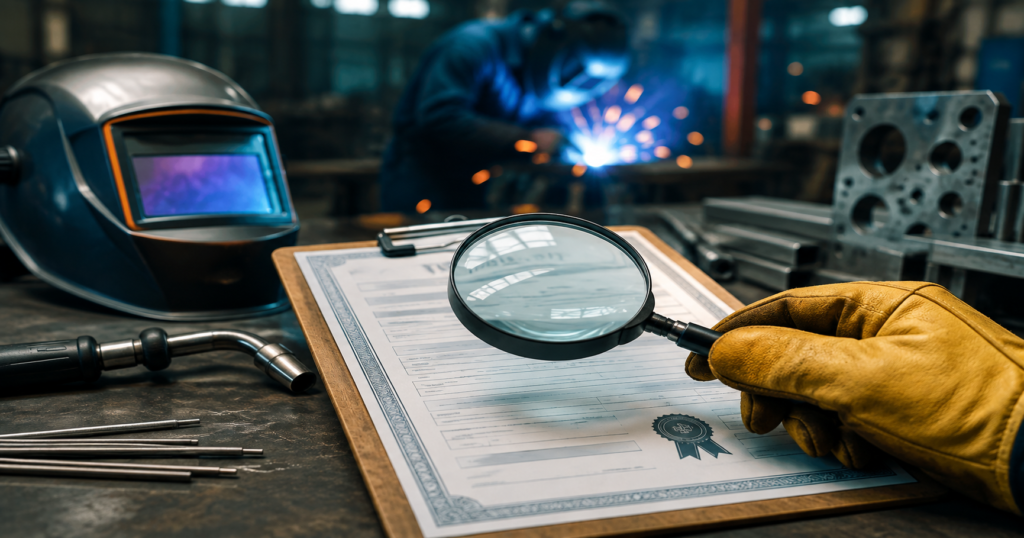
ISO 9606-1 certification includes more information than just the welder’s name and the date of certification.Each part of the certificate shows specific conditions under which the welder demonstrated their welding skills.
For people like welding contractors, quality managers, inspectors, production engineers, and manufacturers, it’s important to understand all this information before assigning a welder to do work.
ISO 9606-1:2012 outlines the testing needed to qualify welders who do fusion welding on steel.
It focuses on the welder’s ability to control the welding tools by hand and create a good weld.This standard covers manual and partially automated welding, but not fully automatic welding.
What Does an ISO 9606-1 Certificate Show?
An ISO 9606-1 welding certificate shows the test conditions and the welding skills the welder proved during the test.
The way the certificate looks might be different depending on the organization that gave the certificate or the person who checked it.
However, most certificates have similar important details like:
– The welder’s name
– The welding method used
– What kind of product was being made
– The type of weld
– The group of materials used
– Details about the filler metal
– The size of the test piece
– The welding position
– The welding conditions
– Information about the test and how it was checked
– The range of welding conditions the welder is qualified for
– The name of the person or organization that did the check
– The dates and a unique number for the certificate
The key point is that the certificate shows the specific welding conditions the welder is qualified for, not just that they are a qualified welder.
Field-by-Field Explanation
1.Welder’s Name or Identification
Start by finding the welder’s full name or their identification number.
Check for:
– Full name
– Identification number, if available
– Employer or organization, if given
– Certificate or qualification number
Make sure the name matches the person who is supposed to do the welding.
2.Applicable Standard
Find the standard, like ISO 9606-1:2012 or a national or European version if it’s available. This shows that the qualification was done according to a specific technical standard. According to ISO, the latest version is ISO 9606-1:2012. However, a new version called ISO/DIS 9606.2 is currently in development.
3.Welding Process
This refers to the method used to create the test weld.
Look for process numbers such as:
– 111 – manual metal arc welding
– 135 – MAG welding
– 136 – MAG welding with flux cored wire
– 141 – TIG welding
It’s important to note that being qualified for one process doesn’t automatically qualify you for others.
4.Product Type and Weld Type
The certificate may show whether the test was for:
– Plate
– Pipe
– Butt weld
– Fillet weld
These details help define the qualification range. For example, a pipe test and a plate test are not the same.You need to check the standard to know the exact qualification range.
5.Material Information
This section will list the material or group used in the test. The certificate identifies the material according to the classification system used during testing. This is important because the qualification is tied to the tested material.When checking if the welder is qualified for a production job, compare the material on the certificate with the one listed in the welding instructions.
6. Filler Material
The certificate may include details about the filler material or consumables used in the test.
Depending on the welding process, this might include:
– Electrode type
– Wire classification
– Filler material designation
– Diameter
This information helps understand the conditions under which the qualification test was done.
7.Test Piece Thickness
Thickness is one of the most important details to check. The certificate may list the thickness of the test piece along with the qualified range of thickness. It’s important not to assume that the test piece thickness is the same as the production thickness. Compare the qualified range on the certificate with the rules in the standard.ISO/TC 44 has provided specific interpretations addressing qualified ranges, especially for butt and fillet welds.
8.Outside Diameter for Pipe Tests
Diameter matters for pipe welding qualifications. The certificate may give the outside diameter of the test piece and the qualified range. If the welding project involves pipes, compare the production diameter with the qualified range in the certificate, not just rely on the welder’s overall pipe qualification.
9.Welding Position
Welding position is another key detail.
Common positions include:
– PA
– PB
– PC
– PD
– PE
– PF
– PG
The position used in the test affects the qualified range. When planning production, compare the actual welding position with the one listed on the certificate.
10.Backing and Other Welding Conditions
Depending on the process and test setup, the certificate may include information like:
– Backing
– Gas backing
– Consumable insert
– Flux backing
– Single-side or relevant joint conditions
All these factors can influence the welder’s qualification range. ISO/TC 44 has provided interpretations on how backing and gas-backing conditions are considered in qualification ranges.
How to Read the Qualification Range
It’s important to remember that the most important part of the certificate isn’t the test conditions, but the qualified range that comes from those tests.
The certificate has three main parts:
Test Conditions → Qualified Range → Production Use
Here’s an example:
First, the tested process
Then, the test material and how the parts are joined
Next, the test thickness or diameter
Then, the test position
Followed by the examination results
Finally, the qualified range
This qualified range can then be used by the production engineer to check if the actual products meet the required standards.
Quick Certificate Review Table
| Certificate Field | What to Check | Why It Matters |
|---|---|---|
| Welder identification | Name / ID | Confirms the person |
| Standard | ISO 9606-1 reference | Identifies qualification basis |
| Process | Process number | Defines welding process |
| Product type | Plate / pipe | Establishes test configuration |
| Weld type | Butt / fillet | Defines joint qualification |
| Material | Material group/designation | Checks material applicability |
| Thickness | Test and qualified range | Checks production thickness |
| Diameter | Pipe test diameter/range | Checks pipe applicability |
| Position | PA, PB, PC, etc. | Checks welding position |
| Backing | Applicable backing condition | Checks joint conditions |
| Examination | Test results | Confirms test outcome |
| Qualification range | Stated limits | Determines production applicability |
Certificate Reading Flow
STEP 1
Find out who the welder is
↓
STEP 2
Check which standard is being used
↓
STEP 3
Figure out what welding process is being used
↓
STEP 4
Identify the product and the type of weld
↓
STEP 5
Determine the material and the filler metal
↓
STEP 6
Find out the thickness or diameter
↓
STEP 7
Check the welding position and other conditions
↓
STEP 8
Look at the qualification range
↓
STEP 9
Compare it with the requirements for actual welding
This simple process helps when checking the certificate while reviewing documents and setting up production.
Common Mistakes When Checking a Certificate
Error #1: Only looking at the certificate date
A date alone doesn’t tell you if the certificate is for your specific production applicationError #2: Mixing up welding process qualifications
A qualification for one welding process doesn’t mean it automatically covers another process.Error #3: Not checking the position
A welder might have a valid qualification, but their actual job position could be outside the approved range.Error #4: Focusing only on test thickness
The thickness of the test piece may not match the thickness range covered by the qualification.Error #5: Ignoring pipe work diameter
The diameter of the pipes can be an important factor in determining if the certificate is suitable.Error #6: Assuming all certificates are the same
Certificates can look different depending on the organization that issued them.
Only check the technical details.
Frequently Asked Questions
1. What kind of information is included in ISO 9606-1 certificate?
ISO 9606-1 certificate includes information about welder identity, applicable standard, welding procedure, test layout, material data, dimensions, welding position, examination results and corresponding qualification range. The format might vary between certificate issuers.
How can I verify if a welder qualification covers certain welding job?
Compare the production requirements with the welder’s qualification range. Make sure that the welding procedure, product, weld type, material, thickness or diameter, welding position and welding conditions match.
What does it mean when a thickness range is indicated in a welder qualification certificate?
The thickness range indicates the thickness limits of qualification according to applicable qualification rules. It should not be presumed that thickness of the test piece is the full range of production range.
What should I consider to confirm welding position on qualification certificate?
Identify the position identification, like PA, PB, PC, PD, PE, PF and PG, and compare it with the welding position for production welding. Always check the applicable qualification range and not the assumption that all positions are covered.
What fields should I pay attention to in welder qualification certificate when deciding which welder to assign?
Among the most important fields are the welder identification, standard, welding procedure, product type, weld type, material, test dimensions, welding position, backing conditions, examination data and qualification range.
Conclusion
Reading a welder’s qualification certificate isn’t just about looking at the name and when it expires.The certificate also has details about the welding method, the type of material, the kind of joint, size, position, and other factors that determine what the welder is qualified to do.For someone working in a factory, managing welding, or ensuring quality, the solution is simple: find out the test conditions, check the qualification range, and compare it with what’s needed for the actual welding work.ISO 9606-1:2012 is the standard used to test welders for fusion welding of steel, and ISO/TC 44 keeps updating how this standard should be applied.
To learn more about how long a welder’s qualification lasts, how it keeps going, and how it gets renewed, read our article: ISO 9606-1 Welder Qualification: Validity, Continuity & Renewal Explained (2026).
Verify Your ISO 9606-1 Welder Qualification
Certification verification needs to be accurate, especially when assigning welding staff to production work. First Welding Certification Pvt Ltd (PRVÁ ZVÁRAČSKÁ,a.s.) offers welding personnel certification based on international standards.Check the qualification details.Find the right area of application.Make sure you have a trustworthy welding certification.