WPQR VALIDITY
QUALITY & COMPLIANCE
TECHNICAL INSIGHT
How Long Is WPQR Valid? WPQR Validity Explained
By Technical Editorial Team
5 Min Read
11 Aug 2026
Table Of Contents
- Does a WPQR Have an Expiry Date?
- What Determines WPQR Validity?
- Does a Change in WPS Affect the WPQR?
- When Is Requalification Required?
- WPQR Validity vs WPQR Certificate Expiry
- Can an Old WPQR Be Used?
- Does a Standard Revision Automatically Make a WPQR Invalid?
- WPQR Validity and Traceability
- Conclusion
Key Takeaways
WPQR Does Not Automatically Expire With Time
Validity Depends on Qualified Welding Variables
Applicability Depends on the Applicable Standard
Requalification May Be Required for Changes
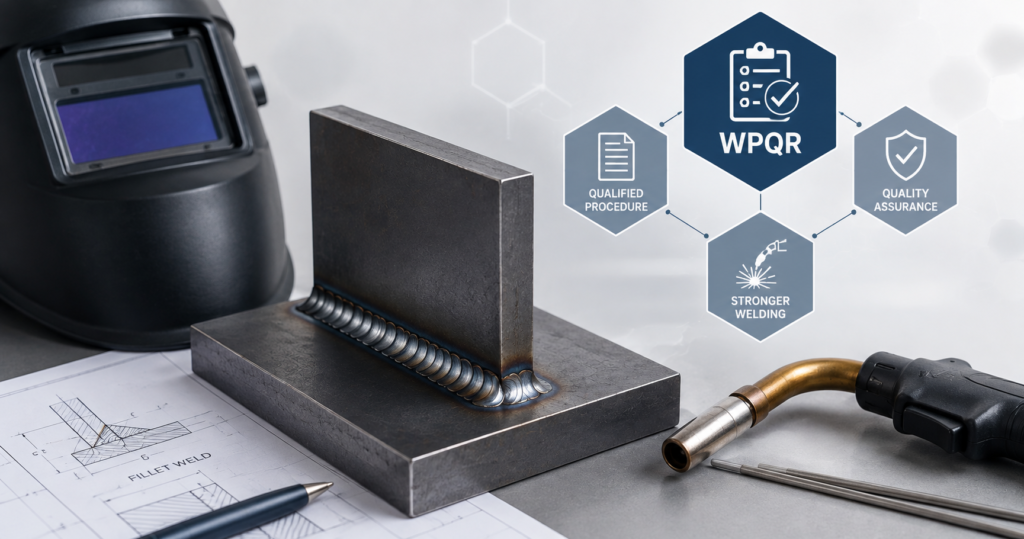
A Welding Procedure Qualification Record (WPQR) is a technical document that shows the real welding settings and test results used to prove a welding method works.People often ask about welding papers, like: How long is a WPQR good for?Usually, a WPQR doesn’t have an expiration date based just on how many years have passed since it was made.Unlike some certificates that expire, a WPQR stays valid as long as these things are true: it follows the right welding standards, uses the correct welding settings, and matches the job it’s meant for.
Does a WPQR Have an Expiry Date?
Generally, a WPQR doesn’t automatically become invalid just because a few years have passed, like two, three, five, or ten years.
For example, if a WPQR was approved several years back, it doesn’t automatically lose its validity just because of the time that has passed.
What’s important is whether the WPQR still fits the welding conditions according to the relevant standard.
So, a WPQR should be checked based on its technical suitability alone.
What Determines WPQR Validity?
The WPQR can still be used depending on certain technical factors.
1.Proper Welding Standard
The first thing to check is which welding standard was used to approve the welding method. For example, EN ISO 15614-1 gives rules for testing welding methods for metal materials.
It’s important to look at the specific qualifications allowed by the current version of the standard to see if the WPQR is suitable for the job. There may also be other standards for the product or how it’s used that include extra requirements.
2.Approved Welding Settings
A WPQR shows that a welding method is approved for certain settings. These settings include:
• The type of metal and its group
• Thickness of the metal
• Size of the pipe
• Welding method used
• Type of joint
• Position where the welding is done
• Welding rod or wire used
• Size of the welding rod or wire
• Gas used for protection
• Temperature before welding starts
• Temperature between weld passes
• Amount of heat used
• Technique used for welding
If the welding settings used in production are within the approved range, the WPQR can still be used.
But if any of these key settings go beyond what was approved, a new test will be needed.
Does a Change in WPS Affect the WPQR?
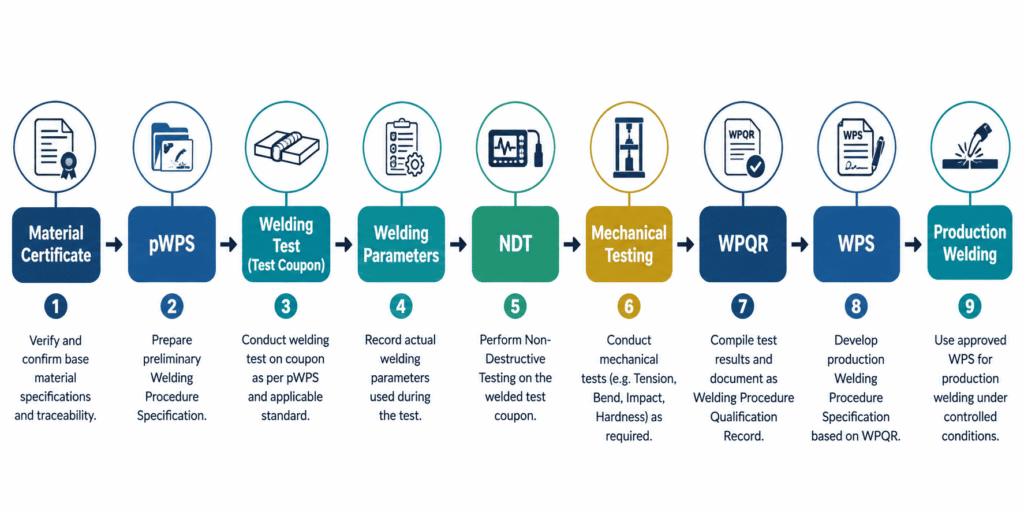
WPQR and WPS are connected but are separate papers.WPQR records the real test conditions and results from the qualifying test.WPS is the paper that lists the welding settings to be used during actual production welding.However, a WPS can be changed if the production process changes, as long as the new WPS is still within the range covered by the WPQR.If a proposed WPS has a qualification range that goes beyond what is covered by the WPQR, it is not acceptable in that situation.
When Is Requalification Required?
Requalification might be needed if there’s a change in any factor that goes beyond the accepted limits.
Some examples might be:
• A change in how materials are grouped
• A big change in the thickness of the material
• A change in the welding method used
• A change in the type of joint being welded
• A change in the welding position if the limits are exceeded
• Any change in the classification of welding materials
• A change in pipe size that is outside the qualified range
• A change in the shielding gas used, if shielding gas is part of the process
These are just a few examples of situations that might require requalification.
The need for requalification depends on the specific qualification standard in use.
So, it’s not correct to say that a WPQR is invalid just because there has been a change in the production conditions.
WPQR Validity vs WPQR Certificate Expiry
There needs to be a clear difference between the validity of a WPQR and other welding certificates.
A WPQR is simply a document that shows proof of a qualification test.
It is not always a certificate that has an expiration date.
Other certificates, such as those for welder qualifications, products, inspections, or management systems, may have their own set of validity dates.
So, you should not assume that a WPQR has the same expiration date as these other certificates.
Can an Old WPQR Be Used?
If the current WPQR was properly qualified, can be found, and matches the welding conditions for the new production, it can be used again.
Before using an older WPQR, check the following:
• The relevant qualification standard
• The version of the standard
• The existing WPQR
• Welding test records
• Material group
• Material thickness
• Welding process
• Welding consumables
• Joint design
• Welding position
• Qualification range
• Non-destructive test results
• Mechanical test results
• Current production requirements
A technical review should check if the existing qualification is suitable for the welding work that needs to be done.
Does a Standard Revision Automatically Make a WPQR Invalid?
A new or updated welding standard does not automatically make all current WPQR qualifications invalid.
You need to check the transition rules in the relevant standard.
Some old qualifications might still be acceptable under specific conditions, but a new qualification must follow the rules of the updated standard.
Therefore, it’s important to always record which version and revision of the standard was used.
WPQR Validity and Traceability
Traceability is very important for WPQR during the production welding process.Proper documentation is needed, and traceability shows how the qualification test is connected to the actual welding process.
Conclusion
The validity of a WPQR isn’t just about how many years have passed since the qualification certificate was issued.What really matters is whether the qualification is still suitable for the welding conditions it was meant for and if it follows all the rules of the standard it was based on.
A WPQR can still be used if all the key factors are carefully checked again.
Before using any WPQR, you should look at the relevant standard, the range of qualifications, essential variables, any updates to the document, and the production conditions.
If a change goes beyond what was originally qualified, a new qualification might be needed.
Need to Verify the Applicability of Your WPQR?
If you’re using an existing WPQR for a new production application, you should check the qualification range, the relevant standard, essential variables, and production conditions before moving forward.
Learn more about WPQR and WPS certification with First Welding Certification Pvt Ltd.
to understand the qualification and approval requirements for your welding procedures.