SET REQUIREMENTS
RECORD DATA
CONFIRM QUALITY
From WPS to Digital Weld Records: Building a Connected Welding Quality System
By First Welding Certification Technical Editorial Team
6 Min Read
28 Aug 2026
Table Of Contents
- What a connected welding quality system should achieve
- Start with the WPS and WPQR
- Give every weld a unique identity
- Connect material and consumable records
- Link the qualified person to the weld
- Capture production and welding data
- Connect inspection and NDT results
- Build the final digital weld record
- Practical implementation roadmap
- Common mistakes to avoid
- The Result: One Weld, One Connected Record
- Frequently Asked Questions
HOW A CONNECTED WELDING QUALITY SYSTEM WORKS
01
WPS
02
WELD ID
03
MATERIAL
04
WELDER
05
DATA
06
INSPECT
Digital Weld Record
One Weld ID connects the evidence needed to produce, inspect and accept the weld.
IDENTITY
Weld ID
W-104-027
Component A-104
QUALITY RECORDS
WPS / WPQR ✓
Material ✓
Welder ✓
Welding Data ✓
QUALITY RECORDS
VT ✓ PASS
UT ✓ PASS
FINAL STATUS
ACCEPTED
A company might have approved WPSs, qualified welders, material certifications, inspection results, and welding logs—but will find it difficult to answer a single, simple question:
“Show me all the evidence that shows this weld is done properly.”
This is not a documentation problem if it means going through Excel documents, paper-based weld maps, WhatsApp chats, PDF folders, and inspection documents.
The issue is the lack of connection between the documents.
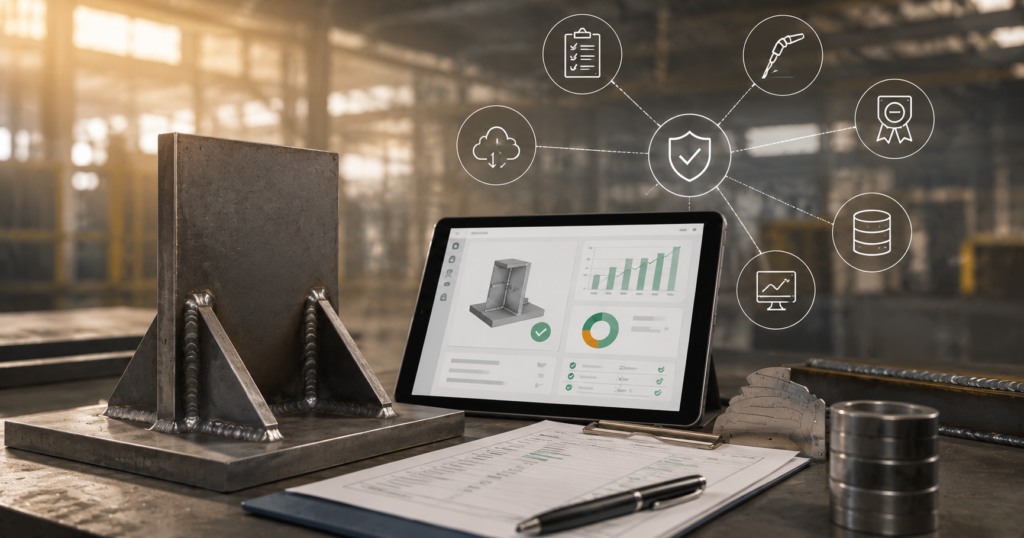
What is a connected welding quality management system? It is a welding quality management system that connects information from pre-welding, during welding, and post-welding into one record. This article discusses how to implement such a system without fully digitizing the manufacturing process.
Think of a digital weld record as the electronic identity document of a weld.
Rather than storing information in different places, the ideal would be for the system to produce a chain like this:
Material -> Component -> Weld Identity -> WPS/WPQR -> Welder/Operator -> Weld Data -> Inspection/NDT -> Repair -> Final Acceptance
What specific information needs to be stored will depend on the relevant standard, the contract, and the product and quality plans. The idea is very straightforward: each key quality document should be linked to the manufacture of that product.
This works well in situations where a documented welding control process is required, such as EN ISO 3834, which encompasses welding procedure, people, material, equipment, inspection, testing and quality records.
Avoid initiating the process of digitalization by purchasing the software.
Ask:
“What is the document that controls the weld?”
For each weld in production, specify the WPS in use, its revision, and the WPQR and qualified range.
Practical digital record of WPS may include:
| FieldExample | |
|---|---|
| WPS number | WPS-045 |
| Revision | Rev. 03 |
| Welding process | 135 |
| Parent material | S355 |
| Joint type | Butt joint |
| Position | PA |
| Consumable | ER70S-6 |
| Thickness range | As qualified |
| WPQR reference | WPQR-021 |
| Status | Approved give me this in a excel file |
The critical control is that of revision management. The production crew must not unintentionally utilize an obsolete WPS by virtue of the availability of an old PDF.
In case your firm requires procedure qualification or approval, your WPS & WPQR can be used as the technical base prior to digitization of the documents.
This is where many paper-based systems become unwieldy.
Provide a unique weld ID instead of ” the weld on assembly 14″.
For example:
Project: P-2026-018 Assembly: A-104
Weld ID W-104-027
That weld ID can then be displayed on the weld map, production record, inspection request and final quality dossier.
This can be made even more practical for larger fabrication projects by using QR codes or barcode identification. Instead of sifting through documents to find the relevant record, a technician can scan the weld and open the record instantly.
The weld record should not end at the WPS level.
Where necessary due to the project or the quality management system, the weld must be traceable to the material from which it was created.
An appropriate trace chain could be:
Heat No. → Material Certificate → Component → Weld
E.g.:
Heat No. 45871 → MTC 3.1 → Plate P-204 → Weld W-104-027
One can then extend it further with the data on the consumables used, such as filler/butt weld metal batch no. /electrode/butt weld metal/shielded gas information.
It becomes especially important if some problems with the material/consumables arise later. It enables manufacturers to focus their investigations on the components and welds concerned rather than going through the whole production batch.
This method is especially helpful for structural manufacturers due to the material traceability requirements for EN 1090.
The following is the next issue:
Who did the welding work?
It must relate the Weld ID to the correct welder/welding operator and his qualification status in the electronic records.
According to the process, it could be the welder qualification according to EN ISO 9606 or the welding operator qualification according to ISO 14732. The welding personnel certification provided by First Welding Certification Pvt Ltd includes both, including the latest version of ISO 14732:2025 for the mechanized and automated welding personnel.
A good system would allow for easy verification of:
- Person ID
- Certificate number
- Welding process
- Position
- Material/product range
- Qualification status
- Continuity if any
This would avoid the frequent issue of finding out that there is indeed a record of a weld, but the qualification of the person who did it cannot be easily verified.
Digitalisation doesn’t entail documenting all potential parameters of any machine simply because the machine provides them.
First of all, choose what information will help you perform your quality control checks.
Based on your specific process and needs, this might involve:
- Current
- Voltage
- Wire feeding
- speed
- Travelling speed
- Heat input
- Welding time
- Gas flow
- Machine id
- Program/job number
- Date and time
What is crucial here is linking information about production to the specific weld or other production operations.
The key is to connect relevant production data to the specific weld or production activity. For example, instead of storing a machine’s welding parameters as a general production log, associate the relevant values with the Weld ID, equipment ID, program number and date/time. This makes the data useful later when investigating a deviation, verifying production records or preparing an inspection package.
For robotic welding, the data captured should also be considered alongside the wider controls of the robotic cell, including process parameters, consumables, shielding gas and joint positioning. See our article on What Manufacturers Need to Monitor Beyond the Robot for a practical look at what manufacturers should monitor around the robotic welding process.
A digital weld inspection record takes on a lot more meaning when the inspection process is integrated with the same Weld ID.
Like for instance:
W-104-027 → VT → Pass
OR
W-104-027 → UT → Indication → Repair → Re-test → Pass
It may contain:
- Type of inspection
- Inspector
- Date of inspection
- Acceptance status
- Report number
- NDT outcome
- Indication/defect
- Status of repair
- Result of re-inspection
And for companies that make use of non-destructive testing, the competence of inspectors counts too. The ISO 9712 certification provides the qualification and certification scheme for industrial non-destructive testing personnel.
And hence an important difference:
Software records and links the proof; competent personnel perform the actual technical inspection and evaluation.
At this point, it is enough for one Weld ID to summarize everything.
Example: Digital Weld Record
Weld ID: W-104-027
Component: A-104
Drawing: DWG-104 Rev B
Material: S355 / Heat 45871
WPS: WPS-045 Rev 03
WPQR: WPQR-021
Welder: W-018
Process: 135
Machine: MIG-07
Production data: Recorded
VT: Accepted
NDT: UT-026 / Accepted
Repair: None
Status: ACCEPTED
Much better than having a folder of unrelated PDFs.
This also makes answering an auditor’s question simpler:
“Provide me with the evidence for this weld.”
It’s easier to provide the digital record than to compile
Don’t try to digitize everything in one day.
Follow this order of actions:
Step 1 – Document current workflow
Describe the existing flows of material, WPS, personnel, production, and inspections records.
Step 2 – Develop IDs standards
Create standard IDs for projects, assemblies, materials, WPSs, welds, and inspection reports.
Step 3 – Centralize controlled documents
Begin with WPS, WPQR, certificates and procedures.
Step 4 – Weld IDs creation
Bind production weld with an assembly or weld mapping.
Step 5 – Bind personnel and material records
Bind the qualified person and the information about the material.
Step 6 – Bind production information
If needed bind welding machine or robotic cell information.
Step 7 – Bind inspection / NDT reports
Bind inspection, results, repairs and repeated inspections information.
Step 8 – Produce final quality dossier
The system should be able to produce structured record for customers’ inspection and audits, project handover.
This is a much more realistic way than making a full-scale digitalization at once.
Just because a badly controlled Excel process is converted to a piece of software does not mean that it becomes a well-managed and high-quality system.
Lack of version control
An approved WPS and an obsolete WPS should never be considered as one and the same thing.
Collecting data out of context
It is meaningless to see 250A recorded by a machine when you do not know which weld, WPS, part and manufacturing procedure it relates to.
Separate inspections
If you have a digital welding record, your NDT report has to be found somewhere else, in a different folder.
Confusing software with certification
Yes, digitalisation may assist compliance, but it will not substitute qualified personal, approved procedures, inspection controls or requirements of the appropriate standard. In EN ISO 3834 case, it speaks about the welding quality system in general, not only about digitalisation.
The idea is not to increase the amount of paperwork on a computer screen. The idea is to make the quality documentation available.
A developed welding quality system should provide an opportunity for the manufacturer to get from:
“We have the papers somewhere.” to: “We can find the weld, its relevant WPS, qualified personnel, track the materials used, check the production data and get the test result.”
This is what digital weld records really bring to the table. And when your quality system needs to prove the control of welding processes, qualified personnel, inspections and traceability, it is possible to implement digital records as a useful tool for meeting standards like EN ISO 3834, and not just one more paperwork exercise.
Frequently Asked Questions
What is a digital weld record?
It is an electronic record that contains information relating to a particular weld, including its Weld ID, WPS, material type, welder/operator, production information, inspection information, NDT reports, repairs and acceptance.
What should be in a digital weld record?
This will vary based on the product, contract and requirements. However, Weld ID, component/drawing number, WPS/WPQR, material identification, personnel qualification, welding data, inspections/NDT information, repairs and acceptance information may be required.
How does WPS relate to digital weld records?
The Weld ID needs to reference the relevant WPS that is approved for use in that production operation. In cases where WPQR information is required, this should be linked back to the applicable WPQR and qualification range.
Is it possible to have robotic welding data in digital weld records?
If the equipment allows for it, yes. Information on things like current, voltage, wire feed rate, travel speed, gas flow, welding time and equipment identification should be added to the digital weld record.
Do digital welding documents substitute ISO 3834 requirements?
No. The digital solution allows you to control, connect and access quality information, but this does not replace the necessary quality procedure, qualified personnel, inspections and technical control.
Make Every Weld Audit-Ready
First Welding Certification Pvt Ltd (PRVA ZVÁRAČSKÁ, a.s.) delivers professional expertise for welding certification and compliance.