EN 10025-1
EUROPEAN STEEL STANDARD
DELIVERY CONDITIONS
EN 10025-1: Technical Delivery Conditions for Hot Rolled Structural Steel Products – A Complete Guide
By Technical Editorial Team
12 Min Read
12 Aug 2026
Table Of Contents
- What Is EN 10025-1?
- What Does EN 10025-1 Cover?
- EN 10025 Series and Related Standards
- Steel Grades Under EN 10025
- Chemical Composition Requirements
- Mechanical Properties
- Delivery Conditions
- Impact Testing and Toughness
- Material Identification and Traceability
- Inspection Documents According to EN 10204
- EN 10025-1 and Structural Steel Fabrication
- EN 10025-1 and Welding Requirements
- EN 10025 Material Selection for Structural Applications
- Common Mistakes When Specifying EN 10025 Materials
- EN 10025 Material Inspection Checklist
- Practical Example: S355 Structual Steel
- Frequently Asked Questions
- Conclusion
- Need EN 10025-1 Certification for Your Structural Steel Products?
Key Takeaways
Defines technical delivery conditions for structural steel
Covers hot-rolled steel products for construction use
Specifies requirements for testing and product quality
Ensures conformity with EN 10025-1 requirements
What Is EN 10025-1?
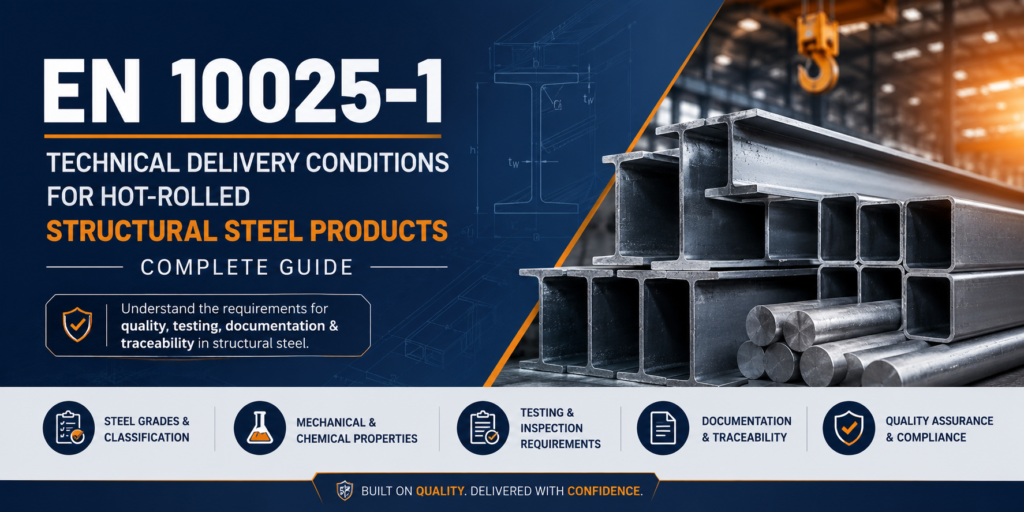
EN 10025-1 is the first part of the EN 10025 European standard series and covers hot-rolled structural steel products.It outlines the general technical conditions that apply to structural steel products covered by the EN 10025 series.This standard is commonly used in specifications for materials used in various applications like steel buildings, structural frames, bridges, industrial structures, platforms, towers, machinery structures, engineering structures, and fabricated steel structures.It is important to note that this standard is not a specification for individual steel grades.Instead, it provides general requirements that work together with the other parts of the EN 10025 series.The structure of the standard includes the following parts:
EN 10025-1 – General Technical Delivery Conditions,
EN 10025-2 – Non-alloy Structural Steels,
EN 10025-3 – Normalized/Normally Rolled Weldable Fine Grain Structural Steels,
EN 10025-4 – Thermomechanically Rolled Weldable Fine Grain Structural Steels,
EN 10025-5 – Structural Steels with Improved Atmospheric Corrosion Resistance,
EN 10025-6 – Quenched and Tempered High Yield Strength Structural Steels.
When specifying a particular structural steel material, it is necessary to refer to both the specific part of the EN 10025 series and the required steel grade and delivery condition.
What Does EN 10025-1 Cover?
EN 10025-1 sets out general rules for hot rolled flat and long structural steel products.
These rules cover several important areas, including:
– How the steel should be delivered
– The names and types of steels
– The size of the product
– The chemical makeup of the steel
– The strength and other physical properties
– The conditions under which the steel is delivered
– How the steel is checked and tested
– How the products are marked
– The condition of the surface
– The absence of internal flaws
– The allowed differences in size or shape
– The documents provided for inspection
The exact rules for a particular steel will depend on which part of the EN 10025 series is used, along with the specific steel grade.
For instance, when using a non-alloy structural steel grade, EN 10025-1 must always be used together with EN 10025-2.
EN 10025 Series and Related Standards
The EN 10025 family is divided into several parts.
| Standard | Main Subject |
|---|---|
| EN 10025-1 | General technical delivery conditions |
| EN 10025-2 | Technical delivery conditions for non-alloy structural steels |
| EN 10025-3 | Normalized/normalized rolled weldable fine grain structural steels |
| EN 10025-4 | Thermomechanically rolled weldable fine grain structural steels |
| EN 10025-5 | Structural steels with improved atmospheric corrosion resistance |
| EN 10025-6 | Quenched and tempered high yield strength structural steels |
This structure is important because EN 10025-1 alone does not cover all steel grades or all mechanical properties.
For example:
S355JR, as defined in EN 10025-2, must meet the requirements of EN 10025-2 along with the general requirements from EN 10025-1.
Steel Grades Under EN 10025
Structural steel grades are named with labels like:
– S235
– S275
– S355
– S420
– S460
These names come from the EN 10025 family of standards. The letter “S” shows that it’s a structural steel grade. The number usually means the minimum yield strength needed under certain conditions. Other symbols can mean different things, such as:
– Impact toughness
– How the steel is prepared for use
– Any special needs or requirements
For example, S355JR includes extra letters to tell it apart from other types of S355 steel. Always use the full name of the material based on the correct standard, not just the short name.
Chemical Composition Requirements
Chemical composition is an important part of the rules for structural steel.
Depending on the type of steel grade and the specific part of EN 10025 that applies, there are rules for the following elements:
– Carbon
– Silicon
– Manganese
– Phosphorus
– Sulfur
– Nitrogen
– Copper
– Chromium
– Nickel
– Molybdenum
The allowed amounts of each element can change based on the steel grade, the thickness of the material, and how it is delivered.
Chemical composition matters because it affects:
– Strength
– Toughness
– How well it can be welded
– Hardness
– How well it resists corrosion
– How easy it is to shape or work with
So, the chemical makeup listed on the material test report should match the standard for that type of steel.
Mechanical Properties
The structural steel should have mechanical properties that match the required grade and delivery condition.
The mechanical properties are usually listed as:
Yield Strength
This is the stress level at which the metal begins to stretch permanently.
Tensile Strength
This is the maximum stress the metal can handle before breaking, as found from a tensile test.
Elongation
This shows how much the metal can stretch before breaking, which tells us about its flexibility.
Impact Strength
If needed, this test measures how tough the metal is under sudden force, based on the test conditions.
These values depend on:
– The type of steel
– The thickness of the product
– The temperature
– The delivery condition
– The specific part of the EN 10025 standard
So, when checking the material certificate, it’s important to look at the correct grade and thickness category.
Delivery Conditions
The way the steel is delivered shows the way it has been treated during manufacturing.
This depends on the specific part and grade of the EN 10025 standard.
The delivery condition can be one of these options:
– As rolled
– Normalized
– Normalized rolled
– Thermo mechanically rolled
– Quenched and tempered
The delivery condition affects the steel’s properties and how it can be used.
So, it’s important to mention it in the purchase specification.
Impact Testing and Toughness
Impact toughness is very important for structures, especially when the material is used in cold conditions or when specific fracture toughness requirements are needed.
EN 10025 steel grades may have impact testing requirements listed in their designations.
Some examples of these designations are:
– JR
– J0
– J2
These letters show the impact properties at certain test temperatures.
For example, you can’t just guess what temperature a certain designation refers to—you need to check the related product standard. To confirm the details, you should look at the material certificate.
It will show:
Grade → Impact designation → Test temperature → Impact energy → Test result
This is especially important for structural steel that is used in tough or extreme environments.
Material Identification and Traceability
Material traceability is important when using EN 10025 steel in structures that are made from pieces of metal.
A common way to track the steel is:
Purchase Order → Steel Grade → Heat Number → Material Certificate → Product Marking → Fabricated Component
The heat number or another type of marking helps link the steel to its test records.
During the building process, it’s important to keep track of the steel through steps like:
– Receiving the steel
– Storing it
– Cutting it
– Shaping it
– Assembling parts
– Welding
– Checking the work
– Putting the final piece together
If the steel’s marking is lost, it becomes hard to prove that the right type of steel was used.
Inspection Documents According to EN 10204
EN 10025 materials are usually provided with inspection documents that follow the EN 10204 standard.
Depending on what is needed for the purchase, the documents can be of different types:
– Type 2.1
– Type 2.2
– Type 3.1
– Type 3.2
The correct inspection document should be clearly stated in the purchase order or technical specifications.
A Type 3.1 inspection certificate typically includes detailed test results that have been approved by an independent inspector from the manufacturer’s authorized team, not from the production department.
A Type 3.2 inspection certificate is prepared by two authorized inspectors—one from the manufacturer and another as required by the relevant standards.
The certificate must match the actual material being delivered, including details like:
– Grade
– Heat number
– Dimensions
– Chemical composition
– Mechanical properties
– Delivery condition
– Required testing
EN 10025-1 and Structural Steel Fabrication
EN 10025 materials are commonly used in building structures made from steel.
A usual process for making these structures might go like this:
Receive the material
↓
Check the material to make sure it’s the right type
↓
Inspect the material to ensure it meets quality standards
↓
Cut the material into the needed shapes
↓
Put the pieces together properly
↓
Weld the parts together
↓
Check the size and shape to make sure they’re correct
↓
Treat the surface, like painting or coating
↓
Do a final check to make sure everything is good
The material standards, like EN 10025, are part of the whole process of making the structure.
The process might also need other standards, especially EN 1090, depending on what type of structure is being built and how it will be used.
So:
EN 10025 covers the material needs
EN 1090 covers how the structure is made and how it meets standards
These two standards are not the same and should not be used interchangeably.
EN 10025-1 and Welding Requirements
Welded structures are made from various types of EN 10025 structural steel.
Whether a certain steel can be used for welding depends on several factors:
– The type of steel
– Its carbon equivalent
– The thickness of the steel
– The welding method used
– The amount of heat added during welding
– Whether pre-heating is needed
– The temperature between passes
– The type of welding material
– The kind of joint being made
– The welding procedure followed
So, you can’t just pick a welding procedure based on the steel’s name.
For example:
Material → Welding Procedure → Welding Procedure Qualification Record (WPQR) → Welding Procedure Specification (WPS) → Qualified Welder → Production Weld → Inspection
Some important welding standards that might apply are:
EN ISO 15614 series
EN ISO 9606 series
EN ISO 3834 series
EN ISO 14731 series
The specific requirements will depend on the project, the product, and the manufacturing standards being used.
EN 10025 Material Selection for Structural Applications
The material grade needs to be chosen based on the design and what the application needs.
Here are some factors that should be considered:
1.Structural Strength
The strength needed should match what the design calls for.
2.Thickness
The mechanical needs can change depending on how thick the product is.
3.Toughness
The impact resistance should be suitable for the service temperature and the conditions the design is facing.
4.Weldability
The material’s composition and the way it’s made will affect how it’s welded.
5.Delivery Condition
If there are any metallurgical requirements, they need to be clearly stated.
6.Corrosive Environment
For structures exposed to the atmosphere, the right material grade and product standards should be considered.
Common Mistakes When Specifying EN 10025 Materials
Manufacturers and buyers might face problems with material documentation if the full material designation isn’t clearly stated.
Common issues are:
– Writing only “S355” without giving the full grade
– Using the wrong part of EN 10025
– Not stating the correct thickness range
– Missing impact test requirements
– Choosing the wrong delivery condition
– Not including the heat number
– Not having full material traceability
– Using the wrong type of inspection certificate
– Chemical makeup not matching the grade specified
– Mechanical properties not matching the required thickness
– Not providing inspection results
– Confusing material requirements with fabrication requirements
– Using an old material standard without checking the project needs
The key rule is:
Do not just use the general name for structural steel.
Always clearly state the full material designation, the correct EN 10025 part, dimensions, delivery condition, and inspection requirements.
EN 10025 Material Inspection Checklist
| Inspection Area | Check | Verified |
|---|---|---|
| Material standard | Applicable EN 10025 part | ☐ |
| Material standard | Steel grade | ☐ |
| Material standard | Complete designation | ☐ |
| Product type | Dimensions | ☐ |
| Product type | Thickness | ☐ |
| Traceability | Heat number | ☐ |
| Mechanical / chemical properties | Chemical composition | ☐ |
| Mechanical / chemical properties | Yield strength | ☐ |
| Mechanical / chemical properties | Tensile strength | ☐ |
| Mechanical / chemical properties | Elongation | ☐ |
| Mechanical / chemical properties | Impact properties | ☐ |
| Condition / identification | Delivery condition | ☐ |
| Condition / identification | Surface condition | ☐ |
| Condition / identification | Product marking | ☐ |
| Condition / identification | Material traceability | ☐ |
| Documentation | EN 10204 inspection document | ☐ |
| Requirements | Purchase order requirements | ☐ |
| Requirements | Applicable project requirements | ☐ |
Practical Example: S355 Structural Steel
For example, when purchasing structural fabrication made from S355 steel:
The procurement team should not just buy ‘S355 Steel Plate.
The purchase specification must include these details about the material:
– Which part of EN 10025 it follows
– The steel grade
– The type of product
– The thickness
– The impact resistance requirement
– The delivery condition
– The size
– The surface finish
– The inspection document
– Any other test requirements
The material is bought and checked to make sure it meets all the purchase requirements. A typical chain of documents might look like this:
Purchase Specification
↓
EN 10025 Material
↓
Heat Number
↓
Material Inspection Certificate
↓
Incoming Inspection
↓
Material Identification
↓
Fabrication
↓
Welding
↓
Final Product
This creates a clear link between the material that was ordered and the finished structural part.
Frequently Asked Questions
What is EN 10025-1?
EN 10025-1 specifies general technical delivery conditions applicable to hot rolled structural steel products covered by the EN 10025 series.
Is EN 10025-1 a steel grade standard?
EN 10025-1 provides general requirements. Specific steel grades and their technical delivery requirements are established in the relevant subsequent parts of the EN 10025 series.
What is the difference between EN 10025-1 and EN 10025-2?
EN 10025-1 establishes general technical delivery conditions, while EN 10025-2 specifies technical delivery conditions for non-alloy structural steels.
What are common EN 10025 structural steel grades?
Common structural steel designations include S235, S275 and S355, while higher-strength grades are specified in the applicable parts of the EN 10025 series.
What does S355 mean?
S355 is a structural steel designation. The complete requirements, including the applicable minimum yield strength and other properties, depend on the relevant EN 10025 part, product thickness and grade designation.
What do JR, J0 and J2 mean?
These designations identify specified impact toughness requirements at particular test temperatures under the applicable EN 10025 requirements.
What is the EN 10025-2 equivalent Indian standard?
There is no single direct Indian equivalent that can automatically replace the requirements of EN 10025-2. Indian standards such as IS 2062 may cover comparable structural steel applications, but grade, chemical composition, mechanical properties, thickness, toughness and delivery conditions must be compared before considering equivalence.
What does EN 10025-2 chemical composition include?
The chemical composition requirements specify limits for elements such as carbon, manganese, silicon, phosphorus, sulfur and other applicable alloying elements. The limits can vary depending on the steel grade, product thickness and specified delivery condition.
How can I compare an EN 10025-2 grade with an Indian steel grade?
A proper comparison should consider the complete material designation rather than comparing grade names alone. Yield strength, tensile strength, impact properties, chemical composition, thickness range and delivery condition should all be checked before treating two grades as equivalent.
Where can I verify the EN 10025-2 chemical composition requirements?
The applicable product standard should be used to verify the required chemical composition and mechanical properties for the specified grade. The material documentation should then be checked against the applicable requirements to establish conformity.
Conclusion
EN 10025-1 provides the basic technical rules for the EN 10025 series, which includes different types of hot-rolled structural steel products.
For both manufacturers and buyers, choosing the right steel grade isn’t enough.
You also need to make sure the material meets specific requirements.
These requirements should include:
– Which part of EN 10025 applies
– The specific steel grade
– The shape or form of the product
– The thickness of the steel
– The mechanical properties it needs to have
– Any impact resistance requirements
– The condition it should be delivered in
– The inspection documents
– How the material can be traced back to its origin
When building structures, these material details also connect with other important standards:
– EN 10025: for the steel itself
– EN 10204: for the inspection and documentation
– EN ISO 3834: for welding quality
– EN 1090: for how the structure is built and checked for compliance
The important question isn’t just:
“Is this S235, S275, or S355 steel?”
It’s more about:
“Does the steel you’re getting match all the EN 10025 requirements, your purchase specifications, the inspection documents, and the traceability rules?”
This full approach gives the technical support needed to manage structural steel from when you buy it, through the building process, to the final paperwork.
Need EN 10025-1 Certification for Your Structural Steel Products?
Firstwelding Certification Pvt Ltd (PRVÁ ZVÁRAČSKÁ,a.s.,) offers certification based on European and international standards, covering material needs, inspection records, traceability, and conformity checks.
Related Searches
- EN 10204 Type 3.2 Inspection Certificate: Complete Guide for Manufacturers and Buyers
- EN 1090 Material Traceability & Inspection: Complete Guide for Steel and Aluminium Fabricators
- EN 1090 Certification Requirements: 15-Point Checklist Before Your Certification Audit
- How Indian Steel Manufacturers Can Export to Europe: Complete EU Compliance Guide (2026)