EN 1090
STRUCTURAL STEEL
CHECKLIST
EN 1090 Certification Requirements: 15-Point Checklist for Structural Steel & Aluminium Manufacturers
By Technical Editorial Team
7 Min Read
31 July 2026
Table Of Contents
- What Is EN 1090 Certification?
- Who Needs EN 1090 Certification?
- EN 1090-1 vs EN 1090-2 vs EN 1090-3
- Why EN 1090 Requirements Matter
- EN 1090 Certification Requirements: 15-Point Checklistem
- Documents Manufacturers Should Review
- EN 1090 Requirements for Indian Manufacturers
- Final Pre-Certification Check
- Related Sources
- Conclusion
- Need EN 1090 Certification?
- FAQs
Key Takeaways
15-POINT CHECKLIST
FACTORY PRODUCTION CONTROL
WELDING REQUIREMENTS
CERTIFICATION READINESS

What Is EN 1090 Certification?
Skilled welders, approved welding procedures, qualified welders, properly calibrated equipment, and manufacturing experience are all important—but are these enough to get EN 1090 Certification?Many manufacturers often ask similar questions.They want to know which Execution Class applies, if ISO 3834 is needed, whether the WPS/WPQR records are enough, what should be included in Factory Production Control (FPC), and how Indian manufacturers can get their products certified in Europe.EN 1090 compliance is more than just having certificates.Manufacturers need to show that their structural steel or aluminum components are consistently made according to the required standards.For products covered by the standard, EN 1090-1 links FPC, Declaration of Performance (DoP), and CE marking requirements under the Construction Products Regulation (CPR).
This 15-point checklist covers the main things manufacturers should check before applying for EN 1090 certification.
It also helps determine if ISO 3834 is required or not.
Who Needs EN 1090 Certification?
EN 1090 certification applies to manufacturers of structural steel and aluminium parts used in construction, but it depends on what the product is meant to do, how it functions, and which technical standards apply.Common examples include steel frames, beams, columns, trusses, platforms, stairways, bridges, towers, load-bearing parts, and structural aluminium components.The main point is that not all steel or aluminium products need EN 1090-1 certification.Whether a product is covered depends on its function, its intended use, and the relevant technical specifications.
EN 1090-1 vs EN 1090-2 vs EN 1090-3
One of the simplest ways to understand the EN 1090 family is:
Standard Primary Goal
EN 1090 – 1: Structural components – Conformity assessment requirements
EN 1090 – 2: Technical requirements for the erection of steel structures
EN 1090 – 3: Technical requirements for the execution of aluminium structures
So, a manufacturer should not think that EN 1090-1 covers all the technical details for fabrication.
For a steel fabricator, EN 1090-1 and relevant parts of EN 1090-2 are usually used together.EN 1090-3 applies to the specific requirements for making aluminium structures.
| Standard | Main focus | Relevant to |
|---|---|---|
| EN 1090-1 | Conformity assessment requirements for structural components | Manufacturers placing applicable structural steel or aluminium components on the market |
| EN 1090-2 | Technical requirements for execution of steel structures | Structural steel fabrication and execution |
| EN 1090-3 | Technical requirements for execution of aluminium structures | Structural aluminium fabrication and execution |
Why EN 1090 Requirements Matter
It might seem fine as a structural part, but to meet EN 1090 standards, you need clear proof that the production was properly controlled.Manufacturers must show they can track materials back to their source, have a valid welding procedure specification, qualified welders, properly calibrated tools, records of inspections, and a strong Factory Production Control system.
Key point: EN 1090 focuses on consistent, controlled, and traceable manufacturing – not just how things look.
EN 1090 Certification Requirements: 15-Point Checklist
Use this EN 1090 checklist to review your manufacturing process before getting certified.
1.Check if EN 1090-1 applies to your product
Look at the product’s role, how it will be used, the materials used, the standards it must follow, and the market it’s going to be sold in to decide if EN 1090-1 applies.
2.Choose the right Execution Class
Find out which Execution Class (EXC1, EXC2, EXC3, or EXC4) applies based on your project and technical needs.
This choice affects how you make the product, weld, and inspect it.
3.Set up a good Factory Production Control (FPC) system
Create a system that covers who is responsible, how production happens, how inspections are done, record-keeping, tracking materials, dealing with issues, and fixing them.
4.Check incoming materials
Make sure the materials you receive match the right grade, standards, size, markings, condition, and that all required inspection documents are with them.
5.Keep track of materials
Make sure you can follow the materials from their certificates and markings all the way through the making process to the finished part.
6.Control Welding Procedure Specifications (WPS)
Make sure there is a correct and controlled WPS that is followed during welding.
7.Confirm Welding Procedure Qualifications
Check that the supporting WPQR or procedure qualification covers the real welding process, materials used, thickness, types of joints, and the range it applies to.
8.Check Welder Qualifications
Ensure that the welders and operators are qualified and that their qualifications match the work they are doing.
9.Set up Welding Coordination
Assign people who are skilled in welding coordination with clear roles for managing welding processes and ensuring quality.
10.Meet ISO 3834 Requirements
Choose the right welding quality standard based on EN ISO 3834-2, ISO 3834-3, or ISO 3834-4, as needed for your project.
11.Control Welding Consumables
Manage the buying, identification, storage, handling, and distribution of welding materials according to the set standards.
12.Control Production Equipment
Make sure all equipment that might affect the product quality is properly maintained, checked, or verified.
13.Do Inspection and Testing
Plan and document needed checks like measurements, welding checks, visual inspections, non-destructive testing, and final checks as needed.
14.Handle Nonconforming Products
Make sure any issues are found, recorded, assessed, fixed, or properly dealt with, and that everything is checked to be okay.
15.Keep Conformity and CE Marking Records
If needed, keep all necessary records to show the product meets requirements, including the Declaration of Performance (DoP) and CE marking details.
Final Check: Can you show how the product comes from materials, goes through fabrication, welding, inspection, and ends with a declared performance and CE marking?
If you can, your EN 1090 documents and production system are well prepared.
Scope & Requirements
✓ Product applicability
✓ Applicable EN 1090 requirements
✓ Execution Class
Factory Production Control
✓ FPC system
✓ Defined responsibilities
✓ Controlled procedures and records
Welding Control
✓ Welding coordination
✓ Qualified welding procedures
✓ Qualified welding personnel
Materials & Production
✓ Material identification
✓ Traceability
✓ Controlled fabrication activities
Certification
✓ Inspection & testing
✓ Equipment control
✓ NC control
✓ Documentation and records
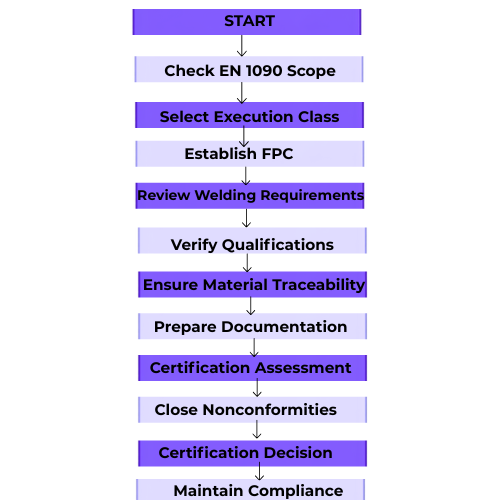
EN 1090 Certification Process: Simple Overview
For manufacturers who want to know what happens after preparation, the process can be explained like this:
1.Check if the product applies and find out what requirements are needed
Find out which product is included, the technical details, and the Execution Class.
2.Set up Factory Production Control
Create and follow the rules that help make sure the product is always made to the right standards.
3.Set up welding controls if needed
If welding is part of the process, make sure the methods, trained workers, teamwork, and quality are all properly managed.
4.Get ready with technical and quality proof
Collect records that show how the product was made, tested, and checked.
5.Assess the Factory Production Control
Check if the Factory Production Control system meets the EN 1090-1 standards.
6.Fix any issues found
If problems are discovered, take steps to fix them and show proof that the fixes work.
7.Get the certification
Once everything meets the standards, the Factory Production Control system can be officially certified.
8.Keep the system running
Certification isn’t the end.
The manufacturer must keep up with the rules and be checked regularly to stay in compliance.
EN 1090 Requirements for Indian Structural Steel & Aluminium Manufacturers
A common mistake is thinking that EN 1090 certification only matters for companies based in Europe.
For an Indian manufacturer, the key thing to consider is the product and where it will be sold, not just where the factory is located.
If structural steel or aluminium parts made in India are meant for the European market and fit under the EN 1090-1/CPR rules, then the necessary compliance steps must be followed before selling those products there.
This is especially important for Indian manufacturers working on:
– Export fabrication projects
– Structural steel work
– Infrastructure parts
– Industrial buildings
– Aluminium structures
– Contracts with European clients
For exporters, getting the right manufacturing controls in place early can help avoid last-minute compliance problems after production has started.
Final Pre-Certification Check
Before you ask if your company is ready for EN 1090 certification, try this exercise.
Pick one completed structural part from your workshop.
Now look back at how it was made.
Can you find out:
- What the specification was?
- What material records were used?
- What material identification was applied?
- Who made and welded it?
- Which welding method was used?
- Were the qualifications for that method correct?
- What equipment and inspection processes were used?
- Is there proof of inspection?
- Did any issues happen during production?
- What documentation is linked to the finished part?
If your organisation can answer all these with clear, easy-to-find records, you’re already thinking about EN 1090 in the right way.
If the answers rely on one person remembering, there’s a lack of control that needs to be checked.
EN 1090 compliance comes down to one simple idea:
Can your production system show, again and again, that structural parts are made under controlled conditions that follow the right rules?
That’s a much better question than:
“Do we have all the certificates?”
Related Sources
- EN 1090 Audit Checklist: Complete Guide to Pass Your Certification Audit (2026)
- Mastering EN 1090 Factory Production Control (FPC)
- EN 1090 Execution Classes: Complete Guide to EXC1, EXC2, EXC3 & EXC4
- EN 1090 Material Traceability & Inspection: Complete Guide for Steel and Aluminium Fabricators
- EN 1090 WPS & WPQR Requirements: Ensuring Welding Quality and Compliance
Conclusion
EN 1090 certification demonstrates that structural steel and aluminium products are manufactured under controlled and documented conditions.
Manufacturers should identify the applicable EN 1090 requirements, Execution Class, welding controls, and Factory Production Control requirements.
Proper material traceability, qualified welding procedures, competent personnel, inspection, and production records are essential for conformity.
For Indian manufacturers, meeting the applicable requirements is particularly important when placing structural products on the European market.
A well-maintained production system makes the EN 1090 certification process clearer and supports consistent product conformity.
Need EN 1090 Certification?
First Welding Certification Pvt Ltd | PRVÁ ZVÁRAČSKÁ, a.s. provides certification for manufacturers who work with structural steel and aluminium parts, following the EN 1090 certification standards.
Manufacturers looking to get certified should set up and keep all the necessary Factory Production Control, welding, traceability, inspection, and documentation processes that are relevant to their specific manufacturing activities and Execution Class.
Are you planning to get EN 1090 certification for your factory?
Frequently Asked Questions
What are the requirements for EN 1090 certification for structural steel manufacturers?
To obtain EN 1090 certification for structural steel manufacturers, companies must implement a Factory Production Control (FPC) system, comply with the applicable execution class (EXC1–EXC4), use qualified welding procedures, employ competent welding personnel, maintain material traceability, and successfully complete the conformity assessment conducted by a notified certification body. Compliance with EN 1090-1 and relevant parts of EN 1090-2 or EN 1090-3 is required depending on the product.
Who needs EN 1090 certification before exporting steel structures to Europe?
EN 1090 certification is required for manufacturers exporting structural steel or aluminium products to the European Economic Area (EEA) when those products fall under the Construction Products Regulation (CPR). Fabricators of steel buildings, bridges, industrial structures, towers, staircases, handrails, and aluminium structures generally require EN 1090 certification before placing products on the European market.
What documents are required for EN 1090 certification?
The documentation required for EN 1090 certification typically includes:
- Factory Production Control (FPC) Manual
- Quality Management Procedures
- Welding Procedure Specifications (WPS)
- Welding Procedure Qualification Records (WPQR)
- Welder Qualification Certificates
- Material Test Certificates
- Inspection and Test Plans (ITP)
- Calibration Records
- Non-Destructive Testing (NDT) Reports
- Material Traceability Records
Maintaining complete documentation is essential for demonstrating conformity during05 certification audits.
What is Factory Production Control (FPC) in EN 1090 certification?
Factory Production Control (FPC) is a documented quality control system required under EN 1090-1. It ensures that every structural component manufactured consistently meets specified technical and regulatory requirements. The FPC system covers purchasing, material verification, welding, inspections, testing, production processes, equipment calibration, and final product verification.
What are the different EN 1090 execution classes (EXC1, EXC2, EXC3, and EXC4)?
EN 1090 defines four Execution Classes (EXC1 to EXC4) based on the complexity and risk level of the structure.
- EXC1 – Agricultural and simple structures
- EXC2 – Commercial and industrial buildings (most common)
- EXC3 – Bridges, stadiums, and heavy industrial structures
- EXC4 – Critical infrastructure such as nuclear facilities and major public structures
The applicable execution class determines the level of welding quality, inspection, documentation, and manufacturing controls required.
Is welding qualification mandatory for EN 1090 certification?
Yes. Qualified welding procedures and certified welders are essential requirements for EN 1090 certification when welded structural components are manufactured. Depending on the manufacturing process, organizations may need qualified WPS, WPQR, welder qualification certificates, welding coordination, and compliance with applicable welding quality standards such as EN ISO 3834.
What is EN 1090 certification validity period?
The validity period of an EN 1090 certificate depends on the applicable certification scheme and the certification body’s conditions. Continued certification requires the manufacturer to maintain the certified Factory Production Control system and meet applicable requirements during ongoing surveillance. Significant changes to the manufacturing process, production site, or certified scope may also require assessment by the certification body.
Is EN 1090 certification required for exporting structural steel to Europe?
EN 1090 certification may be required when structural steel products are covered by EN 1090-1 and are placed on the European market under the applicable Construction Products Regulation requirements. For an Indian manufacturer, the need for certification depends on the product, its intended use, applicable harmonised specifications, and the conformity assessment requirements. The manufacturer should determine the applicable scope before exporting.