EN 15085-2 : 2025
INDIA & GLOBAL RAILWAY MARKETS
DOCUMENTATION & COMPLIANCE
EN 15085 Latest Edition 2026: EN 15085-2:2025 Update for Indian & International Manufacturers
By First Welding Certification Technical Editorial Team
08 Min Read
09 Sep 2026
Table Of Contents
- What Is the Latest EN 15085 Edition in 2026?
- What Is EN 15085-2:2020+A2:2025?
- What Changed in the Latest EN 15085-2 Update?
- What Does the Current Edition Mean for Indian Manufacturers?
- What EN 15085 Documents Should Manufacturers Review?
- Can Indian Manufacturers Use EN 15085 for International Markets?
- En 15085 Readiness Checklist for 2026
- Frequently Asked Questions
- Conclusion
- Related Resources
- Need EN 15085 Certification for Your Railway Welding Manufacturing?
EN 15085: From Indian Manufacturing to Global Railway Markets
01
EN 15085 Standard
Applicable welding quality and manufacturer requirements for railway vehicles and components.
02
Indian Manufacturer
Defined certification scope, welding coordination, qualified personnel and controlled production.
03
Documented Compliance
WPS/WPQR, welder qualifications, welding procedures, traceability and inspection records.
04
International Supply Chain
Certification evidence aligned with applicable customer, project and market requirements.
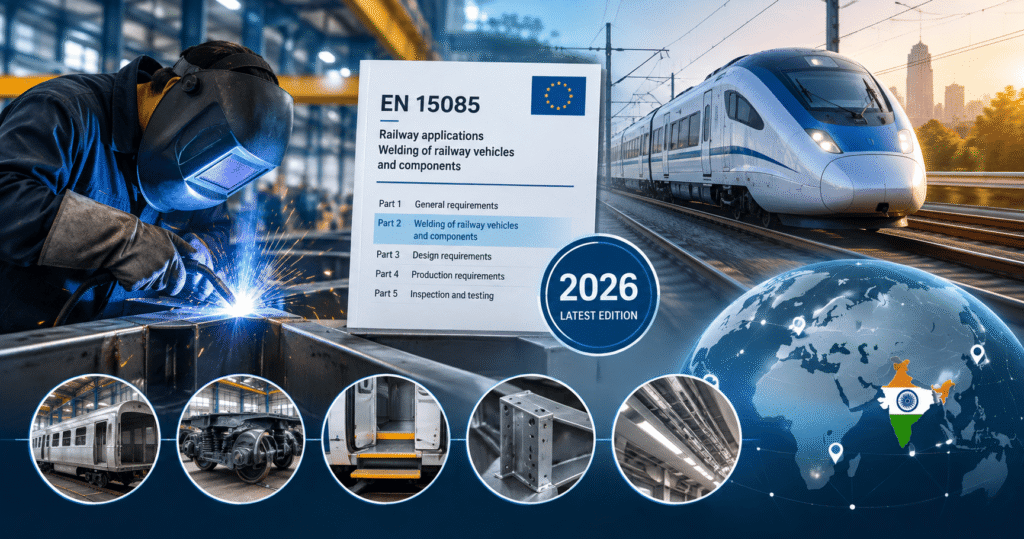
Is your railway welding documentation still up to date with the EN 15085 requirements? For companies making railway vehicles and parts, knowing which version of the standard is current is the first step. The bigger question is whether your certification scope, welding coordination, procedures, trained staff, traceability, and quality records are still in line with the requirements as of 2026.
The current European part 2 standard is EN 15085-2:2020+A2:2025.
In Germany, the national version is DIN EN 15085-2:2025-09, based on the European amendment. This makes the 2026 standard environment especially important for manufacturers who work with international railway clients.
What Is the Latest EN 15085 Edition in 2026?
For Part 2, the current European standard is EN 15085-2:2020+A2:2025.It’s important to note that searching for “EN 15085 edition 2026” can cause confusion between the year someone is searching and the actual version of the standard.BSI currently lists BS EN 15085-2:2020+A2:2025 as the current version and marks it as identical to EN 15085-2:2020+A2:2025.In Germany, the same standard is published as DIN EN 15085-2:2025-09, based on EN 15085-2:2020+A2:2025.
Because of this, manufacturers might come across similar search terms like: EN 15085 latest edition 2026, EN 15085-2:2025, EN 15085-2:2020+A2:2025, DIN EN 15085-2, EN 15085 2026, EN 15085 latest version, and EN 15085-2 requirements.
To find the current status of the standard, check the BS EN 15085-2:2020+A2:2025 standard record.
What Is EN 15085-2:2020+A2:2025?
EN 15085-2 is part of the EN 15085 railway welding series.It sets out the requirements for companies that weld parts for railway vehicles and components.
The EN 15085 series covers different stages and areas of railway welding.
These include:
– EN 15085-1: General information
– EN 15085-2: Requirements for welding companies
– EN 15085-3: Design requirements
– EN 15085-4: Production requirements
– EN 15085-5: Inspection, testing, and documentation
– EN 15085-6: Maintenance welding
So, the series goes beyond just certification.
Companies involved in manufacturing may need to look at design, production, welding coordination, inspection, testing, documentation, and maintenance, depending on what they do.
The BS EN 15085 series explains the structure of the series and gives references for each part.
For welding companies, it’s more helpful to know which part applies to their specific work rather than treating the whole series as one single document.
What Changed in the Latest EN 15085-2 Update?
One of the key issues in 2026 is confusion about which version of the standard is being used.
The old version, EN 15085-2:2020+A1:2023, has been replaced by EN 15085-2:2020+A2:2025.
This means that manufacturers using controlled documents need to check if the old version is still valid for their certification and project needs.
A good review should cover:
– The version of the standard mentioned in the certification
– The version referenced in customer specifications
– Copies of the relevant standards that are controlled
– Internal procedures and work instructions
– Welding coordination records
– Quality documentation
– The scope of the certification
– Production and inspection records
The main thing to remember is that just because the standard has been updated, it doesn’t mean all production documents need to be completely rewritten.
The manufacturer should decide which parts of the standard apply to their work and find out which documents or processes need to be changed.
What Does the Current Edition Mean for Indian Manufacturers?
For a railway welding manufacturer, the first question shouldn’t be “Which certificate do we need?”
A better place to start is:
“What exactly are we making, how are we welding it, and how can we show that it meets the required standards?”
A manufacturer should look into:
Manufacturing scope: Figure out which railway vehicles, parts, welded pieces, and production sites are included in the planned certification.
Welding processes: Make sure the welding methods used in real production match the approved procedures and qualifications.
Classification: Check the certification level for the welded parts within the manufacturer’s scope.
Welding coordination: Ensure that the people involved in welding coordination are qualified, have clear responsibilities, and their involvement is properly documented.
Personnel qualifications: Review whether welders and welding operators have the right skills and certifications, and whether inspection and testing staff are also properly qualified.
Welding procedures: Confirm that the WPS and WPQR documents match the materials, welding methods, types of joints, and how the welding is actually done in production.
Traceability: Follow a finished component through its production records to check if all the material details, welding steps, inspections, and final documents can be connected properly.
This approach based on the scope is especially important for Indian manufacturers who supply parts for both railway projects and international customers.
What EN 15085 Documents Should Manufacturers Review?
Documentation is an important part to check when making sure a company is ready to follow EN 15085 rules.
Depending on what the manufacturer does and the work they carry out, these documents may be needed:
– WPS and WPQR
– Welder qualification records
– Welding operator qualification records
– Welding coordination records
– Welding procedure instructions
– Material certificates and identification records
– Welding consumable records
– Inspection reports
– NDT reports
– Equipment maintenance records
– Calibration or measurement records
– Production records
– First Article Inspection records
– Heat-treatment records when needed
– Repair records
– Non-conformance records
– Traceability records
– Quality documentation
The main thing is not just having the documents.
It’s about having a clear and traceable chain of records.
For example:
Material identification → WPS/WPQR → welder → production weld → inspection/NDT → final quality record
This shows how a railway component was made and checked.
EN 15085-5 focuses on inspection, testing, and documentation, which makes documentation a key part of the EN 15085 system.
Can Indian Manufacturers Use EN 15085 for International Markets?
Yes.EN 15085 is helpful for manufacturers who want to supply railways outside India, especially when customers require controlled welding and proof that their manufacturing process is well-documented.
Just having an EN 15085 certificate isn’t enough on its own.
Depending on the customer and the project, international railway organizations may look at several factors, including:
– Certification scope
– Applicable classification level
– Manufacturing location
– Welding processes
– WPS and WPQR
– Welder qualifications
– Welding coordination
– NDT capability
– Material traceability
– Inspection records
– Production controls
– Quality documentation
– Customer technical requirements
For Indian manufacturers looking to enter European or other international railway markets, the goal is to create a controlled and traceable welding system.
This system must show that everything—from the starting materials through production, inspection, and final documentation—meets the required standards.
Terms like EN 15085-2 and DIN EN 15085-2 often appear in customer specifications, supplier requirements, or discussions in these markets.
For manufacturers reviewing their certification scope, refer to First Welding Certification Pvt Ltd (PRVÁ ZVÁRAČSKÁ, a.s.) EN 15085 certification.
En 15085 Readiness Checklist for 2026
Before checking your EN 15085 certification status, go through these eight areas:
1.Check the standard reference: Make sure you know which version and amendment of the standard are used in your certification, customer documents, and project files.
2.Set the manufacturing scope: Write down all the railway parts, assembled components, welding tasks, processes, and places where welding happens that need to be included.
3.Check the classification: Ensure that the classification of the parts matches how they will be used in the railway system.
4.Verify welding coordination: Look into the qualifications, job roles, and records of the welding coordinator.
5.Match WPS and WPQR: Ensure that the approved welding procedures are suitable for the production process.
6.Check staff qualifications: Confirm that welders, welding operators, welding coordinators, and NDT personnel have the right qualifications for their jobs.
7.Test traceability: Choose one finished railway part and follow its history from the material ID through welding, inspection, and final documentation.
8.Review quality records: Make sure that records for production, inspection, NDT, repairs, and non-conformances are complete, well-kept, and easy to find.
Frequently Asked Questions
What is the latest EN 15085 edition in 2026?
For Part 2 the current European version is EN 15085-2:2020+A2:2025. National standards might use different year names. Follow the same European document.
Is DIN EN 15085-2 the same as EN 15085-2?
DIN EN 15085-2 is the name. The current German version, DIN EN 15085-2:2025-09 is based on EN 15085-2:2020+A2:2025.
Does EN 15085-2:2020+A2:2025 matter to manufacturers?
It can matter, especially if certification, customer specs, controlled documents or production rules refer to a version. Manufacturers should compare requirements with their certification and how they operate.
What documents are important for EN 15085?
Depending on the scope manufacturers may need controlled welding procedures WPS/WPQR, personnel qualifications, welding coordination records, material and traceability records inspection/NDT reports, production records and repair or non-conformance documents.
Is EN 15085 relevant for railway markets?
Yes. EN 15085 is used in railway welding supply chains. Can be important when customers want proof of qualified welding, controlled processes and documented compliance.
Does having EN 15085 certification automatically qualify a company for every railway project?
No. Customer, project, product and contract rules vary. Certification should be seen along, with scope, technical ability, documentation, traceability and customer-specific needs.
Conclusion
The discussion about the EN 15085 edition 2026 is more than just adding “2026” to the standard’s name.
For Part 2, manufacturers should be aware of the European standard EN 15085-2:2020+A2:2025, while documents for the German market might refer to DIN EN 15085-2:2025-09.
Railway welding manufacturers should check if their certification scope, welding coordination, WPS/WPQR, qualified personnel, inspection processes, traceability, and quality records are still in line with the current requirements.This is especially important for companies that work in the railway market.Customers might ask for proof that a manufacturer can consistently manage welding processes and show compliance through proper records.
In 2026, the best approach is not just to know the EN 15085 edition.
It’s about understanding how the current requirements affect your manufacturing process and whether your documented system can actually show compliance in real practice.
Related Resources
- EN 15085 Certification Requirements: What Railway Manufacturers Should Check Before Certification
- What Is EN 15085 Certification? Understanding the Railway Welding Standard
- EN 15085 Certification Cost in India: What Determines the Price?
- EN 15085 Certification in Chennai: 10 Common Audit Problems Railway Manufacturers Face
- CL1 vs CL2 vs CL3: Understanding EN 15085 Classification Levels Correctly
Need EN 15085 Certification for Your Railway Welding Manufacturing?
If your company is looking at the EN 15085 standards in 2026, or if you’re updating your certification coverage, or if you’re getting ready for documentation for railway projects in India or other countries, First Welding Certification Pvt Ltd offers certification focused on welding documentation and making sure the manufacturer is ready.
Take a look at EN 15085 Certification to learn about the requirements that apply to your railway welding manufacturing work.