SPVD CERTIFICATION MODULES
SPVD MODULE SELECTION
SPVD COMPLIANCE PATHWAYS
How Do Indian and Global Manufacturers Choose the Right SPVD Conformity Assessment Module? B, C, C1 & C2
By First Welding Certification Technical Editorial Team
08 Min Read
16 Sep 2026
Table Of Contents
- What Is SPVD 2014/29/EU?
- Why Do Manufacturers Struggle With Module Selection?
- First Check: Does the Vessel Fall Under SPVD?
- Calculate PS × V
- What Is Module B?
- What Are Modules C, C1 and C2?
- SPVD Conformity Assessment Process
- What Technical Evidence Should Manufacturers Prepare?
- SPVD Certification for Indian and Global Manufacturers
- What is the correct directive to follow: SPVD or PED?
- Frequently Asked Questions
- Conclusion
- Related Resources
- Choose the SPVD Conformity Assessment Route for Your Pressure Vessel
Which SPVD Conformity Assessment Module Fits Your Vessel?
01
Module B
EU-Type Examination
02
Module C
Conformity to Type
03
Module C1
Supervised Vessel Testing
04
Module C2
Random Supervised Checks
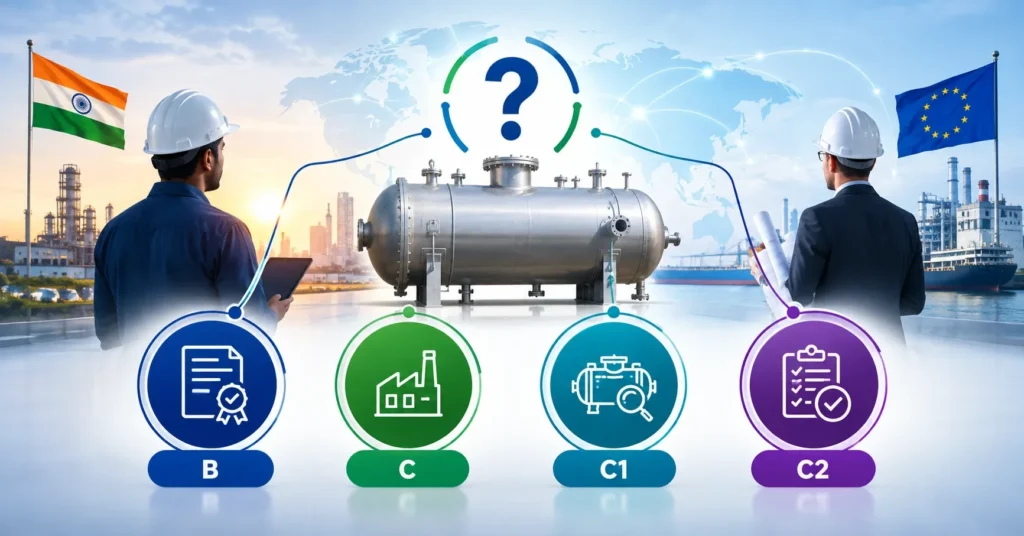
A manufacturer may design a pressure vessel correctly use the material, finish welding pass a pressure test and still encounter a problem when trying to enter the European market.
Why?
Because technical quality alone does not prove that the pressure vessel meets the Simple Pressure Vessels Directive (SPVD) 2014/29/EU.
Manufacturers often face questions such as:
- Does my vessel actually fall under SPVD?
- Is SPVD certification required?
- What is the difference between Module B, C, C1 and C2?
- How is PS × V calculated?
- When is a Notified Body involved?
- Does an air receiver fall under SPVD?
- What documents are required?
- When can the CE marking be applied?
The solution is to decide the route, before production instead of trying to finish compliance after the product is made.
What Is SPVD 2014/29/EU?
The Simple Pressure Vessels Directive 2014/29/EU sets rules for the design, manufacture and conformity assessment of simple pressure vessels sold in the EU market. The Directive covers series‑manufactured welded vessels that are intended for air or nitrogen and that meet its scope conditions.
For manufacturers the first question should therefore be:
“Does this vessel fall, within SPVD 2014/29/EU?”
Only after you have established that the vessel falls within SPVD 2014/29/EU should you choose the conformity assessment route.
Why Do Manufacturers Struggle With Module Selection?
Common problems include:
| Problem | What can go wrong? |
|---|---|
| Wrong Directive | SPVD and PED requirements may be confused |
| Wrong module | Incorrect conformity assessment route |
| PS × V not calculated | Wrong assessment category |
| Late documentation | Missing technical evidence |
| Welding records incomplete | Difficulty demonstrating production conformity |
| Material traceability gaps | Manufacturing evidence becomes incomplete |
| Testing records missing | Assessment delays |
| CE marking considered too early | Compliance process is incomplete |
The practical solution is to build compliance into the product-development and manufacturing sequence.
First Check: Does the Vessel Fall Under SPVD?
Before discussing Module B, Module C, Module C1 or Module C2, check the basic product characteristics.
| Problem | What can go wrong? |
|---|---|
| Wrong Directive | SPVD and PED requirements may be confused |
| Wrong module | Incorrect conformity assessment route |
| PS × V not calculated | Wrong assessment category |
| Late documentation | Missing technical evidence |
| Welding records incomplete | Difficulty demonstrating production conformity |
| Material traceability gaps | Manufacturing evidence becomes incomplete |
| Testing records missing | Assessment delays |
| CE marking considered too early | Compliance process is incomplete |
The practical solution is to build compliance into the product-development and manufacturing sequence.
Calculate PS × V
For ships that are covered by Article 13 PS multiplied by V is a decision point. PS means the maximum working pressure in bar, V means the container capacity in litres
Example
If:
PS = 10 bar
V = 30 litres
Then:
PS multiplied by V = 10 multiplied by 30 = 300 bar·L
The container therefore is in the range of than 200 to less than or equal, to 3,000 bar·L.
The routes that apply under Article 13 are:
| PS × V | Conformity-to-type route |
|---|---|
| > 3,000 bar·L | C1 |
| > 200 to ≤ 3,000 bar·L | C1 or C2 |
| > 50 to ≤ 200 bar·L | C1 or C |
These routes follow Module B EU-type examination before the vessel is made, for vessels that’re above 50 bar·L then the correct way to check if the vessel meets the rules is done before it is sold.
Module B means EU-Type Examination
For vessels where PS multiplied by V is than 50 bar·L Article 13 says EU-type examination has to happen before the vessel is built. Module B checks if the vessels design meets the rules that are in place for pressure equipment.
Depending on the situation Module B can include:
- documents
- Design details
- Design calculations
- Applicable rules
- Evidence to support the design
- Testing of a sample if needed
- Materials used
- Welding details
- Test results
The Directive has Module B – design type and Module B – production type options based on how the vessel is made and if the standard rules are used.
Easy to understand
Module B = “Does the design of the vessel follow the rules?”
What Are Modules C, C1 and C2?
Once the correct type is known the manufacturer goes to the way to check if the vessel meets the rules.
Module C
Module C means checking against the type using the manufacturers control during production.
The manufacturer makes sure that all the vessels made are the same as the type in the EU-type examination certificate.
Module C1
Module C1 means using the manufacturers control plus tests on the vessels that are done while someone is watching.
It adds tests on the vessels to the process of controlling the production.
Module C2
Module C2 means using the manufacturers control plus checks, on the vessels that happen at random times.
This adds checks that are done at times as set out in the checking process.
Module Comparison
| Module | Main Purpose |
|---|---|
| B | EU-type examination |
| C | Conformity to type + internal production control |
| C1 | Conformity to type + supervised vessel testing |
| C2 | Conformity to type + random supervised vessel checks |
SPVD Conformity Assessment Process
SPVD Standards & Module Selection Flow
Identify the vessel
↓
Confirm SPVD applicability
↓
Identify PS and V
↓
Calculate PS × V
↓
Is PS × V > 50 bar·L?
↓
EU-Type Examination. Module B
↓
Determine conformity-to-type route
↓
>3,000 bar·L → C1
>200–3,000 bar·L → C1 or C2
>50–200 bar·L → C1 or C
↓
Manufacturing controls + testing
↓
Technical documentation
↓
EU Declaration of Conformity
↓
CE Marking
↓
EU Market Placement
SPVD sequence follows the structure of Article 13 and the conformity assessment procedures, in Annex II.
What Technical Evidence Should Manufacturers Prepare?
SPVD Standard goes beyond getting a final test certificate. Manufacturers must keep technical and production records during the entire manufacturing process. This includes things like vessel drawings and design calculations, material identification and traceability records welding procedures and their qualification records, welder or operator qualifications, manufacturing and inspection records pressure-testing reports, technical documentation, conformity assessment records the EU Declaration of Conformity and CE marking information. The Directive also sets out rules, about welding processes, qualified welders or operators and proof of weld-quality testing. For manufacturers who want to improve their welding-quality processes EN ISO 3834 Certification is a standard that fits well with their SPVD aasessment.
Welding documentation is particularly important for welded pressure vessels. Manufacturers should maintain records for welding procedures, qualification of welding processes and qualified welding personnel as required for the applicable production and conformity assessment route. Where welding procedures require qualification manufacturers can refer to WPS & WPQR Qualification to establish the required welding procedure qualification in accordance with standards such, as EN ISO 15614.
SPVD Certification for Indian and Global Manufacturers
For manufacturers in India and other countries SPVD compliance must be checked before finishing production. Even if a manufacturer builds a good vessel selling it in the EU also requires meeting the rules of Directive 2014/29/EU and finishing the proper conformity assessment. This Directive covers pressure vessels that go to the EU market no matter if the maker is, in India, Europe, Asia, the Middle East or anywhere else. This includes things like vessel drawings and design calculations, material identification and traceability records welding procedures and their qualification records, welder or operator qualifications, manufacturing and inspection records pressure-testing reports, technical documentation, conformity assessment records the EU Declaration of Conformity and CE marking information. The Directive also sets out rules, about welding processes, qualified welders or operators and proof of weld-quality testing. For manufacturers who want to improve their welding-quality processes EN ISO 3834 Certification is a standard that fits well with their SPVD compliance efforts.
| Stage | Manufacturer's Key Question | Evidence / Output |
|---|---|---|
| 1. Product Scope | Does the vessel fall under SPVD? | Product and scope assessment |
| 2. Design | Does the design meet applicable requirements? | Drawings and calculations |
| 3. PS × V | What is the applicable pressure-volume range? | PS × V calculation |
| 4. Standards | Which applicable EN standard should be used? | Applicable standard reference |
| 5. Conformity Route | Which procedure applies? | Module B + C/C1/C2, where applicable |
| 6. Manufacturing | Is production controlled and traceable? | Manufacturing records |
| 7. Welding & Testing | Are welding and testing requirements documented? | WPS/WPQR, qualification and test records |
| 8. Technical File | Is the required evidence complete? | Technical documentation |
| 9. Declaration | Has conformity been formally declared? | EU Declaration of Conformity |
| 10. Market Placement | Is the product ready for the EU market? | CE marking and applicable documentation |
India and International Manufacturers: What Changes?
The rules for safety do not change just because a product is made in a country. What matters most is whether the product falls under the SPVD rules and whether it will be sold in the EU market.
For an Indian manufacturer for example:
India Manufacturing Facility
→SPVD Applicability
→ Technical & Design Requirements
→ PS × V Assessment
→ Applicable Conformity Assessment
→ Production & Testing
→ Documentation
→ CE Marking
→ EU Market
For a manufacturer in any other country the same basic rules apply if the vessel is meant for sale, in the EU market. Paragraph 13 states which conformity assessment steps must be followed based on the vessels PS × V value.
What is the correct directive to follow: SPVD or PED?
A frequent challenge for companies that operate internationally is figuring out whether a pressure vessel is covered by SPVD 2014/29/EU or PED 2014/68/EU. These are two EU directives that have separate ranges and requirements for checking if they meet the rules to get better quality refer our article on PED vs SPVD: Understanding the Difference Between Pressure Equipment Directive and Simple Pressure Vessels Directive . SPVD is for pressure vessels that meet certain criteria. PED is, for pressure equipment that falls within its range. As a result companies need to decide which directive applies based on the features of the product before choosing a way to check if it meets the rules.For manufactures to get clarity on this refer our PED Certification scope.
Frequently Asked Questions
What is SPVD 2014/29/EU?
SPVD 2014/29/EU is the EU Simple Pressure Vessels Directive that covers the design, manufacture and conformity assessment of qualifying pressure vessels.
What are the SPVD certification requirements for pressure vessels?
They can include design requirements, materials, manufacturing controls, welding, inspection, testing, technical documentation, conformity assessment and CE-marking requirements.
What is the SPVD notified body role?
Depending on the conformity assessment procedure a Notified Body can perform the relevant EU-type examination or supervised conformity assessment activities. The Directives Annex II defines the responsibilities associated with the modules.
What is EN 286-1 in relation to SPVD?
EN 286-1 is a standard, for certain simple pressure vessels. Its applicability should be checked against the harmonised-standard framework and the actual vessel design and scope.
What documents are required for SPVD CE marking?
Depending on the procedure documentation can include technical design information, drawings, calculations, materials information, welding documentation, test reports, manufacturing records, conformity assessment evidence and the EU Declaration of Conformity.
Conclusion
Selecting the SPVD conformity assessment route should not begin with choosing Module C, C1 or C2.
It should begin with a sequence:
Confirm the product scope → calculate PS × V → complete Module B where required → determine C/C1/C2 → control manufacturing → complete testing and documentation → complete conformity assessment → prepare the EU Declaration of Conformity → apply CE marking.
For international manufacturers this chronological approach can make SPVD certification, technical documentation and EU market preparation much easier to manage.
Related Resources
- SPVD Certification 2026: Latest 2014/29/EU Update, EN 286-1, Documents & CE Marking for Indian Manufacturers
- SPVD Certification: Complete Guide to the Simple Pressure Vessels Directive (2014/29/EU)
- SPVD Scope: 10 Questions to Determine Whether Your Pressure Vessel Is Covered
- PED vs SPVD: Understanding the Difference Between Pressure Equipment Directive and Simple Pressure Vessels Directive
- WPS & WPQR Explained: Welding Procedure Qualification, Requirements, Standards and Industrial Applications
Choose the SPVD Conformity Assessment Route for Your Pressure Vessel
Thinking about putting a qualifying simple pressure vessel on the European market? First Welding Certification Pvt Ltd (PRVÁ ZVÁRAČSKÁ, a.s.) provides conformity assessment for the SPVD 2014/29/EU requirements, including the Module B, C, C1 and C2 procedures that are relevant. Manufacturers need to decide on the route based on the SPVD scope the products PS × V, the technical documentation the manufacturing controls and the testing requirements.
For SPVD certification in India and, in international manufacturing markets get in touch with First Welding Certification Pvt Ltd to talk about your vessel and the conformity assessment requirements that apply to you.