ISO 9712
ELIGIBILITY
INDIA
What Are the ISO 9712 Eligibility Requirements for Internationally Recognized NDT Personnel in Indian Manufacturing Companies?
By First Welding Certification Technical Editorial Team
08 Min Read
17 Sep 2026
Table Of Contents
ISO 9712 Eligibility Requirements
Training
Experience
Vision
Examination
Introduction
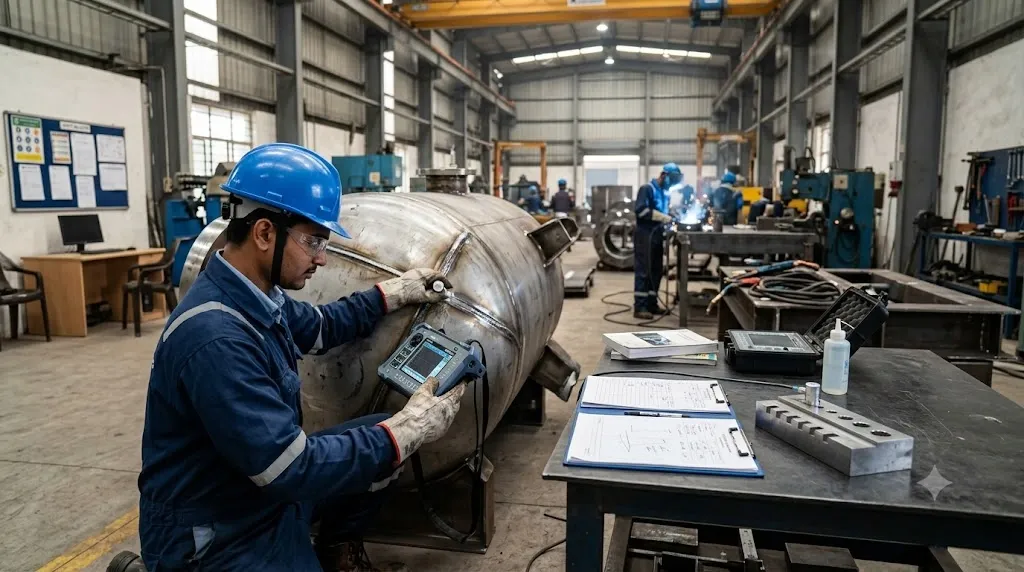
For manufacturing companies that work in engineering, fabrication, oil and gas railways, aerospace, automotive and pressure equipment, qualified non‑destructive testing or NDT personnel are essential. These experts help check the integrity of materials and components without causing damage. The standard ISO 9712 sets out the rules for how these NDT workers should be trained, tested and certified. The latest version of this standard is ISO 9712:2021.
Knowing what the ISO 9712 eligibility requirements are can help Indian manufacturers make sure their NDT staff have the training real‑world experience, test results and other qualifications needed to get certified.
What Is ISO 9712 Certification?
ISO 9712 defines the rules for qualifying and certifying people who do non‑destructive testing. This includes methods like testing (UT) radiographic testing (RT) magnetic particle testing (MT) penetrant testing (PT) eddy current testing (ET) leak detection, thermography and other approved methods under a certification plan.
For manufacturers having staff certified according to ISO 9712 helps create a system to show that NDT workers are competent and capable in inspection work.
ISO 9712 Eligibility Requirements
The eligibility pathway generally involves several important elements:
| Requirement | What It Covers |
| NDT Training | Training appropriate to the selected NDT method and certification level |
| Industrial Experience | Verifiable practical experience in the relevant NDT method |
| Vision | Required visual acuity appropriate to NDT activities |
| Examination | Written and practical examination requirements |
| Certification | Certification through the applicable certification scheme/body |
The exact requirements can vary according to the NDT method, certification level, applicable certification scheme, and certification body.
Requirements for NDT Personnel
NDT Training Requirements
Candidates must complete training that matches the NDT method they want to be certified in and the level they are aiming for. This training teaches both the theory and hands‑on skills needed before taking any exams.Industrial Experience Requirements
Practical experience in NDT is a part of qualification. How much experience is needed depends on the method and certification level.
Level 1 and Level 2 certifications usually require amounts of experience. Some certification schemes, such as those from BINDT’s PCN program say that candidates must have documented experience along with their training.Vision Requirements
Vision matters a lot for NDT workers because many inspections depend on spotting flaws by eye. Poor eyesight can affect the ability to see defects correctly.
The related ISO standard, ISO 18490:2026 outlines ways to test near vision, far vision and color vision for NDT personnel. Candidates must pass these checks to meet eligibility.Examination Requirements
After fulfilling all conditions candidates must take the required exams for their selected NDT method and certification level.
Depending on the certification scheme exams can include both written knowledge tests and practical skill assessments. Certification bodies set up the exam procedures within each scheme’s framework.
ISO 9712 Levels for NDT Personnel
LEVEL 1 → LEVEL 2 → LEVEL 3
LEVEL 1
Perform
Workers who can perform NDT tasks using instructions and within defined limits.
LEVEL 2
Evaluate
Workers with independence to conduct and evaluate NDT tests within their scope
LEVEL 3
Lead
Experts who lead NDT operations develop testing procedures. Give guidance.
Why ISO 9712 Matters for Indian Manufacturers
Companies working with customers outside India often need proof that their NDT staff’re qualified. This proof can be required during project bids, quality audits, contracts or regulatory inspections.
Having certified NDT personnel aligned with ISO 9712 can be especially helpful for businesses involved in:
– Structural steel fabrication
– Railways and rolling stock
– Pressure equipment
– Oil and gas
– Power generation
– Aerospace
– Automotive manufacturing
– Engineering
However not all certificates are accepted everywhere. Acceptance depends on the customer, the project rules, local regulations and which certification scheme is used. So companies should always confirm what certification is needed before assigning any inspection jobs.
Iso 9712 Eligibility Checklist
| Eligibility Check | What to Verify | |
|---|---|---|
| ☑ Selected NDT Method | Identify the required method such as UT, RT, MT, PT, ET, or another applicable method | |
| ☑ Certification Level | Confirm whether Level 1, Level 2, or Level 3 certification is required | |
| ☑ Training Completed | Verify that the candidate has completed the required training for the selected method and level | |
| ☑ Industrial Experience | Confirm relevant and documented practical NDT experience | |
| ☑ Vision Requirements | Verify that applicable near, far, and colour vision requirements are met | |
| ☑ Training Records | Keep certificates, attendance records, and training-hour evidence available | |
| ☑ Experience Records | Maintain documented evidence of relevant industrial experience | |
| ☑ Examination Eligibility | Confirm that the candidate meets the applicable conditions before examination | |
| ☑ Examination Completed | Complete the required theoretical and practical examinations | |
| ☑ Certification Scheme | Verify requirements established by the applicable certification body or scheme | |
| ☑ Certificate Scope | Check the NDT method, level, sector, and applicable techniques covered by the certificate | |
| ☑ Certificate Validity | Verify certification status and validity before assigning inspection responsibilities |
Frequently Asked Questions
What are the main ISO 9712 eligibility requirements?
The main areas are NDT training, industrial experience meeting vision standards. Passing the required exams under the certification scheme.
Is ISO 9712 certification applicable to Indian NDT personnel?
Yes. ISO 9712 is a standard that applies to anyone doing NDT, including workers in India
What NDT methods are covered by ISO 9712?
ISO 9712:2021 covers testing, radiographic testing, magnetic particle testing, penetrant testing, eddy current testing, leak testing, thermographic testing, acoustic emission and other approved methods under a recognized certification system.
Does NDT experience matter for ISO 9712 certification?
Yes. World industrial experience is a part of eligibility. The amount needed depends on the method and the certification level.
Are ISO 9712 Level 1 Level 2 and Level 3 requirements the same?
No. Each level has expectations around training, experience, responsibilities and exams. The requirements change based on the level and the certification scheme.
Conclusion
Understanding the ISO 9712 eligibility requirements helps Indian manufacturing companies find NDT personnel for inspection and quality control. All steps. From training to certification. Play a role in building a workforce.
For companies that work with clients choosing staff whose certifications match the project needs makes it easier to prove competence and meet compliance standards.
Related Searches
Kick Start Your Certification Journey
First Welding Certification Pvt Ltd (PRVÁ ZVÁRAČSKÁ, a.s.) guides certification processes for welding and NDT skills. Reach out to the team to learn more about ISO 9712 certification requirements for NDT personnel, in India.