
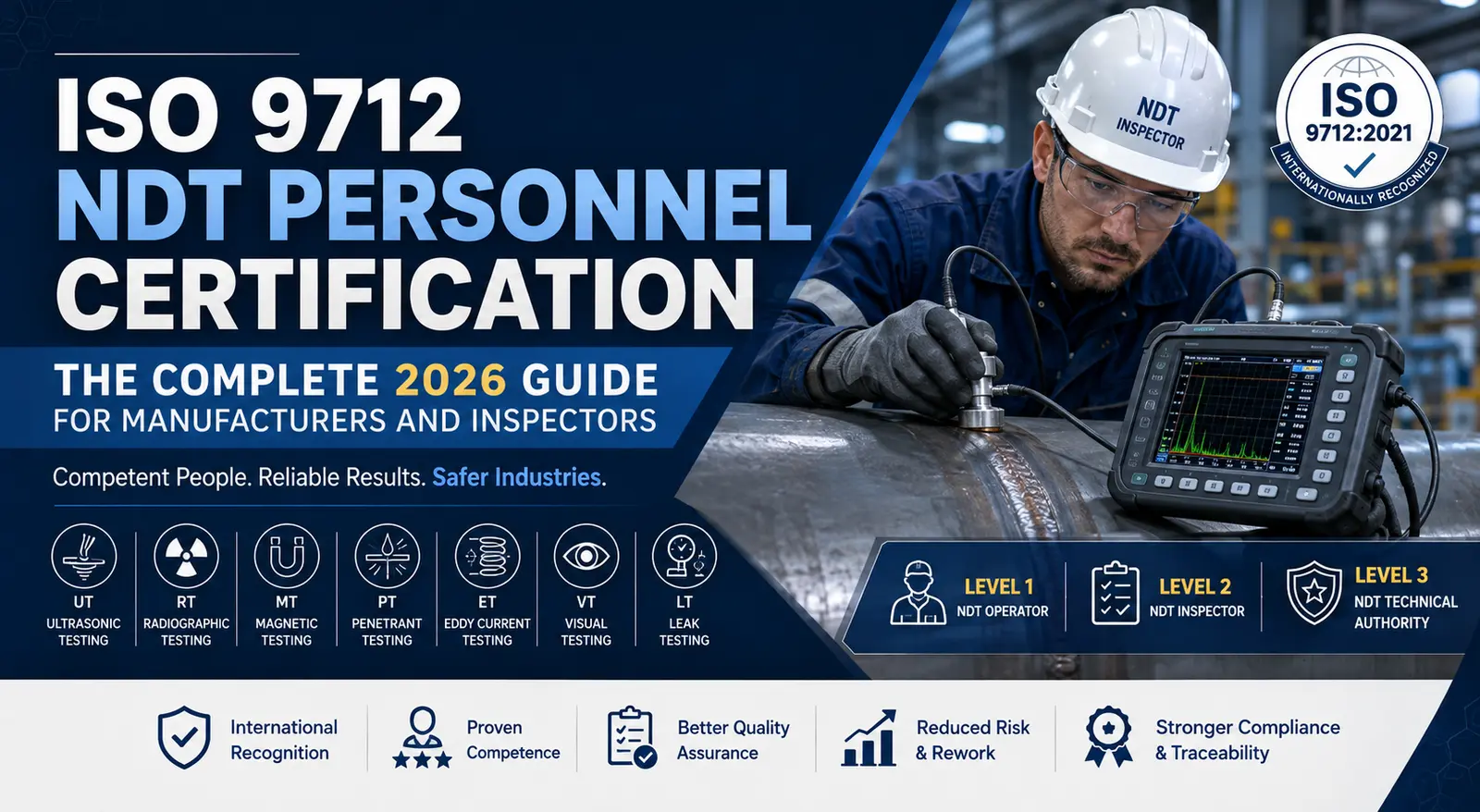
ISO 9712
NDT PERSONNEL
GUIDE
02 Sep 2026
ISO 9712 NDT Personnel Certification: The Complete 2026 Guide for Manufacturers and Inspectors
By Editorial Team
Table Of Contents
- What Is ISO 9712?
- Why ISO 9712 Certification Matters in 2026
- ISO 9712 Certification Levels Explained
- How Does ISO 9712 Certification Work?
- Employer Responsibility: The Part Manufacturers Often Miss
- ISO 9712 vs. Training Certificate: What's the Difference?
- What Manufacturers Should Verify
- Why Certification Body Recognition Matters
- What's New and Relevant in 2026?
- ISO 9712 Certification Checklist for Manufacturers
- The Bottom Line
Related Blogs
SEP
05
Do You Need a Level 3 NDT Inspector or Can a Level 2 Handle Your Quality System?
SEP
05
Cost vs Capability: Do Smaller Manufacturers Really Need a Full-Time NDT Level 3?
SEP
04
How to Verify an NDT Certificate Is Genuine: A Quality Manager’s Due-Diligence Checklist
SEP
03
How to Renew or Recertify Your ISO 9712 Certificate Before It Expires (Continuity, Maintenance & Revalidations Rules)
SEP
02
ISO 9712 vs ASNT SNT-TC-1A: Which NDT Certification Should Indian Technicians Choose?
See Also.....
In non-destructive testing, the equipment can find a problem, but it takes skilled workers to properly understand what they see.
This is why the ISO 9712 certification for NDT personnel is still a key standard for manufacturers, inspection firms, fabricators, and quality teams in industries where safety is the top priority.
As global supply chains require better tracking, trained inspectors, and internationally accepted skills, knowing ISO 9712:2021 is more important than ever in 2026.
What Is ISO 9712?
ISO 9712:2021 is a standard that talks about the qualifications and certifications needed for people who do non-destructive testing in industry.This is the latest version, and the older version, ISO 9712:2012, is no longer used.
This standard covers the requirements for people who use different testing methods like:
– Ultrasonic Testing (UT)
– Radiographic Testing (RT)
– Magnetic Testing (MT)
– Penetrant Testing (PT)
– Eddy Current Testing (ET)
– Visual Testing (VT)
– Leak Testing (LT)
– Thermographic Testing (TT)
– Acoustic Emission Testing (AT)
– Strain Gauge Testing (ST)
ISO also says that this certification system can be used for other NDT methods if there is a proper certification system in place.
Why ISO 9712 Certification Matters in 2026
Modern manufacturing relies more and more on skilled NDT workers, not just NDT tools.
If an inspection is done or understood wrong, it can cause problems like:
– Accepting parts that are broken
– Rejecting parts that are actually good
– Delaying production
– Extra costs for fixing and checking again
– Issues with customers
– Safety dangers
– Problems with contracts and rules
For companies that make parts for railways, planes, cars, pressure systems, energy, oil and gas, and heavy machinery, showing that their NDT staff are properly trained is very important when they are trying to become approved suppliers.
ICNDT says that having well-trained NDT workers is key to making sure inspections are reliable and that the products and how they are put together are safe and of good quality.
ISO 9712 Certification Levels Explained
ISO 9712 sets up three levels of skill in Non-Destructive Testing (NDT).
Level 1 – NDT Operator
People at Level 1 are trained to carry out NDT tasks based on written guidelines.
Their main jobs include:
– Preparing the equipment
– Doing the inspections
– Following approved steps
– Writing down the findings
– Recognizing signs as instructed
Level 1 is mostly about carrying out tasks as directed.
Level 2 – NDT Inspector
Those at Level 2 have more technical skills and responsibilities.
They can:
– Choose the right NDT methods within their allowed area
– Set up and check the equipment
– Carry out and watch over tests
– Understand and explain what they see
– Judge the results against set standards
– Create or approve NDT instructions when allowed
– Share the test results
In most manufacturing settings, Level 2 is the main certification needed for daily work.
Level 3 – NDT Technical Authority
Level 3 is the top level of expertise in NDT.
People at Level 3 are usually responsible for:
– Picking the best NDT methods and ways to use them
– Making and testing procedures
– Understanding and applying industry standards and rules
– Setting the standards for acceptance when allowed
– Managing NDT work
– Teaching and helping lower-level workers
– Giving support for difficult testing situations
Important note: The level of certification isn’t just about being more experienced.
It shows what skills and duties someone has in NDT work.
How Does ISO 9712 Certification Work?
A normal way to get certified has several steps:
Training → Work Experience → Test → Getting Certified → Keeping the Certification Up to Date
– Training
People get organized training in the NDT method they choose. The training plans are based on ISO/TS 25107.
Right now, ISO is working on a new standard called ISO/CD 25108 that will cover NDT training programs.
– Work Experience
Candidates need to gain the right kind of hands-on experience connected to their chosen method and the level of certification they want. Having enough experience is important because just passing a test doesn’t show that someone can really work well in a real job.
Test
The process of getting certified checks if someone is truly skilled through tests that match the certification program. Depending on the method and level, the test might include:
– General test
– Specialized test
– Hands-on test
– Getting Certified
Certification comes from a certification program that is run by a trusted organization.
This is a key point: Training is not the same as Certification
A training certificate shows someone finished a training course. An ISO 9712 certification shows that the person has met the standards of a third-party certification program.
Employer Responsibility: The Part Manufacturers Often Miss
One of the key things for manufacturers to remember is that having an ISO 9712 certificate doesn’t mean a person can do every non-destructive testing job in every work environment.
The employer still has important responsibilities, including:
– Making sure the person is allowed to do the specific job
– Checking if they have the right work experience in that industry
– Ensuring they meet the vision standards needed for the job
– Confirming they know how to use the right equipment and follow the correct steps
– Making sure they understand the rules and standards that apply to the job
– Verifying they have the skills needed for the particular task
– Keeping records of all personnel certifications
ICNDT gives clear advice on how employers should use these certifications properly.
In simple terms:
A certificate shows someone is qualified. But it’s up to the employer to decide if and how that qualification is used for a specific job.
ISO 9712 vs. Training Certificate: What's the Difference?
This difference is important for the people who buy goods and check quality.
| Training Certificate | ISO 9712 Certification |
|---|---|
| Demonstrates training completion | Demonstrates certified competence |
| Usually issued by training organization | Issued under a personnel certification scheme |
| Does not necessarily establish third-party certification | Third-party certification framework |
| May be course-specific | Method and level specific |
| Not equivalent to personnel certification | Internationally recognized framework |
What Manufacturers Should Verify
Before accepting an NDT certificate, manufacturers need to check more than just the certificate number.Here’s what to look for:
Check:
Certification Standard
Is the certificate based on the correct version of ISO 9712?
Certification Body
Who gave the certificate?
NDT Method
Does the certificate include the necessary method, like UT, RT, MT, PT, ET, or VT?
Certification Level
Is the level—Level 1, Level 2, or Level 3—right for the job?
Sector and Scope
Does the certificate apply to the right industry and type of work?
Validity
Is the certificate still active and properly kept up to date?
Vision Requirements
Have the required vision tests been done and recorded?
Employer Authorization
Has the company approved the person to do this specific work?
Why Certification Body Recognition Matters
Not all certificates that have the words “ISO 9712” on them are the same or can be treated as equal.
The trust people place in a certification system is based on how skilled and fair the certification body is, along with the rules and checks in place for exams and certification.
ICNDT has a Multilateral Recognition Agreement (MRA) that allows certified personnel from approved bodies to have their certificates accepted by other countries that are part of the agreement, as long as they follow the rules set out in the agreement.
For companies that work around the world, this is especially important when customers or government officials ask for certification from a trusted third party.
What's New and Relevant in 2026?
ISO 9712:2021 is still the main international standard for NDT, but the certification system is changing and growing.
The ISO NDT staff group is making new standards, like ISO 18490:2026, which looks at how well NDT workers can see, and a new draft called ISO 25108 for training centers that prepare NDT staff.
At the 2026 ICNDT certification event, they talked about new areas such as:
– Digital transformation
– NDE 4.0
– Future ways to certify people
– Quality and safety
– New NDT tech
– Making certification practices more consistent worldwide
This shows a bigger change in the industry:
NDT certification is shifting from just paper work to proving real skills, making sure they can be traced, and keeping up with new tech.
ISO 9712 Certification Checklist for Manufacturers
Before you start any non-destructive testing work, make sure the following are checked:
✓ The person has a valid ISO 9712 certification
✓ The correct NDT method is being used
✓ The certification level matches the task
✓ The person is qualified for the specific industry or type of work
✓ They have enough experience in that industry
✓ Their vision has been checked and is up to standard
✓ Their certification comes from a recognized body or scheme
✓ They have permission from their employer to do the work
✓ The right procedures and acceptance standards are followed
✓ All inspection records can be traced back properly
This simple list helps avoid a big problem: having someone on paper who is certified, but not actually qualified to do the job correctly.
The Bottom Line
ISO 9712 certification is more than just a badge for inspectors—it plays a key role in ensuring quality in non-destructive testing.
For inspectors, it offers a clear way to show they are skilled and qualified.
For manufacturers, it gives a reliable way to assess the people who check for important flaws in their products.