WELD TRACEABILITY
DIGITAL RECORDS
QUALITY COMPLIANCE
Digital Welding Traceability: How to Track Every Weld from Material Receipt to Final Inspection
By First Welding Certification Technical Editorial Team
6 Min Read
26 Aug 2026
Table Of Contents
Key Takeaways
Connect Every Weld
Trace Key Records
Verify Inspection
Strengthen Compliance
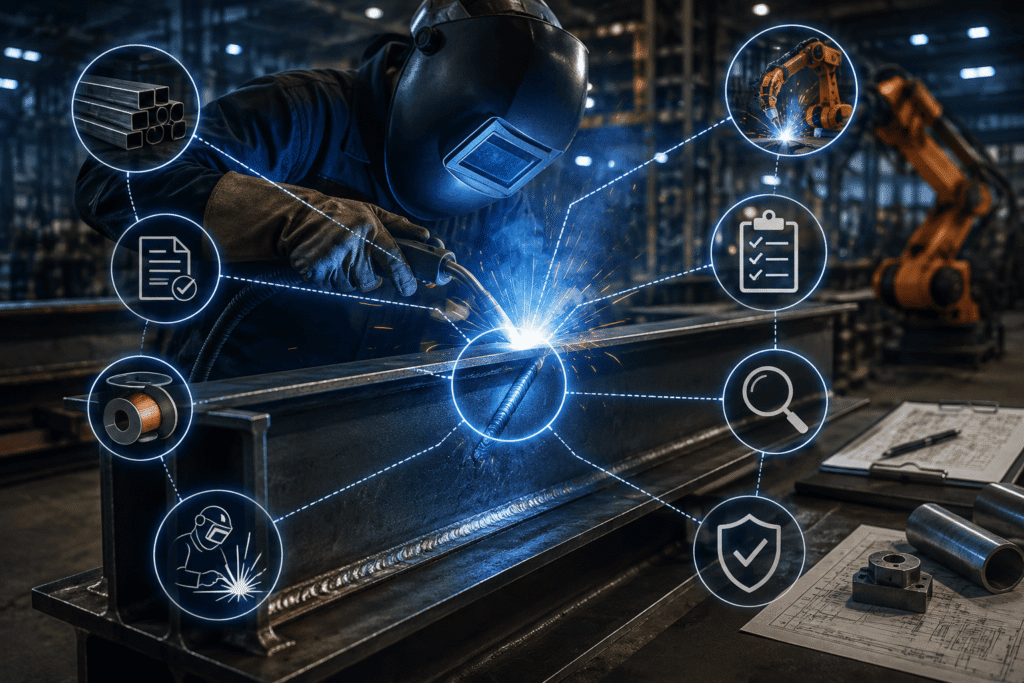
A customer points to one weld on a finished component and asks : “Show me everything behind this weld on the finished product.” Does your quality department have the answer in five minutes?
If your answer depends on looking up information from material certificates, WPS, welder certificates, spreadsheets, and other documents, then while you may have some digital information, you lack digital welding traceability.
Manufacturing in today’s world is moving towards connected quality records where one weld can be traced back to its material, welding procedure, personnel, consumables, inspection and acceptance.
It is simple:
Start with one weld. Find out its whole history.
What Is Digital Welding Traceability?
Digital weld traceability refers to the ability of linking an individual weld to the information about its manufacturing and quality.
The usual structure of the traceability chain is:
Material → Component → Weld Number → WPS → Welder/Welder Operator → Consumables → Inspection → NDT → Repair → Release
The crucial word is link.
A WPS in the form of a PDF file is just a piece of electronic documentation.
However, if you can link together the information such as:
Weld W-027 → WPS-014 Rev.03 → Welder W-108 → NDT Report 0264
you have got a digital traceability linkage.
How Does Weld Traceability Work?
Imagine a finished assembly contains Weld W-027.
A quality engineer should be able to follow that weld backwards through production.
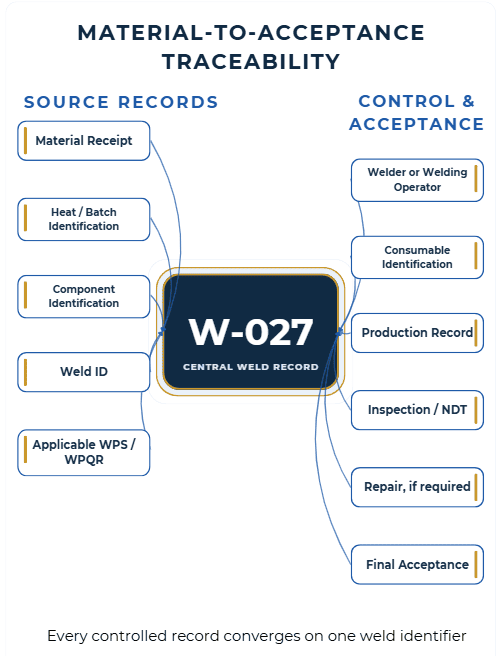
Material traceability is the starting point of this chain. EN 1090 Material Traceability & Inspection guide explains how heat numbers, material certificates and identification need to remain connected through cutting and fabrication,
What Should a Digital Weld Record Contain?
A practical digital weld record does not need to collect every possible piece of information. It needs to capture the information that allows the manufacturer to demonstrate control and investigate problems.
| Area | Typical information |
|---|---|
| Material | Grade, heat/batch number, certificate |
| Welding procedure | WPS, revision, WPQR |
| Personnel | Welder/operator and qualification |
| Production | Process, equipment, relevant parameters |
| Inspection | Visual inspection, NDT and results |
| Final status | Repairs, NCRs, acceptance and release |
This relation is very significant indeed. The WPS outlines the process of performing the actual welding task, whereas the WPQR is proof of qualification of the appropriate procedure.
Yet another critical element in the chain is the personnel record. This system should determine who was involved in the welding activity or controlled it and whether the appropriate qualification covered this particular job. Manual or semi-automatic welding could be covered by ISO 9606-1, and mechanised or automatic welding might require ISO 14732.
Why Traceability Matters for Welding Compliance
Traceability assumes particular significance when it acts as an integral component of the larger welding quality management process.
In case your company works within EN ISO 3834 framework, welding quality documentation will cover procedure qualifications, welder qualifications, material documentation, testing and inspection documentation, equipment-related documentation and non-conformance documentation. Hence your EN ISO 3834 Certification will be the most pertinent certification pathway in this scenario.
Structural steel and aluminium manufacturers will find that traceability is an integral aspect of their EN 1090 Factory Production Control certification scheme where production process, welding, material identification, testing and technical documentation processes are required to integrate. Hence EN 1090 Certification will be the most relevant certification pathway for this manufacturing industry.
The practical aspect
Instead of asking:
“Do we have all the documents?”
ask:
“Can we trace all the documents back to one completed weld?”
This is a much more stringent test of traceability.
What Happens When One Weld Fails?
In case Weld W-027 is found defective at final inspection stage,
With disconnected information, the quality team would need to look for:
- Certificate of material
- Heat no.
- WPS
- Qualification of welder
- Consumable information
- Inspection information
- NDT information
- Repair information
With traceability system, the investigation starts with Weld W-027.
The team would be able to know:
1.Which material was used?
2.Which revision of the WPS was used?
3.Which person made the weld?
4.Which batch of the consumable was used?
5.What kind of inspection was done?
6.Was the weld repaired?
And, most importantly:
7.Did any other weld use the same material or procedure or consumable?
Common Digital Welding Traceability Gaps
Watch out for these symptoms:
- Heat numbers are gone after welding.
- Completed welds lack any kind of identifier.
- Modified WPS cannot be traced back to production history.
- Qualifications of welder/operators exist in separate systems than production information.
- Inspection/NDT reports cannot be traced to individual welds.
You can test your system with the following test:
Pick up a completed weld at random. Is it possible to trace its entire history without using several systems?
If not, you found the first thing to improve.
Frequently Asked Questions
What is digital weld traceability?
It is the capacity to link a weld with its material, welding procedure, people, materials, production data, inspection reports, and finally acceptance documents.
What is the distinction between material traceability and weld traceability?
Material traceability tracks material throughout the manufacturing process. Weld traceability further links this information to the actual welding process and associated documentation.
Is there any special software needed for digital weld traceability?
No. The manufacturer starts with creating digital data and proper identification. In the future, the manufacturer can integrate the welding data with the production or quality management systems or even ERP or MES systems.
How does traceability make audits easier?
With traceability, the manufacturer can access information more easily and provide information on how a certain weld has been made and accepted.
Is it possible to do traceability for robotic welding?
Yes. In robotic welding, the environment can link production and process information with certain parts or welds. The necessary controls depend on certain procedures and qualification.
Conclusion
The proof of digital welding traceability process is rather obvious.
Show one weld. And tell the whole story of it.
- Where does it come from?
- What heat number was used?
- What WPS was used in the process?
- Who was the person making the weld?
- What was the material being used?
- What kind of inspection was done?
- Was there any repair?
- And who released it?
Once you have the answers to all those questions, you will see that you are beyond having just digital data but a digital thread of welding quality.
For those manufacturers who are ready to get certified, improve welding quality management system or enhance production control, this process makes it much easier.
Take the Next Step in Welding Certification
First Welding Certification Pvt Ltd (PRVÁ ZVÁRAČSKÁ, a. s.) provides certification for manufacturers working to applicable international and European requirements.