
EN 1090
ALUMINIUM FABRICATORS
GUIDE
EN 1090 Material Traceability & Inspection: Complete Guide for Steel and Aluminium Fabricators
By Technical Editorial Team
10 Min Read
12 Aug 2026
Table Of Contents
- Introduction
- What Is Material Traceability Under EN 1090?
- Why Is Material Traceability Important?
- EN 1090 Material Traceability Requirements
- Steel Material Traceability Under EN 1090-2
- Aluminium Material Traceability Under EN 1090-3
- Material Certificates and EN 1090
- What Should Be Checked During Incoming Material Inspection?
- Material Certificate vs Material Identification
- How Should Material Identification Be Maintained?
- Traceability During Cutting
- What Happens If Material Identification Is Lost?
- EN 1090 Material Inspection Process
- Material Storage and Segregation
- EN 1090 Inspection and Test Plan
- EN 1090 Component Specification and Inspection
- How Execution Class Affects Traceability
- Material Traceability for Welding Consumables
- Inspection of Bolting Materials
- Inspection of Finished Components
- EN 1090 Material Traceability Audit: What Will an Auditor Look For?
- Common Material Traceability Non-Conformities
- EN 1090 Material Traceability Checklist
- Practical Example of an EN 1090 Traceability System
- How to Improve Material Traceability Using Digital Systems
- Material Traceability vs Material Inspection
- FAQ
- Conclusion
Key Takeaways
Documentations
Process Flow
Tips
Checklist
Introduction
Material traceability and inspection are key parts of following EN 1090 rules. A manufacturer needs to show that the materials used in making structural parts meet the required standards and can be followed through the whole production process.
According to EN 1090-1 Clause 6.3.5, manufacturers must have a written plan for checking and noting that materials meet the needed standards, and for tracking how they are used when making components.
EN 1090-1 also says that the specific traceability rules come from EN 1090-2 for steel and EN 1090-3 for aluminium. The level of detail in traceability depends on the execution class.
For companies working towards EN 1090 certification, just keeping material certificates in a file isn’t enough.
The manufacturer needs a managed system that links the material certificate, the material’s identification, the production process, inspection records, and the final product.
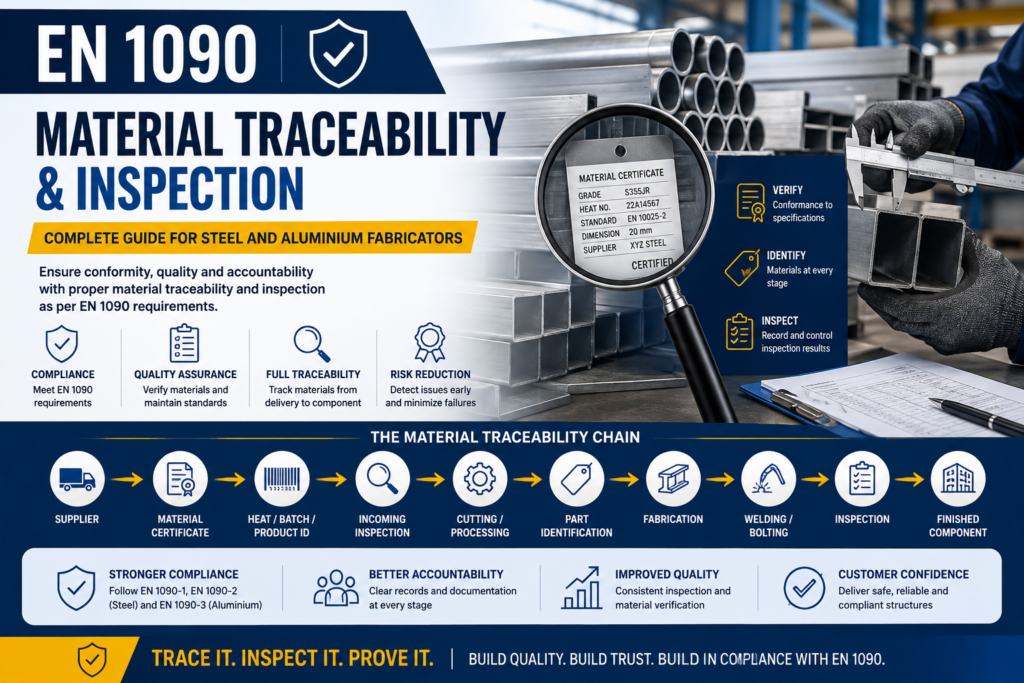
What Is Material Traceability Under EN 1090?
Material traceability means being able to show a clear, written link between a part of a product and the bigger structure it’s used in.
Here’s a simple example of how this traceability works:
Supplier
↓
Material Certificate
↓
Heat / Batch / Product Identification
↓
Incoming Inspection
↓
Cutting / Processing
↓
Part Identification
↓
Fabrication
↓
Welding / Bolting
↓
Inspection
↓
Finished Structural Component
The goal is to make sure the manufacturer can tell what material was used, where it was used, and whether it met the needed standards.
EN 1090-1 requires that there are written procedures for checking if materials meet the required standards and for tracking where each part came from.
Why Is Material Traceability Important?
Structural parts are made using certain materials that have specific qualities.
For example, a drawing might say things like:
– What type of steel to use
– Which aluminum alloy
– The temper of the material
– How thick it should be
– Which product standard to follow
– What mechanical properties it needs
If the maker uses the wrong material without checking, the finished part might not match the design anymore.
Traceability shows that the material used in making the part is the same as what was planned for it.
It also helps in situations like:
– If a problem with the material is found
– If a customer asks for proof
– If an inspector checks a finished part
– If there’s a problem with the supplier
– If there’s a problem that needs looking into
– If a part needs fixing or replacing
EN 1090 Material Traceability Requirements
EN 1090-1 puts the responsibility for the FPC on the manufacturer.
Clause 6.3.5 says the manufacturer must have a written plan for:
– Checking each part to make sure it meets its requirements
– Keeping records of the inspection
– Tracking the products through the manufacturing process
The standard also says that the traceability rules from EN 1090-2 and EN 1090-3 must be followed.
This is an important difference:
EN 1090-1 sets up the FPC requirement, while EN 1090-2 and EN 1090-3 give the specific rules for steel and aluminium respectively.
Steel Material Traceability Under EN 1090-2
For structural steelwork, EN 1090-2 sets out the technical rules for how the work should be done.
The manufacturer’s system for tracking where each part comes from should match the type of work being done and the needs of the project.
Some key details that need to stay clear and identifiable include:
– The type of steel used
– The shape or form of the product
– The heat number from the steelmaking process
– The batch or cast number
– The size and measurements
– The certificate of materials
– The supplier’s name
– The specific part or job it’s for
The manufacturer should have a good way of keeping these details clear throughout the whole process.
For example:
Steel plate arrives
→ Heat number is written down
→ Plate is marked with the number
→ It is cut into pieces
→ Each piece gets the same identification mark
→ Pieces are given to a specific job or part
→ The finished component keeps all the tracking information
The exact way this is done can be different for each manufacturer, as long as it ensures the right level of tracking is achieved.
Aluminium Material Traceability Under EN 1090-3
For aluminium structures, the technical standard to follow is EN 1090-3.
EN 1090-3:2019 applies to aluminium structural parts made from materials like:
– Rolled sheet
– Strip
– Plate
– Extrusions
– Cold-drawn rod, bar, and tube
– Forgings
– Castings
This standard also sets out the rules for execution classes and connects them to consequence classes.
Traceability becomes more important as the execution class gets higher.
For example, EN 1090-3 says that for EXC3 and EXC4, every part used must be traceable from when it is delivered until it is added to the structure.
For EXC2, EXC3, and EXC4, when different types of aluminium (like different alloys or temper levels) are used together, each piece must be marked clearly to show its alloy and temper.
This is especially important with aluminium because materials that look the same can have very different properties based on their alloy or temper.
Material Certificates and EN 1090
Material certificates are important because they show what materials were used in making a product.
Depending on the product and the rules that apply, the documents may include:
– How to identify the product
– What type of material it is
– Its size or measurements
– What chemicals are in it
– How strong or tough it is
– Information about the heat or batch it came from
– The standard used to make it
– What kind of inspection was done
– Details about the supplier or manufacturer
A manufacturer shouldn’t just keep certificates without looking at them to make sure they are correct.
What Should Be Checked During Incoming Material Inspection?
A practical incoming inspection can include checking:
1 Material identification
Is the material type listed on the document the same as what was ordered and what is needed for the part?
2 Dimensions
Are the measurements like thickness, width, length, diameter, or section size correct?
3 Quantity
Was the right amount of material delivered?
4 Material certificate
Is there a proper inspection report available?
5 Heat or batch number
Do the numbers on the material match the numbers on the certificate?
6 Physical condition
Does the material look damaged, rusty, or in any way not fit for use?
7 Alloy/temper
For aluminium, is the material the correct type of alloy and finish?
8 Product standard
Does the product meet the standard it was supposed to?
9 Identification
Can the material be clearly marked so it can be tracked during production?
The exact checks should be set out by the manufacturer’s FPC and the relevant EN 1090 or project rules.
The incoming inspection process should make sure the certificate matches the actual material received.
Material Certificate vs Material Identification
These are two separate things.
A material certificate gives information about the product that was sent.
Material identification helps link that certificate to the actual physical material.
For example:
Certificate
Heat No. H12345
Steel Grade: Specified Grade
Thickness: 12 mm
The actual plate should have an identification system that lets the manufacturer know where it came from, like Heat No. H12345.
If the certificate is kept but the real material can’t be matched to it, then the ability to track it back is lost.
How Should Material Identification Be Maintained?
There are several useful ways to identify items.
The method used depends on the material and how the item is made.
Some common methods include:
– Stamping
– Painting a mark
– Using tags
– Adding labels
– Applying barcodes
– Using QR codes
– Writing production numbers
– Heat-number transfer
– Digital tracking systems
It’s important to choose a method that works well for the product and doesn’t damage it or break any rules.
For example, a maker might use:
Material ID: ST-0245
connected to:
Heat No.: H12345
connected to:
Material Certificate: MTC-2026-015
connected to:
Production Order: PO-7845
connected to:
Component: C-104
This helps create a clear and traceable record, either digitally or through documents.
Traceability During Cutting
One of the most common issues that happen in real work is during the cutting process.
Think about a plate that comes in with a clear heat number written on it.
Then, this plate is cut into 30 separate parts.
If the heat number isn’t passed on to each of these cut pieces, the manufacturer might not know which certificate goes with which part.
So, the traceability process should clearly explain:
– How the identification is passed on
– Who is responsible for doing that
– When it happens
– How it is recorded
– How it is checked
This is especially important when different grades or heats are being worked on at the same time.
Traceability should not just stop at cutting.
The identification needs to stay attached to the part through all the important production steps.
For example:
Raw material
→ Cutting
→ Drilling
→ Forming
→ Assembly
→ Welding
→ Inspection
→ Painting
→ Final assembly
At each of these steps, the manufacturer should have a way to keep track of the identification.
The exact way to do this will depend on the class of work, the type of product, and the relevant EN 1090 standards.
What Happens If Material Identification Is Lost?
When identification is lost, it should be treated as a traceability issue, not just overlooked.
The manufacturer needs to have a process in place for handling such situations.
Possible steps could be:
– Stop any further processing of the material.
– Find out which materials were affected.
– Look through production records.
– Check any available documents.
– Try to figure out if the material can be clearly identified.
– Report a non-conformity if needed.
– Decide what to do with the material based on the rules that apply.
– Only re-identify the material if there is a good reason to do so.
Guessing the material grade or heat number is not a proper way to handle traceability.
EN 1090 Material Inspection Process
A practical material inspection system has several steps.
Step 1: Purchasing
The purchase order includes details like:
– Material type
– Standards it must meet
– Size and measurements
– How much is needed
– Required inspection documents
– Any other project-specific needs
Step 2: Receiving
The materials are delivered to the factory.
Step 3: Incoming Inspection
The factory checks the materials to make sure they match what was ordered and what the project needs.
Step 4: Certificate Check
They look at the certificate that comes with the materials to confirm everything is correct.
Step 5: Identification
The materials are labeled or marked with the necessary information.
Step 6: Storage
Materials are stored separately based on their type, alloy, temper, and batch to avoid mixing up different items.
Step 7: Manufacturing
During production, the identification of the material is kept track of and passed along.
Step 8: Final Check
The factory makes sure all the required information about the material’s origin and history is available.
Material Storage and Segregation
Materials can become hard to track if they are not properly labeled.
For example, a fabrication shop might have:
– Many types of steel
– Different thicknesses of steel
– Several heat numbers
– Various aluminium alloys
– Different temper states of aluminium
If these materials are placed together without clear labels, it’s easier to pick the wrong one by mistake.
A good way to store materials includes:
– Clearly labeled storage areas
– Tags with material information
– Marks showing the heat number
– Labels for alloy and temper
– Separate spaces for each type of material
– Digital records of inventory
The way materials are stored should match the traceability needs of the manufacturer.
EN 1090 Inspection and Test Plan
Material checks need to be linked to the manufacturer’s Inspection and Test Plan (ITP) or another written document that outlines how inspections are done.
An ITP can include:
| Stage | Inspection | Responsibility | Record |
|---|---|---|---|
| Material receipt | Grade and certificate | QC/Stores | Material Inspection Report |
| Identification | Heat/batch verification | Stores/QC | Traceability Record |
| Cutting | Identification transfer | Production | Cutting Record |
| Fabrication | Component verification | QC | Inspection Report |
| Welding | Weld inspection | QC/Welding Inspector | Weld Inspection Report |
| NDT | Required NDT | Qualified personnel | NDT Report |
| Final inspection | Component conformity | QC | Final Inspection Report |
The actual ITP should be adapted to the component and project requirements.
EN 1090 Component Specification and Inspection
EN 1090-1 says that when making a component, the manufacturer must use a specification that has enough details to make the part and check if it meets the required standards.
This specification needs to show which execution class applies.
The manufacturer also has to write a plan for checking and testing the component, and keep records of how it meets the standards.
This creates a clear connection:
Design details
↓
Component specification
↓
Material needs
↓
Making the component
↓
Checking and testing
↓
Proof that the component is correct
So, keeping track of materials isn’t just a job for the warehouse.
It’s part of the whole system that ensures the component is made correctly.
How Execution Class Affects Traceability
Execution class matters because the need for traceability can change depending on the situation.
The rules are not just:
“EN 1090 means every item must have its own traceability record.”
Instead, the level of traceability needed depends on the specific execution class and the relevant EN 1090 standard being used.
For example, with aluminium, EN 1090-3 shows this clearly: EXC3 and EXC4 require tracking of individual parts through each step of the building process, but other classes have different rules.
For steel, the manufacturer should check the relevant parts of EN 1090-2 based on the project’s execution class.
That’s why it’s important to decide on the execution class before setting up the traceability system.
Material Traceability for Welding Consumables
Material traceability applies to more than just structural steel and aluminium.
When needed, welding materials also need to be handled carefully.
A manufacturer might need to manage several things:
– The type of consumable used
– Batch or lot number
– How it is stored
– Drying or baking if necessary
– Who gets it issued to
– How it is returned
– Conditions for storage and use
– Linking it back to specific welding work if required
This can be part of the welding control process.
A good system can link:
– Consumable batch
– Welding procedure specification
– The welder
– The part being made
– The welding record
Inspection of Bolting Materials
For structural bolting, the manufacturer must also set up controls that are right for the specific bolting system used.
Depending on the project, this might involve:
– Identifying the bolts
– Knowing the grade or class of the bolts
– Keeping track of the lot or batch number
– Providing certificates
– Making sure the nuts and washers are suitable
– How the bolts are stored
– What is needed for installing the bolts
– Keeping records of inspections
These requirements should be based on EN 1090-2 and the project’s specific instructions.
Inspection of Finished Components
Material traceability is just one part of making sure the final product meets all requirements.
The completed part may also need to be checked for:
– Size measurements
– Shape
– Weld quality
– How bolts are installed
– Surface condition
– Coating applied
– Markings
– Identification details
– Required non-destructive testing
– Any other specific features needed for the project
The final check should be connected to the component’s specifications and the inspection plan that applies.
EN 1090 Material Traceability Audit: What Will an Auditor Look For?
During an EN 1090 audit, an auditor might pick a finished component and check the records in reverse order.
For example:
Finished Component C-104
↓
What material was used?
↓
Material ID ST-0245
↓
What is the batch number?
↓
Batch H12345
↓
Where is the certificate?
↓
Material Certificate MTC-2026-015
↓
Was the material inspected?
↓
Incoming Material Inspection Record
↓
Was it used as per the component specifications?
↓
Production/Traceability Records
This shows how well the FPC system is working in practice.
The auditor might also check if the written procedures match what is actually happening on the shop floor.
EN 1090 certification checks include looking at FPC and production control systems.
Certification bodies like RINA mention both the initial inspection and the ongoing checks of the production facility and FPC.
Common Material Traceability Non-Conformities
1- Missing material certificates
The manufacturer can’t give the certificate for the material used in a part.
Corrective action: Improve receiving checks and certificate verification.
2 Heat number does not match the certificate
The material’s physical ID and the certificate have different numbers.
Corrective action: Look into the difference and manage the affected material until it meets the standards.
3 Identification disappears after cutting
The original plate can be traced, but the cut pieces can’t.
Corrective action: Create a controlled process for moving identification from the original to the cut parts.
4 Different materials are mixed
Different types, alloys, or temper levels are kept together without clear labels.
Corrective action: Improve how materials are separated, labeled, and stored.
5 Traceability records are incomplete
The manufacturer has material certificates but can’t show which material went into which part.
Corrective action: Link material IDs with production orders and part records.
6 Uncontrolled substitutions
Production uses a different material than what was specified without proper approval.
Corrective action: Set up a process for material changes and handling non-conforming materials.
7 Damaged or unreadable markings
Material labels become hard to read during production.
Corrective action: Set clear rules for marking materials and check them at key points.
EN 1090 Material Traceability Checklist
Before an EN 1090 audit, make sure the following steps are done:
Purchasing
– The details of the materials needed are clear
– The purchase orders show what requirements need to be met
– The suppliers give all the documents that are needed
Receiving
– The materials that arrive are checked
– The certificates are looked at to make sure they are correct
– The type of material is checked
– The size is checked when needed
– The batch or heat numbers are written down
Identification
– The materials are marked in a clear way
– The markings match the documents
– Different types of materials are kept separate
– Special marks for aluminium alloys and their temper are kept under control when needed
Production
– The marks on the materials stay even after cutting
– The marks are moved when needed
– The parts can be tracked back to the materials used
– The production records link the materials to the parts made
Inspection
– The records from incoming inspections are kept
– The plans for inspection and testing are followed
– The final check is recorded properly
– The records for non-destructive testing are kept when needed
Non-Conformity
– Materials that are not identified are handled properly
– Materials that are wrong are not used in the wrong way
– Any differences in the materials are recorded
– The steps taken to fix problems are written down
Audit Preparation
– The certificates for materials can be found quickly
– The finished parts can be traced back to the materials used
– The procedures used match what happens in the factory
– The workers understand how to track materials and parts through the process
Practical Example of an EN 1090 Traceability System
Imagine a steel beam made for a construction project.
Step 1 – Purchase
The company buys the correct type and size of steel.
Step 2 – Receive
The steel arrives along with all the needed paperwork to prove it’s good.
Step 3 – Inspect
A quality control team checks several things:
– The type of steel used
– The size and shape of the beam
– The certificate of quality
– The heat number, which is like a serial number for the steel
Step 4 – Identify
Each beam gets a special ID number:
MAT-2026-0087
Step 5 – Production
The beam is linked to a specific project:
Project PZ-26015
Step 6 – Fabrication
Records of cutting and making the beam show:
MAT-2026-0087
Step 7 – Welding
The welding instructions and records mention the part being welded.
Step 8 – Inspection
The beam is checked for size and the welds to make sure they are strong.
Step 9 – Final Release
All the final papers connect the finished beam to its steel ID and inspection records.
This whole process creates a clear record that can be shown during an official check.
How to Improve Material Traceability Using Digital Systems
Manufacturers don’t always need advanced software.
A properly made spreadsheet can offer a lot of control.
For example:
| Material ID | Heat No. | Grade | Certificate | Project | Component |
|---|---|---|---|---|---|
| MAT-001 | H12345 | Specified Grade | MTC-001 | PZ-2601 | C-001 |
| MAT-002 | H12346 | Specified Grade | MTC-002 | PZ-2601 | C-002 |
Big companies can use:
– ERP systems
– Barcode systems
– QR codes
– Digital material records
– Production management software
– Document management systems
The technology isn’t the main thing.
What really matters is that the system works well to keep track of everything needed.
Material Traceability vs Material Inspection
These terms are connected but not exactly the same.
Material Inspection
Answers:
Does the material meet the required standards?
Material Traceability
Answers:
Can we show which material was used in this part?
Both are needed.
For example, a factory might have checked a steel plate properly at first, but later lose track of its heat number.
The steel could have been okay when it was received, but the factory can’t now prove where it came from.
Frequently Asked Questions
Is material traceability mandatory under EN 1090?
Yes, EN 1090-1 requires manufacturers to establish written inspection procedures for checking constituent products and tracing their correct use in component manufacture. The detailed traceability requirements are provided by EN 1090-2 and EN 1090-3 and depend on execution class.
Do I need a material certificate for every component?
The documentation required depends on the constituent product, execution class, applicable standard and project requirements. Manufacturers should not assume that one generic certificate arrangement applies to every product.
Is a 3.1 certificate always required?
Not universally. The required inspection document depends on the applicable product and execution-class requirements. For example, EN 1090-3 specifies different inspection-document requirements by execution class for aluminium constituent products.
What happens if I lose material traceability?
The affected material/component should be controlled and evaluated according to the manufacturer’s non-conformity procedure and applicable requirements. The manufacturer should not simply assume the material identity.
Is traceability the same for EXC1, EXC2, EXC3 and EXC4?
No. Traceability requirements can vary according to execution class and the applicable execution standard. EN 1090-1 explicitly notes that traceability requirements in EN 1090-2 and EN 1090-3 depend on execution class.
Does EN 1090 require digital traceability software?
No general requirement means that a specific software system must be used. A paper-based or spreadsheet-based system may be suitable if it effectively meets the applicable requirements and is properly controlled.
Does traceability apply to aluminium?
Yes. EN 1090-3 contains specific requirements for traceability of aluminium constituent products, including enhanced requirements for higher execution classes.
Conclusion
Material traceability and inspection are important parts of following EN 1090 standards.
A manufacturer needs more than just having material certificates.
They need a controlled process that shows:
Right material → Right identification → Right component → Right production → Right inspection → Right records
EN 1090-1 says the manufacturer must create written procedures to check the materials used and track how they are used in making components.
The specific rules come from the relevant execution standard—EN 1090-2 for steel and EN 1090-3 for aluminium—and these rules depend on the execution class that applies.
For manufacturers, the clear goal should be:
At any time during an EN 1090 audit, you should be able to pick a finished component and trace it back to the material, certificate, production records, and inspection proof that show it meets the required standards.
A good material control and inspection system not only helps with getting EN 1090 certification—it also helps manufacturers manage production quality, find problems quickly, and keep better customer records.
If your company is getting ready for EN 1090 certification, First Welding Certification Pvt Ltd.
can check your material traceability, inspection methods, FPC documentation, and how ready you are for an audit against the correct requirements.