WELDER QUALIFICATION
AUDIT & COMPLIANCE GAPS
HOW TO STAY COMPLIANT
Welder Shortage: How Unqualified Welders Can Create Audit Risks in 2026
By First Welding Certification Technical Editorial Team
6 Min Read
01 Sep 2026
Table Of Contents
- Why a Welder Shortage Can Become a Compliance Risk
- Can an Unqualified Welder Perform Production Welding?
- What to Check Before Assigning a Welder
- How ISO 9606 and EN 15085 Fit Into the Problem
- Why WPS and WPQR Still Matter During a Welder Shortage
- What Manufacturers Can Do During a Welder Shortage
- Frequently Asked Questions
WELDER SHORTAGE: AUDIT RISK AT A GLANCE
The safety relevance of the welded component determines the certification level.
QUALIFICATION
Verify:
- Welding process
- Material
- Position
- Qualification range
PRODUCTION
Verify:
- Applicable WPS
- Correct assignment
- Welding parameters
- Production requirements
RECORDS
Maintain:
- Qualification records
- Continuity records
- WPS / WPQR
- Traceability
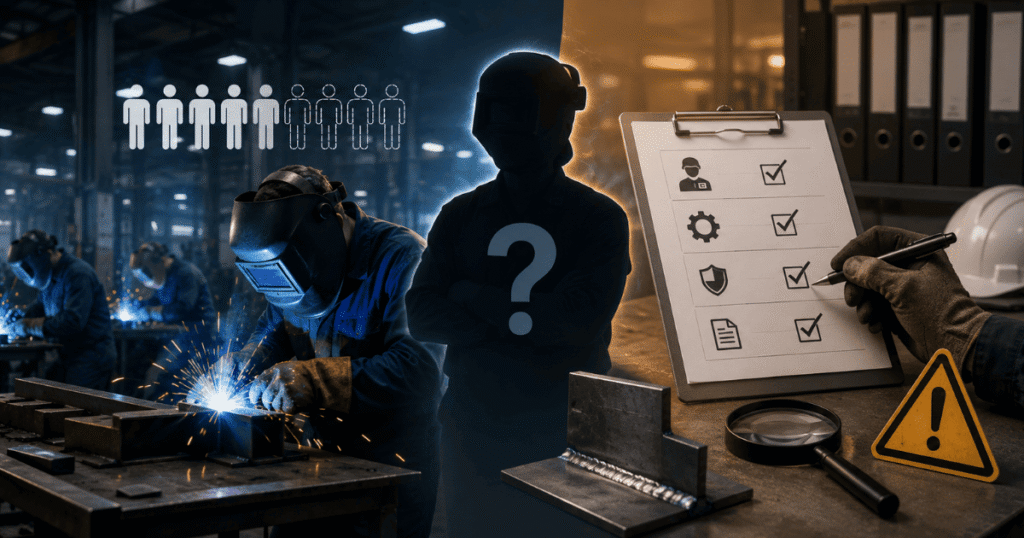
Why a Welder Shortage Can Become a Compliance Risk
A production order is coming up, but two qualified welders are not available.The other welders are already working extra hours, and the production line needs one more person to help with welding.
This shows that the welder shortage is becoming more than just a problem of finding workers.
As we talked about in our article on the [global welder shortage], manufacturers are under more pressure than ever to keep production running while making sure they have properly trained welding staff.
When production teams try to cover the gap by moving workers between tasks, adding more overtime, or giving welding jobs to people based only on experience, it can lead to problems with the quality of the welds and with being ready for audits.
The real question isn’t just:
“Can this person weld?”
It’s:
“Is this person qualified for the welding job they’re doing?”
Can an Unqualified Welder Perform Production Welding?
Experience and qualifications are not the same thing.
Even if a welder has many years of experience, they still need a specific qualification to do a certain welding job.
ISO 9606-1 sets out how qualifications are obtained through testing under certain conditions and for specific ranges, rather than giving one qualification that covers all welding work.
When a manufacturer gives welding tasks to workers, they must make sure that the welder’s qualification includes the right process, material, position, and type of work involved.
So, for manufacturers who have trouble finding qualified welders, getting ISO 9606 welder qualifications is a key part of keeping their qualification coverage up to standard.
However, having a qualification by itself isn’t enough.
There needs to be a match between what the welder is qualified to do and the actual work they are asked to perform.
What to Check Before Assigning a Welder
| Check | What to Verify |
|---|---|
| Qualification | Is the qualification current? |
| Welding process | Does it cover the process being used? |
| Material | Is the material within the qualified range? |
| Position | Is the required welding position covered? |
| WPS | Is the applicable welding procedure available? |
| Records | Can qualification and continuity records be demonstrated? |
This verification process becomes even more crucial when there is a need to quickly deliver the products.
Another key difference to understand is between a regular welder and a welding operator.
When mechanized or automated welding is involved, the qualifications required for the personnel may change.We have already explained the differences between ISO 9606-1 and ISO 14732 for welder and welding operator qualifications in another article.
How ISO 9606 and EN 15085 Fit Into the Problem
ISO 9606-1 is about qualifying welders, while EN 15085 sets rules for welding companies that work on railway vehicles and parts.
Having qualified people is just one part of what EN 15085 requires from a manufacturer.
Qualified staff are part of a larger system that includes welding plans, how production is controlled, inspections, keeping records, and tracking work.
This system works like this:
Qualified people -> Approved welding method -> Managed production -> Inspection -> Keeping track of all records
If there aren’t enough welders and this affects any part of that process, it’s hard for the company to show that everything was done properly according to the necessary standards.
That’s why getting EN 15085 certification is very important for railway makers.
It helps them make sure they have enough skilled workers, good procedures, and strong control over their production process.
Why WPS and WPQR Still Matter During a Welder Shortage
A welder’s skills alone don’t mean they can skip using a controlled welding process.
The welding work must be done according to the right WPS, and the procedure must be qualified if needed.
When there’s a shortage of welders, the manufacturer needs to check two important things:
Is the person trained and qualified?
Is the right procedure being used for the job?
This is why it’s important to check both the WPS and WPQR alongside the welder’s qualifications to make sure production is ready.
There should never be a situation where a lack of welders leads the production team to use someone’s experience instead of following a proper welding process.
What Manufacturers Can Do During a Welder Shortage
Having no welders available doesn’t have to turn into a problem that’s only dealt with at the last minute.Here are some real steps that manufacturers can take to stay on track:
1.Keep track of current welders
Make a list showing how many welders you have, the welding methods they use, the materials they work with, the positions they handle, and what qualifications they hold.
2.Check for weak spots
Look at parts of your production that rely on just one or two qualified welders.
3.Focus on qualifications
If you need more welders, figure out exactly what your production needs and find a way to get the right qualifications.
4.Train more qualified welders
Having more trained welders helps reduce your reliance on just a few people, making your production less likely to be affected by someone being away or switching roles.
5.Review your production controls
Make sure all records, welding procedures, welder qualifications, inspection rules, and traceability are properly managed, no matter how your production schedule changes.
If your company follows a welding qualification system, you can also use ISO 3834 standards as a guide when checking the skills of your welders and how well your welding processes are controlled.
Frequently Asked Questions
How could a shortage of welders impact welding conformance?
A shortage could lead to overtime, reassignment and use of temporary personnel. Where qualification scope, procedure and record control is not adequately established, such situations could increase nonconformities.
Can an experienced, but unqualified welder carry out production welding?
Being experienced does not qualify a welder to perform any particular production welding activity. It is important to verify the qualification requirements and scope of production.
What are the potential risks of using an unqualified welder?
Some of the potential risks include qualification deficiency, problems with weld quality, rework, traceability difficulties and audit challenges.
What should manufacturers consider when assigning a welder?
Some of the considerations include qualification status of the welder, welding process, material used, position and applicability of the qualification range and requirements, WPS and production records.
Is there requirement for qualified welders under EN 15085?
EN 15085 has requirements that relate to qualified welders and welding operators in controlled railway welding production. The requirements that apply are dependent on the manufacturing company’s scope and welding activities.
How can manufacturers deal with a shortage of qualified welders?
Manufacturers can develop an understanding of their qualification coverage, identification of gaps, additional qualifications prioritization and cross-training.
Conclusion
A welder shortage becomes an audit risk when production pressure causes manufacturers to lose control over who performs which welding work.
The practical response is not simply to increase headcount. Manufacturers should match personnel qualifications to actual production requirements, maintain appropriate records and ensure that welding procedures and quality controls remain effective.
Where qualification gaps exist, establishing the appropriate ISO 9606 welder or welding operator qualification route before production begins can reduce the risk of avoidable compliance problems.
Ensure Your Welders Meet Qualification Requirements
Lack of welders may cause qualification gaps if production staff has to be reallocated fast. First Welding Certification Pvt Ltd offers certification services to manufacturers looking to keep qualified welding staff and satisfy welding requirements.
Before assigning production welding, make sure that the qualification, welding process, material, position, and applicable range of each welder are in line with the work performed.
Make sure your welding staff is qualified before production starts.