
EN ISO 3834
CERTIFICATION
WELDING MATERIALS
EN ISO 3834 Certification Requirements: What Welding Manufacturers Need to Know in 2026
By Technical Editorial Team
5 Min Read
30 July 2026
Table Of Contents
Key Takeaways
INSPECTION & TESTING
EN ISO 3834
Certification
QUALITY ASSURANCE
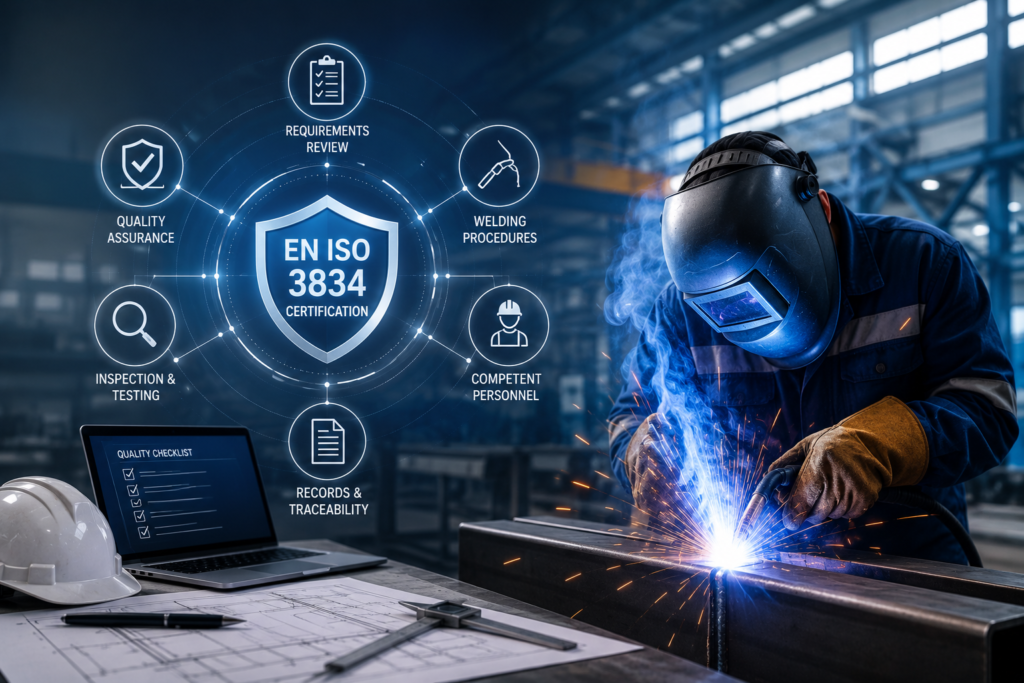
A good weld by itself isn’t enough.Can your welding quality system show that the right process, trained workers, checks, and records were used to make that weld?
For companies that do fusion welding, this is really important.
EN ISO 3834 is a standard that sets quality rules for fusion welding of metal.
It gives a clear way to manage all parts of welding—from checking the requirements and setting up the welding plan, to making sure the people are qualified, doing inspections, keeping track of everything, and keeping proper records.
If you’re a manufacturer in India making parts for railways, buildings, pressure equipment, machines, or exporting, knowing these rules early can stop problems with paperwork and delays in getting certified.
This article answers a real question: What should a welding company have ready for EN ISO 3834 certification in 2026?
What Is EN ISO 3834 Certification?
ISO 3834 is a set of standards that focus on the quality needed for welding metal materials together. These standards, created by the International Organization for Standardization (ISO), set rules for how well welding should be done and help decide which level of quality is needed depending on what a company does with welding. Unlike other standards that cover overall quality management, ISO 3834 is only about making sure welding is done right. It applies whether welding happens in a workshop or at a job site. This is especially important when it’s necessary to show that welding is done properly through trained people, clear methods, checking work, and keeping records.
For a manufacturer, the basic idea is straightforward:
Needs → trained workers → approved methods → controlled welding process → checking the work → keeping records
This shows that welding is being managed in a planned way, not just checked at the end.
ISO 3834-2, ISO 3834-3, or ISO 3834-4?
One of the first things manufacturers need to decide is:
“Which ISO 3834 part applies to us?”
ISO 3834-1 provides criteria for selecting among three levels of welding quality requirements.
| Standard | Quality requirement level |
|---|---|
| ISO 3834-2 | Comprehensive quality requirements |
| ISO 3834-3 | Standard quality requirements |
| ISO 3834-4 | Elementary quality requirements |
The correct level should not be picked just because it seems simpler. Choosing the right level depends on the product, how it’s made, the contracts involved, and the standards that apply. This is why manufacturers should figure out the right requirements first, instead of treating certification just as a way to fill out paperwork.
7 EN ISO 3834 Certification Requirements Manufacturers Should Check
1.Contract and Technical Requirements
Before the welding process begins, the manufacturer needs to understand the product and technical requirements that apply to the job.
A common issue is finding out about welding requirements after production has already started.
Check: Are welding requirements identified and reviewed before accepting and starting the job?
2.Welding Coordination Who is responsible for managing the welding activities?
ISO 14731 outlines the tasks and responsibilities for welding coordination and stresses the importance of having qualified staff for each task.
The problem is not just having a name listed as “welding coordinator.” The tasks and the person’s skills must match the welding work being done.
Pain point: Responsibility is listed on paper but not clear in the workshop.
3.WPS and Welding Procedure Qualification A Welding Procedure Specification (WPS) tells how the weld should be made.
If procedure qualification is needed, the qualification must cover the actual production work.
For example, ISO 15614-1 covers welding procedure qualification through tests.
Check the chain:
WPQR → WPS → Production weld → Inspection → Record
Just having a WPS in a file isn’t enough if the welding done is outside the limits of that WPS.
4.Qualified Welders Manufacturers should ensure welders are trained and qualified for the work they do.
For instance, ISO 9606-1 sets the requirements for testing welders performing fusion welding on steel.
Before production, check if the welder’s qualification covers the factors involved in the actual job.
Common gap: A welder has a certificate, but the qualification does not match the work being done.
5. Materials and Traceability Picture a welded component with good-looking welds, but the manufacturer can’t connect the materials used to the required records.
This is a traceability issue.
Depending on the requirements, manufacturers may need controlled records for:
– Base materials
– Welding consumables
– Identification and traceability
– Storage and handling
– Relevant material documentation
The goal isn’t to create more paperwork. It’s to ensure the right information is available when traceability is needed.
6. Inspection and Testing Welding quality can’t be judged just by how the weld looks.
Inspection and testing should follow the required standards, and proper records need to be kept.
A helpful process is:
Before welding → During welding → After welding
This makes inspection part of the production process, not something done only after the work is finished.
7. Welding Quality Records This is where many requirements come together.
Records may include:
– WPS and procedure qualifications
– Welder qualifications
– Material records
– Inspection and testing records
– Equipment-related records
– Nonconformity records
The exact records needed depend on the manufacturer’s activities and applicable standards.
The main question is:
“Can you show how welding quality was controlled for the work being assessed?”
| Area | Question to ask |
|---|---|
| Requirements | Are contractual/technical welding requirements reviewed? |
| Procedures | Are applicable WPSs available and controlled? |
| Qualification | Are required procedure qualifications valid and applicable? |
| Welders | Are personnel appropriately qualified for assigned work? |
| Coordination | Are welding responsibilities defined? |
| Materials | Is required material/consumable control maintained? |
| Inspection | Are required inspections/tests performed and recorded? |
| Records | Can relevant welding records be retrieved and connected? |
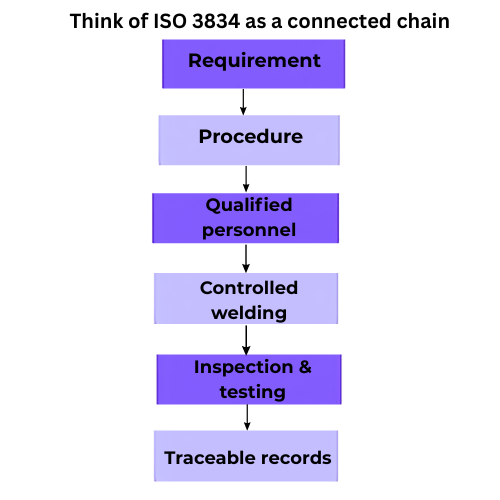
If one link is missing, the manufacturer may have difficulty demonstrating consistent welding quality.
Real-World Example: A Fabricator Preparing for an Export Project
An Indian company makes welded steel parts for a customer in another country.
The company has skilled welders and official design drawings.
But when they check the documents, they find:
– Welding Procedure Specifications (WPS) are available
– Welder qualifications are on file
– Records of the materials used are present
– There’s a clear connection between the welds made and the related records
The problem isn’t about whether the welds are good or bad.
The real issue is showing that the welding process was properly controlled, using real proof.
That’s why the EN ISO 3834 standards should be part of the welding quality system, not just added at the end of a project.
EN ISO 3834 Certification in India
Indian manufacturers who work with customers from other countries might come across ISO 3834 because of what their customers ask for, the rules of their industry, the standards for their products, or projects that involve exporting goods.
First Welding Certification Pvt Ltd.(PRVÁ ZVÁRAČSKÁ, a.s.) says it is a certified organization that checks quality systems for welding and gives certifications based on ISO 3834-2, ISO 3834-3, and ISO 3834-4. Their areas of work include sectors like railways, steel and metal buildings, bridges, wind turbines, pressure vessels, and heavy machinery.
To know more about certification, check the EN ISO 3834 Certification page.
Related Sources
- EN 1090 WPS & WPQR Requirements: Ensuring Welding Quality and Compliance
- WPS & WPQR Explained: Complete Guide to Welding Procedure Qualification (2026)
- Welder Certification (ISO 9606): Complete Guide to Qualification, Testing, Validity, Certification Process & Industry Requirements (2026)
- EN 15085 Requirements: Complete Guide for Railway Manufacturers
Conclusion
The biggest error is viewing EN ISO 3834 certification as just about getting a certificate first.
Start with the welding system:
Are the requirements clear?Are the procedures suitable?Are the workers skilled and properly trained?Are the welding processes properly controlled?Can the records show this?
When these elements are in place, ISO 3834 becomes more than just paperwork—it offers a clear framework to show that welding quality is being properly managed
Frequently Asked Questions
What are the main ISO 3834 requirements for welding manufacturers?
The main ISO 3834 requirements cover welding quality planning, welding procedures, qualified personnel, welding coordination, material control, inspection, testing, and quality records. The applicable quality level depends on the type and complexity of the welded products.
What are the ISO 3834-2 requirements?
The ISO 3834-2 requirements represent comprehensive quality requirements for fusion welding of metallic materials. They cover areas such as welding personnel, equipment, production planning, welding procedures, inspection and testing, non-conformities, and quality records.
Does ISO 3834 certification require qualified welders?
Yes. Qualified welding personnel are an important part of the ISO 3834 requirements. Manufacturers must ensure that welding activities are performed by personnel with appropriate qualifications for the applicable welding processes and product requirements.
Is ISO 3834-2 suitable for all welding manufacturers?
The ISO 3834-2 requirements are intended for manufacturers where a comprehensive level of welding quality control is required. The appropriate ISO 3834 quality level should be selected according to the product, welding activities, applicable standards, and required quality.
What documents are required to meet ISO 3834 requirements?
Depending on the applicable requirements, manufacturers may need welding procedures, welder qualification records, welding coordination records, inspection and testing records, material documentation, equipment records, and other quality records. These form an important part of demonstrating compliance with the ISO 3834 requirements.