
WELDER
ISO 9606-1
QUALIFICATION
ISO 9606‑1 vs ISO 14732: Welder vs Welding Operator Qualification
By First Welding Certification Technical Editorial Team
8 Min Read
22 Aug 2026
Table Of Contents
- Executive Summary
- What is ISO 9606 1? (Welder Qualification)
- What is ISO 14732? (Welding Operator Qualification)
- ISO 9606 1 vs ISO 14732 – Key Differences
- Scope & Applicability
- Test Methods and Acceptance
- Certificate Validity and Renewal
- Documentation and Scope of Qualification
- Employer vs. Certifying Body Roles
- Practical Implications
- Qualification Process Flowcharts
- FAQs
- Call to Action
Key Takeaways
Identify audit requirements before assessment
Review welding procedures and quality records
Verify personnel competence and qualifications
Maintain consistent welding quality and traceability
Executive Summary
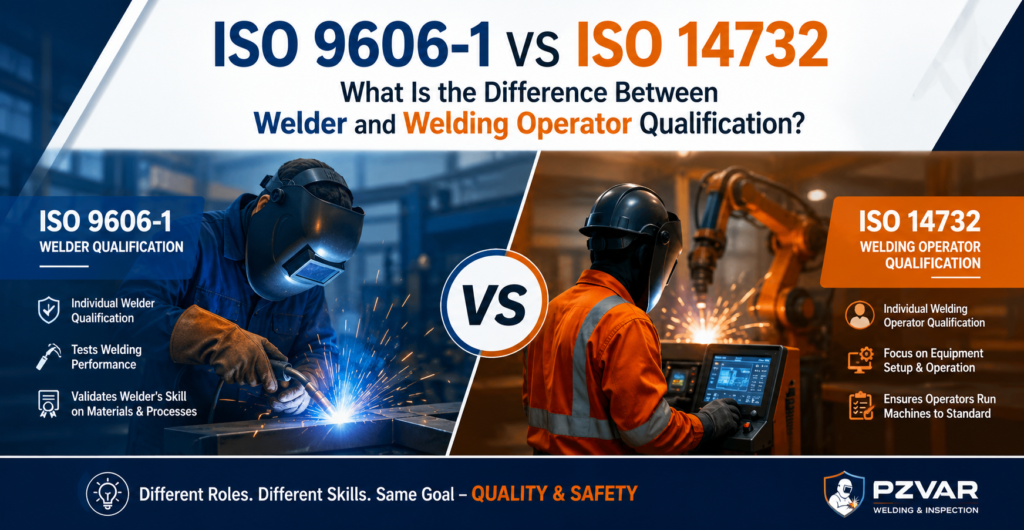
ISO 9606-1 and ISO 14732 are two international standards that help qualify welders, but they are used in different ways within welding quality systems.ISO 9606-1 is for qualifying welders who do manual or semi-mechanized welding on steel, and it checks if a welder can make good, strong welds under controlled test conditions.On the other hand, ISO 14732 is for qualifying the person who operates automated or mechanized welding equipment.In short, ISO 9606-1 is about the welder’s skill, while ISO 14732 is about the person who runs the machine.
This post looks at each standard, explains their purpose, and compares things like their scope, how tests are done, what makes a test pass, how long the qualification is valid, and how to keep it up to date.
It also covers how to document everything properly.The post discusses how these standards affect employers, welders, and quality control teams in real-world situations.There are comparison tables and flowcharts to help explain the differences between the standards.Examples are included, such as ASME Appendix L.The content is structured to be SEO-friendly with FAQs and suggestions on what to do next.All the information comes from official ISO documents, trusted welding resources, and industry guides to make sure it is accurate and reliable.
What is ISO 9606 1? (Welder Qualification)
ISO 9606‑1 is the international standard used to qualify welders who do fusion welding on steel.It sets out the requirements for testing welders to make sure they can weld steel properly.In practice, a welder who wants to be qualified has to weld test pieces, like flat plates or pipes, under certain conditions.After welding, these test pieces are checked carefully using both visual inspection and mechanical or non-destructive testing to make sure the weld is strong and good quality.The main focus of ISO 9606‑1 is on the welder’s ability to control the welding tools like an electrode, torch, or blowpipe to create a weld that meets the required standard.
Key points about ISO 9606‑1:
– Material Scope: It applies to fusion welding of steel, including carbon and alloy steels. Other parts of the ISO 9606 series cover other materials like aluminum and nickel, but ISO 9606‑1 is specifically for steel.
– Process Scope: It covers manual or semi-automated welding processes, such as shielded metal arc welding (SMAW), gas tungsten arc welding (GTAW), and gas metal arc welding (GMAW).
It does not apply to fully automated welding.
– Test Coupon: The welder welds one or more test coupons according to a welding procedure specification (WPS). These coupons are then tested using methods like X-rays, bend tests, and others to check if they meet the required standards.
– Certification: If a welder passes the test, they get a certificate that shows the welding process, position, type of steel, filler material, and thickness range they were tested on.
– Renewal: The certificate can be renewed by retesting, using production welds for verification, or through other valid methods, depending on the rules set for certificate validity and renewal.
In summary, ISO 9606‑1 is used to qualify welders who manually or semi-automatically weld steel, ensuring they can make strong, reliable welds under controlled conditions.
What is ISO 14732? (Welding Operator Qualification)
ISO 14732 is an international standard that helps qualify welding operators and weld setters for mechanized and automated welding of metals.It sets out the requirements that people who run or set up welding machines must meet.A welding operator is someone who watches over and controls a welding machine like a robot or a mechanized carriage, but doesn’t do the welding by hand.A weld setter is someone who programs or sets up the welding equipment before it starts working.
Main points of ISO 14732 include:
Scope: This standard is for people who operate mechanized and automatic welding equipment such as robots, orbital welders, and submerged arc welders.
It doesn’t cover people who only load or unload parts but don’t control the welding process.
Processes: It applies to all fusion welding methods done by machines.
These are often the same welding processes covered by ISO 9606, like gas metal arc welding (GMAW), tungsten inert gas (TIG), and submerged arc welding (SAW), but in a mechanized or automated setting.
Test Requirements: To qualify, the operator must complete a supervised welding test on real equipment, using a proper welding procedure specification (WPS).
The test usually involves:
– Welding the joint automatically on a test piece or sample.
– Keeping the welding parameters within the set limits.
– Cleaning the weld, such as removing spatter and leftover flux.
– Showing understanding of the welding equipment and the process, which may include a written or spoken test.
Certification: Once the weld is tested and reviewed – sometimes with non-destructive testing (NDT) – the operator gets a certificate, often called a welding license, that proves they’re qualified to operate the process and the type of equipment.
Validity: ISO 14732 certificates are usually valid for up to six years.
During that time, they need to be checked every six months.Alternatively, they can be renewed every three years.The exact details depend on the certification body.
In simple terms, ISO 14732 makes sure that the person controlling or setting up an automated welding system has been tested and is capable of producing welds that meet specific standards.
It focuses on the control side of welding quality, not on the manual welding skills themselves.
ISO 9606 1 vs ISO 14732 – Key Differences
The two standards have different roles in a welding quality system.The table below shows their key differences.
| Aspect | ISO 9606-1 (Welder) | ISO 14732 (Operator) |
|---|---|---|
| Who it qualifies | A welder who manually executes welds (hand or partly mechanized). | A welding operator or machine setter who runs or programs automated/mechanized welding equipment. |
| Welding processes | Manual fusion processes (SMAW, GMAW, GTAW, FCAW, etc.) on steel (ISO 9606-1). | Mechanized/automatic fusion welding (often same process types, any metallic base, often steel). |
| Test environment | Performed on a test coupon (plate or pipe) in a controlled testing station. | Performed on actual welding equipment (e.g. robot/automated line) under supervision. |
| Knowledge test | Not required (focus on skill). | Mandatory knowledge exam on equipment/process. |
| Acceptance tests | Destructive/NDT tests on the coupon (bends, X-ray, etc.) per codes (e.g. ISO 5817) to verify weld quality. | Post-weld NDT/inspection per WPS and standards; weld quality must meet applicable acceptance levels. |
| Qualification range | Specifies process, positions, material group, thickness, etc., by test coupon. Range extended by standard rules. | Specifies process and equipment; often tied to specific WPS(es) and machine parameters. |
| Certificate validity | Typically 3 years for non-renewable certificate; or 2-year renewable (with 6-month confirmations). | Typically 6 years for non-renewable; or 3-year renewable. |
| Renewal requirements | 6-month activity confirmations by employer; re-test per ISO 9606 (3-yr), or production weld testing (2-yr), or continuous route (if ISO 3834-2/3). | 6-month activity confirmations; re-certification at 3 or 6 years via supervised test (e.g. WPS test, sample weld). |
| Certifying authority | Generally an accredited third-party (inspection body) or authorized examiner under ISO/IEC 17024. Employer cannot self-certify revalidations. | Typically a notified/inspection body supervises testing; employer/designated supervisor verifies ongoing competence every 6 months. |
| Role of employer | Must confirm welder has welded within scope every 6 months (or certificate invalid). | Must verify operator competence every 6 months (sign certificate). Often conducts initial scheduling of test and maintenance of records. |
| Documentation | Formal welder qualification record/certificate listing essential variables and ranges. | Certificate (often called “welding license”) showing approved processes/WPS, plus knowledge test record. Annexes define knowledge test contents. |
These differences mean that ISO 9606‑1 is used when the welder’s skill is very important, like in pressure vessels or pipelines, while ISO 14732 is used in automated or mechanized systems where the operator controls a process that has already been checked and approved.
Scope & Applicability
ISO 9606-1 is commonly used to certify manual welders in fabrication work.It is used everywhere where steel is welded by hand.The certificates help welders get recognized in different countries.But it is not used for welding that is fully automatic.
ISO 14732 is used by companies that do welding with robots or automated machines.
It is often needed by quality rules like ISO 3834 or when contracts involve robots and automated setups.For instance, a car plant or a train factory that uses robotic welding machines would use ISO 14732 to check that the robot operators and machine setup people are properly trained.
Example: A company with a robotic welding system needs to certify the robot operator using ISO 14732 to make sure they can operate the robot properly according to the approved welding procedure.
At the same time, a welder doing TIG welding by hand on-site must have an ISO 9606-1 certificate for TIG welding on steel.
Test Methods and Acceptance
ISO 9606-1 (Welder Test): The welder does one or more test pieces using a welding procedure that has already been approved.After welding, the test pieces are checked in different ways, such as breaking them apart or using methods like X-rays or bend tests.The standards that decide if the weld is good include ISO 5817, which sets limits on how bad the weld can be, and the annexes of EN ISO 9606-1.If the weld passes these checks, the welder is considered qualified.There is no test for knowledge or theory, only practical welding skills.
ISO 14732 (Operator Test): The person being tested works at the actual welding machine or robot setup, with a supervisor watching.
The test includes:
Following the WPS: The person has to do the weld exactly as outlined in the approved welding plan.
They must make sure all settings are correct and use the right parameters.
- Understanding the process: They must take a test, either written or spoken, about how the machine works, its controls, and common problems.
They need to explain the equipment and answer questions, based on what is in ISO 14732 Annex A. - Making the weld: The person does the weld on a sample or a real joint.
They must set up the machine themselves, make sure it stays within the right limits, run the weld, and then clean up the weld. - Checking the weld: Once it’s done, the weld or a sample is tested, either by looking at it closely or breaking it apart.
This is done using the right standards, such as ISO 5817 or the customer’s requirements, to make sure the weld is sound and safe.
The result of ISO 14732 is that it shows the person knows how to follow the welding plan and control the process properly, not just how well they can weld by hand.
As DEKRA points out, the test makes sure the operator can explain how the welding machine works and keeps all settings within the correct limits.
In both cases, the weld has to meet quality standards, but the test is different depending on what is being certified: whether it’s a person who does the welding manually or someone who controls an automated process.
Certificate Validity and Renewal
ISO 9606‑1 certificates usually last for 3 years and cannot be extended.According to ISO rules, the welder or their employer must sign a 6-month confirmation form on the certificate to show the welder has been doing qualified work.If this confirmation is missing or if there is a break of more than 6 months in the welder’s activity, the certificate becomes invalid.To renew an ISO 9606‑1 certificate, one of three options must be chosen at the start, as outlined in ISO 9606‑1 Clause 9.3:
- Option 9.3a: The welder must take a new qualification test, including a weld and exams, every 3 years.
- Option 9.3b: Every 2 years, two welds from actual production are fully tested.
- Option 9.3c: If the employer’s quality system is certified under ISO 3834-2 or 3, the certificate can remain valid indefinitely.
ISO 14732 certificates are usually valid for 6 years and cannot be extended, but they can also be valid for 3 years if a renewable scheme is used.
Like welders, operators must have their skills checked by their employer every 6 months, with a signed confirmation on the certificate.To renew the certificate, the operator must take another supervised test, which could be a WPS test, a sample test, or a procedure test, depending on how they were originally certified.For example, after 6 years, the operator must redo the full certification test, but after 3 years under a renewable scheme, they might only need a lighter re-evaluation.
Industry note: Accredited organizations like Kiwa say that an ISO 9606‑1 certificate can start with a 3-year non-extendable period or a 2-year renewable period.
For ISO 14732, the certificate can be 6 years non-extendable or 3 years renewable.These options match what the standards allow.
Documentation and Scope of Qualification
An ISO 9606-1 welder’s certificate is a personal document, as stated in ISO/IEC 17024, that shows the welding processes, positions, material groups, thickness ranges, and filler metals that the welder has been tested on.It clearly lists the ranges in which the welder is qualified for each of these factors.For instance, a 9606-1 certificate might list “GMAW (135), Butt joint, 1G, S275JR, 2–10 mm” and so on.This certificate is signed by an authorized examiner or organization.
An ISO 14732 operator’s certificate, also known as a “welding license,” is also a personal document that shows the approved welding processes, welding procedure specifications (WPS), and equipment.
It is based on a supervised test record.Annex B of ISO 14732 gives an example of the certificate format.In real use, these documents usually include the WPS ID, the equipment used, and the limits of the operator’s qualifications.DEKRA mentions that after the certification process is complete, a “welding license” is issued once all the paperwork is reviewed and approved.
In both cases, the welding qualifications are limited to specific ranges.
Like any welding certification, you need to check the exact ranges listed.For example, a 9606-1 certificate valid for 10 mm steel plate does not automatically mean the welder is qualified for 30 mm pipe unless it is specifically mentioned.Similarly, an ISO 14732 certificate only covers certain machines and processes, not all welding equipment.(Misusing qualifications outside of the stated range is a common problem, which is why many companies use qualification matrices or digital tracking systems to make sure welders and operators are used properly.)
Employer vs. Certifying Body Roles
Testing and certification for ISO 9606-1 welders are usually handled by an approved testing center or examiner. Employers often send welders to take these exams or have an approved testing site at their workplace. Once certified, the employer’s main job is to check that the welder is still active every six months.The employer can’t renew the certificate on their own; any retesting or production checks must be done by a certified examiner or organization. In short, an outside group with proper accreditation, like ISO 17024, must be involved to issue or renew a welder’s ISO 9606-1 certificate.
For ISO 14732 operators, the certification process is often more connected with the manufacturer’s system.
While an external body, like a notified organization or inspection agency, usually oversees the first test, the standard allows more involvement from the employer.After the initial certification, which is typically monitored by a welding inspector from a company like DEKRA, the employer or someone they choose must check the operator’s skills every six months by signing and dating the certificate.Some companies also train and test their operators internally under the ISO 14732 rules, provided they follow the standard’s guidelines.
In summary, for ISO 9606-1, the certification body handles all the testing, exams, and issuing of certificates, and the employer is mainly responsible for keeping track of the certificate’s validity.
For ISO 14732, there is a shared responsibility—certification bodies monitor the testing process, but employers or trainers are in charge of ongoing checks.In all cases, the certificate is owned by the certifying body or the notified organization, even if it was issued through the employer.
Practical Implications
For Employers and QA/QC: Knowing these standards helps make sure you follow the rules and keep track of everything.If a company uses automated machines, they need to check both ISO 14732 and 9606-1 certifications. Digital systems usually connect each weld to the operator’s certificate and the welding procedure specification, because auditors want to see that the right person, method, and settings were used. For example, if a problem happens with a welding robot, quality assurance has to check if the operator had the right ISO 14732 certificate and if it was still valid at the time. Modern welding quality management software can help with these checks automatically. Quality teams should remember that six-month confirmations are important for both standards.
If someone misses signing a certificate, it becomes invalid, which could cause problems like non-compliance, needing to redo work, or facing audits.As Evroproces says, “A certificate becomes invalid right away if the six-month confirmation is missed.”
For Welders and Operators: Welders need to keep their skills up to date and record their work to renew or get a new certificate. Operators need proper training on the equipment and must pass both practical and theory tests.Both should understand what is called “qualification envelopes.” For example, a welder should know which types of materials and thicknesses they are allowed to work on, while an operator should know which machines and processes they are permitted to use, often listed on an ISO 14732 card.
Case Example – ASME Appendix L: Some companies around the world use ASME Section IX Appendix L to make getting certifications easier. Appendix L lets you get both ISO 9606-1 and ISO 14732 certificates from a single welding test.If the weld and method meet all the requirements, the welder or operator gets both certifications.This helps combine American (ASME) and European (PED) rules, because a notified body can watch the test and approve the qualification under both ISO and ASME.This shows how ISO 9606-1 and ISO 14732 can work together: the same test proves the person’s ability (9606-1) and that the process was properly controlled (14732).
Qualification Process Flowcharts
Here is a sample flowchart showing each qualification process.These easy-to-follow diagrams explain the usual steps, starting from the initial training or testing up to the certification.
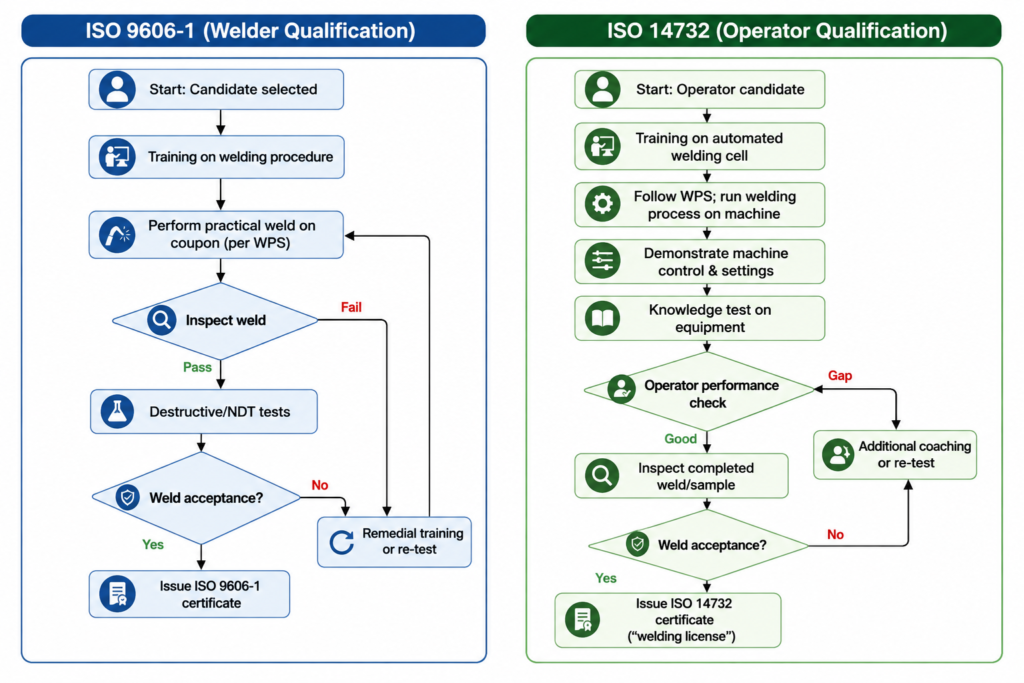
These flowcharts show similar steps: both begin with training, move on to practical welding tests, and finish with inspection and certification.The ISO 14732 process also has a step for checking knowledge, which shows how important it is for welders to have the right skills and understanding.
FAQs
What does ISO 9606 1 certify?
ISO 9606‑1 certifies that an individual welder can produce acceptable welds by hand (or hand-held gun) under a qualified procedure. It is specifically for fusion welding of steels.
What does ISO 14732 certify?
ISO 14732 certifies that a welding operator or machine setter can correctly run an automated or mechanized welding process. It ensures the operator follows approved procedures and understands the equipment.
Can one certificate cover both manual and automated welding?
No. ISO 9606‑1 (welder certificate) does not cover fully automatic processes, and ISO 14732 (operator certificate) does not cover manual welding skills. However, some companies use ASME Appendix L to obtain both from one test.
How long are the certificates valid?
By default, ISO 9606‑1 welder certificates are valid up to 3 years (non-renewable) or 2 years (renewable). ISO 14732 operator certificates are valid up to 6 years (non-renewable) or 3 years (renewable). In both cases, six-monthly confirmations of activity are required to maintain validity.
Who can perform the qualification tests?
For ISO 9606‑1, tests must be witnessed by an authorized examiner/certifying body (per ISO 17024) – employers cannot self-approve the welder’s test. For ISO 14732, an external welding inspector or notified body usually supervises the initial test, though internal staff (trained to those standards) may conduct or proctor future tests under ISO rules.
What happens if the certificate expires?
If an ISO 9606‑1 or ISO 14732 certificate expires (or the 6-month sign-off is missed), the person must requalify – usually by repeating the certification test or taking an approved revalidation route. Working without a valid certificate on regulated projects may require rework or can void warranties/inspections.
Is ISO 14732 mandatory?
ISO 14732 is not legally mandatory worldwide, but it is often required contractually or by quality codes (e.g. PED, EN 1090) for automated welding. It can also be a competitive advantage: showing operators are ISO-qualified builds customer trust in welding quality.
How do ISO 9606 1 and ISO 14732 relate to ISO 3834/ISO 14731?
They are complementary. ISO 3834 (quality requirements) and ISO 14731 (welding coordination) expect qualified personnel: ISO 9606‑1 for manual welders, ISO 14732 for operators, and ISO 14731 outlines the coordinator’s role. Effective QA systems link these together so that any audit can trace a weld back to the qualified welder/operator and WPS.
Call to Action
Are you ready to make sure your team has the correct welding qualifications?Reach out to our welding specialists or enroll in an ISO welding certification workshop now.Our training includes both ISO 9606-1 for welders and ISO 14732 for operators, helping your fabricators stay qualified and your quality system pass audits.Subscribe for more articles about welding standards, or download our free guide on creating a digital welding traceability system.