
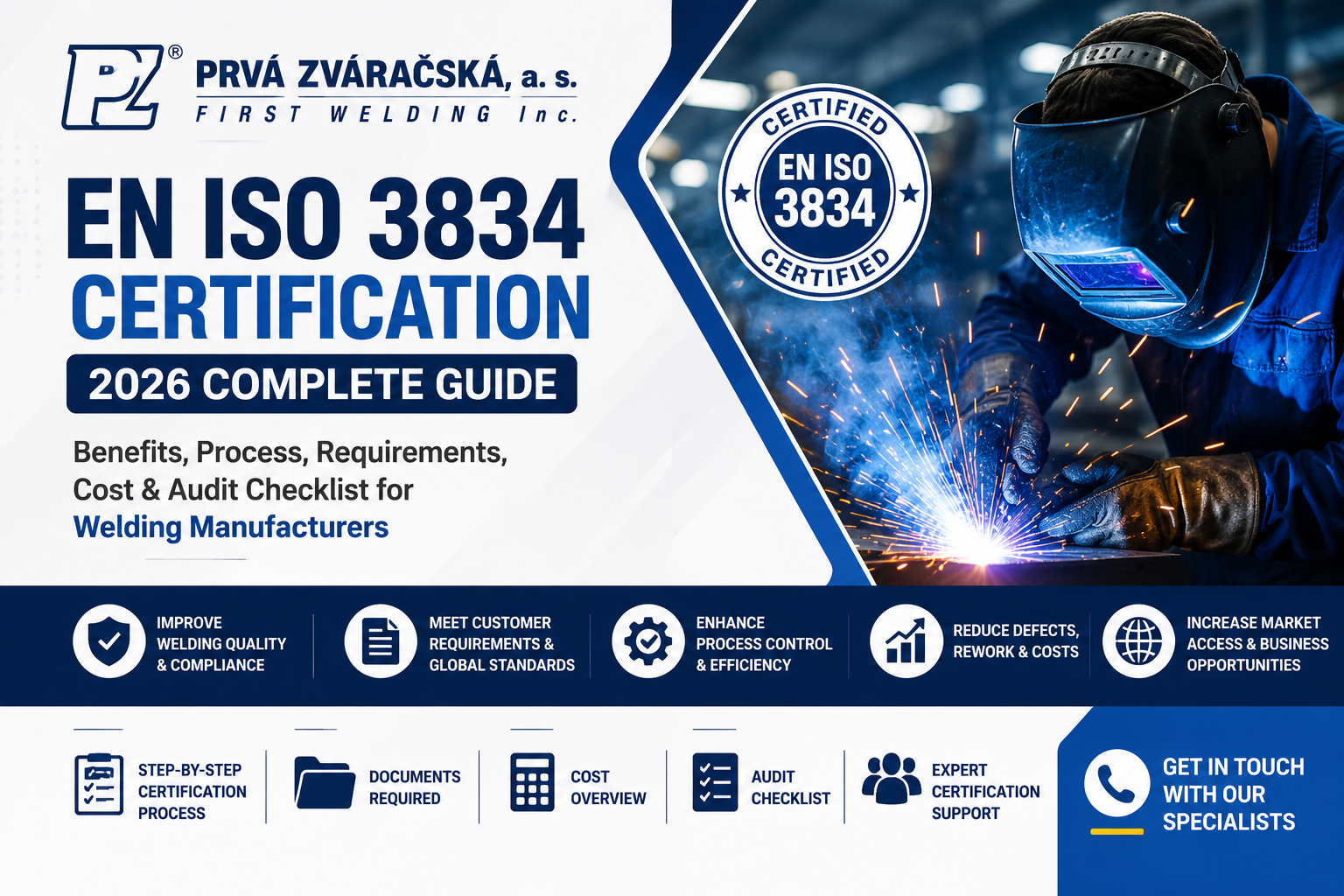
EN ISO 3834 Certification Guide 2026: Benefits, Process, Requirements, Cost & Audit Checklist for Welding Manufacturers & Visual guide
Introduction
EN ISO 3834 certification is an internationally recognized quality standard that specifies comprehensive quality requirements for fusion welding of metallic materials. The standard helps organizations establish effective welding quality management systems and demonstrate their capability to consistently produce welded products that meet customer, regulatory, and industry requirements.
For manufacturers involved in structural steel fabrication, pressure equipment production, railway components, heavy engineering, oil and gas projects, and industrial manufacturing, EN ISO 3834 certification is often a key requirement for securing contracts and improving customer confidence.
At PRVÁ ZVÁRAČSKÁ, a. s. (First Welding Certificate Pvt Ltd), we provide professional support for organizations seeking EN ISO 3834 certification through documentation review, audit preparation, welding quality system implementation and compliance guidance.
Table of contents
- What is EN ISO 3834 Certification?
- Why is EN ISO 3834 Important?
- Benefits of EN ISO 3834 Certification
- Industries That Require EN ISO 3834 Certification
- EN ISO 3834 Certification Process
- EN ISO 3834 Certification Cost
- Documents Required for EN ISO 3834 Certification
- EN ISO 3834 Audit Checklist
- Behance Visual Guide
- Conclusion
- Professional EN ISO 3834 Certification Support
- Related Articles
- Frequently Asked Questions (FAQ)
What is EN ISO 3834 Certification?
EN ISO 3834 is a welding quality management standard developed by the International Organization for Standardization (ISO). The standard defines quality requirements for welding processes and ensures that welding activities are properly planned, controlled, documented, and monitored.
The certification demonstrates that an organization has implemented an effective welding quality system capable of delivering consistent and reliable welding results.
The standard is divided into multiple parts, including:
- EN ISO 3834-2 Comprehensive Quality Requirements
- EN ISO 3834-3 Standard Quality Requirements
- EN ISO 3834-4 Elementary Quality Requirements
- EN ISO 3834-5 Documents Required to Claim Conformity
Why is EN ISO 3834 Important?
Welding is considered a special process because the final quality of a weld cannot always be verified solely through inspection and testing. Therefore, organizations must establish systematic controls throughout the welding process.
EN ISO 3834 helps companies:
- Improve welding quality
- Reduce defects and rework
- Meet customer requirements
- Demonstrate international compliance
- Improve project success rates
- Increase market competitiveness
- Strengthen quality management practices
Benefits of EN ISO 3834 Certification
Improved Welding Quality
The certification helps organizations implement standardized welding procedures and quality controls, resulting in improved weld consistency and reliability.
Reduced Rework and Defects
By following documented welding procedures and inspection requirements, organizations can significantly reduce costly rework and production defects.
Enhanced Customer Confidence
Customers often prefer certified suppliers because certification demonstrates commitment to quality and compliance with international standards.
International Recognition
EN ISO 3834 is recognized worldwide and can help manufacturers compete in international markets.
Better Contract Opportunities
Many infrastructure, manufacturing, railway, oil and gas, and construction projects require suppliers to comply with EN ISO 3834 requirements.
Industries That Require EN ISO 3834 Certification
EN ISO 3834 certification is widely used in:
- Structural Steel Fabrication
- Construction Industry
- Pressure Equipment Manufacturing
- Heavy Engineering
- Railway Manufacturing
- Industrial Manufacturing
- Oil and Gas Projects
- Energy Sector
- Metal Fabrication Companies
- Machinery Manufacturing
EN ISO 3834 Certification Process
The certification process generally involves the following steps:
1. Initial Assessment
The organization’s current welding quality system is reviewed to identify gaps and improvement opportunities.
2. Documentation Review
Welding procedures, quality manuals, inspection plans, and related documentation are evaluated.
3. Welding Personnel Qualification
Welder qualifications and welding coordination personnel requirements are verified.
4. Implementation of Quality Controls
Necessary welding quality controls and procedures are implemented throughout the organization.
5. Internal Review
An internal assessment is conducted to ensure compliance with certification requirements.
6. Certification Audit
The certification body performs an audit to verify conformity with EN ISO 3834 requirements.
7. Certification Approval
Upon successful completion of the audit, the organization receives EN ISO 3834 certification.
EN ISO 3834 Certification Cost
One of the most common questions asked by fabrication companies, structural steel manufacturers, pressure equipment manufacturers, and engineering organizations is: “How much does EN ISO 3834 Certification cost?”
The cost of EN ISO 3834 Certification varies depending on several factors, including company size, number of welding procedures, welder qualification requirements, manufacturing complexity, certification scope, documentation readiness and audit duration.
Organizations seeking EN ISO 3834 compliance may incur costs related to gap assessment, welding procedure qualification (WPQR), welding procedure specifications (WPS), welder qualification testing, documentation development, internal audits and certification body audits.
Companies that already maintain a structured welding quality management system generally experience lower implementation costs and faster certification timelines. Businesses entering international markets often view EN ISO 3834 Certification as a strategic investment because it improves project eligibility, reduces quality-related risks, enhances customer confidence and supports participation in global fabrication and engineering contracts.
For an accurate certification budget, organizations should evaluate their current welding quality controls, documentation status, and project-specific compliance requirements before beginning the certification process.
Documents Required for EN ISO 3834 Certification
To demonstrate compliance with EN ISO 3834 welding quality requirements, organizations typically maintain the following documented information:
- Welding Procedure Specifications (WPS)
- Welding Procedure Qualification Records (WPQR/PQR)
- Welder Qualification Certificates
- Welding Coordination Responsibility Records
- Quality Manual and Welding Quality Procedures
- Inspection and Test Plans (ITP)
- Material Traceability and Identification Records
- Calibration and Equipment Maintenance Records
- Non-Conformance and Corrective Action Reports
- Internal Audit and Management Review Records
The exact documentation requirements may vary depending on the applicable EN ISO 3834 quality level, manufacturing activities, customer specifications, and project requirements. Proper document control and record management play a critical role in demonstrating welding quality compliance during certification audits.
EN ISO 3834 Audit Checklist
Before an EN ISO 3834 certification audit, organizations should verify the following key compliance areas:
EN ISO 3834 Audit Readiness Checklist
| EN ISO 3834 Audit Checklist Item | Why It Matters | Status |
| WPS Approval | Ensures welding procedures are controlled | ✓ |
| WPQR Records | Demonstrates procedure qualification | ✓ |
| Welder Qualification | Verifies personnel competence | ✓ |
| Material Traceability | Supports product quality assurance | ✓ |
| Calibration Records | Ensures measurement accuracy | ✓ |
| Internal Audits | Confirms compliance readiness | ✓ |
| Corrective Actions | Shows continuous improvement | ✓ |
| Inspection Records | Verifies quality control | ✓ |
| Welding Coordinator | Maintains technical oversight | ✓ |
| Quality Documentation | Supports certification audit | ✓ |
Relationship Between EN ISO 3834 & EN 1090 Certification
Many structural steel manufacturers require both EN ISO 3834 and EN 1090 certification.
While EN ISO 3834 focuses on welding quality requirements, EN 1090 addresses the execution of steel and aluminium structures.
For organizations involved in structural steel fabrication, both certifications often work together to demonstrate compliance and quality assurance.
Behance Visual Guide
We have also published a detailed visual guide explaining EN ISO 3834 certification benefits, audit process and compliance requirements.
Professional EN ISO 3834 Certification Support
First Welding Certification Pvt Ltd | PRVÁ ZVÁRAČSKÁ, a. s. provides professional support for organizations seeking EN ISO 3834 certification.
Our services include:
- Gap Assessment
- Documentation Review
- Welding Quality System Implementation
- Audit Preparation
- Compliance Guidance
- Certification Support
- EN 1090 Consulting
Why Choose PRVÁ ZVÁRAČSKÁ, a. s.|First Welding Certification Pvt Ltd
PRVÁ ZVÁRAČSKÁ, a. s. |First Welding Certification Pvt Ltd is a recognized certification and technical support organization helping manufacturers achieve compliance with international welding standards. Our team supports companies in welding quality management, documentation review, audit preparation, EN ISO 3834 implementation, EN 1090 certification support and continuous compliance improvement.
We work with structural steel fabricators, engineering companies, construction contractors, railway manufacturers and industrial organizations seeking reliable certification guidance and welding quality assurance.
Our objective is to help organizations improve welding quality, reduce non-conformities, achieve certification readiness, and meet international customer requirements.
Conclusion
EN ISO 3834 Certification is an internationally recognized welding quality standard that helps manufacturers establish a reliable welding quality management system and demonstrate compliance with international welding requirements. Organizations involved in structural steel fabrication, pressure equipment manufacturing, railway projects, construction, and heavy engineering can benefit significantly from implementing EN ISO 3834 requirements.
A well-planned EN ISO 3834 certification process improves welding quality assurance, strengthens documentation control, reduces defects and rework, and enhances customer confidence. By maintaining proper welding procedures, qualified personnel, inspection records, and compliance documentation, companies can achieve consistent product quality and meet industry expectations.
Whether you are preparing for your first EN ISO 3834 audit or looking to improve your existing welding quality system, understanding the certification requirements and implementing best practices can help your organization achieve long-term compliance and business growth.
Start Your EN ISO 3834 Certification Journey Today
Achieving EN ISO 3834 Certification requires proper planning, documentation, welding quality controls and audit readiness. Working with experienced certification professionals can help reduce implementation challenges, avoid common compliance issues and streamline the certification process.
PRVÁ ZVÁRAČSKÁ, a. s.| First Welding Certification Pvt Ltd supports organizations throughout the certification journey from initial assessment and documentation review to audit preparation and compliance guidance.
Whether you are a structural steel fabricator, engineering company, pressure equipment manufacturer or welding organization, our team can help you understand certification requirements and prepare for a successful audit.
Get in touch with our specialists to discuss your project requirements and certification objectives.
Talk to Our Certification Expert
Related Articles
- EN 15085 vs EN ISO 3834: Key Differences in Welding Certification and Quality Standards
- Material Traceability & Consumable Control: The Unsung Heroes of Weld Quality
- WPQR & WPS Certification: Ensuring Welding Quality, Compliance, and Consistency in Fabrication
- ISO 3834: The Foundation of Consistent Welding Quality in Modern Manufacturing
- More Than Just a Certificate: Building a Culture of Compliance in Welding and Pressure Systems
- EN 1090 Execution Classes Explained: EXC1, EXC2, EXC3 and EXC4
- EN 1090 Certification for Structural Steel and Aluminium – Complete Guide for Manufacturer
Frequently Asked Questions(FAQs)
EN ISO 3834 Certification is an internationally recognized welding quality management standard that specifies quality requirements for fusion welding of metallic materials. It helps welding manufacturers improve quality control, reduce welding defects, meet customer requirements, and demonstrate compliance with international welding standards
EN ISO 3834 Certification is recommended for structural steel fabricators, pressure vessel manufacturers, railway component manufacturers, heavy engineering companies, oil and gas contractors, metal fabrication companies, and organizations involved in welding operations where quality assurance and compliance are critical.
The main benefits include improved welding quality, reduced rework and defects, enhanced customer confidence, international recognition, better project eligibility, stronger quality management systems, and compliance with welding quality requirements.
EN ISO 3834 focuses on welding quality requirements and welding process control, whereas EN 1090 focuses on the execution of steel and aluminium structures. Many structural steel manufacturers require both certifications to meet project and regulatory requirements.
The certification process typically includes a gap analysis, documentation review, welding procedure qualification, welder qualification verification, implementation of welding quality controls, internal assessment, certification audit and final certification approval by an accredited certification body.
Required documents may include welding procedures (WPS),welding procedure qualification records (PQR), welder qualification records, inspection and test plans, quality manuals, welding coordination records, calibration records and non-conformance management procedure
The certification timeline depends on the organization’s current level of compliance, documentation readiness, number of welding processes, and audit requirements. Most companies complete the certification process within several weeks to a few months
While EN ISO 3834 is not legally compulsary in every country or industry, many customers, engineering projects, railway contracts, pressure equipment projects and structural steel fabrication contracts require compliance with EN ISO 3834 requirements.
Industries that commonly require EN ISO 3834 Certification include structural steel fabrication, construction, railway manufacturing, oil and gas, energy, shipbuilding, heavy engineering, pressure equipment manufacturing, and industrial fabrication sectors.