
Related Blogs
AUG
22
ISO 9606‑1 vs ISO 14732: Welder vs Welding Operator Qualification
AUG
22
How to Read an ISO 9606-1 Welder Qualification Certificate: A Field-by-Field Guide
AUG
22
ISO 9606-1 Welder Qualification Test: What Happens During the Certification Process?
See Also.....
Certification Alerts
- EN ISO 3834-4 transition deadline: 31 Dec 2024
- NABCB accreditation renewal — Updated requirements
WELDER CERTIFICATION
ISO 9606-1
INSPECTORS GUIDE
19 Sep 2026
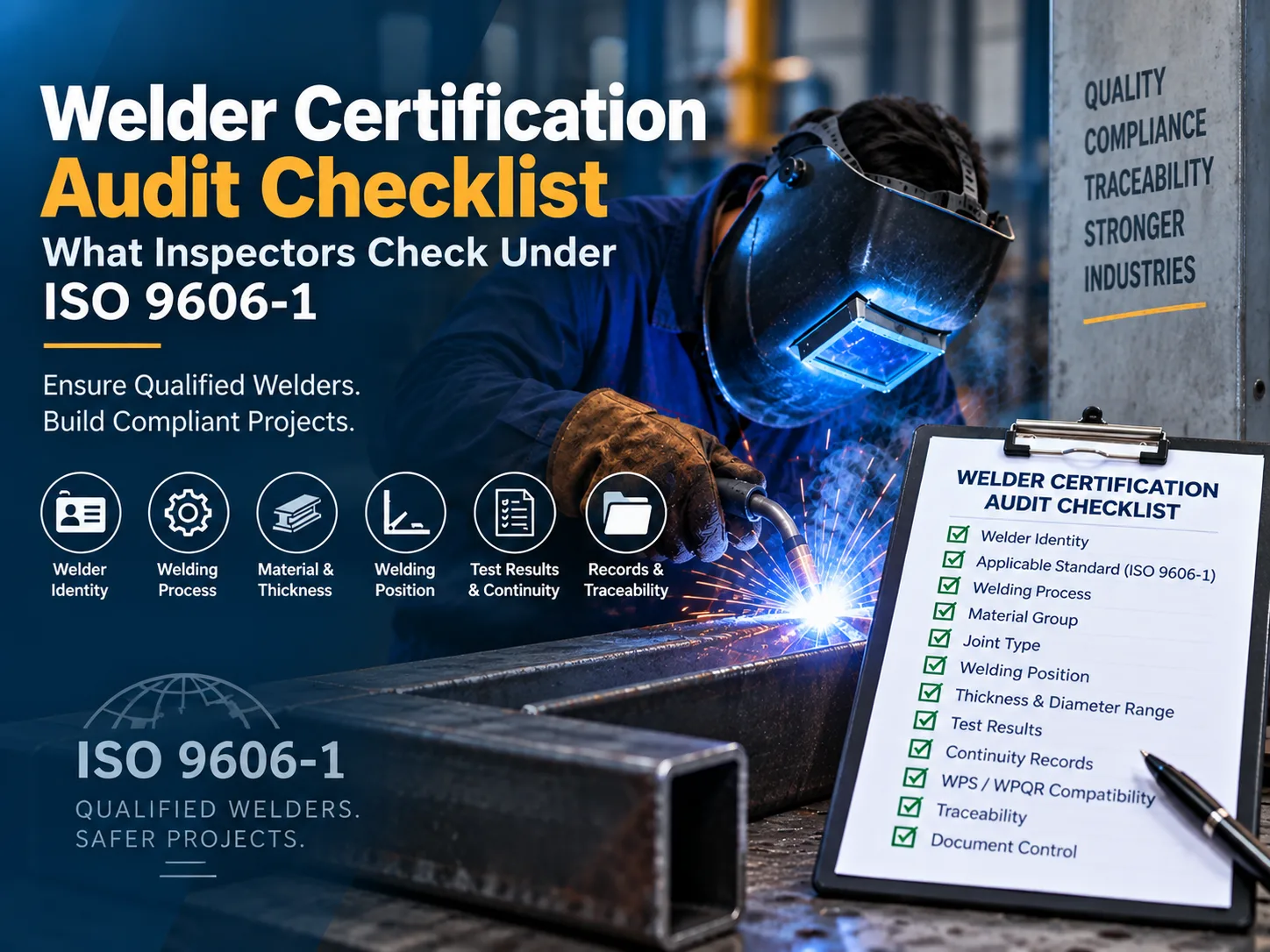
Welder Certification Audit Checklist: What Inspectors Check Under ISO 9606-1
By Editorial Team
A welder’s certificate alone does not mean they are qualified for every welding job.During a certification audit, inspectors check the qualification record, test conditions, the range of welds they are qualified for, continuity, and any supporting documents related to the welding.
ISO 9606-1:2012 sets out the requirements for testing welders who do fusion welding on steel.
It gives a clear way to check if a welder can manually make a good weld.This standard covers manual and semi-automated welding, but not fully automated processes.
For companies that follow ISO 3834, EN 1090, pressure equipment standards, or other welding quality rules, keeping proper records of welder qualifications is a key part of making sure their production meets quality standards.
What Is a Welder Certification Audit?
A welder certification audit is a thorough check of a welder’s qualification papers and welding records to make sure the qualification is right, up-to-date, and can be traced back to the work that needs to be done.
An inspector may check:
– The welder’s name and ID
– The standard used for qualification
– The welding method used
– The test piece used
– The type of material being welded
– The kind of product being made
– The welding position
– The filler material used
– The shielding gas, if any
– The thickness and diameter ranges
– The test results
– The qualified range
– Records showing continuous work
– Supporting documents like the WPS or WPQR
The goal is not just to check if a certificate exists, but to make sure the documented qualification matches the welding work being done.
ISO 9606-1 Welder Certification Audit Checklist
1 Verify the Welder’s Identity
The first step is to check if the qualification certificate clearly shows who did the test.
– Inspectors may compare:
– Full name
– Welder ID number
– Employee records
– Welder identification system
– Qualification certificate
– Production welding records
The identification should connect the qualified welder to the actual welds made in production.
2 Check the Applicable Standard
The auditor needs to make sure the qualification was done according to the right standard.
For steel fusion welding, the standard is ISO 9606-1:2012.
ISO currently lists the 2012 edition as the latest published version, but they are working on updates.
Organizations should decide which edition and contract requirements apply to their project.
3 Verify the Welding Process
The certificate should say which welding process was used during the test.
– Examples include:
– 111 — Manual metal arc welding
– 131 — MIG welding
– 135 — MAG welding
– 136 — Flux-cored arc welding
– 141 — TIG welding
The auditor checks if the production welding process is within the welder’s qualified range.
A welder qualified for one process is not automatically qualified for another.
4 Check the Test Material and Material Group
The qualification record should show what material was used in the test.
The inspector checks if the production material is within the qualified range.
This is important when manufacturers use different steel grades or material groups in production.
The qualification range should be checked against the ISO 9606-1 requirements, not assume one test covers all steel grades.
5 Verify Joint Type
The auditor checks if the qualification covers the type of weld being made.
Common types include:
– Butt welds
– Fillet welds
The qualification record and ranges should match the actual joints being welded.
ISO has official interpretations that explain how butt and fillet weld qualifications relate, so it’s important to check the specific clauses.
6 Check Welding Position
Welding position is a key part of qualification.
The inspector checks the position used in the test and the positions the welder is qualified for.
Examples include:
– PA
– PB
– PC
– PD
– PE
– PF
– PG
The qualified range depends on the test setup and ISO 9606-1 requirements.
ISO’s interpretations also address how positions like H-L045 and J-L045 affect the qualified range.
7 Verify Thickness and Diameter Range
Inspectors check if the production weld is within the welder’s qualified:
– Material thickness range
– Weld deposit thickness range, if any
– Outside diameter for pipe welds
This is a common area where a certificate might be wrongly assumed to cover more than it actually does.
For example, a test thickness does not mean the welder is qualified for all thicknesses.
8 Check Filler Material and Consumables
The audit should check the filler metal and if the production consumables are within the qualification range.
– Depending on the welding process, this might include:
– Filler classification
– Filler designation
– Electrode type
– Consumable identification
– Grouping requirements
The goal is to make sure the welding conditions stay within the qualified scope.
9 Verify Shielding and Backing Conditions
– When needed, inspectors check:
– Shielding gas
– Gas mixture
– Gas backing
– Material backing
– Flux backing
– Consumable insert
These factors can affect the qualified range.
ISO’s official interpretations cover questions about how backing conditions relate to qualification ranges.
10 Review the Qualification Test Results
The auditor checks if the welder passed the required tests.
Depending on the test and requirements, methods may include:
– Visual inspection
– Radiographic testing
– Ultrasonic testing
– Bend testing
– Fracture testing
– Macro examination
The exact testing requirements depend on the setup and ISO 9606-1 rules.
The important thing is that the certificate is supported by real test results showing the qualification was met.
11 Check the Welder’s Continuity
A qualification certificate isn’t valid forever without considering continuity rules.
Auditors may check records showing the welder has kept working within the qualification conditions.
Useful records can include:
– Welding logs
– Production weld records
– Welder continuity logs
– Job cards
– Weld maps
– Welding reports
– Project records
– Keeping continuity records helps show that the qualification is still good under the right rules.
12 Check Certificate Dates and Status
Inspectors need to check:
– Qualification or test date
– Certificate issue date
– Valid or extended dates
– Continuity status
– Requalification records
The company should have a way to find qualifications that are about to expire or need action.
An expired or not properly kept qualification should not be treated as if it’s still valid, even if the original certificate is in the worker’s file.
13 Verify WPS and WPQR Compatibility
A welder’s qualification and the welding procedure are connected but not the same.
During an audit, inspectors might compare:
Welder Qualification → WPS → WPQR → Production Weld
The WPS gives the instructions for making the weld during production, while the welder’s qualification shows they can make a good weld within their qualification range.
So, having a valid welder certificate doesn’t mean the welder can use every WPS.
14 Check Welder Traceability
A good welding quality system should let the company know who did each weld.
Auditors might look at:
– Welder ID
– Weld number
– Weld map
– WPS number
– Material or heat number
– Welding process
– Production records
– Inspection reports
This creates a chain that shows:
Welder → Qualification → WPS → Production Weld → Inspection Record
This is especially important for companies that follow welding quality systems like ISO 3834.
15 Check Document Control
Inspectors also check if welder qualification documents are managed properly.
The company should be able to quickly find:
– Current certificates
– Expired certificates
– Continuity records
– Requalification records
– Welder ID
– Applicable welding processes
– Qualified ranges
– Supporting test reports
Having a central welder qualification matrix can help with this process a lot.
Common Findings During Welder Certification Audits
Some common issues with documentation and compliance are:
Old or missing qualification records
The company has a certificate, but cannot show that it is still valid.
Wrong qualification range
The welder is given tasks that are not within the allowed thickness, diameter, position, process, or other related limits.
No continuity records
The organization cannot show that the qualifications are up to date and ongoing.
Hard to track welders
It is not possible to clearly link the welds to the people who made them.
Certificate and WPS do not match
The welder’s qualifications do not cover the conditions needed for the actual work being done.
Missing test documents
The certificate is there, but the supporting test or exam records are not complete.
Uncontrolled records
Different departments have different or old versions of the same qualification.
Welder Certification Audit Checklist
Before an ISO 9606-1 audit, verify the following:
| Audit Check | Status | |
|---|---|---|
| Welder identity verified | ☐ | |
| ISO 9606-1 qualification identified | ☐ | |
| Welding process verified | ☐ | |
| Material group checked | ☐ | |
| Joint type checked | ☐ | |
| Welding position checked | ☐ | |
| Thickness range checked | ☐ | |
| Diameter range checked | where applicable | ☐ |
| Filler material checked | ☐ | |
| Shielding/backing conditions checked | ☐ | |
| Required test results available | ☐ | |
| Certificate status verified | ☐ | |
| Continuity records available | ☐ | |
| WPS compatibility checked | ☐ | |
| WPQR relationship reviewed | ☐ | |
| Production weld traceability established | ☐ |
How to Maintain Welder Qualification Compliance
Manufacturers can make it easier to manage welder certifications by keeping a central list that shows important details about each welder’s qualifications.This list should include:
Welder ID | Process | Material | Joint Type | Position | Thickness | Diameter | Certification Status | Next Check Date
This list needs to be kept up to date whenever a welder:
– Takes a new qualification test
– Changes what they are qualified to do
– Does welding work that requires their qualifications
– Needs to be requalified
– Has a change in their certification status
This helps welding supervisors and quality control staff check if a welder is qualified before starting a job, instead of finding out there’s a problem during an inspection.
Final Takeaway
A successful welder certification audit under ISO 9606-1 is more than just checking if a welder has a certificate.
Inspectors need to make sure the qualification:
– Is linked to the right welder
– Covers the correct welding process
– Applies to the right material and joint type
– Includes the needed position and size
– Has proper test results to back it up
– Is kept up to date with continuity rules
– Can be connected to the actual production welding records
For manufacturers, keeping detailed ISO 9606-1 qualification records, continuity logs, and welder-to-weld links helps make audits go smoother and cuts down on problems related to qualifications.
ISO 9606-1:2012 is the latest version approved by ISO as of 2026, though a new version is being created.
Companies should check which edition is needed for each project and make sure it meets any contract rules.