
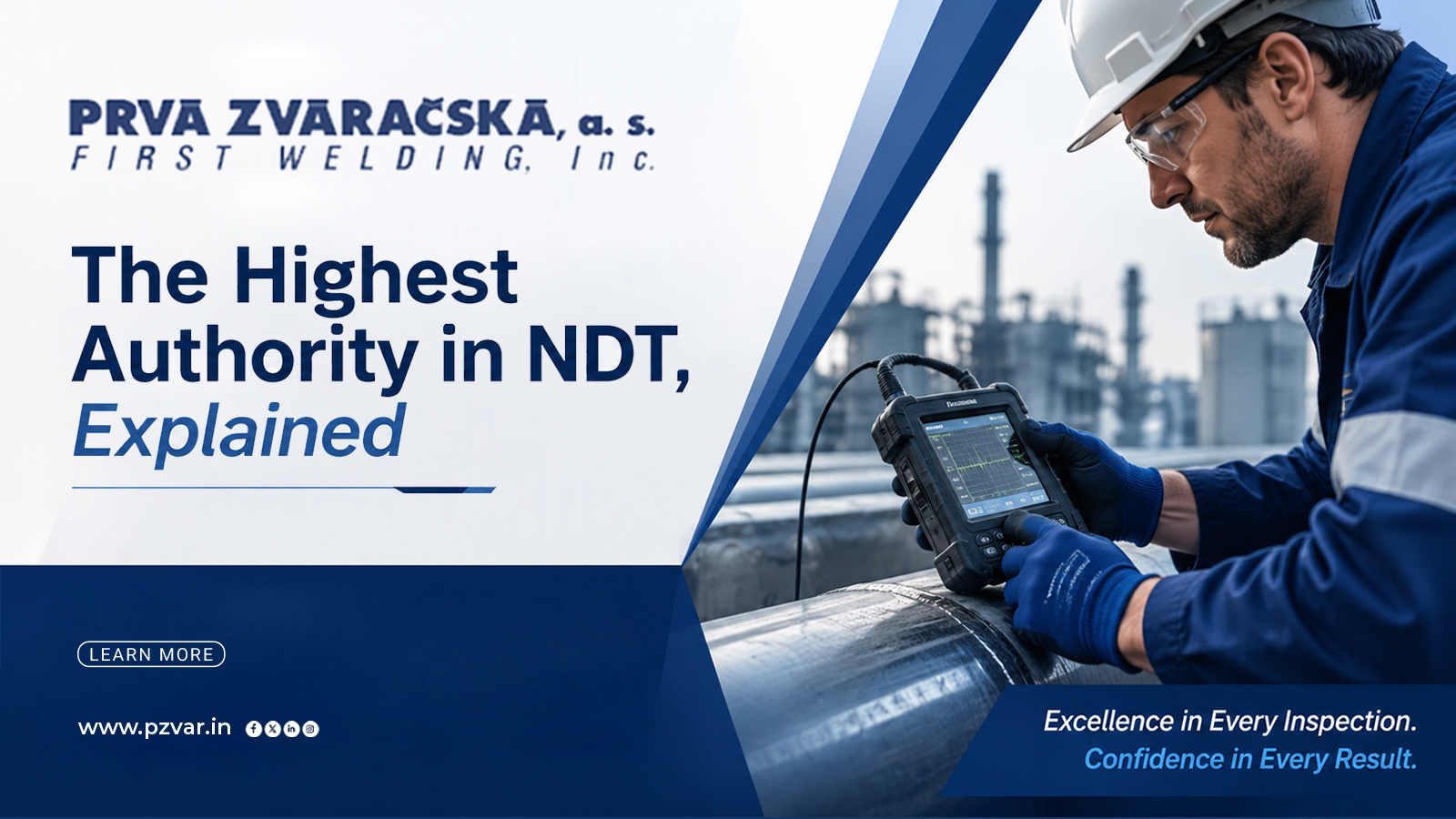
NDT Level III Certification Explained – Roles, Qualification & Benefits
In any industry where a hidden flaw can lead to failure — aerospace, energy, railways, pressure equipment — someone has to take ultimate responsibility for how testing is done and how results are judged. In the world of non-destructive testing, that person is the NDT Level III. It is the most senior and demanding qualification in the field, and in this article we’ll explain what it involves, how you reach it, and why it’s so valuable.
First, what is NDT?
Non-destructive testing (NDT) is a group of techniques used to inspect materials, welds, and components for defects without damaging them. Common methods include visual testing (VT), liquid penetrant testing (PT), magnetic particle testing (MT), radiographic testing (RT), ultrasonic testing (UT), and eddy current testing (ET), along with advanced techniques like phased array and TOFD. NDT lets you find cracks, porosity, and other flaws while the part stays fit for service.
The three levels of NDT certification
Under the international standard EN ISO 9712 (currently the 2021 edition), NDT personnel are certified in three levels, each with a clearly defined scope:
- Level 1 carries out NDT operations according to written instructions and under supervision, recording the results.
- Level 2 performs and supervises testing according to established procedures, sets up and calibrates equipment, interprets and evaluates results against codes and specifications, and writes the instructions that Level 1 follows.
- Level 3 holds full technical responsibility. This is the top of the pyramid.
What a Level III actually does
A Level III is far more than a very experienced inspector. The role carries responsibilities that shape an entire organisation’s testing programme:
- Developing and approving procedures. The Level III establishes, reviews, and validates NDT procedures and techniques, and approves them for use.
- Interpreting codes and standards. They take the requirements of codes, standards, and specifications and translate them into practical acceptance criteria.
- Selecting methods and techniques. They decide which NDT method best suits a given material, component, or defect concern.
- Approving the written practice. In schemes that require it, the Level III reviews and approves the organisation’s written practice — the document that governs how its NDT personnel are qualified and certified.
- Training and examining. Where authorised, they train and assess Level 1 and Level 2 candidates.
- Managerial oversight. They often carry overall responsibility for the NDT function and its quality.
In short, a Level III is the technical conscience of an NDT operation. Many companies that can’t justify a full-time Level III in-house bring one in as an external, approved authority.
How do you become a Level III?
It’s a serious commitment. Under EN ISO 9712, a candidate must meet requirements across several areas before certification:
- Training in the relevant methods and broader NDT knowledge.
- Documented industrial experience, typically built up through Level 2 work.
- A satisfactory vision test, since NDT depends on the inspector’s eyesight.
- Examinations, including a basic exam covering general NDT knowledge and product technology, plus main-method exams testing the candidate’s ability to develop procedures and interpret standards.
Certificates are not for life. They’re issued for a defined period (commonly five years) and must be renewed and periodically recertified, keeping competence current.
Why Level III certification is worth it
For the individual, it’s the pinnacle of an NDT career — opening the door to roles as an NDT manager, procedure author, trainer, or independent authority, usually with greater autonomy and earning potential. For organisations, having access to a qualified Level III means procedures are sound, results are trustworthy, and compliance with demanding codes is assured.
At PRVÁ ZVÁRAČSKÁ, a. s., NDT competence sits at the heart of what we do. Whether you need testing carried out, procedures developed, or personnel trained and certified, Level III expertise underpins the reliability our clients depend on.
Frequently Asked Questions
1. What is an NDT Level III?
The most senior NDT qualification. A Level III takes full technical responsibility for developing and approving procedures, interpreting standards, selecting methods, and overseeing an organisation’s NDT activities.
2. Which standard governs NDT certification?
In Europe, EN ISO 9712 (2021 edition) is the main standard for qualifying and certifying NDT personnel. Other schemes such as ASNT-based certification exist internationally.
3. What’s the difference between Level 2 and Level III?
Level 2 performs and supervises testing to established procedures. Level III creates and approves those procedures, interprets codes, selects methods, and may train and examine other personnel.
4. How do you qualify as a Level III?
Through a combination of training, documented experience, a vision test, and rigorous examinations, followed by certification by a recognised body. Certificates are renewed periodically.
5. Why do companies need a Level III?
A Level III ensures NDT procedures are valid, results are reliable, and the organisation meets the demands of the codes and standards that govern safety-critical work.