WPS
WPQR
REQUIREMENTS
WPS & WPQR Explained: The Complete Manufacturer's Guide to Welding Procedure Qualification, Requirements, Standards and Industrial Applications (2026)
By Technical Editorial Team
6 Min Read
4 Aug 2026
Table Of Contents
- Introduction
- Why A Single Document Matters
- Why WPS & WPQR Matter More Than Ever
- What Is WPS in WPS and WPQR?
- What Is WPQR in WPS and WPQR?
- WPS vs WPQR
- Industry Applications of WPS and WPQR
- How a Qualified Welding Procedure Is Developed
- WPS and WPQR Qualification Timeline
- Benefits of WPS and WPQR
- Common Misconceptions About WPS and WPQR
- Essential WPS and WPQR Documents
- WPS and WPQR Checklist Before Production
- Recent Developments in Welding Procedure Qualification
- Essential WPS and WPQR Documents
- FAQ
Key Takeaways
Qualification Workflow
Standards Overview
Indudtry Applications
Common Mistakes
Introduction
Manufacturers sometimes start making products before they finish the welding procedure qualification. According to the experience shared by First Welding Certification Pvt Ltd (PZVAR), this is a common problem in welding projects. Another issue that often comes up is using a WPS that doesn’t have a valid WPQR, which can cause big problems with quality and keeping proper records during production.
The European Commission’s official guidance on the EU Carbon Border Adjustment Mechanism says its main goal is to stop carbon leakage and encourage cleaner ways of making things.
Carbon leakage happens when industries move their production to places where carbon costs are lower, or when high-carbon products from other areas replace goods made in the EU.
For example, a steel maker in the EU has to pay for carbon emissions as required by the EU Emissions Trading System (EU ETS).
Steel producers in other areas might not have to pay these costs.The EU CBAM aims to make the cost of carbon the same for products imported from other countries and those made inside the EU.
The EU CBAM was created to help the EU reach some of its climate goals.
These goals include the European Green Deal and the plan for the EU to become climate-neutral by 2050, as well as the goal to reduce net greenhouse gas emissions by at least 55% by 2030.
A Single Missing Document Can Delay an Entire Welding Project
Think about all the time you’ve spent on making products, buying materials, arranging workers, and planning how to build them. But then, when you check your work, you find out that the welding method used throughout the whole process wasn’t properly checked and approved. This could mean you have to throw away the welds, slow down your production, do more tests, spend more money, and repeat important steps. This kind of problem happens more than some manufacturing companies think. In the fabrication industry, the quality of welding isn’t just about the welder’s skill. It also depends on how well the welding method is approved, how it’s written down, and how it’s used in the actual production.
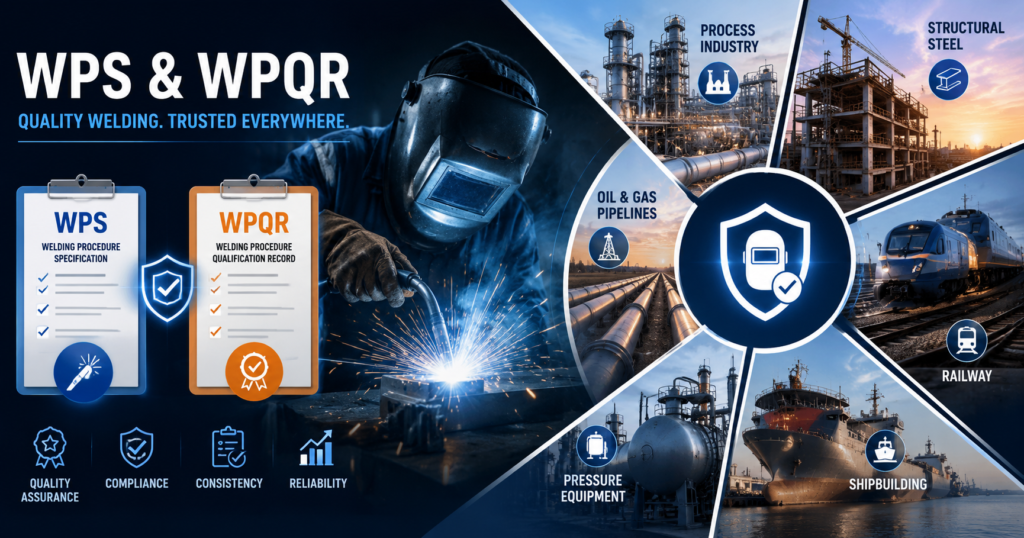
No matter what you’re making — like railway parts, steel structures, pressure vessels, heavy engineering equipment, or assembled metal components — learning about Welding Procedure Specifications (WPS) and Welding Procedure Qualification Records (WPQR) is really important for you.
It’s surprising how many companies have skilled welders and up-to-date machines but still face delays because they don’t understand the link between WPS and WPQR.
A WPS tells you what welding settings are approved for making your product, while a WPQR shows that those settings have been tested and approved through proper experiments.
If you’re looking for official information about WPS and WPQR qualifications, you can also visit the dedicated WPS & WPQR page on the PZVAR website.
Through this guide, you’ll also find references to related topics like EN 15085, EN 1090, EN ISO 3834, SPVD (2014/29/EU), PED (2014/68/EU), and EN ISO 9606, which are closely linked to welding quality management.
You can check the official legal texts of European directives and regulations through the EUR-Lex database, which is maintained by the European Union.
Why WPS & WPQR Matter More Than Ever
Today’s manufacturing processes have higher standards when it comes to the quality, tracking, and records of the welding process.
A properly approved welding procedure allows a manufacturer to:
– Make sure the welds are always of good quality.
– Cut down on the need to redo work.
– Have more consistent results on each project.
– Prove that the project meets all required standards.
– Build trust when customers review the work.
Instead of seeing the WPS and WPQR just as forms to fill out, a successful manufacturer treats them as important parts of their quality control system.
What Is WPS in WPS and WPQR?
A Welding Procedure Specification (WPS) is a welding method that has been approved and outlines the steps needed to properly perform welding tasks.
A Welding Procedure Specification is similar to a set of instructions for making welded parts in a factory.
Instead of letting each welder choose their own welding settings, a Welding Procedure Specification gives everyone the same instructions to follow when doing the job.
A typical Welding Procedure Specification includes:
– The welding method used
– The type of base metal
– The kind of joint being made
– The position in which the welding is done
– The filler metal used
– The shielding gas
– The electrical settings
– Whether preheat is needed
– The temperature between weld passes
– The speed at which the weld is made
– The amount of heat used
– What needs to be done after welding
By following these Welding Procedure Specifications, the welding process stays consistent and reliable.
Practical Example
Think of a manufacturer building metal structures.
Without a Welding Procedure Specification:
– One welder uses a different current setting
– Another uses a different electrode
– Another uses a different welding position
– The welds end up being of different quality
But when there is a Welding Procedure Specification, all qualified welders follow the same steps, ensuring that each weld is done the same way.
What Is WPQR in WPS and WPQR?
WPQR stands for Welding Procedure Qualification Record.It is a document that shows a welding procedure was tested and approved.
In simpler terms:
A WPS tells you how welding should be done, while a WPQR proves that the welding method was properly tested and approved.
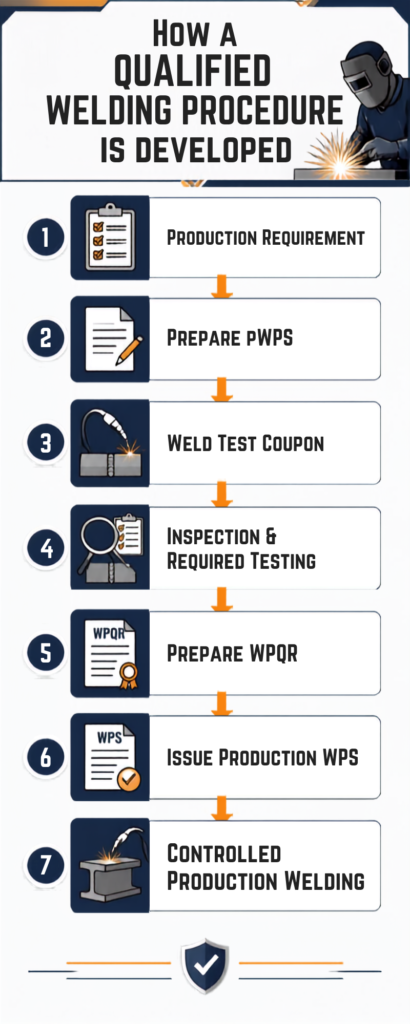
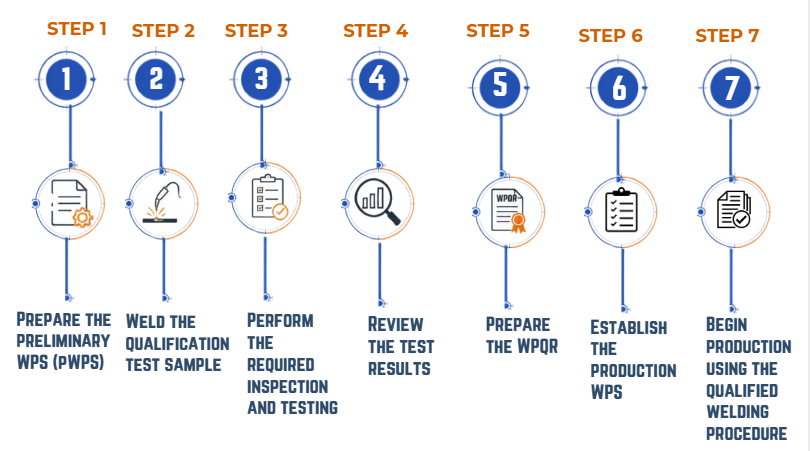
Based on the process suggested by PZVAR’s technical team, here are the steps for welding qualification:
First, a preliminary WPS (pWPS) is made.
Then, welding is carried out using that pWPS.
Next, a test sample is tested. If the sample passes, a WPQR is created.
After that, a production WPS is developed based on the approved welding method.
The rules for welding procedure qualification are given in ISO 15614-1.
Manufacturers should always use the most recent version of this standard from the International Organization for Standardization (ISO).
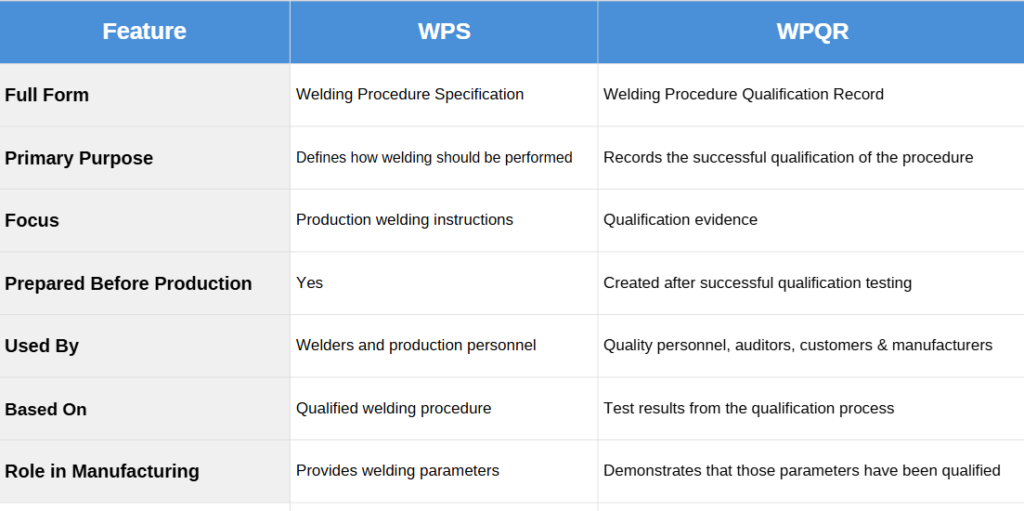
WPS vs WPQR – Understanding the Difference between WPS and WPQR
Industry Applications of WPS and WPQR
WPS and WPQR are commonly used in many industries where it’s important to ensure good welding quality, keep processes consistent, and have proper written records.
– Railway Manufacturing
– Structural Steel Fabrication
– Pressure Equipment Manufacturing
– Process Plants
– Oil & Gas
– Heavy Engineering
– Shipbuilding
– Power Generation
– General Fabrication
How a Qualified Welding Procedure Is Developed
WPS and WPQR Qualification Timeline
Technical Insight: Based on experience with PZVAR projects, the total time usually depends on the kind of sample and tests needed.If all the necessary information is ready, most qualification tasks can be done in around five workdays.
Benefits of WPS and WPQR
Using welding procedures helps manufacturers keep their welds consistent, make it easier to track the welding process, reduce the need for fixing mistakes, and keep their production steps the same every time.Also, having written welding procedures can help build trust during customer inspections and quality checks.
Common Misconceptions About WPS and WPQR
Manufacturers sometimes get confused about how to use WPS and WPQR correctly.
Myth: Having a WPS alone is enough to begin welding work.
Fact: A WPS must be paired with a qualified WPQR, as required by the applicable code.
Myth: One WPQR can be used for every welding method.
Fact: If there are changes to essential variables, a new qualification is needed.
Myth: A skilled welder is sufficient for a WPS.
Fact: Welder qualification and welding process qualification are separate things.
Essential WPS and WPQR Documents
A qualification package typically contains:
– Preliminary WPS (pWPS)
– Material details
– Welding settings
– Test outcomes
– NDT results (if required)
– Lab findings
– WPQR
– Final WPS
Maintaining these records is really important for being able to track and follow back everything that happened.
WPS and WPQR Checklist Before Production
Before you begin any welding work, make sure that:
– The approved welding procedure specification is available.
– The welding procedure specification is supported by a suitable welding procedure qualification record.
– All welders are properly qualified as needed.
– All necessary documents are reviewed before starting production.
– The correct welding parameters are used during the fabrication process.
Recent Developments in Welding Procedure Qualification
Manufacturing standards keep getting better to help make welds better and easier to track. New versions of standards like ISO 15614 and other welding standards now include updates based on changes in how things are made and what is needed to qualify welds .Companies should always use the most recent version of the standard that their customer, contract, or rules say to use.
Because of the growth of digital quality management systems, it’s very important to keep accurate records of WPS and WPQR documents.
Essential WPS and WPQR Documents
WPS and WPQR are important parts of a controlled welding process.The WPS explains the steps that will be followed during welding, while the WPQR shows that these steps have been tested and approved.
Having a clear qualification process helps a manufacturer keep the welding work consistent, track the work back to its start, reduce risks, and meet all the requirements of a project.
Understanding when welding needs to be qualified or requalified, and knowing how different international standards relate to WPS and WPQR, helps build reliable welding methods.
If your company works in areas like railroad manufacturing, structural steel, pressure equipment, process industries, or general fabrication, it’s important to know how standards like EN ISO 3834, EN 15085, EN 1090, ISO 9606, PED (2014/68/EU), SPVD (2014/29/EU), EN ISO 14732, EN 10025-1, and EN 10204 Type 3.2 affect WPS and WPQR.
You can find more information about these standards on the PZVAR website.
WPS and WPQR FAQs
What is the difference between WPS and WPQR?
A WPS specifies how welding should be performed, while a WPQR records the successful qualification of that welding procedure through testing. Both documents work together to establish controlled welding practices.
Is a WPQR required before production welding?
Where the applicable standard or project specification requires procedure qualification, production welding should be carried out using a WPS supported by a qualified WPQR.
When is a new WPQR required?
A new WPQR may be required when essential welding variables change beyond the qualified range, such as changes to the base material, welding process, material thickness, filler material, shielding gas, welding position, or heat input.
Can one WPQR support multiple WPS documents?
Depending on the applicable qualification standard and qualified ranges, a single WPQR may support more than one WPS. The final applicability should always be verified against the relevant standard.
What is a Preliminary WPS (pWPS)?
A pWPS is the initial welding procedure prepared before qualification testing. It is used to weld the test sample that forms the basis for preparing the WPQR.
Which industries commonly use WPS and WPQR?
WPS and WPQR are widely used in railway manufacturing, structural steel fabrication, pressure equipment manufacturing, process industries, oil & gas, shipbuilding, heavy engineering, power generation, and general fabrication.
Ready to Qualify Your Welding Procedure?
Make sure your welding methods are approved following international standards. First Welding Certification Pvt Ltd – India does its own WPS and WPQR testing and certification for companies in the railway, structural steel, pressure equipment, process industries, shipbuilding, and heavy engineering sectors.