AI INSPECTION
NDT & QUALITY
FUTURE OF WELDING
AI-Powered Weld Inspection: Benefits, Limitations & Future of NDT
By First Welding Certification Technical Editorial Team
10 Min Read
01 Sep 2026
Table Of Contents
- What Is AI-Powered Weld Inspection?
- How Does AI in Weld Inspection Work?
- Benefits of AI-Powered Weld Inspection
- Role of NDT in AI-Powered Weld Inspection
- AI-Powered Weld Inspection and Welding Certification
- Limitations of AI-Powered Weld Inspection
- AI vs Traditional Weld Inspection
- Future of AI in NDT and Welding Inspection
- How Manufacturers Can Prepare for AI-Based Welding Inspection
- Frequently Asked Questions
- Conclusion
How Does AI in Weld Inspection Work?
Data Collection
Image and Data Processing
AI-Based Analysis
Defect Classification
Human Verification
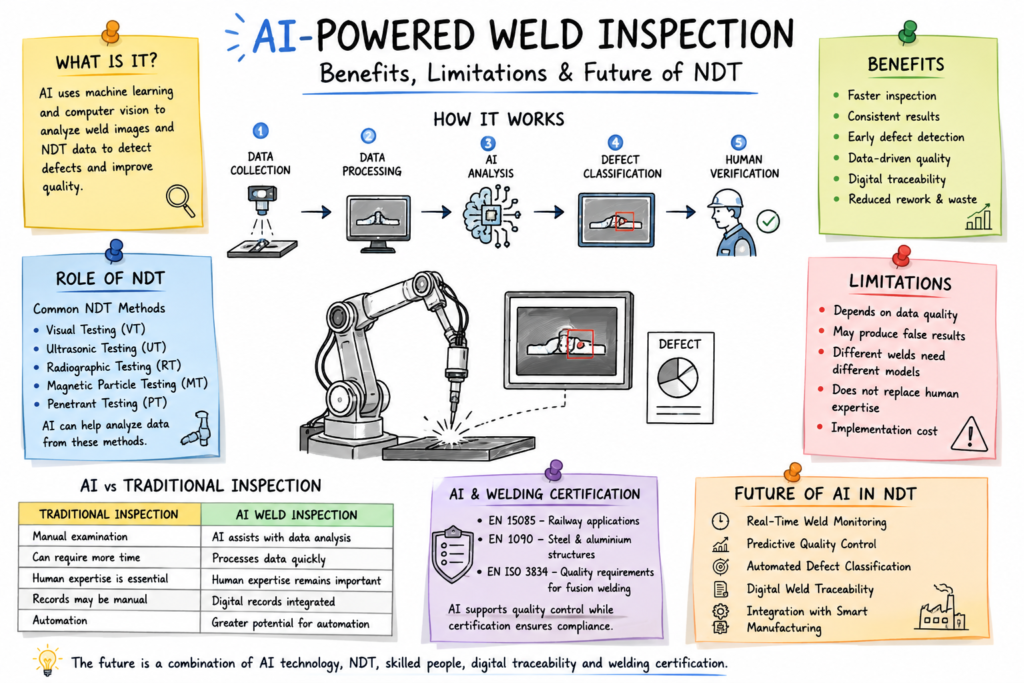
Weld quality is very important in industries where safety, reliability, and how well structures work are key.In places like railways, making cars, building steel structures, pressure vessels, and heavy engineering, even a small problem with the weld can weaken a part and make it last shorter.Welding is a big part of these industries, and any tiny mistake in the weld can reduce the strength, safety, and how long a part works.That’s why it’s so important to check welds carefully and make sure they are of high quality.As factories move towards Industry 4.0, using AI for weld inspections is becoming more popular.This new technology uses AI, machine learning, computer vision, and non-destructive testing to help find and understand welding issues in a more consistent and smart way.
What Is AI-Powered Weld Inspection?
AI-powered weld inspection uses smart technologies and machine learning to look at pictures of welds, inspection reports, and other quality information to find problems or issues.
In the past, weld inspections were done by trained people who checked welds using standard methods like inspection or non-destructive testing.
AI helps make this better by looking through a lot of data and finding patterns that are hard or take too long to notice by hand.
Depending on the tools and what they’re used for, AI systems can help find different kinds of problems, such as:
– Porosity
– Cracks
– Lack of fusion
– Lack of penetration
– Slag inclusions
– Weld shape issues
– Surface problems
How Does AI in Weld Inspection Work?
An AI-based weld inspection process usually has several steps.
1.Data Collection
Information about the weld is gathered using tools like cameras, sensors, X-ray images, or other testing equipment.
2.Image and Data Processing
The collected data is organized and prepared so that key parts of the weld can be studied.
3.AI-Based Analysis
Special computer programs use learning methods to look at the data. They compare what they see with what they have learned from past examples.
4.Defect Classification
If the system has been properly trained and checked, it can help find and sort out different types of problems in the weld.
5.Human Verification
Trained experts check the results. They decide what needs to be done next.
Benefits of AI-Powered Weld Inspection
AI can offer benefits when used properly.
1.Faster Inspection
Checking many welds by hand takes a lot of time.
AI can quickly handle large amounts of inspection data.
2.Better Inspection Consistency
People can get tired or stressed, which may affect their work.
AI can apply the same process to all the data it gets, making inspections more reliable.
3.Early Spotting of Possible Problems
AI can point out areas that need checking.
Finding problems early helps manufacturers fix them before they cause extra work or slow down production.
4.Smart Quality Control
AI can look at inspection data and find repeated issues.
For example, if the same defect appears again and again, it might mean something is wrong with how the welding is done, the materials used, the process followed, the welder’s skills, the equipment, or the environment.
5.Digital Tracking
AI systems can connect with quality management tools.
This links information from materials to welding procedures, welders, the welding process, inspections, defects found, and the actions taken, creating a clear digital record of each weld.
6.Less Re-work and Waste
Finding quality issues early helps reduce the need for redoing work, using extra materials, and causing delays, which makes the manufacturing process more efficient.
Role of NDT in AI-Powered Weld Inspection
Non-Destructive Testing, or NDT, is commonly used to check the quality of welds without harming the part being tested.
Some common NDT methods are:
Visual Testing, Ultrasonic Testing, Radiographic Testing, Magnetic Particle Testing, and Penetrant Testing.
AI can help with analyzing data from some of these testing methods. But whether AI is suitable depends on the type of NDT method, the equipment used, the application, and the requirements that apply.
AI-Powered Weld Inspection and Welding Certification
Technology by itself can’t always ensure good welding quality.A proper welding quality system needs more than just equipment.It includes things like correct welding methods, trained welders, people who check the work, proper records, tracking of the process, and following industry standards.That’s why welding certification is important.
Depending on the industry and what the work is used for, manufacturers might need to follow certain standards and rules, like:
– EN 15085 – for use in railway applications and welding parts of trains and railway vehicles
– EN 1090 – for building steel and aluminum structures
– EN ISO 3834 – for setting quality standards in fusion welding
Using AI for inspections can help with quality control, but having proper certification and qualification systems helps companies show they meet the necessary standards and requirements.
Limitations of AI-Powered Weld Inspection
AI has potential but also has limits.
1.AI depends on good data.
AI models need high-quality, representative training data.If the data is not complete, has bias, or is not properly labeled, the system can give wrong results.This is called “garbage in, garbage out,” and it also applies to AI-based inspection.
2.AI can give false results.
AI systems might show positives when there are none, miss real problems, or misclassify things.So, it’s important to check the results carefully and not rely solely on AI.
3.Different welds need different methods.
Welding can vary a lot depending on the material, process, joint design, thickness, position, environment, and the standards being followed.An AI model that works well for one type of weld might not work as well for another.
4.AI doesn’t replace human experts.
Some people think AI can completely take over the job of inspectors.But trained professionals are still needed to understand results, make decisions, and make sure everything follows the rules.AI should be seen as a tool that helps, not a replacement for human judgment.
5.Setting up an AI inspection system can cost a lot.
It might require buying cameras and sensors, inspection equipment, software, data systems, developing the AI model, integrating it with existing systems, training employees, and validating the whole setup.Before spending money, manufacturers should think about whether the benefits will be worth it.
AI vs Traditional Weld Inspection
| Traditional Weld Inspection | AI Weld Inspection |
|---|---|
| Manual examination plays a role. | AI assists with data analysis. |
| Can require inspection time. | AI can process datasets quickly. |
| Human expertise is essential. | Human expertise remains important. |
| Records may be manually maintained. | Digital records can be integrated. |
| Automation. | Greater potential for automation. |
Future of AI in NDT and Welding Inspection
The future of AI in Non-Destructive Testing (NDT) is likely to be more connected with manufacturing and smart quality control systems.
Some possible future developments are:
– Real-time monitoring of welds as they are being made
– Using AI to predict potential quality issues before they happen
– Automatically identifying and sorting different types of defects
– Keeping a digital record of each weld’s history and details
– Connecting AI inspection tools with smart manufacturing systems
AI-based inspection can work with sensors, robotic welding machines, manufacturing systems, digital quality tools, and production databases to create a fully connected system for managing welding quality.
How Manufacturers Can Prepare for AI-Based Welding Inspection
Manufacturers thinking about using AI should begin by developing a solid quality and inspection plan.
1.Know What You Need to Check
Understand the rules, rules, and what customers expect.
2.Choose the Right Inspection Method
Decide if visual testing, ultrasonic testing, radiographic testing, magnetic particle testing, penetrant testing, or another method is best for the job.
3.Make Data Collection Better
Ensure that the data from inspections and production is correct, consistent, and can be traced back.
4.Check the AI Technology
Make sure the AI tool has been tested and works well for the specific task it’s meant to handle.
5.Keep Qualified People
Ensure that the people doing the inspections and welding have the right training and skills.
6.Connect AI to the Quality System
Use AI as part of the overall quality process, not as a separate tool.
AI-powered welding inspection is a new way to improve quality control and non-destructive testing.By using AI and computer vision, manufacturers can make inspections faster, more consistent, better at finding flaws, and more traceable in digital records.
However, AI isn’t perfect. It needs good data, proper testing, and careful setup.Importantly, AI shouldn’t take the place of trained experts, standard inspection methods, or required certifications. The future of welding inspection will probably use a mix of AI, non-destructive testing, trained workers, digital records, and welding certifications. Companies that combine these tools can create strong, smart quality systems that also meet industry standards.
Frequently Asked Questions
What is AI-powered weld inspection?
AI-powered weld inspection uses intelligence, machine learning and related technologies to analyze weld images or inspection data then spot potential defects or irregularities.
Can AI replace welding inspectors?
No. AI can help with inspection activities. Qualified professionals remain essential for interpretation, verification and technical decision-making.
What welding defects can AI detect?
Depending on the system and training data AI can help spot defects such as porosity, cracks, undercut, lack of fusion, lack of penetration and other irregularities.
What is the role of NDT in welding inspection?
NDT lets welds and materials be examined without damaging the component. Common methods are VT, UT, RT, MT and PT.
Is welding certification important for AI-based inspection?
Yes. AI technology does not replace the need for welding procedures, personnel, inspection processes or compliance with applicable certification and quality requirements.
Conclusion
As manufacturing moves toward Industry 4.0, the future of welding inspection will probably include more connection between AI, non-destructive testing, robotic welding, sensors, digital quality systems, and production data.Companies that use these technologies along with experienced workers and solid quality procedures can create more efficient, trackable, and data-based welding inspection systems, while also meeting industry standards and requirements.
Strengthen Your Welding Quality with the Right Certification
Want to enhance your AI-based weld inspection, NDT, and welding quality processes? First Welding Certification Pvt Ltd helps organizations set up the correct welding certification and qualification system that follows industry standards.
We provide support with certifications like EN 15085, EN 1090, and EN ISO 3834, as well as WPS, WPQR, and welder qualifications. This helps build strong welding quality systems that meet all necessary requirements.