WPQR
QUALIFICATION
TESTING
How to Prepare a WPQR: Step-by-Step Welding Procedure Qualification Guide
By Technical Editorial Team
6 Min Read
10 Aug 2026
Table Of Contents
Key Takeaways
Actual Welding Parameters
NDT & Mechanical Testing
Qualification Range
Complete Document Traceability
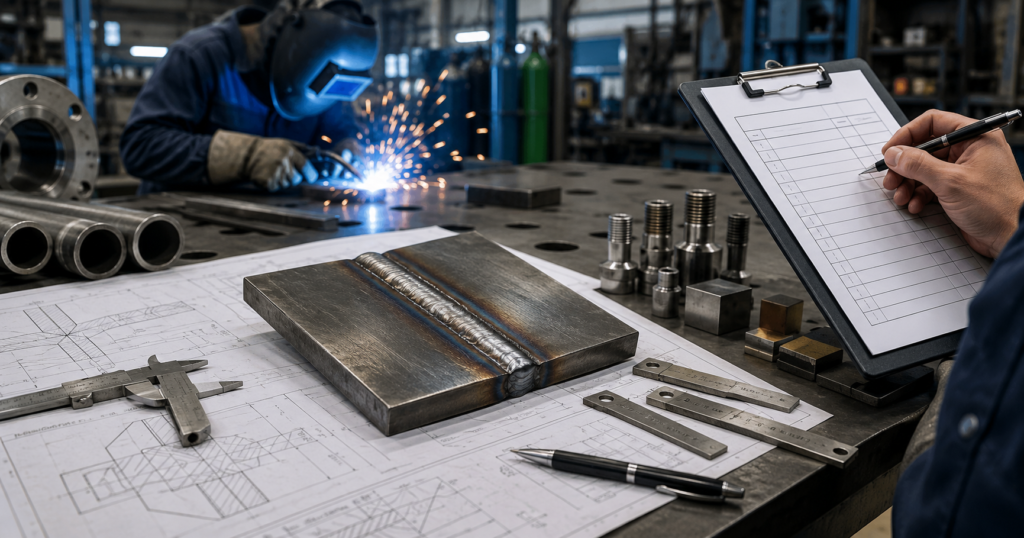
A WPQR, which stands for Welding Procedure Qualification Record, is a controlled document that includes details about the actual welding conditions and the results of tests done to qualify a welding process.
A WPQR acts as proof that a specific welding method has been tested under certain conditions and meets the required standards for welding.
Creating a WPQR means controlling the welding test, recording the welding parameters, properly conducting the test, assessing the results, and deciding the range of conditions for which the welding procedure is qualified.
What Is a WPQR?
A WPQR (Welding Procedure Qualification Record) includes details about the actual conditions used in a welding procedure qualification test and the results from inspections and mechanical tests.
A WPQR is different from a WPS (Welding Procedure Specification).
The WPS explains the welding conditions used in actual production, while the WPQR records the real conditions used during the welding test and defines the range of acceptable conditions.
One important standard for welding procedure qualification of metal materials in many fusion welding cases is EN ISO 15614-1.
The right standard should be chosen based on the product, material, welding method, application, and any specific requirements from the contract.
How to Perform a WPQR: 9 Critical Points
Step 1: Set Up the Right Standard
Before you start the qualification test, you need to decide which standard applies to your welding work.
There are several standards that can be used depending on the application, such as:
– EN ISO 15614-1 – Record for welding procedure qualification
– EN ISO 15609 – Standards for welding procedures
– EN ISO 3834 – Quality standards for fusion welding
– EN ISO 9606 – Testing welders
– EN 15085 – Welding for railway vehicles
– EN 1090 – Execution of steel and aluminum parts
– ISO 9712 – Training and certification for non-destructive testing (NDT) personnel
– PED (2014/68/EU) – Pressure equipment directive
– SPVD (2014/29/EU) – Simple pressure vessels directive
At this stage, you should also set up the material specifications, drawings, joint design, client requirements, and acceptance criteria.
Step 2: Create the pWPS
A preliminary Welding Procedure Specification (pWPS) is a plan for the welding parameters you will use during the qualification test.
The pWPS usually includes these details:
– The welding process used
– The type of base metal and its group
– The thickness of the material
– The type of joint
– The welding position
– The welding consumable and its size
– Preheat and interpass temperatures
– Welding current and voltage
– Welding speed
– Shielding gas used
– Number of weld passes or layers
– Welding method
– Heat input (if needed)
You should then weld the test coupons according to this pWPS.
Step 3: Pick the Right Test Coupon
You need to choose the test coupon based on the welding range you want to qualify.
Important factors to consider include:
– The parent material
– The material group
– The material thickness
– The type of joint
– Pipe diameter (if used)
– Welding position
– Welding process
– Consumables used
It is very important to track the material being tested back to its material certificate.
The identification of this material should be clear and traceable throughout the entire qualification process.
Step 4: Do the Welding Qualification Test
While performing the welding test, you need to record the actual welding parameters used.
These values should be clearly shown in the final WPQR.
Common values to record include:
– The welding process
– Welding current and voltage
– Welding speed
– Welding position
– Preheat and interpass temperatures
– The type of consumable used
– Diameter of electrode or wire
– Shielding gas
– Number of passes or runs
– Welding technique
– Heat input (if applicable)
Step 5: Do Visual and Non-Destructive Tests
After the welding test is complete, you need to check the test coupon according to the required standards.
Depending on the qualification needs and the setup, the tests might include any of the following:
– Visual Testing (VT)
– Radiographic Testing (RT)
– Ultrasonic Testing (UT)
– Magnetic Particle Testing (MT)
– Penetrant Testing (PT)
You need to make sure that the test results meet the required acceptance criteria before proceeding with the qualification.
Step 6: Carry Out Mechanical Testing
For mechanical testing, you will take samples from the qualified test coupon.
Depending on the qualification requirements, the tests may include:
– Tensile testing
– Bend testing
– Impact testing
– Hardness testing
– Macro examination
All laboratory reports should clearly show which test coupon they are related to and have good traceability to the WPQR.
Step 7: Evaluate the Test Results
The results from the non-destructive and mechanical tests need to be reviewed based on the welding qualification standard.
You need to check if the weld meets the required acceptance criteria.
If the results don’t match the criteria, the qualification is considered not acceptable.
Step 8: Define the Qualification Range
Setting the qualification range is a key part of preparing the WPQR.
Depending on the actual test conditions and the relevant standard, the qualification range may include any or all of the following:
– Material group
– Material thickness
– Pipe diameter
– Welding process
– Welding position
– Joint type
– Consumables used
– Shielding gas
– Heat input
– Preheat and interpass conditions
The qualification range must be based on the actual test conditions and the relevant standard.
You cannot make assumptions or extend the range beyond what was tested.
Step 9: Make the WPQR
The final Welding Procedure Qualification Record (WPQR) should include all the actual welding parameters, details about the test coupon, results from the tests, the standard used, and the qualification range.
It is important to track all the steps in the following way:
Material Certificate → pWPS → Welding Test → Welding Parameters → NDT Reports → Mechanical Test Reports → WPQR → WPS
All the information in these documents should match.
If there are any differences between the pWPS, welding data, test reports, and the WPQR, those differences need to be carefully reviewed.
WPQR Preparation Checklist
Before you finish making the WPQR, make sure that:
– The right qualification standard has been chosen
– The pWPS is ready and available
– The test coupon has been properly selected
– Material certificates and traceability are confirmed
– The actual welding parameters have been recorded
– The required NDT tests have been done
– The necessary mechanical tests have been completed
– The test results meet the required acceptance standards
– The qualification range has been clearly defined
– All supporting reports can be traced back to the WPQR
– The WPQR data matches the corresponding WPS
WPQR and WPS: The Technical Connection
The WPQR is the official record that comes from a qualification test.The approved results and their ranges provide the technical foundation for creating the WPS.
The connection between these steps is like this:
PWPS → Welding Qualification Test → WPQR → Qualification Range → WPS
This link ensures that the welding procedure used in production is based on a properly tested and approved welding process.
For more detailed information about WPQR requirements, qualifications, testing, documentation, and how WPQR relates to WPS, please check our WPQR Complete Guide.
Conclusion
Creating a Welding Procedure Qualification Record (WPQR) is a step-by-step process.The first thing you do is pick the right welding code and prepare the procedure weld specification (pWPS).
Next, you choose the test pieces, weld them, record the actual welding settings, do non-destructive testing (NDT), perform mechanical tests, look at the results, and decide on the range of conditions the welding procedure is qualified for.
A properly made WPQR shows that a welding procedure is qualified and gives the technical information needed to write a WPS.
Frequently Asked Questions
How do you prepare a WPQR according to EN ISO 15614-1?
Preparing a WPQR according to EN ISO 15614-1 involves identifying the applicable qualification requirements, preparing the pWPS, selecting and identifying the test coupon, performing the welding test, recording the actual welding parameters, completing the required NDT and mechanical tests, evaluating the results, and determining the applicable qualification range.
What information should be recorded during a WPQR welding qualification test?
During a WPQR welding qualification test, the actual welding conditions should be recorded. These may include the welding process, parent material, material group, thickness, welding position, consumable, current, voltage, travel speed, preheat temperature, interpass temperature, shielding gas, number of runs or layers, welding technique, and heat input where applicable.
What tests are required for WPQR qualification?
The tests required for WPQR qualification depend on the applicable welding qualification standard and test arrangement. They may include Visual Testing (VT), Radiographic Testing (RT), Ultrasonic Testing (UT), Magnetic Particle Testing (MT), Penetrant Testing (PT), tensile testing, bend testing, impact testing, hardness testing, and macroscopic examination.
How is the qualification range determined from a WPQR?
The WPQR qualification range is determined from the actual conditions used during the qualification test and the requirements of the applicable standard. Depending on the standard, it may include the parent material group, material thickness, pipe diameter, welding process, welding position, joint type, consumable, shielding gas, heat input, and preheat or interpass conditions.
What documents should be traceable to a WPQR?
For proper WPQR documentation and traceability, the material certificate, pWPS, welding test records, actual welding parameters, NDT reports, mechanical test reports, WPQR, and corresponding WPS should be linked and consistent. Any discrepancy between these records should be technically reviewed before the WPQR is finalized.
WPQR Qualification for Your Welding Procedure
First Welding Certification Pvt Ltd, (PRVÁ ZVÁRAČSKÁ, a.s.) performs the approval of welding procedures and related testing activities following European and international standards.Make sure your welding procedure qualification includes the necessary testing, evaluation, and coverage of the required ranges.