EXECUTION CLASSESS
CE MARKING & EU EXPORT
GUIDE
How to Get EN 1090 Certification for Indian Steel Exporters: A Complete Guide
By First Welding Certification Technical Editorial Team
06 Min Read
12 Sep 2026
Table Of Contents
Execution Levels 1 vs 2 vs 3 vs 4
| Area | EXC1 | EXC2 | EXC3 | EXC4 |
|---|---|---|---|---|
| Execution control | Basic | Enhanced | High | Very high |
| Welding control | Applicable | More controlled | Extensive | Highly controlled |
| Inspection | Required as applicable | Increased | Higher | Highest |
| Documentation | Required | Detailed | Extensive | Extensive |
| Application | Lower consequence | Common structural work | Higher consequence | Special/high consequence |
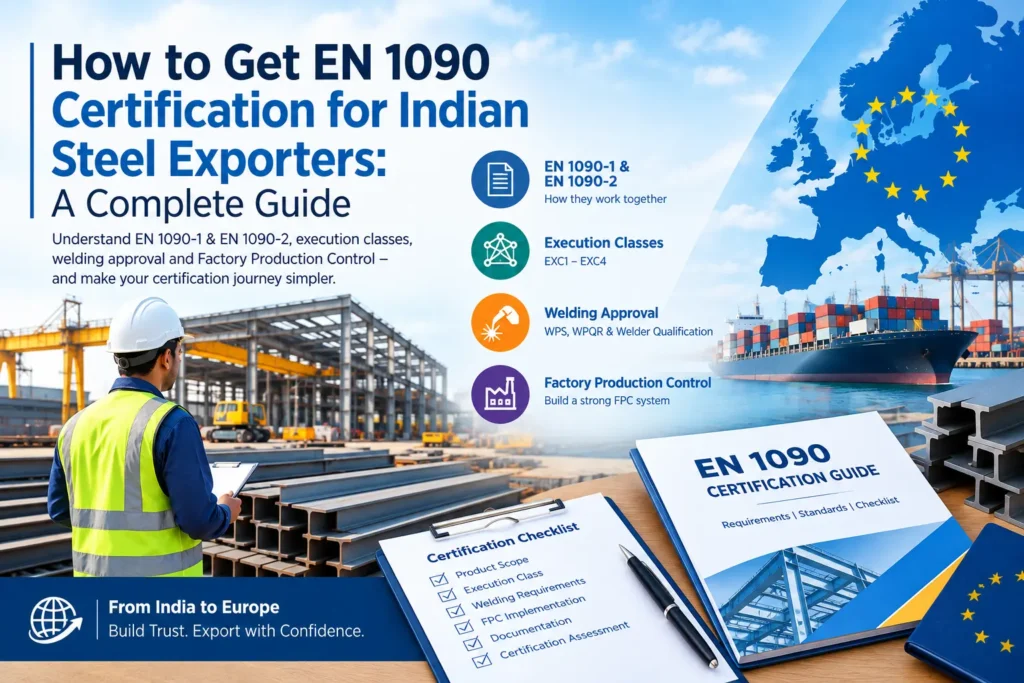
Complete Guide For EN 1090 Certification
– If you own a steel factory in India and want to sell to Europe then EN 1090 certification is a way to show that your products follow the rules for parts. Understanding how EN 1090‑1 and EN 1090‑2 work together, what the execution classes mean, how welding must be approved and how Factory Production Control is set up will make the certification process easier.
This guide explains the steps for exporters to get ready for EN 1090 certification and avoid problems with rules.
What Is EN 1090 Certification?
The EN 1090 series sets rules about how structural steel and aluminum parts are made and how they are checked for following the rules. EN 1090‑1 covers the checking of components. EN 1090‑2 gives the rules for building steel structures. Companies that sell steel products should look at both parts. Find out which rules apply to each product and each project.
Step 1: Define Your EN 1090 Product Scope
The first step is to list what you make and export.
- Structural steel parts
- Steel frames
- Made-up groups
- Sections
- Steel construction parts
- Welded structural items
Your product scope tells you which rules for technical and conformity must be followed.
Step 2: Choose the Execution Class
EN 1090 uses execution classes like EXC1, EXC2, EXC3 and EXC4. The chosen execution class changes the rules for how the product’s made how welding is done how checks are done how testing is done and how quality is managed. Indian exporters should choose the execution class before writing the certification documents. Picking a class without looking at the use of the structure can cause issues.
Step 3: Learn EN 1090‑2 Rule
A big part of the process is understanding the EN 1090‑2 rules for building steel structures. These rules cover:
- Material control and tracking
- Building
- Welding
- Testing
- Size limits
- Surface treatment
- Assembly
- Paperwork
- Quality checks
The latest version is EN 1090‑2:2018+A1:2024.
Older versions like EN 1090‑2:2008, EN 1090‑2:2008+A1:2011 and EN 1090‑2:2018 are out of date. These should not be used with the version.
Step 4: Set Up Welding Approval
Welding is part of making steel. Based on the rules manufacturers might need:
- Welding procedure documents
- Welding procedure test records
- Trained welders
- Welding quality checks
- Inspection and testing steps
Standards like ISO 3834, ISO 9606‑1 and ISO 15614‑1 might be needed, based on the work and the execution class.
Step 5: Put Factory Production Control in Place
Factory Production Control (FPC) is part of the EN 1090 checking process. Indian exporters should write down controls for:
- Materials coming in
- Material tracking
- Building steps
- Welding work
- Checking
- Handling problems
- Tracking
- Final product check
- Production records
These would help prove that the making process always follows the rules.
Step 6: Get Technical Papers Ready
Before the certification check manufacturers should collect all the quality papers.
- Product details
- Material papers
- Welding steps
- Welder papers
- Checking records
- FPC papers
- Tracking records
- Quality steps
- Drawings and details
Having papers can make the check faster.
Step 7: Pick the Right Certification Way
The way to get certified depends on the product the needed checking and the market. Manufacturers should find a certification company. A Notified Body checks the steps. Then the certification process starts.
Different Parts Of EN 1090 Certifications
EN 1090‑1: checks that parts meet the rules.
EN 1090‑2: gives the rules for building steel structures.
EN 1090-3: Technical requirements for execution of aluminium structures
So Indian exporters should not think of EN 1090‑2 as replacing the checking rules in EN 1090‑1.
Why EN 1090 Certification Matters for Indian Exporters
For companies that want to sell in Europe having EN 1090 compliance shows that the making is controlled and that the items meet the needed rules.
It also builds trust with:
- Importers
- Steel buyers
- Engineering companies
- Construction companies
- Project workers
- International buying teams
EN 1090 Welding Requirements
Welding is a major part of structural steel fabrication. Indian exporters should establish suitable welding controls according to their applicable execution requirements.
Key Welding Documents
– WPS – Welding Procedure Specification
A WPS defines how a welding operation is to be performed.
It can include parameters such as:
- Welding process
- Parent material
- Filler material
- Joint details
- Welding position
- Preheating
- Interpass temperature
- Welding parameters
– WPQR – Welding Procedure Qualification Record
Welders performing applicable welding operations need appropriate qualification.
ISO 9606-1 is a key standard for qualification testing of welders for fusion welding of steels.
Depending on the applicable requirements, manufacturers may need to establish welding quality controls in accordance with relevant parts of ISO 3834.
Other Relevant Standards
Depending on the product and applicable requirements, manufacturers may need to consider:
- ISO 3834
- ISO 9606-1
- ISO 15614-1
- ISO 5817
- EN 1090-2
Note: Not every standard listed above automatically means a separate certification is required for every EN 1090 project. Applicability depends on the scope, execution class and project requirements.
Factory Production Control Checklist
Factory Production Control, commonly referred to as FPC, is an important part of demonstrating consistent production control.
Indian exporters should establish documented controls covering relevant manufacturing activities.
FPC Checklist
Material Control
☐ Approved material sources
☐ Material certificates
☐ Material identification
☐ Material traceability
☐ Storage controls
Production Control
☐ Approved drawings
☐ Production procedures
☐ Cutting and forming controls
☐ Assembly controls
☐ Welding controls
☐ Dimensional checks
Welding Control
☐ WPS available
☐ WPQR available where applicable
☐ Qualified welders
☐ Welding consumable control
☐ Welding inspection
☐ NDT procedures where applicable
Inspection & Testing
☐ Incoming inspection
☐ In-process inspection
☐ Final inspection
☐ Dimensional inspection
☐ Weld inspection
☐ Non-conformity control
Documentation
☐ Inspection records
☐ Production records
☐ Traceability records
☐ Welding records
☐ Material documentation
☐ Calibration records
☐ Final product documentation
Indian Exporter Checklist
EN 1090 Pre-Certification Checklist
Before starting the certification process, ask:
Product
☐ Have we clearly defined our structural product scope?
☐ Do we know our intended export market?
Execution
☐ Have we identified the applicable execution class?
☐ Have we reviewed the applicable EN 1090-2 requirements?
Welding
☐ Are our welders appropriately qualified?
☐ Are applicable WPS and WPQR documents available?
☐ Are welding quality requirements established?
Materials
☐ Can we demonstrate material traceability?
☐ Are material certificates properly maintained?
Production
☐ Is Factory Production Control implemented?
☐ Are production procedures documented?
☐ Are inspection records maintained?
Documentation
☐ Are drawings and specifications controlled?
☐ Are inspection and testing records available?
☐ Are non-conformities documented and controlled?
Certification
☐ Have we identified the appropriate conformity assessment route?
☐ Have we selected the appropriate certification body where applicable?
Frequently Asked Questions
How can an Indian company get EN 1090 certification?
The company should list the product scope, choose the execution class, set up welding and production controls, run Factory Production Control, collect papers and then go through the checking.
Is EN 1090‑2:2008 the version?
No. Older versions like EN 1090‑2:2008 and EN 1090‑2:2008+A1:2011 are not used anymore. The new version is EN 1090‑2:2018+A1:2024.
What is the difference between EN 1090‑1 and EN 1090‑2?
EN 1090‑1 checks that parts follow the rules. EN 1090‑2 gives the rules for building steel structures.
What are EXC1, EXC2, EXC3 and EXC4?
They are levels of rules for making, checking and managing steel structures.
Conclusion
The way for Indian exporters to get EN 1090 certification is to follow a plan. Start by listing the product scope, choose the execution class, learn the EN 1090‑2 rules, set up welding and Factory Production Control systems, collect papers and finish the checking. Using the standards. Keeping track will help Indian steel makers get better ready for European market rules.
Related Searches
- EN 1090 Execution Classes: Complete Guide to EXC1, EXC2, EXC3 & EXC4
- EN 1090 COMPLIANCE ELEMENTS EN 1090 WPS & WPQR Requirements: Ensuring Welding Quality and Compliance
- Mastering EN 1090 Factory Production Control (FPC): Comprehensive Audit Checklist & Compliance Guide
- EN 1090 Audit Checklist: Complete Guide to Pass Your Certification Audit (2026)
Start Your Certification Journey With Us
First Welding Certification Pvt. Ltd. (PRVÁ ZVÁRAČSKÁ, a.s.) focuses on welding and certification needs, for companies working with standards.