
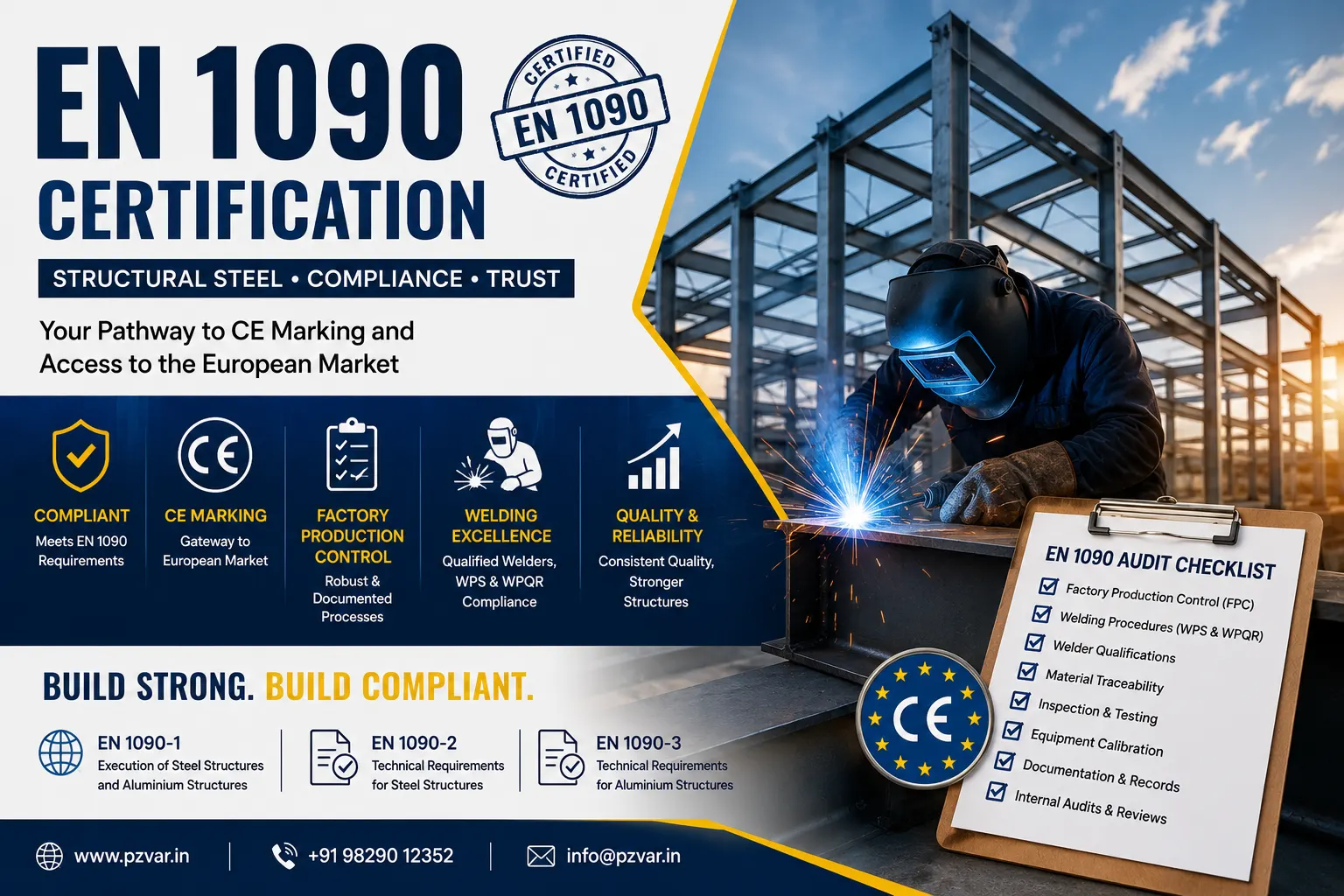
EN 1090
AUDIT CHECKLIST
FAQ
5 Aug 2026
EN 1090 Audit Checklist: Complete Guide to Pass Your Certification Audit (2026)
By Editorial Team
Table Of Contents
- What is an EN 1090 Audit?
- Why is an EN 1090 Audit Important?
- Types of EN 1090 Audits
- Complete EN 1090 Audit Checklist
- Documents Required During an EN 1090 Audit
- Common Non-Conformities Found During EN 1090 Audits
- How to Prepare for an EN 1090 Audit
- Frequently Asked Questions (FAQs)
- Conclusion
- Need Help Preparing for an EN 1090 Audit?
Related Blogs
AUG
14
EN 1090 CE Marking Audit: Complete Checklist, Common Non-Conformities & Preparation Guide
AUG
12
EN 1090 Execution Classes: Complete Guide to EXC1, EXC2, EXC3 & EXC4
AUG
10
EN 1090 WPS & WPQR Requirements: Ensuring Welding Quality and Compliance
AUG
10
Mastering EN 1090 Factory Production Control (FPC): Comprehensive Audit Checklist & Compliance Guide
JLY
31
EN 1090 Certification Requirements: 15-Point Checklist for Structural Steel & Aluminium Manufacturers
See Also.....
- EN 15085 Latest Edition 2026: EN 15085-2:2025 Update for Indian & International Manufacturers
- ASME Section VIII vs EN 13445 for PED 2014/68/EU: CE Marking Requirements for Indian Manufacturers in 2026
- SPVD Certification 2026: Latest 2014/29/EU Update, EN 286-1, Documents & CE Marking for Indian Manufacturers
Achieving EN 1090 certification is more than obtaining a certificate—it demonstrates that your organization has implemented a controlled manufacturing system capable of consistently producing structural steel and aluminium components that comply with European requirements.
However, many manufacturers underestimate the importance of the audit process. Even companies with experienced welding teams can receive non-conformities due to incomplete documentation, inadequate traceability, expired qualifications, or poor implementation of Factory Production Control (FPC).
An EN 1090 audit evaluates not only the quality of welded products but also the effectiveness of your quality management system, welding controls, documentation, personnel competence, and production processes.
This guide explains what certification bodies usually check during an audit and how manufacturers can prepare properly for a successful audit.
What is an EN 1090 Audit?
An EN 1090 audit is an independent assessment conducted by a Notified Body or certification body to verify that a manufacturer complies with the requirements of EN 1090-1 and the relevant execution requirements of EN 1090-2 or EN 1090-3.
The audit confirms that the manufacturer has implemented:
- Factory Production Control (FPC)
- Qualified welding procedures
- Competent personnel
- Material traceability
- Inspection and testing processes
- Documented quality controls
The objective is to ensure that structural components can be CE Marked and supplied to the European market with confidence.
Why is an EN 1090 Audit Important?
A successful audit demonstrates that your manufacturing processes are controlled and capable of consistently meeting the technical requirements of the standard.
Key benefits include:
- Eligibility for CE Marking under the Construction Products Regulation (CPR)
- Improved product quality and consistency
- Greater confidence among customers and project consultants
- Reduced production defects and rework
- Access to European and international markets
More importantly, regular audits help manufacturers identify weaknesses before they affect product quality or customer satisfaction.
Types of EN 1090 Audits
Manufacturers may encounter different types of audits throughout the certification lifecycle.
Initial Certification Audit
Conducted before certification is granted. Auditors review your Factory Production Control system, welding documentation, personnel qualifications, and production capabilities.
Surveillance Audit
Performed periodically to verify continued compliance after certification.
Recertification Audit
Conducted before the certificate expires to confirm that the quality management system remains effective.
Special Audit
May be required after significant organizational or production changes or following major non-conformities.
Complete EN 1090 Audit Checklist
Use this checklist to evaluate your readiness before the audit.
Factory Production Control (FPC)
- Factory Production Control Manual available
- FPC procedures documented and approved
- Responsibilities clearly defined
- Internal audits completed
- Management review records available
Welding Documentation
- Approved Welding Procedure Specifications (WPS)
- Valid Welding Procedure Qualification Records (WPQR)
- Welder qualification certificates
- Welding Coordinator appointed
- Welding procedure revisions controlled
Material Control
- Material certificates (EN 10204)
- Material traceability maintained
- Material identification system implemented
- Incoming inspection records available
Equipment & Calibration
- Welding machines maintained
- Calibration certificates available
- Measuring equipment calibrated
- Inspection tools verified
Inspection & Testing
- Visual inspection procedures
- NDT reports (where applicable)
- Dimensional inspection records
- Corrective actions documented
Personnel
- Qualified welders
- Competent inspectors
- Training records available
- Authorization records maintained
Production Control
- Work instructions available
- Production records maintained
- Non-conforming products controlled
- Final inspection completed
Document Control
- Latest document revisions available
- Obsolete documents removed
- Records securely stored
- Document approval system implemented
Documents Required During an EN 1090 Audit
Auditors commonly request the following documents:
- Factory Production Control Manual
- Quality Manual
- Organization Chart
- EN 1090 Certificate (for surveillance audits)
- WPS
- WPQR
- Welder Qualification Certificates
- Welding Coordinator Appointment Letter
- Material Certificates (EN 10204)
- Inspection Reports
- NDT Reports
- Calibration Certificates
- Internal Audit Reports
- Corrective Action Reports
- Management Review Minutes
- Training Records
- Purchase Records
- Supplier Evaluation Records
- Customer Complaint Records (if applicable)
Maintaining organized and up-to-date documentation can significantly reduce audit time and improve confidence during the assessment.
Common Non-Conformities Found During EN 1090 Audits
The following issues are among the most frequent findings during EN 1090 audits.
- Missing or Expired Welder Qualifications
Welder qualification certificates are outdated or unavailable.
- Invalid WPS or WPQR
Production welding is performed without properly qualified procedures.
- Poor Material Traceability
Materials cannot be traced back to their certificates or production batches.
- Incomplete Calibration Records
Inspection and measuring equipment lack valid calibration certificates.
- Weak Document Control
Employees use outdated procedures or uncontrolled documents during production.
- Insufficient Internal Audits
Internal audit schedules are not followed or findings remain unresolved.
- Inadequate Inspection Records
Inspection activities are performed but not properly documented.
- Factory Production Control Not Fully Implemented
The documented FPC system does not match actual production practices.
How to Prepare for an EN 1090 Audit
Successful audits begin long before the auditor arrives.
Follow these best practices:
- Review your Factory Production Control documentation.
- Verify that all WPS and WPQR documents remain valid.
- Ensure welder qualifications are currently valid.
- Confirm calibration certificates have not expired.
- Conduct an internal audit using the same checklist.
- Resolve outstanding corrective actions.
- Organize all documentation for easy access.
- Train employees on audit procedures and responsibilities.
A structured pre-audit review helps identify potential issues before they become formal non-conformities.
Frequently Asked Questions (FAQs)
How often are EN 1090 surveillance audits conducted?
Surveillance audits are typically carried out annually by the certification body, although the exact frequency depends on the certification scheme and the manufacturer’s compliance history.
Is Factory Production Control mandatory?
Yes. Factory Production Control is a core requirement of EN 1090 and is evaluated during every certification audit.
Are WPS and WPQR required for EN 1090?
Yes. Welding procedures must be documented and supported by valid qualification records where applicable.
Can a failed audit delay CE Marking?
Yes. Major non-conformities must usually be resolved before certification or continued certification can be granted.
What is the most common reason manufacturers receive non-conformities?
Incomplete documentation, poor traceability, expired qualifications, and ineffective implementation of Factory Production Control are among the most common findings.
Conclusion
An EN 1090 audit is not simply a documentation review—it is a comprehensive assessment of how effectively your organization controls manufacturing quality, welding operations, inspection activities, and compliance with European requirements.
By maintaining a robust Factory Production Control system, qualified welding procedures, competent personnel, and organized documentation, manufacturers can approach certification audits with greater confidence and significantly reduce the risk of non-conformities.
Preparation is the key to success. Regular internal audits, proactive document reviews, and continuous improvement will not only support certification but also enhance overall manufacturing quality and customer confidence.
Need Help Preparing for an EN 1090 Audit?
Experts from First Welding assists manufacturers with every stage of EN 1090 compliance, including:
- WPQR witness and approval
- Welder / Welding Operator witness and approval
- Documentation review
- Pre- audit / stage 1 audit
- Final certification audit and release of certification
Whether you’re preparing for your first EN 1090 certification or an upcoming recertification audit, our experts can explain you the complete process.