
EN 1090
COMPLIANCE
ELEMENTS
Mastering EN 1090 Factory Production Control (FPC): Comprehensive Audit Checklist & Compliance Guide
By Technical Editorial Team
8 Min Read
10 Aug 2026
Table Of Contents
- Introduction
- FPC Scope & Legal Context under CPR
- Mandatory FPC Elements (EN 1090 Clauses)
- Practical Audit Checklist & Sample Documents
- Common Nonconformities & Corrective Actions
- Step-by-Step Certification Roadmap
- PZVAR Checklist vs Official EN 1090 Clauses
- FPC Flowchart (Process Overview)
- Records & Retention Periods
- Prioritized Sources
Key Takeaways
FPC Elements
Checklist
Roadmap
Documents
Introduction
Under the EU Construction Products Regulation (CPR), companies that make structural steel and aluminum parts must have a good Factory Production Control (FPC) system.This system ensures that their products match the claimed performance and meet the rules for CE marking.EN 1090-1, which is a standard that everyone agrees on, says that fabricators need clear procedures for controlling production, welding and bolting, staff qualifications, checking and testing, tracking products, handling issues when things don’t go as planned, and keeping records.This guide takes those FPC requirements and explains them in a way that’s easy to use.It connects each part of the FPC to the relevant section in EN 1090, gives a detailed checklist for audits (with examples of what documents to use), lists common problems found during audits and how to fix them, and walks you through the steps needed to get EN 1090 certification.There’s also a comparison table that shows how the user’s PZVAR checklist matches up with the official standard, making it easier to understand both the best practices and the exact wording from the regulation.The guide also includes flowcharts and tables to help with keeping records clear and organized.
FPC Scope & Legal Context under CPR
What is FPC? The Construction Products Regulation (EU) 305/2011 (CPR) defines factory production control as the “documented, permanent and internal control of production in a factory, in accordance with the relevant harmonised technical specifications”.In practice, FPC means manufacturers must constantly check and control their production processes to make sure every structural part meets the stated performance levels.
Why EN 1090 and CE Marking?
EN 1090-1 is the harmonised standard for structural steel and aluminium components.To put a CE mark on these components, it is required to follow EN 1090-1.Under the CPR, when placing CE-marked structural steelwork on the EU market, you need:
– To do a conformity assessment using system 2+ (for EXC1/2) or system 4 (for EXC3/4), which includes factory production control and a Notified Body check.
– To provide a Declaration of Performance (DoP) and add the CE mark, based on EN 1090-1 and any EN 1090-2/3 rules for fabrication.
– To carry out FPC so that materials, production, and inspections follow EN 1090 rules.
Certification requirement: A Notified Body must check and approve the manufacturer’s FPC system.
This includes a first visit to the factory and FPC procedures, followed by continuing checks (system 2+).RINA, a notified certification body, clearly says that EN 1090-1 requires producers to set up and maintain FPC and to do all welding following ISO 3834 standards.In reality, getting the EN 1090 certificate means your FPC manual, records, and processes have been checked and are good enough to ensure consistent product quality and that you can use the CE mark.
Mandatory FPC Elements (EN 1090 Clauses)
EN 1090-1 Clause 6.3 outlines the requirements for the Factory Production Control (FPC) system.Here’s a simple summary of what is needed to have a compliant FPC system:
– Documented FPC system (Clause 6.3.1): You need to have a written FPC manual that includes all the procedures you use to control how you make your products.
This manual should explain how you run your production and inspect your items, and it should have records for all the tests and inspections you do.This is like a mini quality manual specific to EN 1090.It doesn’t need to be full ISO 9001, but it usually follows many of its requirements.
– Organizational roles and responsibilities (Clause 6.3.2): Your FPC system should clearly state who is in charge of different tasks that affect your product’s quality.
You must have a qualified Welding Coordinator, and people in charge of materials, inspections, and dealing with problems (Non-Conformance Reports) must have proper training and be fit for the jobs they do.
– Equipment control (Clause 6.3.3): All equipment you use for measuring, testing, and making your products must be properly controlled.
You must check and maintain your equipment so that it doesn’t cause problems with your products.Every activity like calibration or maintenance must be written down and kept as part of your FPC procedures.
– Design (Clause 6.3.4): If your company is responsible for the design of the structures you make, your FPC system must cover that design process.
You need to make sure that the design meets the requirements, and you must document who checks calculations and who is responsible for each part of the design.Not all fabricators do the design, so this may not apply to them.
– Constituent products (Clause 6.3.5): All the materials and consumables you use must meet the standards EN 1090-2 for steel or EN 1090-3 for aluminum.
You must have written procedures to check that everything you receive matches the specifications.Each batch of materials needs to be identified and easily traced back to its certificate of conformity (CoC).The EN 1090-2 standard adds more specific rules, such as for bolting and cutting, and you need to ensure all steel materials, like filler metals and cut edges, meet the right standards.
– Component specification & production control (Clause 6.3.6–6.3.7): For each part of your structure, you must have a “Component Specification” that includes the design details, materials used, execution class, welding process, and inspection plan.
You also need an inspection and testing plan for production.Each component must be checked against its specification, such as size and weld quality, and the results must be recorded.The sampling process must follow the specified performance characteristics in Annex ZA of EN 1090-1, depending on the execution class.
– Welding and bolting operations: EN 1090-2 and EN 1090-3 require strict controls over welding and mechanical fastening. Your FPC system must include approved welding procedure specifications (WPS) that have been tested and certified (WPQR), as well as qualification certificates for welders and operators (ISO 9606-1/14732).You must also define the role of the Welding Coordinator.Bolted connections, where required, must use certified high-strength bolts, proper tools for tightening, and proper documentation, such as torque certificates.You must also have controls for the purchase, identification, storage, and use of welding consumables, following the First-In-First-Out (FIFO) method.It’s important to note that all welding must follow ISO 3834, depending on the execution class, which often means having EN ISO 3834-2 certification or similar quality control processes for EXC3 and EXC4.
– Inspections & Testing: Your FPC system must cover all required inspections, such as visual checks of welds, measuring dimensions, and non-destructive testing (NDT) when necessary.
All inspection results must be recorded.Annex B of EN 1090-1 (for Notified Body use) implies that your audit will check that inspections and tests are properly planned and documented.
– Nonconformity handling (Clause 6.3.8): You must have written procedures to find, record, and deal with any issues with your products.
As soon as a problem is found, it must be recorded (Non-Conformance Report), assessed, and corrected.All records of non-conformities must be kept, including any rework or special approvals.
– Records & Retention: All records related to the above processes must be kept.
EN 1090-1 requires that test and inspection results are recorded and that any issues and their solutions are kept for the time your company decides and documents.The standard does not set a specific retention period, so you must decide and write it down.(In comparison, CPR requires keeping the Declaration of Performance and technical documents for 10 years after the product is sold, and EN 1090-1 requires retaining initial type test and calculation records for at least 5 years.) In practice, many fabricators keep records from 5 to 10 years, or longer, for warranty and regulatory reasons.
– Internal audits & management review: Although EN 1090-1 does not require internal audits or management reviews like ISO 9001, a solid FPC system (often part of an ISO 9001 Quality Management System) might include these.
Regular internal audits help check that FPC procedures are followed and working, while management reviews ensure that the system is reviewed by top management.PZVAR’s audit advice shows that a lack of internal audits and corrective actions is a common problem.Best practice: schedule annual internal FPC audits and regular management reviews to spot issues early and show that you have control.
Practical Audit Checklist & Sample Documents
To get ready for an EN 1090 audit, use this checklist of important items (with example documents) that cover all parts of the Fabrication and Production Control (FPC):
FPC Manual & Procedures: Make sure your FPC manual and all procedures clearly explain things like material control, welding, inspections, calibration, handling issues, and keeping records.
(Documents: FPC Manual, Quality Plan, Control Procedures.)
Material Control Records: Check that every delivery of steel or aluminum has a material certificate (EN 10204 3.1/3.2) that matches the required standard.
Confirm that batch or heat numbers on parts match the certificates.(Documents: Mill Test Reports, Material Inspection Records, Receiving Logs.)
Traceability: Make sure all fabricated parts have a unique identifier, like a tag or paint mark.
Check that these tags connect back to the material certificates and the component specifications.(Documents: Traceability Sheets, Tag Registers.)
Welding Procedures: Ensure that there are approved welding procedure specifications (WPS) for each welding process and class.
Each WPS should clearly describe the joint types, materials, thickness ranges, and any needed preheat or interpass temperatures.(Documents: Welding Procedure Specifications (WPS), Welding Coordination Record.)
Welding Procedure Qualifications: Check that every WPS has a valid weld procedure qualification record (WPQR) that shows successful tests like bends and tensile tests.
Make sure that the WPQR covers the exact materials and joints used in production.(Documents: WPQR Reports, PQR Test Certificates.)
Welders & Operators Qualifications: Verify that welders and operators have up-to-date qualifications for the processes and positions they use.
Their certificates must cover the materials, positions, and thickness ranges they work with.(Documents: Welder Qualification Certificates, Welder List.)
Welding Coordination: If the project is EXC2 or higher, make sure there is a qualified welding coordinator.
Confirm that there are documents showing who is assigned to this role and proof of their activities like checking compliance with WPS and reviewing records.(Documents: Welding Coordinator Credentials, Assignment Letter.)
Consumables & Bolting: Check records for welding consumables like electrodes and fillers to make sure they meet EN 13479 for steel.
Ensure they are stored and used in the right order (FIFO).Also, check that high-strength bolts meet EN 1090 standards and have tensile test certificates.If torque is applied to bolts, make sure there are calibration records for the torque wrenches.(Documents: Consumables Inspection Log, Bolt Certificate, Torque Wrench Calibration Log.)
Equipment Calibration Logs: Check that measuring tools like gauges and ultrasonic testers have calibration records or stickers.
Make sure that maintenance logs for welding machines are kept if they are part of the quality process.(Documents: Calibration Certificates, Maintenance Schedules.)
Inspection & Testing Records: Make sure each component was inspected following the inspection plan.
Look for completed inspection and test plans showing checks like dimensions, weld appearances, and non-destructive testing results.(Documents: ITPs, Inspection Checklists, NDT Reports.)
Non-Conforming Product (NCR) Records: If there were any defects, there should be non-conformance reports that explain what went wrong, how it was evaluated, and what steps were taken to fix it.
Make sure all these are recorded and resolved.(Documents: NCR Log, Corrective Action Forms.)
Training & Competence Records: Check that there are records of training for FPC, welding safety, and any special training, like for welding coordination, for relevant team members.
(Documents: Training Matrix, Certificates, Attendance Records.)
Internal Audits & Management Review: If you have done internal audits or management reviews, check the latest audit reports and meeting minutes.
(Documents: Internal Audit Reports, Audit Checklists, Meeting Minutes.)
Declaration of Performance & FPC Certificate: Make sure you have the CE marking and the Declaration of Performance (DoP) ready.
Check that you also have a copy of any existing Certificate of Conformity for FPC.(Documents: Draft DoP, CE mark label proof, Notified Body Certificate of FPC.)
Each of these points should be backed by a document or record.
For example, files might be named like “FPC_Manual_v2.3.pdf”, “WPS-123-EXC3.pdf”, “WPQR-EC-34.pdf”, “Welder-Cert-JohnDoe.pdf”, “ITP-ComponentX.pdf”, “NCR-0023.pdf”, “CalibrationLog_FT4.pdf”, “InternalAudit_Aug2025.pdf”, and so on.Using clear file names with dates, version numbers, and initials of the person responsible makes it easier for auditors to find and check the information.
Common Nonconformities & Corrective Actions
Auditors often come across problems when implementing FPC.Here are some common issues and how to fix them:
Incomplete or outdated FPC documentation: When procedures are missing, not controlled, or not up to date, it leads to non-conformity reports.
Fix: Check and update your FPC manual and procedures.Make sure documents are version controlled and approved.Do a document review to cover any missing parts like welding, materials, inspection, or NCRs.
Missing welding documentation: Audits sometimes find that welding procedures (WPS), welding procedure qualification records (WPQR), or welder certificates are missing or expired.
Fix: Prepare or update all WPSs.Ensure each has a valid WPQR that covers the actual material thickness.Make sure every welder is qualified.Keep printed certificates easy to find.
Poor material traceability: Common issues include missing mill certificates, no heat numbers, or parts that are not correctly labeled.
Fix: Label each raw material with a unique ID as soon as it arrives.Keep a material log that connects each ID with its certificate.If a material doesn’t have a certificate, get a replacement from the supplier.Make sure labels stay attached even during cutting and fabrication.
Incomplete inspection or NDT records: Just doing inspections isn’t enough.
Auditors want evidence.Missing logs, reports, or calibration stickers are major findings.Fix: Make sure every inspection step, like a weld visual check or ultrasonic test, is signed off on an ITP or checklist.Keep original NDT reports (like UT, MT, PT, RT) in order.Check that all inspection tools are calibrated and have up-to-date certificates.
Non-conformity management lapses: If there’s no NCR process or log, auditors will mark it as a major issue.
Fix: Set up a formal NCR process.Use NCR forms to record any defects, the root cause, and how to fix them.Train staff to report NCRs quickly.During audits, show closed NCRs as proof of corrective actions.
Lack of internal audits or corrective action system: Not having regular internal audits or a corrective action system is a common finding.
Fix: Do periodic self-audits of the FPC system.Record all findings and actions taken in audit reports.This shows auditors that you’re proactively keeping up with compliance.
Expired certificates: This includes welder certificates, calibration tags, or the FPC certificate itself.
Expired documents are considered non-conformities.Fix: Create a list of all certificates and their expiry dates.Set up reminders to renew them before they expire.
By fixing these issues with clear and documented solutions, manufacturers can avoid delays in getting certified.
Step-by-Step Certification Roadmap
Use this roadmap to help your factory reach CE marking compliance:
– First, figure out if your product needs EN 1090-1 certification.
This depends on how it’s used in construction and if it has a load-bearing role.Check the required Execution Class (EXC) from EXC1 to EXC4 by looking at EN 1090-2/3 Annexes or talking to an authority.
– Next, do a gap analysis.
Check what your current FPC (Fabrication and Production Control) practices are against the EN 1090-1:2011 FPC requirements (Clause 6.3) and EN 1090-2 fabrication rules.Use the checklist provided to find any missing parts.
– Then, create your FPC manual and written procedures.
Cover all areas like material control, welding control, production steps, inspections, calibration, NCRs (Non-Conformity Reports), and records.Make sure to clearly define roles, like assigning a Welding Coordinator with the right qualifications for your EXC.
– Collect all the key documents needed.
This includes WPS/WPQR (Welding Procedure Specifications/Welding Procedure Qualification Records), welder qualifications, material certificates, inspection plans, calibration logs, and NCR forms.Make sure they are all in a consistent format and easily accessible.
– Put the procedures into action in the workshop.
Train your staff on these new practices, such as how to complete an NCR or check incoming materials.Run a few batches of production using the FPC as written.
– Before the Notified Body visit, do an internal audit or a management review.
Walk through the process of making a part, from raw materials to the final product as suggested by PZVAR.Check for traceability, correct WPS use, inspections, and documents for that part.Fix any issues and keep records of the corrections made.
– Choose a Notified Body, like DNV, RINA, or TÜV.
They will register your company and schedule Stage 1 (document review) and Stage 2 (on-site audit).
– During Stage 1 Audit, the auditor will look at your quality documents like the FPC manual, procedures, and records.
Address any non-conformities found, which are often small.Be ready to explain responsibilities, scope, and any unclear parts of the documents.
– In Stage 2 Audit, the auditor will tour your factory, talk to your staff, and check your processes against your documents. They may pick some finished parts and check their records, such as material certificates, WPS used, and inspection results.Any non-conformities found here need to be fixed before you get certified.
If everything is okay, the Notified Body will issue a Certificate of Conformity of FPC (system 2+).
You can then create Declarations of Performance (DoPs) for your products and put CE marks on them.
After certification, keep your FPC system running as it is.
Expect annual audits.Update your procedures when you make new products or change EXC levels.Keep staff training up to date.Use internal audits and management reviews to improve your FPC system continuously.
By following these steps, you build a quality control culture that meets EN 1090 and makes your audit process smoother.
PZVAR Checklist vs Official EN 1090 Clauses
| Checklist Topic | PZVAR Guidance (Audit Prep) | EN 1090 Clause(s) |
|---|---|---|
| Applicability & Scope | “Check if EN 1090-1 applies to your product’s use, materials and market” | EN 1090-1 Clause 1 (Scope of standard for steel/al components) |
| Execution Class | “Choose the correct EXC (EXC1–EXC4) based on project” | EN 1090-2 §4 + Annex (defines EXC levels and requirements). Needed by EN 1090-1 Annex ZA. |
| FPC System (Manual) | “Set up a robust FPC covering responsibilities, production controls, inspections, records” | EN 1090-1 §6.3.1 (Establish, document and maintain FPC with written procedures) |
| Incoming Materials | “Verify incoming steel/al matches required grade, size, spec, with certs” | EN 1090-1 §6.3.5 (Inspections of constituent products used in manufacture); EN 1090-2 sets material standards |
| Material Traceability | “Track materials from certificate through to finished part” | EN 1090-1 §6.3.5 (Identification & traceability of materials) |
| WPS Control | “Use only approved WPS, ensure it is followed during welding” | EN 1090-2 §7.4 (Welding procedure specification requirements per ISO 15614) |
| WPQR Validation | “Ensure each WPS has a valid WPQR covering actual weld conditions” | EN 1090-2 §7.4.1 (Qualification of welding procedures with appropriate tests) |
| Welder Qualifications | “Confirm welders/operators are qualified for the work they do” | EN 1090-2 §7.5 (Welder and operator qualification requirements, e.g. ISO 9606) |
| Welding Coordination | “Assign qualified welding coordinators with defined roles” | EN 1090-2 §4.2 (Welding coordination tasks and qualifications for EXC2–4) |
| ISO 3834 Compliance | “Meet appropriate level of ISO 3834 (welding QA standard) as needed” | EN 1090-1 does not mandate ISO 3834, but notified bodies require welding to ISO 3834 (RINA: “perform all welding in conformity with ISO 3834”). |
| Consumables Control | “Control welding consumables: procurement, ID, storage, distribution” | EN 1090-2 §5.5 (Filler metals & fluxes must comply with EN 13479); ISO 3834 also covers consumables traceability. |
| Equipment Calibration | “Maintain/calibrate all production and test equipment” | EN 1090-1 §6.3.3 (Calibrate and inspect measuring/testing equipment; maintain production equipment) |
| Inspection & Testing | “Plan/document all required inspections (dimensions, welds, NDT)” | EN 1090-1 §6.3.6–6.3.7 (Inspection plan and ongoing conformity evaluation of components) |
| Nonconforming Products | “Record and fix any production issues; segregate bad parts” | EN 1090-1 §6.3.8 (Written procedures for nonconforming products; record and correct deviations) |
| Records & CE Marking | “Keep all necessary records and CE marking documentation (DoP, CE label)” | CPR Art. 11: DoP and technical docs must be kept 10 years; EN 1090-1: records per FPC. |
Table: PZVAR’s 15-point checklist compared to the specific EN 1090 clauses.PZVAR’s recommendations (on the left) are based on its blog guide, while the official requirements (on the right) are taken from the EN 1090-1/2 text and CPR.
FPC Flowchart (Process Overview)
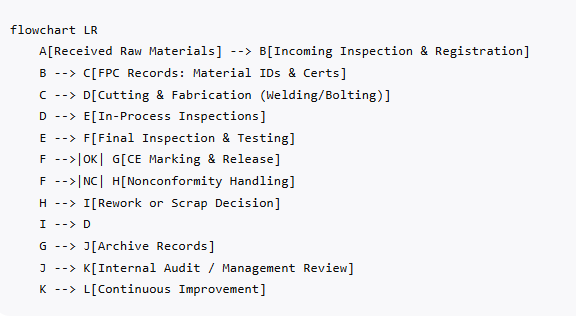
A flowchart shows an example of how an FPC is made.It starts with checking and recording the raw materials to keep track of where each part comes from.Then, the materials are made into the final product using controlled steps.At each step, there are checks to make sure everything is good.Parts that pass are marked with a CE symbol and sent out.If something is wrong, it goes back for fixing.Every part of the process is written down and saved, and the whole system is checked regularly to keep it running well.
Records & Retention Periods
EN 1090 does not set specific time limits for keeping FPC records, unless stated otherwise.Usually, you should keep records for the time period mentioned in the manufacturer’s FPC procedures.The table below shows important documents and how long they should be kept.
| Record / Document | Retention |
|---|---|
| Declaration of Performance (DoP) & Technical Docs | 10 years after last product is placed on market (per CPR Art. 11) |
| Initial type test / calculation reports | ≥ 5 years (per EN 1090-1 clause 6.2.8) |
| Inspection & Test Records, NCR logs | As per FPC manual (not specified in EN 1090); typically 5+ years |
| Equipment calibration & maintenance logs | As per FPC manual (not specified); typically aligned with audits |
| Material mill certificates (EN 10204) | As per FPC/contract (not specified); best practice ≥ 5 years |
| WPS/WPQR documents | As long as procedure is in use (not specified) |
| Welder/operator qualification certificates | While employee is in role (not specified) |
| Internal audit & management review records | As per company policy (not specified; often 3–5 years) |
Table: Key FPC-related records and suggested retention periods.EN 1090 requires certain records, like type test results, to be kept for 5 years, while CPR requires the DoP records to be kept for 10 years.Other records are kept based on the procedures set by each manufacturer.
Prioritized Sources
Regulation (EU) No.305/2011 (CPR) – Sections 2 and 11 (covering definitions and what the manufacturer must do).
EN 1090-1:2009+A1:2011, “Execution of steel structures – Part 1” – Section 6.3 (rules for factory production control).
EN 1090-2:2008, “Execution of steel structures – Part 2” (technical rules for welding and bolting steel structures).
EN ISO 3834 series, “Quality requirements for fusion welding” (mentioned in EN 1090-2 and the NB guidelines).
European Commission Guidance on the Construction Products Regulation.
Notified Body Guidance (such as from RINA, DNV, etc.) – RINA provides an overview of EN 1090-1 (FPC and ISO 3834 requirements).