
EN 1090
GUIDE
ELEMENTS
EN 1090 Execution Classes: Complete Guide to EXC1, EXC2, EXC3 & EXC4
By Technical Editorial Team
13 Min Read
12 Aug 2026
Table Of Contents
- Introduction
- What Is an EN 1090 Execution Class?
- Why Are Execution Classes Important?
- What Are EXC1, EXC2, EXC3 and EXC4?
- EXC2 – Standard Execution Class
- EXC3 – Higher Execution Requirements
- EXC4 – Highest Execution Class
- How Is the EN 1090 Execution Class Selected?
- Who Determines the Execution Class?
- Can One Structure Have More Than One Execution Class?
- What Happens If No Execution Class Is Specified?
- How Does Execution Class Affect Welding?
- Execution Classes and Material Traceability
- Execution Classes and Inspection
- Execution Class and EN 1090 Certification
- Common Mistakes When Selecting an Execution Class
- EN 1090 Execution Class Audit Checklist
- FAQ
- Conclusion
Key Takeaways
Documentations
Process Flow
Tips
Checklist
Introduction
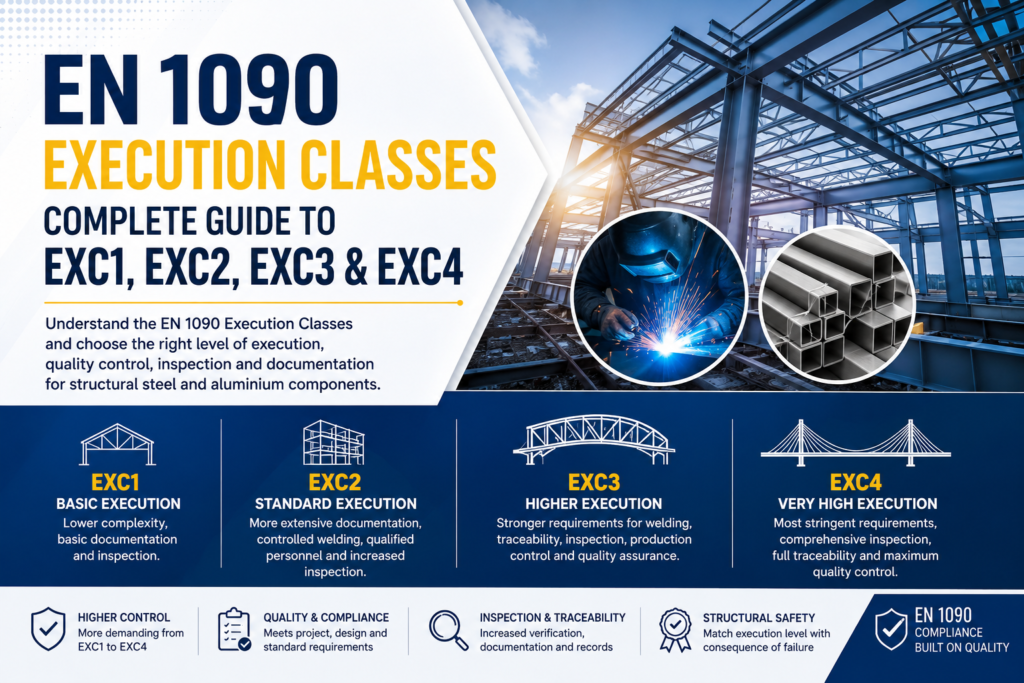
EN 1090 Execution Classes set out the level of execution, quality control, inspection, and fabrication standards that apply to structural steel and aluminium parts.There are four classes: EXC1, EXC2, EXC3, and EXC4.The requirements become more detailed as you go from EXC1 to EXC4.
Selecting the right execution class is important because it affects things like welding standards, inspection processes, traceability, quality records, worker skills, and how well the project follows EN 1090 rules.
But there’s a common mistake people make:
It’s not enough to pick an execution class just because a structure is a building, bridge, or industrial structure.
The correct execution class depends on the design and what the project needs.
Factors like consequence class, service conditions, and production features are all considered.EN 1090-2 and EN 1090-3 connect execution standards to how the structure is designed.
What Is an EN 1090 Execution Class?
An Execution Class (EXC) sets the level of requirements for how a structural part or whole structure must be built.
EN 1090 defines four different classes:
| Execution Class | General Level |
|---|---|
| EXC1 | Basic execution requirements |
| EXC2 | Standard execution requirements |
| EXC3 | Higher execution and quality requirements |
| EXC4 | Highest/special execution requirements |
The order is important:
EXC1 → EXC2 → EXC3 → EXC4
As the execution class goes up, the level of control and checking needed usually gets stricter.
For example, EN 1090-3 clearly says there are four execution classes, and the level of strictness gets higher from EXC1 to EXC4.
Why Are Execution Classes Important?
Execution classes help set up a clear way to link how something is made and controlled with what happens if there’s a problem with the structure.
The execution class can affect several important areas:
– The standards for welding quality
– How welding is organized and managed
– Controls for Welding Procedure Specifications (WPS) and Welding Procedure Qualification Records (WPQR)
– What qualifications welders need
– What checks and inspections are required
– Non-Destructive Testing (NDT) methods
– Ability to track materials used
– Keeping proper quality records
– How production is controlled
– The skills and knowledge of the workers
– Keeping detailed manufacturing records
– How Factory Production Control (FPC) is carried out
Choosing the wrong execution class can lead to big issues with following rules and standards.
For example, a company might have a great welding process but still not meet the project’s needs if the right execution class was not chosen or if the correct inspection steps were not followed.
What Are EXC1, EXC2, EXC3 and EXC4?
EXC1 is the lowest level among the four execution classes.
It is meant for structures or parts of a structure where the problems that could happen if something goes wrong are not too serious, and the design or project rules allow using EXC1.
Examples might include simpler parts of a structure, but the right class depends on the project or design needs, not just the name of the part.
Common features of EXC1 include:
– Less complex work to do
– Less detailed paperwork needed
– Fewer inspections than higher classes
– Not as strict rules about tracking where things came from
– Basic standards for weld quality if welding is involved
For aluminum structures, EN 1090-3 sets different rules based on the execution class, including different levels of quality records, inspection records, and tracing between EXC1 and the other classes.
Important: EXC1 does not mean there is no quality control.
The manufacturer still has to follow the correct technical rules and execution standards.
EXC2 – Standard Execution Class
EXC2 is a common type of execution class used in structural fabrication.It offers more control over the execution process compared to EXC1 and has extra requirements in areas like documentation, welding, inspection, and production control.For many makers, EXC2 is important because it needs a more organized system for production and ensuring good welding quality.The specific requirements can vary depending on the standard and project, and may include:
– More detailed quality records
– Controlled welding methods
– Trained and qualified welders
– Coordinated welding activities
– More frequent inspections
– Better ways to identify materials
– Detailed production records
– Clear plans for inspections and tests
For aluminum structures, EN 1090-3 says that EXC2 needs inspection certificates 3.1 for each part and extra marking rules when different types of aluminum or tempering are used.
EXC3 – Higher Execution Requirements
EXC3 requires more strict rules for how work is done and the quality of the final product.
This standard is used when the structural effects or project needs call for a higher level of control during the manufacturing process.
Compared to EXC2, manufacturers can expect stricter rules in these areas:
– Quality of welds
– Ability to track the product through each stage of production
– Checking the work for quality
– Keeping proper records and documents
– Controlling the production process
– Coordinating welding activities
– Ensuring workers are skilled and trained
– Having a strong quality assurance system
For aluminium fabrication, EN 1090-3 requires that materials used in EXC3 and EXC4 have an inspection certificate labelled 3.1, and it also requires tracking of the product through each step of the process.
Welding requirements become even more important as the execution class increases.
EN 1090-3 links the execution class to specific welding quality standards like this:
– EXC1 → EN ISO 3834-4
– EXC2 → EN ISO 3834-3
– EXC3 and EXC4 → EN ISO 3834-2
Always check the exact requirements in the current version of the execution standard and the project specifications.
EXC4 – Highest Execution Class
EXC4 is the top execution class in the EN 1090 framework.It means the highest level of control during the execution process and is used for structures or parts that have very serious consequences or special needs.
EXC4 isn’t just like EXC3 with more paperwork.
It can mean much stricter rules in several areas, such as:
– Making the parts
– Welding
– Checking for quality
– Keeping track of everything
– Writing quality documents
– Training and skills of workers
– Verifying the work
– Specific needs of a project
The exact rules depend on the execution standard, the design, and the project requirements.
| Requirement | EXC1 | EXC2 | EXC3 | EXC4 |
|---|---|---|---|---|
| Execution strictness | Basic | Standard | High | Highest |
| Quality documentation | Lower | Increased | Extensive | Extensive |
| Material control | Required | More controlled | Higher traceability | Highest control |
| Traceability | Limited depending on requirement | Increased | Strong | Strong |
| Welding control | Basic applicable requirements | Controlled | More demanding | Most demanding |
| Welding quality level* | ISO 3834-4 | ISO 3834-3 | ISO 3834-2 | ISO 3834-2 |
| Inspection | Basic applicable level | Increased | Higher | Highest/special |
| Production control | Required | Required | More stringent | Most stringent |
| Typical risk level | Lower | Normal/standard | Higher | Exceptional/special |
The welding quality shown above follows the EN 1090-3 rules for aluminium and shouldn’t be used for every project without checking the right version and the specific standards for the material being used.
How Is the EN 1090 Execution Class Selected?
This is one of the most important parts of EN 1090.
The execution class should be chosen based on the design and execution specification, not just picked by the fabricator because one class seems easier or cheaper.
The process of choosing the execution class is part of the structural design process.
Here’s a simpler way to look at it:
– First, figure out the structural consequences.
– Then, decide on the applicable consequence class.
– Next, think about the service category.
– Then, consider the production category.
– After that, determine the correct execution class.
– Include the execution class in the execution specification.
– The manufacturer then follows the necessary fabrication controls.
EN 1090-3 explains that execution classes are connected to consequence classes.
It also mentions that EN 1999-1-1 provides guidance on how to choose the right execution class based on the consequence class for aluminium structures.
Who Determines the Execution Class?
The execution class is a key decision made during the design or project planning, not just something chosen by a certification body or based on convenience by the fabricator.
The project documents should clearly state which execution class is needed.
The manufacturer must then make sure their production process and FPC setup can meet that specific class.
In practice:
– The designer, engineer, or project specification sets out the required standards.
– The manufacturer or fabricator is responsible for putting those standards into action.
– The certification body or notified party checks if the manufacturer follows the rules within their area of certification.
If it’s not clear what execution class is needed, the manufacturer should get more information before starting production.
Can One Structure Have More Than One Execution Class?
Yes.
This is an important point.
Execution classes don’t have to be the same everywhere in a structure.
EN 1090-3 says that execution classes can be used for:
The whole structure
A part of the structure
Specific details
And a single structure can have more than one execution class.
For example, a project might say:
Main structural parts → EXC3
Secondary parts → EXC2
Important specific details → EXC4
The exact way it’s done depends on the project or design requirements.
What Happens If No Execution Class Is Specified?
Manufacturers need to be careful in this area as well.
The aluminium execution standard mentioned earlier, EN 1090-3, says that if no specific execution class is given, then EXC2 is the default.
But manufacturers shouldn’t just automatically use EXC2 for every case.
They should check the correct version of the standard, the design basis, any national rules, and the project specifications.
If the project documents don’t clearly say which execution class to use, it’s better to ask the responsible designer or project authority for clarification.
How Does Execution Class Affect Welding?
The execution class directly affects the welding needs.
For a manufacturer, the welding system should include the following areas:
– Welding procedures
– Welding Procedure Specification (WPS)
– Welding Procedure Qualification Record (WPQR)
– Welder qualification
– Welding coordination
– Welding consumables
– Welding parameters
– Preheating
– Interpass temperature
– Welding inspection
– Non-Destructive Testing (NDT)
– Welding records
Higher execution classes usually mean more strict control is needed.
For aluminium structures, EN 1090-3 sets different ISO 3834 quality levels based on the execution class.
This is why it’s important for manufacturers to decide on their execution class before completing their welding documents.
Execution Classes and Material Traceability
Material traceability becomes more important as the execution class gets higher.
For aluminum structures, EN 1090-3 says that for EXC3 and EXC4, each part must be traceable at every step from when it is delivered until it is added to the structure.
A real example of how this traceability works is:
Material Certificate
↓
Heat or Batch Number
↓
Cutting
↓
Part Identification
↓
Fabrication
↓
Welding
↓
Inspection
↓
Finished Component
This helps the manufacturer know exactly which material was used in each part.
Execution Classes and Inspection
As the execution class gets higher, the inspection and quality control needs can become more strict.
Depending on the structure and the rules that apply, inspection might include:
Checking measurements
Looking at welds visually
Examining the surface
Non-destructive testing
Checking the materials
Checking during production
Final check before delivery
You shouldn’t assume how much inspection is needed just from the execution class.
The manufacturer should check:
EN 1090-2 or EN 1090-3
The design documents
The execution plan
The drawing requirements
The inspection rules that apply
The special rules for the project
Execution Class and EN 1090 Certification
Manufacturers who want EN 1090 certification must create a scope that shows the products and types of work they plan to make.
For example, a company might have certification for:
– Structural steel parts – EXC1 and EXC2
Another company might need:
– Structural steel parts – EXC1, EXC2, and EXC3
The scope of the certification should match what the company can really do and the rules that apply to their products.
A business should not say or promise they can make a certain EXC level if they aren’t certified or qualified to do so within their approved area.
Common Mistakes When Selecting an Execution Class
Mistake 1: Choosing EXC2 Automatically
Some companies think:
“Most businesses use EXC2, so we should too.”
This is not a good way to decide.
The right execution class should be based on the specific design and project needs.
Mistake 2: Choosing EXC Only by Building Type
Saying:
“It’s a warehouse, so EXC2 is fine.”
is not enough.
Two buildings with similar uses can have different structural needs and therefore different execution requirements.
Mistake 3: Thinking Higher EXC Is Always Better
Picking EXC4 for everything might seem safer, but it can lead to extra work in manufacturing, writing documents, and checking things.
The correct way is to use the execution class that matches the design and project requirements.
Mistake 4: Not Following Project Specifications
A project’s specifications can have extra rules that go beyond the standard.
The manufacturer must check the full execution specification before starting production.
Mistake 5: Using Steel Rules for Aluminium
EN 1090-2 is for steel structures, and EN 1090-3 is for aluminium structures.
Even though both use EXC1–EXC4, the exact technical rules are not the same.
EN 1090-3:2019 covers aluminium structural parts like rolled shapes, extrusions, cold-drawn items, forgings, and castings.
EN 1090 Execution Class Audit Checklist
Before starting a project, a manufacturer can check the following:
Project Requirements
Is the correct execution class clearly stated?
Is there a clear execution specification?
Has the design documentation been reviewed?
Are the specific project needs known?
Materials
Are the needed material grades known?
Are the material certificates available?
Is there proper traceability for the EXC?
Are there procedures to identify materials?
Welding
Are the right WPS available?
Are the WPS qualifications suitable?
Are the welders and operators qualified?
Is the welding coordination properly assigned?
Are the welding consumables controlled?
Do the inspection needs make sense?
Production
Are the current drawings available?
Are the production procedures controlled?
Are the manufacturing staff trained and skilled?
Are the inspection records kept?
Quality
Is the required level of inspection set?
Are the NDT requirements understood?
Are the non-conformities managed?
Are the necessary documents kept?
Certification
Does the manufacturer’s EN 1090 certification cover the needed EXC?
Does the FPC system support the correct execution class?
Are the manufacturer’s production abilities enough?
Frequently Asked Questions
What are the four EN 1090 Execution Classes?
The four execution classes are:
EXC1, EXC2, EXC3 and EXC4.
The required strictness generally increases from EXC1 to EXC4.
Which is the highest EN 1090 Execution Class?
EXC4 is the highest execution class.
Is EXC2 the standard execution class?
EXC2 is commonly encountered, but it should not automatically be selected for every project. The applicable execution class must be established according to the relevant design and project requirements.
Who decides the EN 1090 Execution Class?
The execution class is established through the applicable design/project requirements and execution specification. The manufacturer implements the requirements in production.
Can one structure have multiple execution classes?
Yes. Execution classes can apply to the whole structure, a part of the structure or specific details.
Does EXC3 require more inspection than EXC2?
Generally, higher execution classes bring more stringent execution and inspection requirements, but the exact inspection extent must be determined from the applicable EN 1090 part, project specification and design requirements.
Does execution class affect welding?
Yes. Execution class affects welding-quality requirements and associated controls. For aluminium structures, EN 1090-3 specifies different ISO 3834 quality levels for different execution classes.
Is EXC4 required for every bridge?
No. The execution class should not be assigned solely from the structure’s name. It must be established using the applicable design and execution requirements.
Conclusion
EN 1090 Execution Classes offer a way to set the level of detail and control needed when making and putting together structural parts.
There are four classes:
EXC1 → EXC2 → EXC3 → EXC4
Each class has more strict rules than the one before it.
For makers, knowing which execution class applies is really important because it affects several things like:
– Welding
– Welding Procedures and Qualifications
– Welder certifications
– How welding is managed
– Tracking the materials used
– Checking for quality
– Non-Destructive Testing
– Controlling the production process
– Keeping records
– FPC requirements
– What is included in the EN 1090 certification
The main rule to remember is simple:
Don’t pick an execution class based on guesses, the type of structure, or what’s easier.
Instead, decide it based on the design, project, and production needs before you start making the parts.
For steel structures, you should follow the rules in EN 1090-2.
For aluminum structures, it’s EN 1090-3.EN 1090-3:2019 is currently active and recognized by national standard organizations like NEN and NBN.
If your company is getting ready for EN 1090 certification or an audit on execution class compliance, First Welding Certification Pvt Ltd. review your FPC, welding documents, production controls, and certification needs against the correct execution class.