
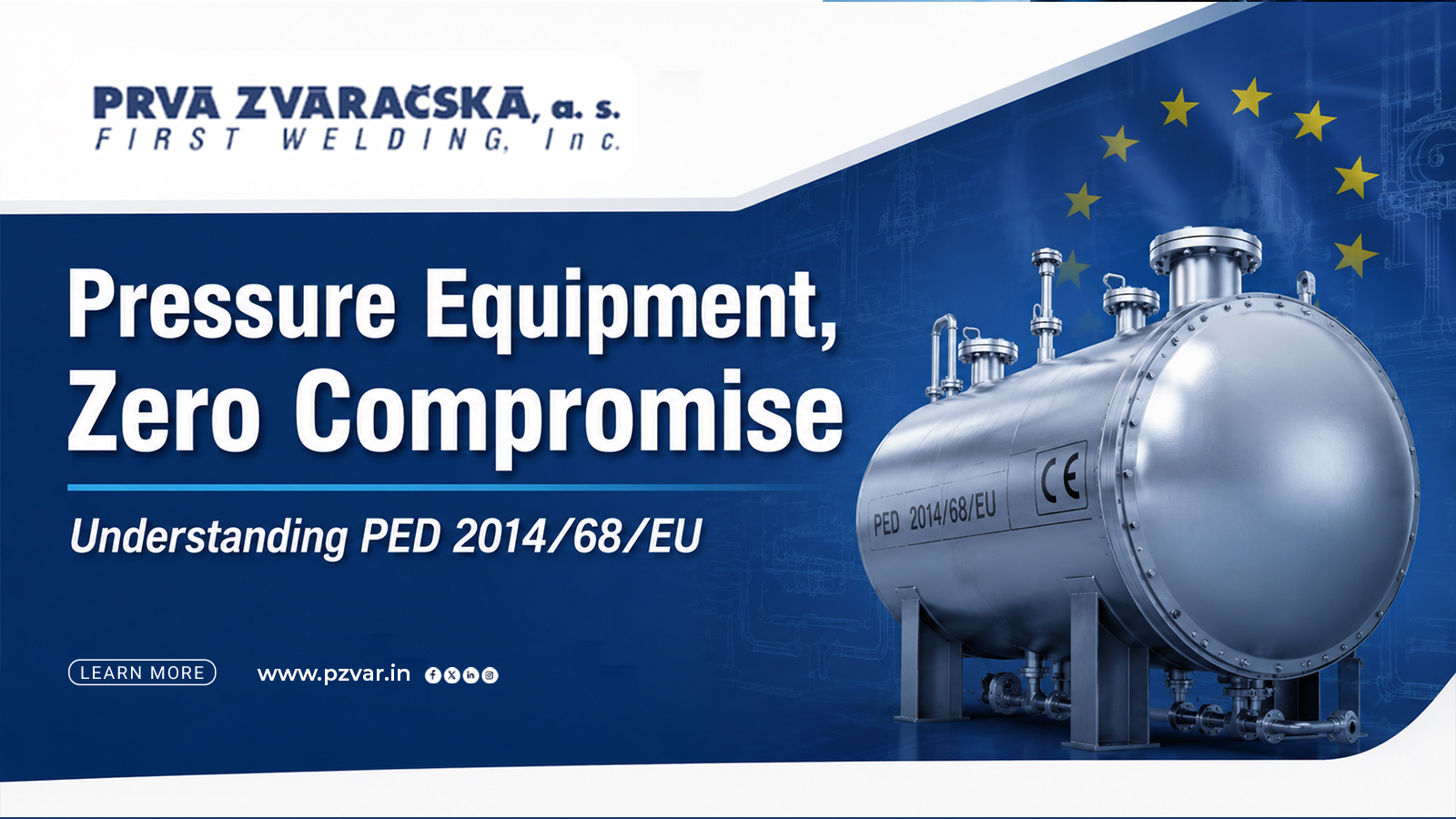
The 2014/68/EU Pressure Equipment Directive: What Manufacturers Need to Know
Anything that holds pressure carries risk. A boiler, a heat exchanger, a reactor, a length of high-pressure piping; when something inside is under pressure and it fails, the consequences can be severe. That’s the simple reasoning behind the Pressure Equipment Directive, known by its reference number 2014/68/EU and usually shortened to PED. If you design, manufacture, or sell pressure equipment in the European market, this directive isn’t optional reading. It’s the law you build to.
PED can feel intimidating at first because it’s written in formal legal language and packed with categories, modules, and annexes. But the core ideas are actually quite logical once you step back. Here’s what manufacturers really need to understand.
What PED covers, and when it applies
The directive applies to the design, manufacture, and conformity assessment of pressure equipment and assemblies with a maximum allowable pressure greater than 0.5 bar. That threshold sweeps in a huge range of products: pressure vessels, steam boilers, piping, safety accessories like relief valves, and pressure accessories, along with assemblies that combine several of these.
Below that 0.5 bar limit, the directive doesn’t apply. Above it, you’re in scope, and you need to demonstrate that your equipment meets the directive’s safety requirements before it can be placed on the EU market and carry the CE mark.
The risk-based approach: categories I to IV
One of the smartest things about PED is that it doesn’t treat all pressure equipment the same. A small accumulator holding a harmless fluid is simply not as dangerous as a large vessel holding a toxic, flammable gas, and the directive reflects that.
Equipment is sorted into categories based on a combination of factors: the pressure, the size (volume for vessels, nominal diameter for piping), the physical state of the contents (gas or liquid), and the fluid group. Group 1 covers dangerous fluids such as flammable, toxic, or oxidizing substances, while Group 2 covers everything else. Plot these factors against the directive’s conformity assessment charts and your equipment lands in a category:
- SEP (Sound Engineering Practice) for the lowest-risk items, which must be safely designed and built but don’t carry a CE mark for pressure.
- Categories I through IV, with the rigour and the level of independent oversight increasing as you move up.
The higher the category, the more a Notified Body has to be involved, and the more thoroughly your design, materials, and production are scrutinized.
Conformity assessment and the role of welding
To prove compliance, you follow one of the conformity assessment “modules” laid out in the directive, chosen according to your category. Lower categories allow more self-assessment; higher categories require a Notified Body to verify your quality system, examine your design, or inspect the equipment itself.
For welded pressure equipment, there’s a point that catches many manufacturers off guard. The directive’s essential safety requirements (in Annex I) treat welding as permanent joining, and for equipment in Category II and above, both the welding procedures and the welders or operators carrying them out must be approved by a competent independent body, not just signed off internally. For the higher categories, the personnel performing non-destructive testing of those welds must also be approved by a recognized third-party organization.
In other words, you can’t simply weld a Category III vessel with in-house-approved procedures and call it done. The procedure qualification records and the people behind them need third-party approval. Planning for this early saves a great deal of time later.
What compliance gives you
Once you’ve met the essential safety requirements, completed the right conformity assessment, and compiled your technical documentation, you draw up a Declaration of Conformity and apply the CE mark. That mark is what lets your equipment move freely across the entire European market.
Beyond the legal access, compliance is a powerful signal of quality. It tells customers, insurers, and regulators that your equipment was designed and built to a demanding, internationally respected safety standard. In a field where failure is dangerous and reputations are hard-won, that credibility is worth a great deal.
Why Choose PRVÁ ZVÁRAČSKÁ, a. s.
Navigating PED is much smoother with a partner who understands both the regulation and the metallurgy behind the weld, and that’s precisely where PRVÁ ZVÁRAČSKÁ, a. s. (First Welding Company Inc.) fits in.
PRVÁ ZVÁRAČSKÁ is a Notified Body recognized by the European Commission under the identification number NB 2408, with the authority to carry out conformity assessment work that the Pressure Equipment Directive demands. For PED-relevant welding, it can approve the welding procedures (WPQR) and the operators that the directive requires to be signed off by a competent third party.
Just as importantly, this isn’t a generalist certifier. Based in Bratislava and serving clients since 2000, PRVÁ ZVÁRAČSKÁ is a research-led welding organization with a dedicated focus on welding technology and automation. That depth means the team understands the science of your joints, not just the paperwork around them, which matters enormously when you’re working with demanding pressure applications. With its headquarters in Slovakia and a regional unit in Chennai, India, the company provides PED certification support across continents.
The takeaway
The 2014/68/EU Pressure Equipment Directive boils down to a sensible principle: the more dangerous the equipment, the more rigorously its safety must be proven. Understand which category your equipment falls into, plan early for the third-party approval of your welding procedures and personnel, follow the right conformity assessment route, and the CE mark and the market access that comes with it are well within reach.
If you’re building pressure equipment for the European market, talk to PRVÁ ZVÁRAČSKÁ, a. s. (NB 2408) about how their notified body and welding expertise can guide you through PED with confidence.