
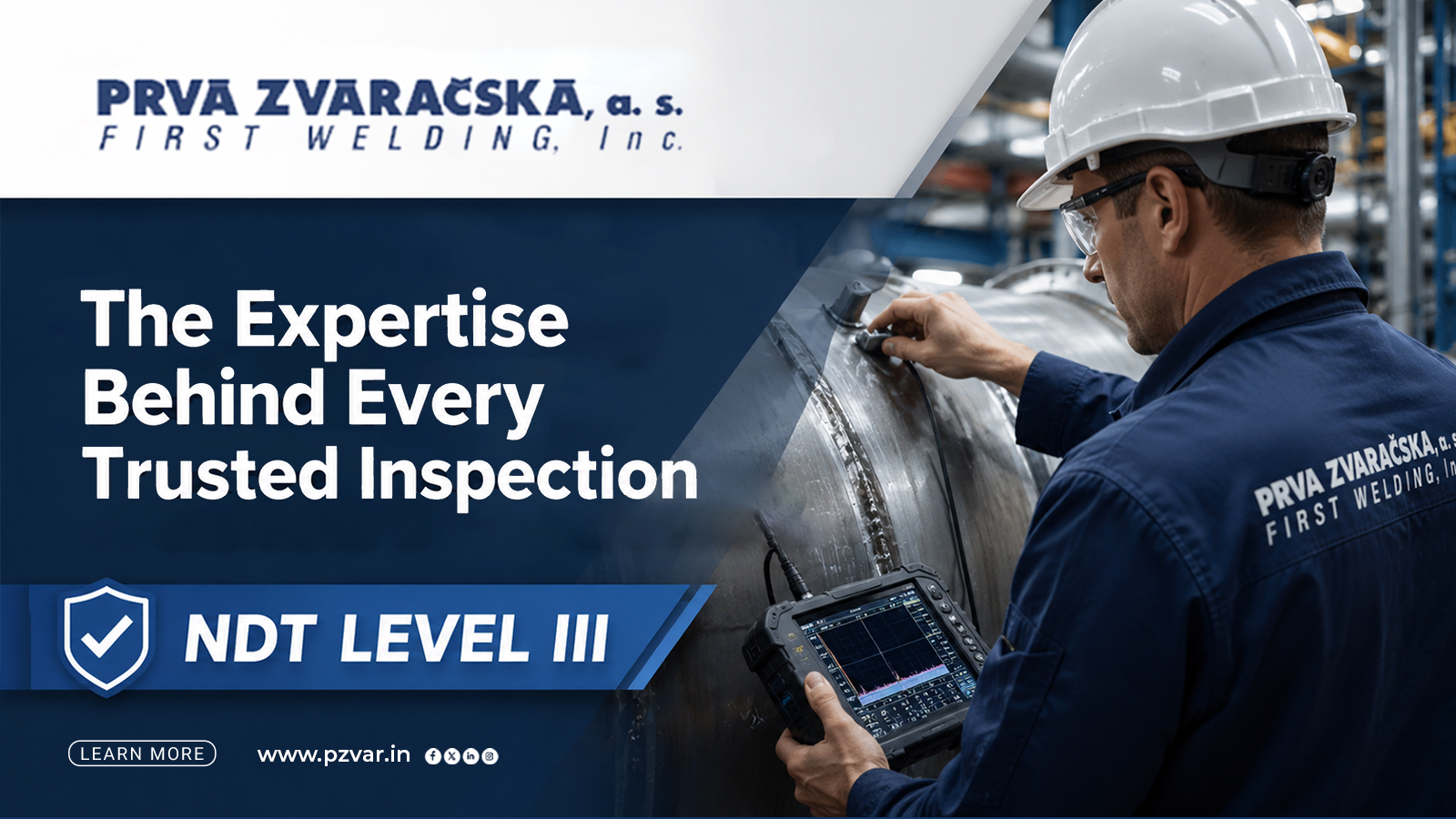
The Role of NDT Level III Certification in Reliable Non-Destructive Testing
NDT lets us inspect welds and materials for hidden flaws without cutting them apart or damaging them. Picture a weld on a pressure vessel. It looks perfect: smooth, even, no visible defects. But a few millimetres below the surface there’s a crack, or a pocket of trapped gas, or an area where the metal never properly fused. You can’t see it. The operator can’t see it. And if that vessel goes into service with the flaw undetected, it becomes a problem waiting to happen.
This is the whole reason non-destructive testing exists. But here’s the part people often miss: NDT is only as reliable as the people running it. A test pointed at the wrong area, set up incorrectly, or interpreted by someone without the right knowledge can give you a clean result on a flawed part, which is arguably worse than no test at all. That’s where NDT Level III certification earns its importance.
A quick tour of the NDT toolbox
Non-destructive testing isn’t one technique but a family of them, each suited to different flaws and materials:
- Visual testing (VT) is the first and most basic check, examining surfaces with the eye or simple aids.
- Penetrant testing (PT) reveals surface-breaking cracks using a dye that seeps into them.
- Magnetic particle testing (MT)finds surface and near-surface flaws in ferromagnetic materials.
- Ultrasonic testing (UT) sends sound waves through the material to map flaws deep inside.
- Radiographic testing (RT) uses X-rays or gamma rays to photograph the interior of a weld.
- Eddy current and leak testing handle more specialized inspection needs.
Choosing the right method, applying it correctly, and reading the results accurately all require real expertise. That expertise is formally recognized through a tiered certification system.
The three levels, and what makes Level III special
NDT personnel are certified to three levels, usually under the international standard ISO 9712 (or schemes like ASNT’s in other regions). The levels build on each other:
- Level 1 technicians carry out specific tests under supervision and record the results, but don’t independently judge whether a part passes or fails.
- Level 2 technicians set up and calibrate equipment, perform tests, interpret and evaluate results against established procedures and codes, and report on them.
- Level 3 is the top of the structure, and it’s a different kind of role entirely.
A Level III isn’t just a more experienced tester. They carry technical responsibility for the NDT operation as a whole. A Level III can develop, qualify, and approve testing procedures; select the right methods and techniques for a given job; interpret codes, standards, and specifications; and take responsibility for the technical correctness of the work. They also have the materials and process knowledge to understand why a flaw formed, not just that one exists. On top of all that, they train, mentor, and examine Level 1 and Level 2 personnel.
In practice, the Level III is the person who makes sure the entire inspection system is sound, from the procedure on paper to the technician at the machine to the final interpretation of what was found.
Why Level III makes testing genuinely reliable
Reliable NDT depends on three things going right: the correct method for the flaw you’re hunting, a properly written and validated procedure, and accurate interpretation of the results. A Level III is the one who ensures all three.
Without that oversight, an organization might use ultrasonic testing where radiography would have been better, follow a procedure with a subtle flaw in it, or accept a borderline indication that should have been rejected. Each of these can let a real defect slip through. The Level III’s judgment is what closes those gaps and turns a set of test results into a trustworthy verdict on a component’s integrity.
This is why regulated, safety-critical industries lean on Level III expertise so heavily. In pressure equipment under the PED, in oil and gas, power generation, aerospace, railway, and structural work, the involvement of properly qualified NDT authority isn’t a nicety; it’s frequently a requirement. For higher-category pressure equipment, for instance, the personnel involved in non-destructive testing must be approved by a recognized independent body, reflecting just how much weight rests on getting the inspection right.
Why Choose PRVÁ ZVÁRAČSKÁ, a. s.
When the reliability of your inspections is on the line, you want a partner with genuine depth in both welding and testing, and that describes PRVÁ ZVÁRAČSKÁ, a. s. (First Welding Company Inc.) well.
Based in Bratislava and active since 2000, PRVÁ ZVÁRAČSKÁ is a research-led welding organization, accredited by the Slovak National Accreditation Service (SNAS) and recognized as a Notified Body by the European Commission (NB 2408). It operates as a testing organization with deep technical expertise across welding and inspection, the kind of environment where Level III knowledge isn’t an add-on but part of the core capability.
Because the company combines welding research, procedure approval, and certification under one roof, it understands the full chain: how a weld is made, how it can fail, and how to inspect it properly. That joined-up expertise is exactly what reliable NDT depends on. With a base in Slovakia and a regional unit in Chennai, India, that support reaches clients across Europe and beyond.
The takeaway
Non-destructive testing protects people and equipment by catching the flaws no one can see, but it only works when the right expertise stands behind it. NDT Level III certification represents that expertise: the authority to choose methods, write and approve procedures, interpret results correctly, and take responsibility for the whole inspection process.
If your work demands inspections you can truly rely on, talk to PRVÁ ZVÁRAČSKÁ, a. s. about how their welding and testing expertise can support your quality and compliance goals.