
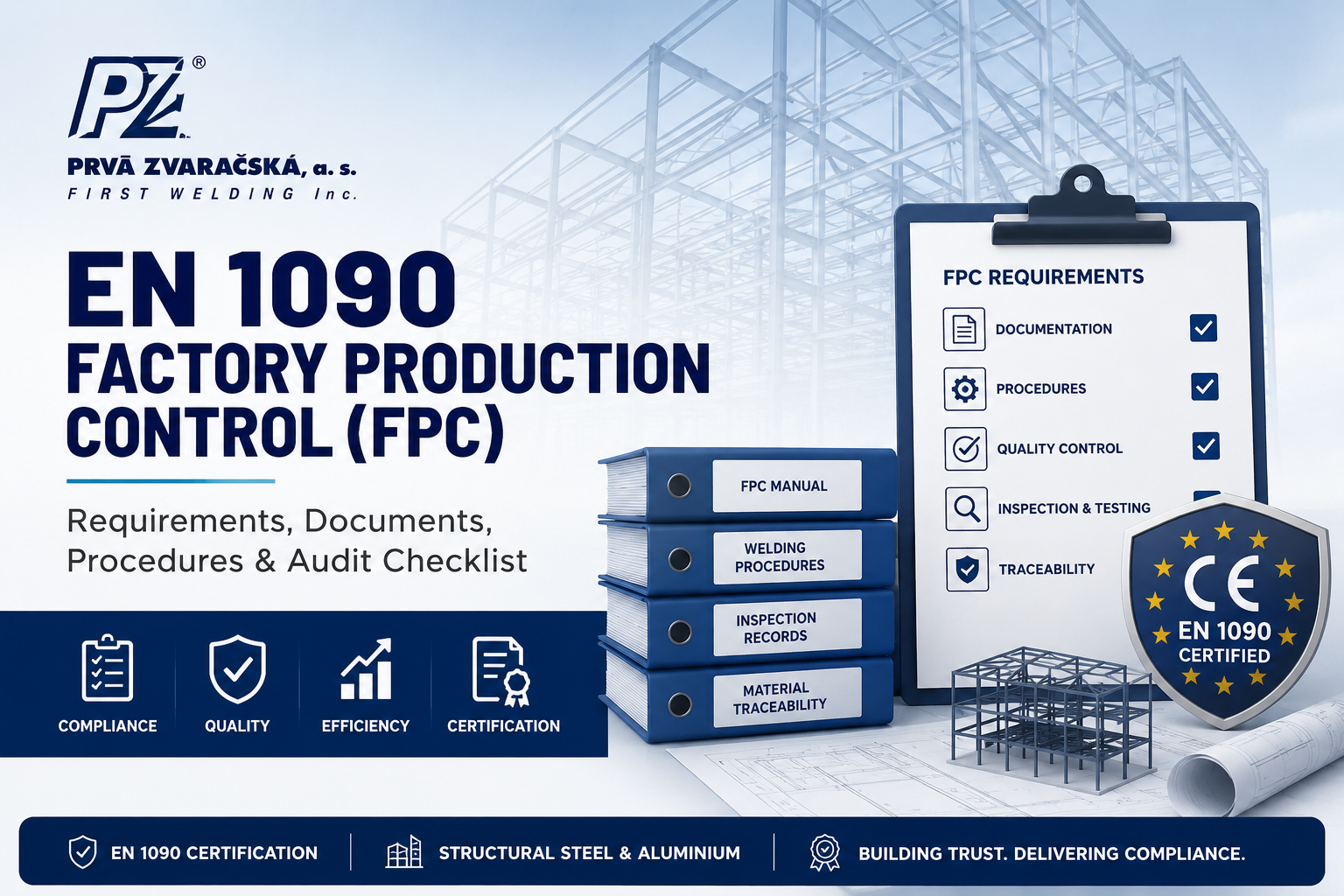
EN 1090 Factory Production Control (FPC): What Every Structural Manufacturer Needs to Know
If you manufacture steel or aluminium structures for the European market, you have likely come across the term Factory Production Control, or FPC. It may sound bureaucratic, but it is the foundation of EN 1090 certification and CE marking for structural components in the EU.
A well-designed FPC system helps manufacturers maintain consistent quality, traceability, and compliance throughout production. Without it, companies face failed audits, delayed approvals, and barriers to market access
What Is Factory Production Control?
Factory Production Control is the internal quality system a manufacturer uses to ensure products consistently meet the requirements of EN 1090-1. It covers how materials are received, stored, processed, inspected and released for use.
Under EN 1090, FPC is not just a set of documents. It is a live production control system that links management responsibility, welding control, traceability, inspection, testing and corrective action into one controlled process.
For structural steel and aluminium products intended for the EU market, this system is essential for CE marking and regulatory compliance.
Who Needs EN 1090 FPC?
EN 1090 FPC applies to manufacturers of load-bearing steel or aluminium components that are used in permanent structures. This includes structural fabricators, bridge component makers, modular building suppliers and exporters supplying the European market.
It is especially relevant for companies producing building frames, industrial structures, staircases, mezzanine floors, silos and other load-bearing metal parts. If the product contributes to structural integrity, EN 1090 compliance is typically required.
Core Elements of a Strong FPC System
A practical EN 1090 FPC system usually includes the following elements:
- Defined organizational roles, including quality responsibility and welding coordination.
- A controlled FPC or quality manual describing how requirements are implemented.
- Written procedures and work instructions for production activities.
- Material control and traceability from incoming certificates to finished products.
- Welding quality control aligned with ISO 3834 requirements where applicable.
- Inspection and testing plans, including final release records.
- Calibration and maintenance records for measuring and production equipment.
- Non-conformance handling, corrective action, internal audits, and management review.
These elements help prove that the factory can repeat compliant production, not just make one acceptable product.
Documents Auditors Expect
During an EN 1090 audit, a Notified Body will usually expect the following documents to be available:
| Document | Purpose |
| FPC / Quality Manual | Describes the system and responsibilities |
| Process Procedures | Controls key production activities |
| Inspection and Test Plans | Defines inspection stages and acceptance points |
| Material Certificates | Proves conformity of incoming materials |
| Traceability Records | Links raw material to finished product |
| WPS and WPQR Records | Confirms qualified welding procedures |
| Welder Certificates | Shows welders are qualified |
| Calibration Logs | Proves measuring equipment is controlled |
| Inspection Reports | Records in-process and final checks |
| NCR and Corrective Action Logs | Shows how defects are handled |
| Internal Audit Reports | Demonstrates ongoing system review |
| Management Review Minutes | Confirms leadership oversight |
Having these documents ready reduces audit delays and makes it easier to demonstrate control during certification.
EN 1090 Audit Checklist
A Notified Body audit typically checks whether your system is actually being followed in production, not just documented on paper. The auditor will usually review:
| Audit Area | What Auditor Checks | Key Documents Required | Risk Level |
| 🏢 Organizational Structure & Responsibilities | Defined roles, responsibilities, authorities | Organization Chart, Job Descriptions, Responsibility Matrix | 🟡 Medium |
| 📄 Document Control & Version Management | Approved and updated procedures | Master Document List, Revision Register, Controlled Procedures | 🟢 Low |
| 🔍 Material Traceability & Certificate Linkage | Material identification and tracking | EN 10204 Material Certificates, Heat Number Register, Traceability Records | 🔴 High |
| 🔧 Welding Procedure Control & Welder Qualifications | Welding compliance and personnel competency | WPS, WPQR, Welder Qualification Certificates, Welding Coordinator Records | 🔴 High |
| 🧪 Inspection, Testing & Release Records | Inspection activities and product conformity | ITP, Inspection Reports, NDT Reports, Release Notes | 🔴 High |
| ⚙️ Equipment Calibration & Maintenance | Equipment accuracy and reliability | Calibration Certificates, Equipment Register, Maintenance Records | 🟡 Medium |
| 🚨 Non-Conformance & Corrective Actions | Handling of defects and root cause analysis | NCR Register, Corrective Action Reports, CAPA Records | 🟡 Medium |
| 📊 Internal Audit & Management Review | System effectiveness and continuous improvement | Internal Audit Reports, Management Review Minutes | 🟡 Medium |
| 🇪🇺 CE Marking & Declaration of Performance | Product compliance for European market | Declaration of Performance (DoP), CE Marking Procedure, Product Records | 🔴 High |
Quick EN 1090 FPC Audit Checklist
| ✔ Check Item | Status |
| FPC Manual Prepared | ☐ Yes ☐ No |
| Organization Chart Available | ☐ Yes ☐ No |
| Material Traceability Implemented | ☐ Yes ☐ No |
| WPS & WPQR Approved | ☐ Yes ☐ No |
| Welder Qualification Certificates Valid | ☐ Yes ☐ No |
| Inspection & Test Plans Implemented | ☐ Yes ☐ No |
| Equipment Calibration Up-to-Date | ☐ Yes ☐ No |
| Internal Audit Conducted | ☐ Yes ☐ No |
| Management Review Completed | ☐ Yes ☐ No |
| Declaration of Performance Prepared | ☐ Yes ☐ No |
EN 1090 FPC and ISO 9001
ISO 9001 can support EN 1090 implementation, but it does not replace it. ISO 9001 is a general quality management standard, while EN 1090 FPC focuses specifically on structural product conformity, traceability and CE marking requirements.
The main difference is that EN 1090 places much greater emphasis on material control, welding quality, and product-specific process verification. Many manufacturers use ISO 9001 as a base and then add EN 1090-specific controls on top.
Why Welding Matters
For many manufacturers, welding is the most critical part of EN 1090 compliance. Where applicable, welding must be controlled through qualified procedures, qualified personnel, and proper supervision.
This is where ISO 3834 often becomes part of the compliance picture, especially for higher execution classes. If welding is not properly controlled, the entire FPC system can be considered weak.
Common Audit Failures
The most frequent EN 1090 audit issues usually involve:
- Incomplete traceability records.
- Missing or outdated welder qualifications.
- Uncontrolled or unapproved welding procedures.
- Poor inspection documentation.
- Expired calibration certificates.
- Weak non-conformance handling.
- Lack of internal audit evidence.
These failures are avoidable with routine document review, production discipline and regular internal audits.
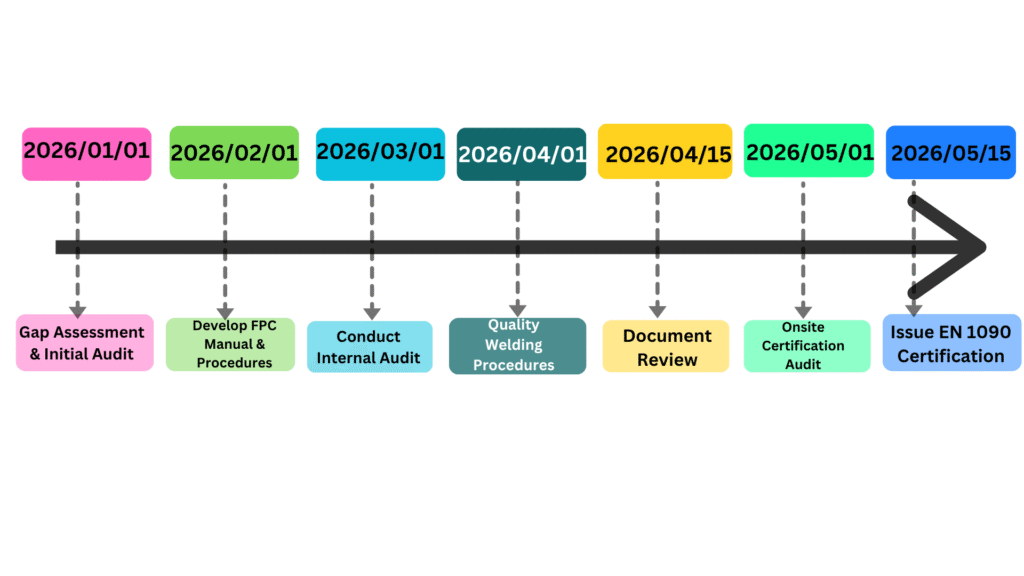
Implementation Timeline
If you are starting from scratch, EN 1090 FPC implementation often takes several months. A typical timeline includes gap assessment, documentation development, welding qualification, internal audits, and certification audit preparation.
Companies that already run a strong ISO 9001 system often move faster because they already have document control, audits and corrective action processes in place.
How PZVAR Can Help
PZVAR supports manufacturers with compliance-focused certification and assessment services for welding and structural standards. Your site’s blog structure and service style show a strong emphasis on practical regulatory guidance, welding certification and industrial compliance .
Conclusion
EN 1090 Factory Production Control is the backbone of CE marking for structural steel and aluminium products. A well-organized FPC system helps manufacturers improve consistency, reduce audit risk and demonstrate compliance with confidence.
If the system is built around traceability, welding control, inspection, and corrective action, certification becomes much easier to manage. For manufacturers targeting the EU market, FPC is not optional; it is a core requirement.Manufacturers implementing EN 1090 Factory Production Control systems can further explore our EN 1090 Factory Production Control (FPC) Technical Resource Guide.
Related EN 1090 Articles
• EN 1090 Certification for Structural Steel and Aluminium – Complete Guide for Manufacturers
• EN 1090 Certification: Ensuring CE Marking Compliance, Quality and Structural Integrity
• From Regulation to Reality: Ensuring Structural Safety with EN 1090 Certification
• Why NDT Level III is the Backbone of EN 1090-3 Compliance
FAQ
What is EN 1090 Factory Production Control?
It is the internal quality control system used by structural manufacturers to meet EN 1090-1 requirements and support CE marking.
Who needs EN 1090 FPC certification?
Manufacturers of load-bearing steel or aluminium components for permanent structures in the EU market generally need it.
What documents are required for EN 1090 FPC?
Auditors usually expect an FPC manual, procedures, traceability records, welding records, inspection reports, calibration logs and audit evidence.
Does ISO 9001 replace EN 1090 FPC?
No. ISO 9001 supports quality management, but EN 1090 adds specific requirements for structural conformity, welding and CE marking.
What is the most common EN 1090 audit failure?
Welding-related documentation and traceability issues are among the most common problems seen during audits.