
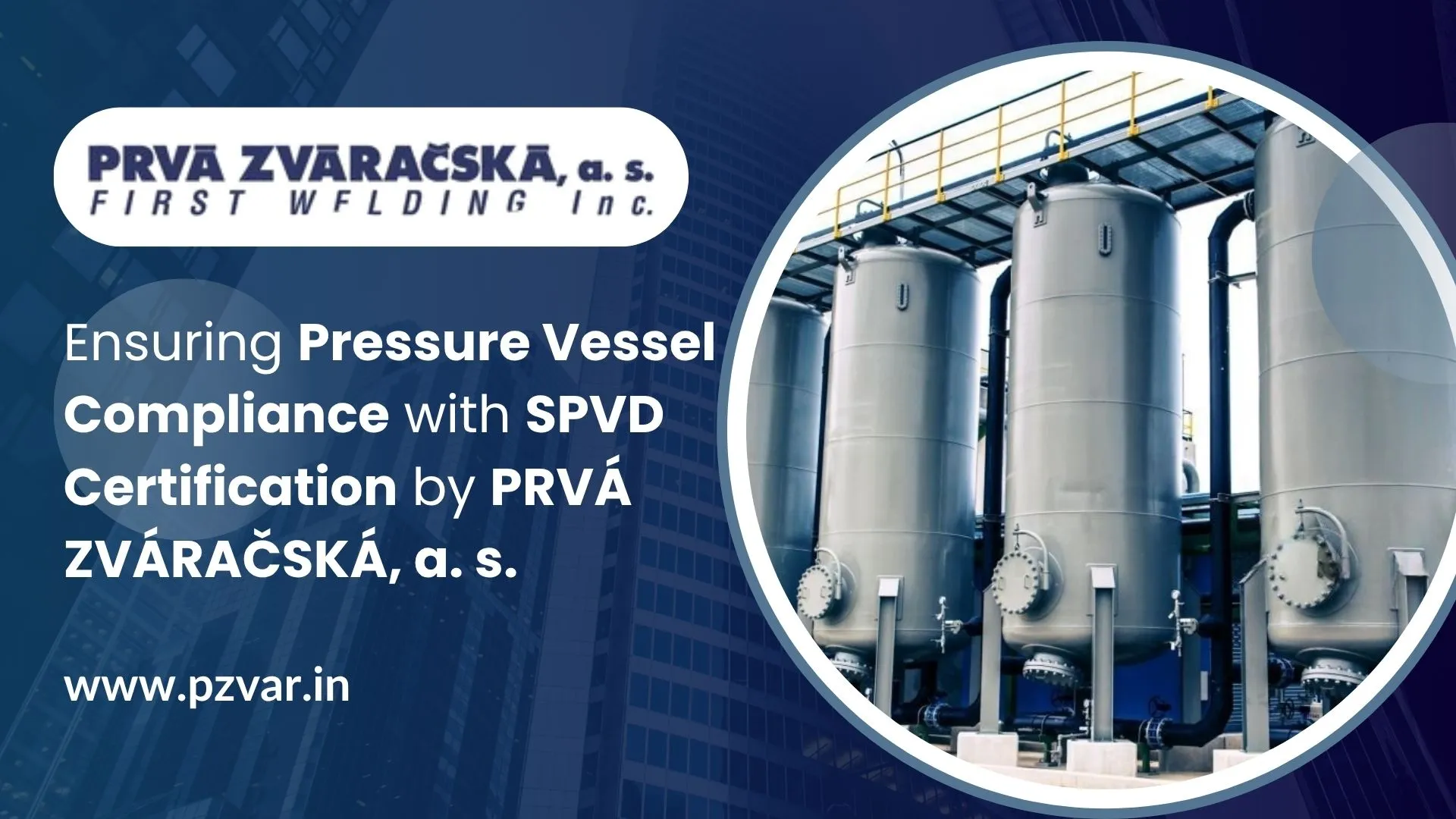
SPVD Certification for Simple Pressure Vessels Compliance | PRVÁ ZVÁRAČSKÁ, a. s.
Introduction
Simple pressure vessels are widely used in industrial and commercial applications such as compressed air systems and storage units. Despite their relatively straightforward design, these vessels operate under pressure conditions that require strict safety and quality control.
The Simple Pressure Vessels Directive (SPVD) 2014/29/EU establishes essential safety requirements for the design, manufacturing, and conformity assessment of simple pressure vessels within the European Union.
With the involvement of PRVÁ ZVÁRAČSKÁ, a. s., achieve certification and demonstrate compliance with European regulatory requirements.
What is SPVD Certification?
SPVD Certification confirms that a simple pressure vessel complies with the Simple Pressure Vessels Directive (2014/29/EU). It applies to vessels that:
- Are welded
- Are intended to contain air or nitrogen
- Operate at a pressure greater than 0.5 bar
- Have a simple geometric shape (typically cylindrical)
The directive ensures that such vessels meet safety requirements before being placed on the European market.
Scope of SPVD Certification
SPVD applies to:
- Air receivers
- Compressed air tanks
- Industrial storage vessels for air or nitrogen
It excludes more complex pressure equipment covered by other directives such as the Pressure Equipment Directive (PED) 2014/68/EU.
Classification of Vessels
SPVD classifies vessels based on the product of pressure (PS) and volume (V):
- PS × V ≤ 50 bar·liters
- Subject to Sound Engineering Practice (SEP)
- No CE marking required
- PS × V > 50 bar·liters
- Requires conformity assessment
- CE marking is mandatory
- Notified Body involvement required
Higher values demand stricter evaluation and verification procedures.
Core Technical Requirements
To comply with SPVD, manufacturers must meet essential safety and manufacturing requirements:
1. Design Requirements
- Simple and well-defined vessel geometry
- Design calculations for pressure resistance
- Consideration of fatigue and operational conditions
2. Materials
- Use of approved and suitable materials
- Material certification (e.g., EN 10204)
- Traceability of materials
3. Welding and Manufacturing
- Qualified welding procedures (WPS, WPQR)
- Certified welders
- Compliance with ISO 3834
4. Inspection and Testing
- Visual inspection (VT)
- Non-destructive testing where required
- Hydrostatic pressure testing
- Verification of design and dimensions
5. Conformity Assessment
- Selection of appropriate assessment module
- Examination by a Notified Body for applicable vessels
- Verification of compliance with directive requirements
6. Documentation
- Technical documentation
- Design calculations
- Material certificates
- Test and inspection reports
- Declaration of Conformity
CE Marking under SPVD
For vessels falling under SPVD requirements:
- Compliance with directive provisions must be demonstrated
- Conformity assessment procedures must be completed
- A Notified Body participates where required
- Declaration of Conformity is issued
- CE marking is affixed to the vessel
Certification bodies such as PRVÁ ZVÁRAČSKÁ, a. s. carry out conformity assessments.
Certification Process
Step 1: Classification
Determine applicability based on PS × V value.
Step 2: Design Verification
Review of design calculations and specifications.
Step 3: Material Approval
Validation of material compliance and traceability.
Step 4: Manufacturing Control
Implementation of qualified welding and production processes.
Step 5: Inspection and Testing
Execution of required examinations and pressure tests.
Step 6: Certification and CE Marking
Issuance of certification and Declaration of Conformity.
Importance of SPVD Certification
SPVD Certification ensures:
- Safe operation of simple pressure vessels
- Compliance with European regulatory requirements
- Reduction of risks related to pressure failure
- Consistent manufacturing quality
- Access to the European market
Related Standards
SPVD is commonly associated with:
- Pressure Equipment Directive (PED) 2014/68/EU – Broader pressure equipment scope
- ISO 3834 – Welding quality system
- EN 10204 – Material certification
- ISO 9712 – NDT personnel qualification
Common Challenges
- Determining whether SPVD or PED applies
- Managing design limitations for simple vessels
- Maintaining material traceability
- Meeting inspection and testing requirements
- Completing conformity assessment procedures
Conclusion
SPVD Certification establishes essential requirements for the safe design and manufacturing of simple pressure vessels. It ensures compliance with European regulations and consistent product quality.
Certification through PRVÁ ZVÁRAČSKÁ, a. s. demonstrates conformity, enables CE marking, and allows manufacturers to place compliant pressure vessels on the European market.
Frequently Asked Questions (FAQs)
1. What is SPVD Certification?
Certification confirming compliance with the Simple Pressure Vessels Directive (2014/29/EU).
2. What vessels are covered?
Welded vessels containing air or nitrogen under pressure.
3. When is CE marking required?
When PS × V exceeds 50 bar·liters.
4. What is the difference between SPVD and PED?
SPVD covers simple vessels; PED applies to more complex pressure equipment.
5. Who performs certification?
A Notified Body such as PRVÁ ZVÁRAČSKÁ, a. s.
6. Why is SPVD important?
It ensures safety, compliance, and reliability of simple pressure vessels.