
ISO 9001:2026
Revision
Checklist
ISO 9001:2026 Revision Is Almost Here: What Manufacturers Should Prepare For
September 2026 | Standards & Certification Update
The field of quality management is evolving.After over ten years with ISO 9001:2015, the next version of the most widely used quality management standard is now in the final stages.ISO/FDIS 9001 has been approved, and the sixth edition of ISO 9001 will be published on 16 September 2026.This new version will replace ISO 9001:2015 and is designed to ensure quality management keeps up with current business needs and changing expectations from stakeholders.For manufacturers, engineering firms, and organizations working in complex supply chains, this isn’t just a standard update.It’s a chance to make their quality management systems stronger, more aware of risks, better suited for digital tools, and focused on improving performance.
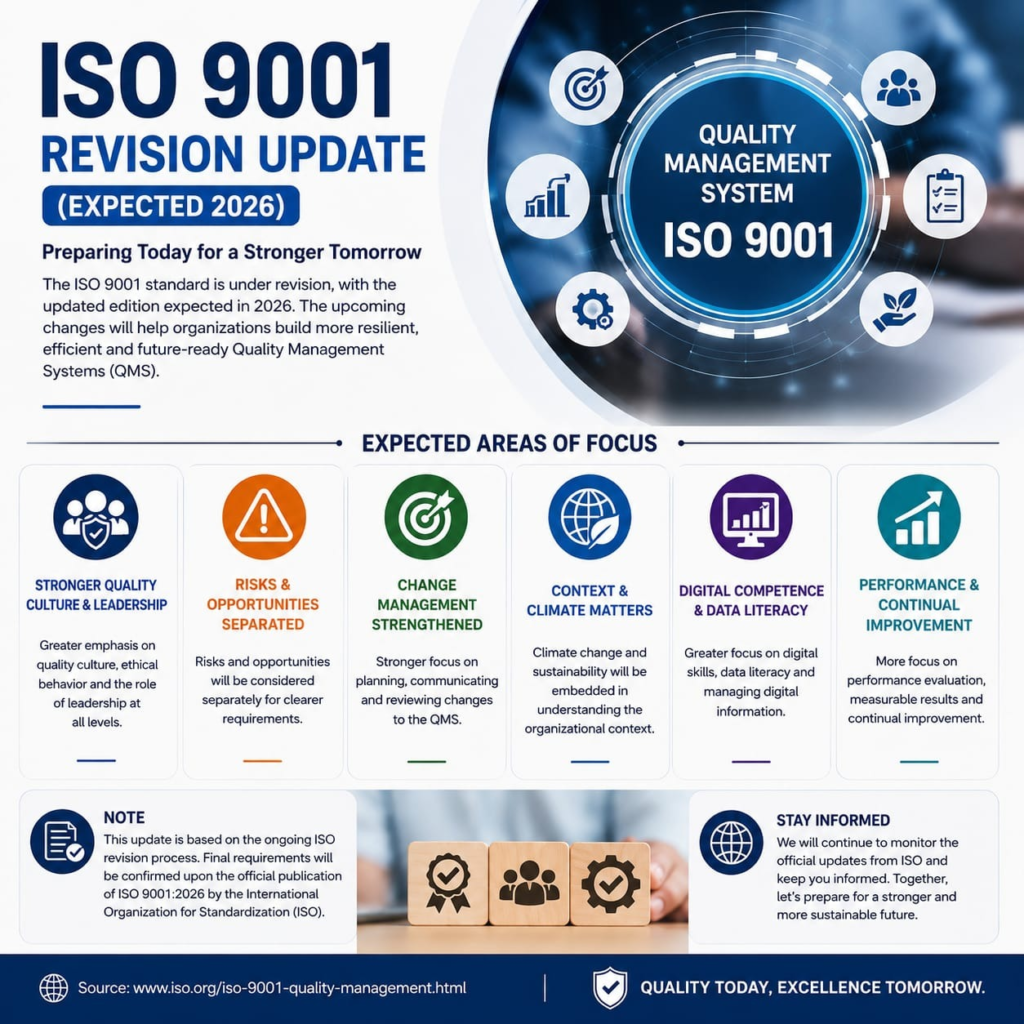
What Is Changing With ISO 9001?
The revision aims to keep ISO 9001 up to date with how companies work today.
While companies should follow the official standard and transition guidance for exact requirements, the revision has brought up several key areas that businesses need to be ready for.
1 A stronger focus on quality culture and leadership is important.
Quality isn’t just the job of the quality team anymore.
Organizations can expect more attention to how leadership is involved, the overall culture, who is responsible, and how much everyone knows about quality at all levels of the company.
For manufacturers, this means making sure that management goals are connected to real-world production, checking products, customer satisfaction, and how well processes are working.
The question isn’t just: “Do we have a quality management system?”
It’s now: “Does our organization really use the QMS to control and improve the business?”
2. Greater Focus on Risks & Opportunities
Risk-based thinking is still a key part of ISO 9001.
The update aims to make it clearer how companies find and deal with risks and opportunities that could affect their ability to meet their quality management system goals.
For manufacturers, these risks might include:
– How well suppliers perform
– Whether materials are available and can be traced
– The way production processes work
– The condition and upkeep of equipment
– The skills and training of staff
– What customers need
– Changes in regulations
– The use of digital systems and data
– Any changes in processes
A strong quality management system should not just respond after a problem happens.
It should help the company see problems coming before they turn into expensive failures.
3. Change Management Becomes Even More Important
Manufacturing settings are always changing.
– New machines.
– New suppliers.
– New materials.
– New ways of making products.
– Digital tools.
– New customer needs.
If changes aren’t managed properly, they can cause quality problems, even if the usual processes are working well.
That’s why companies should make sure that big changes are planned, checked, shared with everyone, and controlled as part of their quality management system.
For manufacturers, good change management can help stop:
Change → problems → mistakes → customer complaints
from becoming the usual thing.
4. Climate Change & Organizational Context
Climate-related problems are becoming more important for management systems.
ISO has already included climate action in its management system standards with the 2024 update.
This requires organizations to check if climate change is a key issue for their specific management context.
The updated ISO 9001 keeps this trend going by helping organizations think about both internal and external factors that might affect their ability to meet their goals.
For manufacturers, this could mean looking at things like supply chain problems, severe weather, access to resources, or other climate-related concerns that apply to them.
The main idea is that what’s relevant matters.
Organizations should assess what really applies to their situation, not just treat climate issues as a routine checklist.
5. Digital Competence & Data
Modern quality management is getting more and more reliant on digital information.
ERP systems, production monitoring, digital inspection records, automated machines, electronic documents, and data analysis are now key parts of manufacturing processes.
A quality management system that is ready for the future needs more than just controlled documents.
It needs accurate information, skilled workers, and good control over digital data.
Manufacturers should think about:
– Who can access important quality information?
– How is data managed and kept secure?
– Can records be tracked?
– Are the digital systems giving correct information?
– Do workers have the skills to use these systems?
– Can quality data help with management decisions?
Digital technology is becoming a key part of quality systems—not just an IT task.
What Does This Mean for Manufacturers?
The updated ISO 9001 standard offers a chance to shift from a system that focuses on documents to one that works better with other management areas.
A good quality management system should link these steps: customer needs, planning, making products, checking them, collecting data, looking at performance, taking corrective actions, and keeping improving.
This is especially important for manufacturers that supply industries with high standards, where quality, tracking products back to their source, meeting delivery times, and building trust with customers all play a key role in business success.
PZVAR’s ISO 9001 framework pays special attention to areas like making processes consistent, building customer trust, managing risks, improving business results, and always looking for ways to get better.
ISO 9001:2015 Certificate? Don't Panic.
If your organization has already been certified to ISO 9001:2015, the update doesn’t mean your current certificate is no longer valid.
ISO says that organizations with the 2015 version will get time to move their quality management system to the new version.
But waiting until the last minute is not a good way to stay compliant.
You should use the transition time wisely.
Start by doing a QMS Readiness Review.
Check your current system in these areas:
Leadership – Is top management actively helping the quality system work?
Risk Management – Are big risks in operations and business properly found and handled?
Change Management – Are changes checked and controlled in a planned way?
Process Performance – Are processes measured with useful performance data?
Customer Satisfaction – Are customer comments, complaints, and needs properly studied?
Digital Information – Are electronic records, systems, and data properly managed?
Competence – Do employees have the right skills and knowledge for their jobs?
Continual Improvement – Can your organization show real improvement, not just fixing problems?
What Should You Do Now?
01 — Understand the Revision
Check for official updates from ISO and wait for the full ISO 9001:2026 guidelines to be released before making any clear claims about compliance.
02 — Review Your Existing QMS
Look for areas where your processes, paperwork, risk handling, performance checks, and internal controls might be weak.
03 — Strengthen Your Evidence
Auditors won’t just look at what you say you do. Your company needs to show that you actually follow the right steps through proper records, performance results, internal audits, management reviews, and corrective actions.
04 — Train Key Personnel
People like quality managers, internal auditors, process owners, and top leaders should know how the new rules will affect their job responsibilities.
05 — Plan the Transition
Once the final version of the standard and any transition rules for certification are available, create a clear plan to move forward instead of just making last-minute changes.
ISO 9001 Is More Than a Certificate
For manufacturers, ISO 9001 should not just be seen as a certificate hanging on a wall.
A well-set-up Quality Management System (QMS) can help organizations:
– Make processes more consistent
– Decrease repeated quality issues
– Build stronger trust with customers
– Spot risks sooner
– Handle complaints more effectively
– Make choices based on real data
– Make operations run better
– Create a culture focused on always improving
First Welding Certification Pvt Ltd (PRVÁ ZVÁRAČSKÁ, a.s.) explains that ISO 9001 certification is an independent check of an organization’s QMS against set standards.
This helps ensure consistent results, better customer satisfaction, and ongoing improvement.
The Takeaway
ISO 9001:2026 isn’t just another update.It shows where quality management is going next.
The future quality management system will need to be more linked to business results, better at handling changes, more aware of risks, better at using digital data, and more focused on ongoing improvement.
The sixth version is set to be released on 16 September 2026, so now is the time for organizations to start getting ready.
Don’t wait until the deadline to find out what needs fixing.
Get started on improving your QMS today.
Need ISO 9001 Certification
First Welding Certification Pvt Ltd (PRVÁ ZVÁRAČSKÁ, a.s.)
Explore: PZVAR ISO 9001 Certification
Stay ahead of standards. Strengthen your quality system. Build customer confidence.