EN 15085 COMPETENCE CRITERIS
EN 15085 ROLE REQUIREMENTS
RAILWAY WELDING
Which EN 15085 Welding Coordinator Level Does Your Railway Manufacturing Company Need? A, B or C Requirements for India & International Markets
By First Welding Certification Technical Editorial Team
08 Min Read
17 Sep 2026
Table Of Contents
- What Is an EN 15085 Welding Coordinator?
- What Does EN 15085-2:2020+A2:2025 Require?
- What Are EN 15085 Welding Coordinator Levels A, B and C?
- Which Welding Coordinator Level Applies to CL1, CL2 and CL3?
- How Do Manufacturer Activities Affect the Coordinator Level?
- What Are the Responsibilities of an EN 15085 Welding Coordinator?
- Can a Manufacturer Have Multiple Welding Coordinators?
- Can a Railway Manufacturer Use a Subcontracted Welding Coordinator?
- What Should Indian and International Railway Manufacturers Check?
- EN 15085 Welding Coordinator Documentation Checklist
- Practical Examples: Choosing the Appropriate Level
- Frequently Asked Questions
- Conclusion
- Related Resources
- Determine Your EN 15085 Welding Coordinator Level
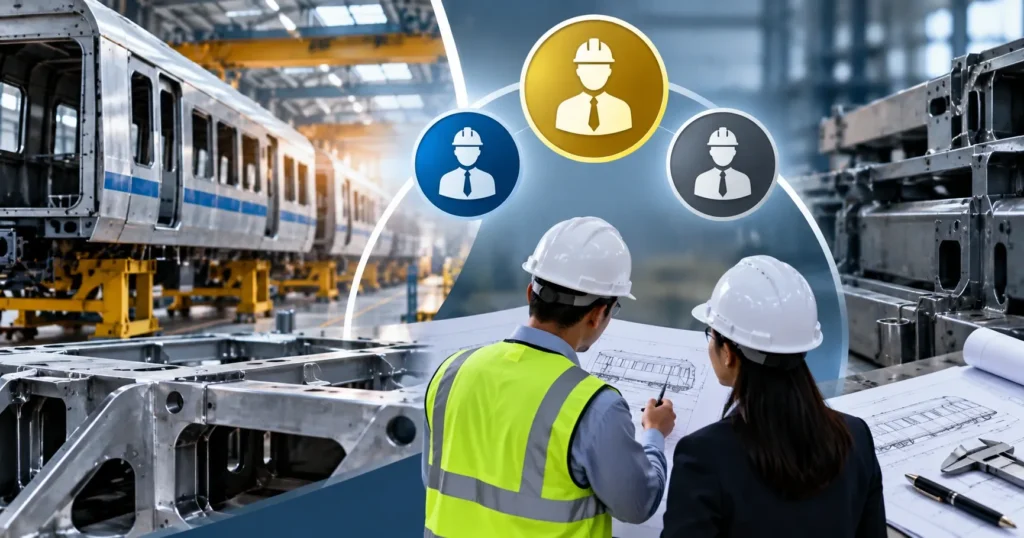
Which EN 15085 Welding Coordinator Level Do You Need?
A
Comprehensive
B
Specific Knowledge
C
Basic Knowledge
Your welders are qualified. Your WPS and WPQR are approved. Your NDT records, traceability and inspection procedures all check out. Everything looks good.
One question still trips up most railway manufacturers during certification: which EN 15085 welding coordinator level do I actually need. A, B or C? This is the thing that keeps many up at night.
Here is the short answer: it is not about your job titles. It is not, about your classification level alone. It depends on a mix of your classification (CL1, CL2, CL3) and your activity type (design, production, maintenance or supply). If you get this wrong you will. Pay more for a coordinator you do not need or you will fail your audit because the coordinator you have is not qualified enough.
Under the EN 15085-2:2020+A2:2025 this is spelled out clearly. You just have to know where to look. Let us break it down.
What Is an EN 15085 Welding Coordinator?
A welding coordinator is the person in charge of all welding quality work in your company. From checking details and controlling the welding procedure specifications to making sure welders are qualified handling testing dealing with problems and keeping track of everything.
EN 15085-2 connects this job directly to EN ISO 14731 which says the main idea is that welding coordination people must have the skills, for the work they do. Not just a certificate that looks good on paper. Skills that fit the actual tasks they need to do. For the manufacturer requirements, see our article EN 15085 requirements for railway manufacturers
What Does EN 15085-2:2020+A2:2025 Require for Welding Coordination?
The EN 15085-2:2020+A2:2025 standard sets rules, for railway manufacturers. These rules cover classification, welding personnel, welding coordination, inspection, WPS, subcontracting and quality documentation. Clause 5.3 says that manufacturers must name welding coordinators who’re suitably qualified. These welding coordinators must have the knowledge and professional experience required for their specific duties. The manufacturer must keep documented proof of the welding coordinator’s competence. Also the manufacturer must have a written procedure that explains how to set up and qualify welding coordinators. The standard describes Level A as having technical knowledge, Level B as having specific technical knowledge and Level C as having basic technical knowledge. These rules also link to welding quality management and ISO 3834 certification. In those cases manufacturers must show that welding processes are controlled that qualified personnel are used that procedures are followed and that quality records are kept.
What Are EN 15085 Welding Coordinator Levels A, B and C?
Qualification alone should not be treated as the assessment. The manufacturer must consider the coordinator’s technical knowledge, real experience and the responsibilities that the coordinator has been given.
| Level | Technical Knowledge | Typical Qualifications |
|---|---|---|
| A | Comprehensive | IWE / EWE, or IWT/EWT with proven comprehensive knowledge |
| B | Specific | IWT / EWT, or IWS/EWS with proven specific knowledge |
| C | Basic | IWS / EWS, or IWP/EWP with proven basic knowledge |
The required coordinator level also connects with the welding quality and personnel competence requirements within railway manufacturing. Manufacturers should ensure that welding procedures, qualified personnel, inspection and NDT personnel competence align with their EN 15085 scope and assigned welding coordination responsibilities. First Welding Certification Pvt Ltd provides ISO 9712 certification, for NDT personnel making it a relevant supporting requirement when establishing controlled railway welding activities.
Which Welding Coordinator Level Applies to CL1, CL2 and CL3?
Many manufacturers often make an assumption in this area.
CL1 = Level A
CL2 = Level B
CL3 = Level C
The notion is an oversimplification. The minimum responsible welding coordinator level changes depending on the classification level. The type of manufacturer activity.
EN 15085-2 Annex B identifies four activity categories:
D — Design
P — Production
M — Maintenance
S — Purchase and Supply
The current standards Annex B provides the following minimum levels: The standards Annex B lays out distinct minimum welding coordinator levels that depend on the manufacturers classification and on the type of activity. For CL1 the acceptable level is Level A when the activity is Design/Production, Level B when the activity is Purchase & Supply and Level A again when the activity is Maintenance but only if certain conditions are met. For CL2 the rule says the minimum level must be Level B for Design/Production and for Maintenance while Level C is required for Purchase & Supply. For CL3 Level C is the level that fits for Design/Production, for Purchase & Supply and, for Maintenance. This tells us that manufacturers cannot pick a welding coordinator level by looking at CL1, CL2 or CL3 alone.
Instead manufacturers must walk through the order: Classification → Activity → Welding Responsibilities → Required Competence → Coordinator Level.
How Do Manufacturer Activities Affect the Coordinator Level?
EN 15085-2 identifies four manufacturer activity types.
D — Design
Design activities include calculation, design and documentation associated with the production and maintenance of welded railway vehicles and components.
Welding coordination may therefore involve:
- weldability considerations;
- welding requirements;
- weld performance;
- joint design;
- technical documentation;
- coordination between design and production.
P — Production
Production includes manufacturing, modification and testing of welded railway vehicles and components, including replacement parts.
The coordinator may have responsibilities relating to:
- WPS;
- WPQR;
- welding parameters;
- welding consumables;
- welding personnel;
- production conditions;
- inspection;
- NDT;
- repairs;
- traceability;
- welding records.
M — Maintenance
Maintenance covers repair of welded railway vehicles and components by welding, including testing.
This can involve:
- repair welding;
- inspection;
- testing;
- repair procedures;
- documentation;
- traceability.
S — Purchase and Supply
Purchase and supply covers the purchase and supply of welded components for new fabrication or maintenance without carrying out the welding operation. Because the organization is not performing the welding itself, the minimum coordinator level differs from production. This is one reason manufacturers should define the actual scope of activity before determining the welding coordination arrangement.
What Are the Responsibilities of an EN 15085 Welding Coordinator?
Welding coordination does not stop at watching welding on the shop floor. The responsibilities can stretch over stages of the manufacturing process.
Contract and technical review : The coordinator may join in reviewing requirements that affect welding.
Welding procedures : The coordinator must make sure that the WPS and WPQR documents match the production needs.
Welding personnel : The organization must keep qualification arrangements for welders and welding operators.
Materials : Material identification and traceability must stay linked to the production documents.
Welding production : The coordinators duties may cover welding parameters, consumables, equipment and production conditions.
Inspection and NDT : Inspection and NDT requirements must match the welding and product needs.
Non-conformity and repair : Welding-related non-conformities and repairs require controlled decisions, within the assigned competence.
Quality records : Records should show the required welding activities and checks.
Can a Manufacturer Have Multiple Welding Coordinators?
Yes. A Manufacturer may set up welding coordination with than one person when its activities, locations, products or technical scope need it. EN 15085-2 requires the organization to be set up so that Welding Coordinators can take on their duties and make decisions about welding on their own separate from the manufacturing operation. The duties, skills and relationships of people who affect welding quality must be written down.
A Manufacturer may therefore set up:
- a Welding Coordinator
- deputies
- Welding Coordinators for specific sites
- Welding Coordinators for particular tasks
- clear duties for design, production or maintenance
The key point is that the organization must clearly state who is responsible for each task.
Can a Railway Manufacturer Use a Subcontracted Welding Coordinator?
EN 15085-2:2020+A2:2025 has rules for a subcontracted Welding Coordinator.
The rule says that the Welding Coordinator should be an employee of the Welding Manufacturer. If a Manufacturer hires a Welding Coordinator from outside the rules in Clause 5.3.6 must be followed.
This means a Manufacturer cannot simply name a person and leave the arrangement without documentation.
The organization should set up:
- set responsibilities
- ensure availability
- list activities performed
- specify location
- set duration
- keep documents
- communicate with the Manufacturer
This is especially important, for Railway Manufacturers that do not have a large internal technical team.
What Should Indian and International Railway Manufacturers Check?
First Indian and international railway manufacturers should examine their product, classification and activities. Identify whether the railway manufacturers produce railway vehicles, bogie components, underframes, structural components, welded assemblies or replacement parts. Then determine which CL1, CL2 or CL3 classification fits the railway manufacturers and label the activity, as D. Design, P. Production, M. Maintenance or S. Purchase & Supply.
Next match the classification and activity with the required Level A, B or C welding coordinator. Verify the coordinator’s qualification, technical knowledge, professional experience and EN 15085 knowledge. The railway manufacturers should also set the coordinator’s responsibilities and authority. Keep proper WPS/WPQR welding personnel qualifications, NDT, material traceability and certification records.
For classification details see EN 15085 CL1, CL2 and CL3 classification. For the Part 2 requirements refer to EN 15085‑2:2020+A2:2025 update.
Follow this sequence: Product → Classification → Activity → Coordinator Level → Competence → Responsibilities → Documentation → Certification Scope.
EN 15085 Welding Coordinator Documentation Checklist
☐ Coordinator formally appointed
☐ Level A, B or C identified
☐ Qualification documented
☐ knowledge verified
☐ Relevant experience documented
☐ EN 15085 knowledge confirmed
☐ EN ISO 14731 tasks assigned
☐ Responsibilities and authority defined
☐ Deputies appointed
☐ Production locations covered
☐ WPS/WPQR controlled
☐ Welding personnel qualified
☐ Inspection and NDT records maintained
☐ Material traceability maintained
☐ Subcontracting arrangements documented
☐ Quality records retained
Key point: Manufacturers must keep clear proof that the welding coordinator has the required technical knowledge and real professional experience.
Practical Examples: Choosing the Appropriate Level
CL1 + Production → Level A: An railway manufacturer that makes welded bogie structures can handle welding, WPS/WPQR, inspection, NDT and material traceability. For CL1 Production Annex B says that Level A is the acceptable level for a responsible welding coordinator. That coordinator must have the technical knowledge and professional experience.
CL2 + Production → Level B: A railway component manufacturer that makes CL2 welded assemblies and manages production welding, WPS implementation, inspection and traceability must use Level B as the acceptable level, for a responsible welding coordinator. That coordinator must meet the required standards.
CL1 + Purchase & Supply → Level B: A company that buys and supplies welded railway components without doing welding inside the shop falls under Purchase & Supply. For CL1 Purchase & Supply Annex B says Level B is required. This shows that manufacturers must look at both the EN 15085 classification and the type of activity when picking the welding coordinator level.
Frequently Asked Questions
What qualification do I need to be an EN 15085 welding coordinator?
EN 15085-2:2020+A2:2025 lists examples for three competence levels. Level A can be shown by IWE/EWE or IWT/EWT with proof of knowledge. Level B can be shown by IWT/EWT or IWS/EWS with proof of knowledge. Level C can be shown by IWS/EWS or IWP/EWP with proof of knowledge. I also need experience and a good understanding of the EN 15085 series.
Can a person who is an IWT become an EN 15085 welding coordinator?
Yes. The current standard says that IWT/EWT can be used as a Level A example if full technical knowledge is shown and as a Level B example if specific technical knowledge is shown. The level that is used depends on the tasks that IWT will do. The evidence of competence.
What is the EN 15085 welding coordinator requirement for CL1?
For CL1 the lowest level required for the EN 15085 welding coordinator depends on the activity. Annex B says Level A is needed for Design/Production, Level B for Purchase & Supply and Level A for Maintenance long as the conditions in the standard are met.
Can a manufacturer hire an EN 15085 welding coordinator?
Yes. EN 15085-2:2020+A2:2025 has rules for subcontracted welding coordinators. The manufacturer must write down the arrangement. Follow the rules for the external EN 15085 welding coordinator.
How does ISO 14731 connect to railway welding coordination?
SO 14731 explains the tasks and responsibilities for welding quality and it says that the EN 15085 welding coordinator must have the right competence, for the tasks they get. The latest edition that is published is ISO 14731:2019.
Conclusion
The right EN 15085 welding coordinator level is not, about CL1, CL2 or CL3. Manufacturers need to look at their classification the type of activities they do the welding responsibilities involved and the technical skills required before choosing between Level A, Level B or Level C. According to EN 15085-2:2020+A2:2025 Level A demands technical knowledge Level B requires specific knowledge and Level C covers basic technical knowledge. The manufacturer must also keep records that show the welding coordinators qualifications, experience, duties and authority. These records should match the manufacturer’s welding work and the scope of their certification.
- What Is EN 15085 Certification? Understanding the Railway Welding Standard
- EN 15085 Certification Requirements: What Railway Manufacturers Should Check Before Certification
- CL1 vs CL2 vs CL3: Understanding EN 15085 Classification Levels Correctly
- EN 15085 Latest Edition 2026: EN 15085-2:2025 Update for Indian & International Manufacturers
- EN 15085 Certification in Chennai: 10 Common Audit Problems Railway Manufacturers Face
First Welding Certification Pvt Ltd (PRVÁ ZVÁRAČSKÁ, a.s.) provides EN 15085 certification for railway manufacturers across India and international markets. Determine the appropriate Welding Coordinator Level A, B or C based on your classification, activity, technical competence and certification scope.