
News Letter
EN 15085
Checklist
EN 15085 Certification in 2026: 7 Mistakes That Can Cost Railway Suppliers New Business
October 2026 Edition | Steel Trade & Compliance Update
Stay informed with the latest developments in international welding standards and certification requirements. This month’s update focuses on the current status of EN ISO 15614-1, one of the most important standards governing welding procedure qualification for metallic materials.
In railway manufacturing, welding quality is crucial for safety, reliability, and customer confidence. EN 15085 certification helps manufacturers demonstrate their welding capabilities. However, achieving this certification requires more than just skilled welders; it involves proper coordination of welding processes, control of production, accurate documentation, and effective implementation of quality systems. The EN 15085 series sets welding standards for railway vehicles, with Part 2 specifically addressing manufacturers. To ensure certification readiness and avoid delays, suppliers should be aware of seven common mistakes that may occur in 2026.
7 EN 15085 Certification Mistakes to Avoid
1. Choosing the Wrong Certification Level
Not all railway parts are equally important for safety. Choosing the wrong safety level can cause issues when setting the certification area and organizing production work.
EN 15085-2 defines three safety levels, CL 1, CL 2, and CL 3, depending on how important the welded part is for safety. The necessary rules depend on the part and its use.
| Classification Level | General Description |
|---|---|
| CL 1 | Welded railway vehicles and components with high safety relevance |
| CL 2 | Welded components with medium safety relevance |
| CL 3 | Welded components with low safety relevance |
Manufacturers should review component specifications, customer needs, planned uses, and the relevant standard to determine the proper classification and certification scope.
Note: These are simplified descriptions. The official classification must follow the applicable standard and related technical requirements.
2. Weak Welding Coordination
Welding coordination helps make sure that welding work is planned, managed, and done with the right technical support.
Issues can happen if everyone knows what they’re supposed to do, if the people doing the work aren’t skilled enough, or if the way things are organized doesn’t fit with what the manufacturer does and what they’re certified for.
What manufacturers need to do:
- Clearly set who is responsible for welding coordination.
- Check that the people in charge have the right skills and knowledge.
- Keep records of their qualifications and abilities.
- Make sure welding work is properly supervised by qualified technicians.
The rules for welding coordination should be checked against the relevant parts of EN 15085 and EN ISO 14731.
3. Incomplete Welding Documentation
Even when welding is done properly, poor or mixed-up records can make it hard to show that the right control steps are being followed.
Manufacturers need to make sure their written instructions and production logs match what really happens on the factory floor.
| Document or Record | Why It Matters |
|---|---|
| Welding Procedure Specification (WPS) | Defines the applicable welding instructions and parameters |
| Welding Procedure Qualification Record (WPQR) where required | Provides evidence supporting a qualified welding procedure |
| Welder qualification records | Helps establish that personnel are qualified for assigned work |
| Material inspection and traceability records | Supports verification of materials used in production |
| Inspection and test reports | Records the results of required examinations and tests |
| Nonconformity and corrective-action records | Documents how identified problems are addressed |
What manufacturers should do: Keep a system for managing documents carefully and make sure all records are full, up to date, easy to find, and match what is actually made.
The specific records needed depend on the rules that apply, the production work being done, and the customer’s requirements.
4. Poor Control of Welding Procedures
Using the wrong welding method or not following the approved steps can lead to poor quality and make people lose trust in how well production is controlled.
A Welding Procedure Specification (WPS) should be right for the job, and the evidence showing it’s qualified must match whenever qualification is needed.
What manufacturers should do:
- Figure out which welding process is needed before starting production.
- Make sure the process covers all the welding conditions that will be used.
- Give the latest instructions to the workers doing the welding.
- Keep track of any changes made to the welding process.
- Keep all the necessary qualification and production records.
Remember: Just having a document isn’t enough. The process needs to be right for the job and actually followed in real work.
5. Inadequate Welder Qualification Management
A welder’s qualification needs to match the job they are doing. If manufacturers ignore things like the scope of their qualification, how long it’s valid, continuity rules, or changes in what they’re making, they can create avoidable risks.
What manufacturers should do: Keep a main record of all welders’ qualifications.
This should include the welding processes they’re allowed to do, the range of work they’re qualified for, when their qualification is valid, and any proof they need to show they’re still qualified. Before giving someone a task, check if their qualification covers that specific job.
This simple check can stop the wrong people from being assigned work and help control the production process better.
6. Weak Traceability and Inspection Controls
Railway manufacturers must show that all necessary production and inspection rules have been followed.
If it’s not possible to properly track material identification, weld identification, inspection outcomes, or any nonconformities, it will be harder to fix quality problems.
| Control Area | Recommended Check |
|---|---|
| Material Traceability | Can relevant material records be linked to the production job? |
| Weld Identification | Are welds identifiable where required? |
| Inspection Planning | Are the required inspections defined and performed? |
| Nonconformities | Are defects documented and addressed appropriately? |
| Final Records | Can the required evidence be retrieved when needed? |
What manufacturers should do: Create a realistic traceability system that links together all the important materials, welding work, checks, and final product records.
7. Treating Certification as a One-Time Activity
Certification readiness shouldn’t stop once the first assessment is done. Changes in staff, production techniques, tools, processes, or the project’s scope might mean manufacturers need to check their current setups again.
Here’s what manufacturers should do:
- Regularly check welding procedures and the supporting documents.
- Watch out for qualification and ongoing compliance needs.
- Do proper internal checks.
- Keep track of any issues and fix them.
- Review any changes before putting them into action.
- Get ready for any follow-up checks or re-certification.
Keeping things consistent helps manufacturers stay in control of their welding work instead of rushing to gather proof just before an inspection.
EN 15085 Certification Readiness: A Practical Checklist
Use this checklist as a first step to review before starting the official certification evaluation.
| Readiness Area | Key Question | Status |
|---|---|---|
| Certification Scope | Have the relevant activities and component requirements been identified? | ☐ |
| Classification | Has the applicable classification level been determined? | ☐ |
| Welding Coordination | Are responsibilities and competence established? | ☐ |
| Welding Procedures | Are suitable WPS documents and supporting qualifications available where required? | ☐ |
| Personnel | Are relevant welder qualifications and continuity records maintained? | ☐ |
| Materials | Are applicable material records and identification controls in place? | ☐ |
| Inspection | Are required inspections tests and acceptance criteria defined? | ☐ |
| Documentation | Are records controlled complete and retrievable? | ☐ |
| Corrective Action | Are nonconformities investigated and addressed? | ☐ |
| Ongoing Control | Are applicable monitoring and review activities planned? | ☐ |
This is a basic check to see if you’re ready, but it’s not the same as the full official standard or a proper official check.
Certification Preparation Flowchart
The following flowchart illustrates a practical approach to preparing for EN 15085 certification.
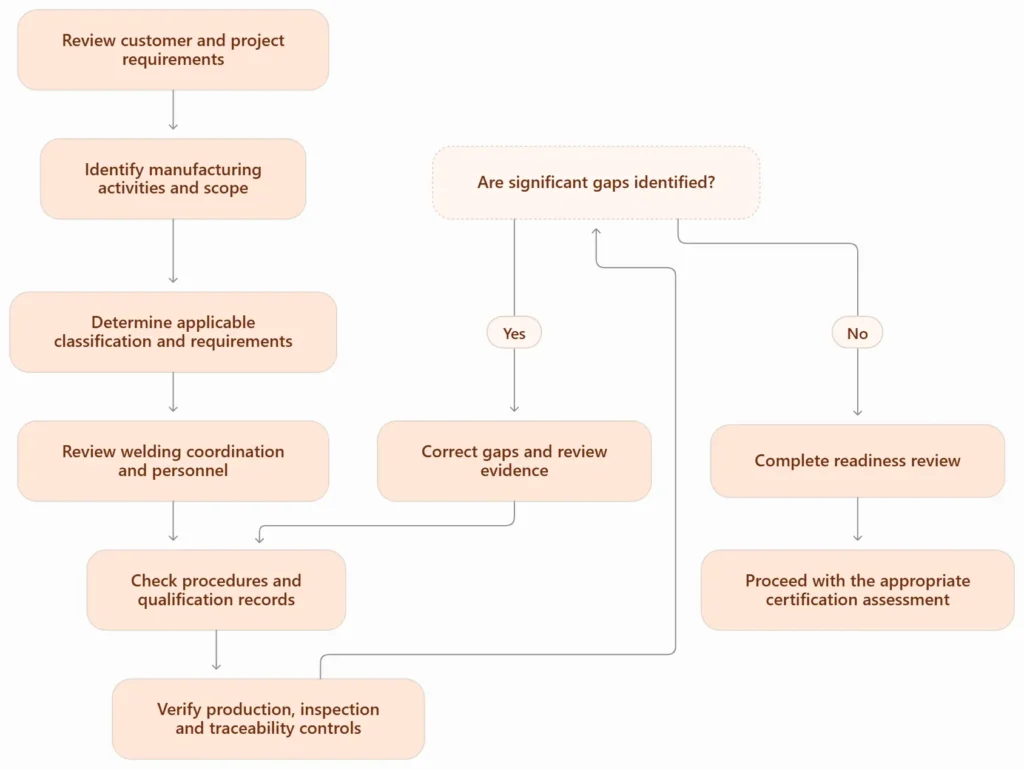
How to use this flowchart: Begin by clearly outlining the scope. Check the relevant technical and organizational requirements, address any identified gaps, and confirm the supporting evidence before moving on to the correct assessment.
What Railway Manufacturers Should Prioritise in 2026
Don’t just gather papers without thinking; check what’s already being done with welding and the documents that are in place.
- Look at the most recent version of the EN 15085 standard and what the customers need.
- Make sure the written plans match what’s actually happening in the production process.
- Check that all the records show that everything meets the required standards.
- Find any problems before the official check starts.
- Give clear jobs to people to fix any issues and make sure those fixes work.
These steps help prevent last-minute problems and make sure the welding quality is reliable.
How First Welding Certification Pvt Ltd Can Help
To get ready for EN 15085 certification, you need to know the requirements, what the manufacturer does, and the proof that meets those standards. Reach out to First Welding Certification Pvt Ltd to talk about the certification process. Figure out your scope, check your documents, and make sure you understand the requirements that apply to your situation, whether it’s a new assessment or an existing setup. If you’re looking for certification in railway manufacturing, visit pzvar.in for more details and to talk about your specific needs.