
EN 15085 bogie frame manufacturing
Railway bogie frame welding
EN 15085 certification India
EN 15085 for Railway Bogie Frame Manufacture – Welding, Inspection & Quality
By First Welding Certification Technical Editorial Team
6 Min Read Time
29 Oct 2026
Table of Contents
- Introduction
- What is a railway bogie frame?
- Why EN 15085 matters to Bogie Frame Manufacturers
- Pre-Welding Requirements
- WPS, WPQR & Welder Qualifications
- Weld Performance Class & Inspection
- NDT, Dimensional Inspection & Control
- Material Traceability & Quality
- Typical issues during production
- EN 15085 Certification Checklist
- EN 15085 Certification for Indian Railway Suppliers
- Frequently Asked Question
- Related Searches
- Conclusion
Review Drawings
Verify Materials
Confirm WPS / WPQR
Weld Bogie Frame
Inspect Welds & Dimensions
Record Quality
Introduction
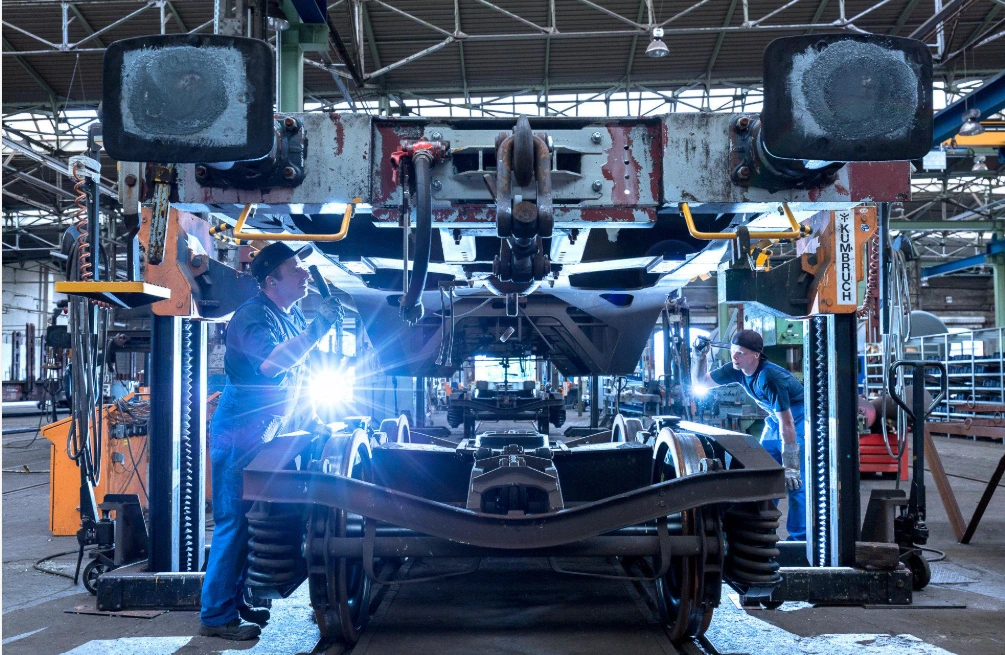
Railway bogie frames are an integral part of railway vehicles. This product needs to be manufactured to a high standard, so not only should good quality steel be used but the preparation of joints, welding process, manufacturing sequence and inspection must be controlled to meet the specification.
EN 15085 certification can be an important part of proving that welding is controlled when supplying railway components to rolling stock manufacturers, railway OEMs and international customers. However, there will be various factors to consider when manufacturing bogie frames such as:
- Drawings
- Customer specifications
- Weld performance class
- Inspection
What is a railway bogie frame?
A railway bogie is the part of the vehicle that sits on the wheels. It is used to support the body of the vehicle. Bogie frames may be manufactured with various sections such as cross members and brackets depending upon the design of the vehicle.The bogie frame may have several sub-assemblies that have been welded. These should be manufactured to the approved drawings and specification. Examples of products that would involve welding during manufacture include:
- Locomotive bogie frame & sub-assemblies
- Passenger coach & metro bogies
- Freight wagon bogie components
- Underframes & cross members
- Brackets & support assemblies
- Other welded structures as per the vehicle manufacturer
Depending on how the product has been designed and what it is for, there may be various welding requirements.
Why EN 15085 matters to Bogie Frame Manufacturers
EN 15085 is a series of standards covering welding of railway vehicles and components. There are various parts to EN 15085 including:
- General requirements
- Manufacturer certification requirements
- Design requirements
- Production requirements (EN 15085-4)
- Inspection, Testing & Documentation requirements (EN 15085-5)
- Maintenance welding requirements
EN 15085-4 focuses on production requirements of bogie frames. EN 15085-5 covers inspection/testing & documentation requirements. EN 15085-2 covers quality requirements of welding manufacturers.
Consider what requirements apply to you and your activities.
2.1 Welding under control
Welding should be planned using appropriate documented procedures and qualified if required. The production team should understand what drawings apply, what joint preparation is required, what welding parameters and what inspection is required.
2.2 Welding co-ordinator
Appropriate welding co-ordinator responsibilities should be set up. The welding co-ordinator will help to ensure that welding is under control.
2.3 Product specific inspection
Depending on the design of the bogie frame, there may be various joint types that will have different inspection requirements.
Pre-Welding Requirements
Many issues can occur during manufacture due to not having the correct requirements in place before welding starts. Having a controlled preparation will help to avoid incorrect drawings, wrong materials, incorrect welding sequence and unnecessary rework.
3.1 Drawings & Weld Identification
The production team should use current approved drawings & documents.
Review the following:
- Material grade(s) & specification(s)
- Joint design & weld preparation
- Weld symbols & weld sizes
- Weld performance & inspection class
- Welding processes & consumables
- Tolerances & Key Dimensions
- Inspection, Testing & Acceptance Criteria
If changes are to be made to the joint design, materials, weld performance or any other controlled design feature these should be done using the correct technical approval process.
3.2 Material Verification
Materials such as steel should be verified against the purchase order, drawings & specifications. Suitable controls should be in place for material identification, certificates, storage, cutting and transfer of material identification.
3.3 Welding Sequence & Distortion
During welding heat and residual stress can cause distortion to the bogie frame. The manufacturer should ensure that suitable clamping, fixtures, tack welding & welding sequence are in place. Having documented welding sequences can help to reduce distortion during series production.
Just because a fixture is in place does not mean that the product will be conforming. The manufacturer should ensure that the final assembly will conform to the drawing & inspection requirements.
WPS, WPQR & Welder Qualifications
Welding procedures are an essential part of manufacture.
4.1 Welding Procedure Specification (WPS)
A WPS outlines the approved conditions for carrying out welding. Depending on the process and qualification this can include what welding process to use, joint design, material group, consumables, welding parameters, preheat & inter-pass temperatures.
Use the correct WPS for the joint & activity.
4.2 Welding Procedure Qualification Record (WPQR)
A WPQR proves that a welding procedure has been qualified to the required qualification standard.
The manufacturer should ensure that the correct qualification route is being used and that the validity and approval range is in place. Controls should be in place for the procedures used.
EN 15085-4 refers to the correct welding procedure qualification standards depending on the welding process. Determine what the correct route is for your application.
4.3 Welder & Welding Operator Qualifications
Ensure that personnel have the correct qualifications for the welding process, material & activity.
Controls should be in place for validation/continuity of the qualifications, supporting documentation and that the personnel can follow the approved manufacturing instructions.
Even with a valid welder qualification a qualified welding procedure may still be required.
Weld Performance Class & Inspection
Welding requirements for railways should relate to the performance of the product and design.
5.1 Weld Performance Class
The weld performance class will outline requirements based on the performance of the joint. This should be determined using the design & classification.
Do not reduce the weld performance class below the specified level without going through the correct technical approval process.
5.2 Inspection Class
The inspection class will outline what inspection is required. The inspection plan should reflect the approved design documentation & acceptance criteria.
5.3 Inspection & Test Plan
Before starting production an inspection & test plan should be in place. This should outline what inspection is required and who is responsible.
A practical inspection & test plan may include:
- Material verification
- Joint preparation & fit-up
- Welding parameters
- Final visual inspection
- Required NDT
- Dimensional inspection
- Final review of production & inspection documentation.
The amount of inspection and what methods should be used will depend on the relevant specifications. Do not assume that radiography, ultrasonic, magnetic particle or penetrant testing will always be required
NDT, Dimensional Inspection & Control
NDT can help to identify any discontinuities that can not easily be seen during visual inspection. The type of NDT should be determined depending on the joint, material, design & inspection class.
6.1 Visual Testing
Helps to identify weld features, surface condition & profile.
6.2 Radiography & Ultrasonic Testing
May be required for suitable joints to look at internal weld quality. This will depend on the joint design, material, processes & customer requirements.
6.3 Magnetic Particle & Penetrant Testing
Magnetic particle testing can be used for suitable ferromagnetic materials. Penitrant testing can help to identify surface breaking discontinuities on suitable non-porous materials.
Ensure that the NDT personnel have the correct qualifications for the type of testing and activity.
6.4 Dimensional Inspection
The bogie frame may require dimensional checks including interfaces, alignment, spacing & other features as per the drawing.
Measurements should be taken using appropriate equipment & methods. Controls should be in place for equipment & measurement documentation.
If post weld heat treatment, stress relieving, machining or proof load testing is required this should be controlled & documented. This may not be a universal requirement for all bogie frames.
Material Traceability & Quality
Quality should be supported by documentation.
A traceability system should be in place for the relevant materials & activities during manufacturing of railway bogie frames.
This may include:
- Material Certificates & incoming inspection
- Material identification & transfer
- Welding consumables control
- WPS & WPQR
- Welder & welding operator qualifications
- Welding co-ordinator
- Welding parameters/production
- NDT reports
- Dimensional inspection reports
- Non-conformance, repair & re-inspection
- Final manufacturing documentation.
The exact documentation will depend on the product, contractual requirements & certification scope.
The documentation should be easily identifiable, up-to-date, related to the correct product/activity & available when required.
Typical issues during production
Issue 1: Incorrect revision of drawings
Using an older revision of the drawing can cause incorrect joint preparation, weld size & component geometry.
Control: Ensure that drawing revisions are controlled at the production workstation and that out of date instructions are removed.
Issue 2: Incorrect WPS
The procedure may not be suitable for the material, process & joint.
Control: Ensure that the correct WPS & qualification is in place before production.
Issue 3: Uncontrolled Welding Sequence
Unplanned welding can cause distortion, dimensional issues & unnecessary rework.
Control: Use an appropriate welding sequence & carry out intermediate dimensional checks.
Issue 4: Unclear inspection requirements
There may be inconsistent interpretation of weld performance & inspection requirements between teams.
Control: Ensure that the approved drawings, inspection class, inspection & acceptance criteria are referenced during manufacture & inspection.
Issue 5: Loss of material identification during cutting
It can be difficult to link parts back to the original material.
Control: Set up a system for transferring material identification.
Issue 6: Uncontrolled repairs to non-conformances
Uncontrolled repairs can cause further defects & incomplete documentation.
Control: Use an approved repair process, required technical authorisation, appropriate re-inspection & documented closure.
Issue 7: Incorrect documentation
Inspection reports may be incomplete & difficult to link to the correct component.
Control: Use consistent component identification & have a defined final review of documentation before release.
EN 15085 Certification Checklist
Before applying for manufacturer certification, consider the following:
- Identify what products & activities will be covered by your certification.
- Identify what level of certification & customer requirements apply.
- Set up welding co-ordinator.
- Review welding personnel qualifications.
- Review relevant WPS & WPQR.
- Verify material identification & traceability.
- Set up production planning & welding sequence.
- Set up relevant inspection & test plans.
- Verify NDT & personnel competence.
- Control equipment & measurement documentation.
- Set up non-conformance, repair & re-inspection.
- Review documentation control & manufacturing.
- Ensure that the correct processes are in place.
This is a helpful guide but should not be used instead of the relevant standard.
EN 15085 Certification for Indian Railway Suppliers
India has an established railway industry with many manufacturers of components. If you are manufacturing bogie frames, underframes, sub-assemblies & other components you may come across EN 15085 requirements if supplying customers with contracts requiring this.
Before applying for certification ensure that you understand:
- What products & welding activities will be covered.
- Whether you are doing design, production, maintenance or purchasing & supplying.
- What level of certification & requirements apply.
- Whether your welding procedures, personnel & inspection are in line with the requirements.
- What documentation & technical specifications are required.
For companies in Chennai & other manufacturing centres in India, the same applies. Firstly determine what technical & contractual requirements apply and build your certification scope around your activities.
Ensure that you have confirmation from a recognised certification body as to what route you should take and if there are any recognition requirements.
Frequently Asked Questions
What is EN 15085 certification for railway bogie frame manufacturers?
EN 15085 manufacturer certification covers the relevant requirements for organisations involved in welding railway vehicles & components. The scope will depend on your activities, products & classification.
Is EN 15085 required for all bogie frame manufacturers?
Not necessarily. It will depend on the relevant contracts, customer requirements, product requirements & certification.
Which part of EN 15085 relates to bogie frame production?
EN 15085-4 covers production requirements. EN 15085-2 covers manufacturer certification requirements. EN 15085-5 covers inspection, testing & documentation requirements.
Are WPS & WPQR required for railway bogie frame welding?
EN 15085-4 states that welding procedures & qualifications are required for applicable weld performance classes. The correct qualification route will depend on the process & requirements. Ensure that you understand what requirements apply to you.
Related Searches
- EN 15085 Certification Non-Conformities in 2026: 9 Railway Welding Audit Failures and How to Prevent Them
- EN 15085 Certification in 2026: 7 Mistakes That Can Cost Railway Suppliers New Business
- EN 15085 EN ISO 3834 Key Difference What Is the Difference Between EN 15085 vs EN ISO 3834 Certification in India?
- EN 15085-4 Documentations Qualifications 15085-4 Welding Preparation Documents: How Do Welder Qualifications Support Quality Railway Production Worldwide?
- Who Needs EN 15085 Certification? 7 Railway Business Types That Should Check Their Scope
- EN 15085-2 SCOPE & PROCESS REQUIREMENTS What Is EN 15085-2 CL2 Certification for Railway Components in India? Requirements, Scope & Process
Conclusion
Manufacturing railway bogie frames requires a controlled approach to design requirements, welding procedures, production planning, inspection & traceability. Ensuring that a technically sound approach is taken will help to ensure that the approved design is linked to the manufacturing process and evidence.
Indian railway component manufacturers should start by understanding what products you are supplying, what welding activities you are carrying out & what certification scope your customers require.
If you are looking to plan your EN 15085 certification for railway components contact PZVAR to discuss your activities, scope & assessment requirements.
Need guidance for EN 15085 railway bogie frame welding, inspection, or certification requirements?
First Welding Certification Pvt Ltd (PRVÁ ZVÁRAČSKÁ, a.s.) can help you explore the relevant welding quality and certification requirements for your application.