
News Letter
Welder Qualification
Checklist
Welder Qualification in India: How to Select the Right Test for Your Industry
November 2026 Edition | Steel Trade & Compliance Update
Stay informed with the latest developments in international welding standards and certification requirements. This month’s update focuses on the current status of EN ISO 15614-1, one of the most important standards governing welding procedure qualification for metallic materials.
Is Your Welding Team Qualified for Your Next Project?
While the expertise of a proficient welder is indispensable for ensuring structural integrity, practical experience alone often falls short of the stringent qualification mandates required by contracts and international clientele. Fabrication enterprises, pressure vessel manufacturers, structural steel contractors, and petrochemical corporations mandate rigorous welder certification to verify that personnel can execute welding operations in strict compliance with established standards. The complexity of navigating requisite testing protocols and qualification frameworks frequently presents a significant hurdle for organizations. Consequently, specialized welder qualification services in India provide critical support by identifying specific testing requirements, evaluating individual personnel competency, and facilitating the acquisition of essential documentation.
Welder Qualification vs. Welding Operator Qualification
Welding personnel do not all undertake identical duties; rather, the requisite qualification pathway is contingent upon both the specific responsibilities assumed by the individual and the particular welding process in application.
| Qualification Type | Applicable Standard | Who Is It For? | Primary Purpose |
|---|---|---|---|
| Manual and partly mechanised welder qualification | ISO 9606 series | Welders who manually manipulate the welding equipment | Demonstrates the welder’s ability to produce acceptable welds within the qualified range |
| Welding operator qualification | ISO 14732 | Personnel operating or setting up mechanised and automatic welding equipment within the standard’s scope | Demonstrates competence for the relevant welding operation |
| Welding procedure qualification | Applicable procedure qualification standard such as ISO 15614-1 | Manufacturers establishing qualified welding procedures | Demonstrates that a welding procedure can produce the required results under specified conditions |
Welder qualification, welding operator qualification, and welding procedure qualification address distinct objectives and must not be conflated, as the validity of one does not inherently supersede the requirements of another.
ISO 9606-1 governs the qualification testing protocols for fusion welding processes applied to steels, whereas ISO 14732 establishes the regulatory framework for welding operators and weld setters engaged in the mechanized and automatic welding of metallic materials.
The selection of the pertinent standard is contingent upon the specific application and the governing requirements.
Which Welder Qualification Does Your Industry Need?
The requisite qualifications fluctuate based on the specific product, material composition, welding methodology, project mandates, and applicable regulatory codes.
The table below serves as an initial framework for delineating the pertinent factors.
| Industry or Application | Key Qualification Considerations | What to Verify Before Testing |
|---|---|---|
| Structural steel fabrication | Steel material, welding process, joint configuration, and applicable execution requirements | Project specifications and applicable standards |
| Pressure vessels | Material, welding process, joint type, and pressure equipment requirements | Governing construction code and customer requirements |
| Petrochemical industries | Pipe or equipment material, welding process, service conditions, and project specifications | Applicable piping or equipment code and approved qualification scope |
| Industrial piping | Pipe material, joint configuration, welding position, and process | Project code and required qualification range |
| Aluminium fabrication | Aluminium alloy, welding process, joint configuration, and material thickness | Applicable qualification standard and project requirements |
| General fabrication | Material, welding process, product type, and customer specifications | Contract requirements and applicable qualification standard |
Consequently, a pipe welder engaged in petrochemical infrastructure projects may require a distinct scope of qualification compared to a welder dedicated to the fabrication of structural steel elements.
Consequently, qualification for aluminium welding necessitates a rigorous assessment of specific material properties and testing protocols, precluding the uncritical transfer of credentials obtained for steel applications.
The essential consideration lies in choosing qualifications that align with the specific demands of the application rather than relying solely on the designation of the position.
The Welder Qualification Process: From Requirement to Certification
A structured qualification process helps companies prepare their personnel and documentation before testing begins.
Welder Qualification Flowchart
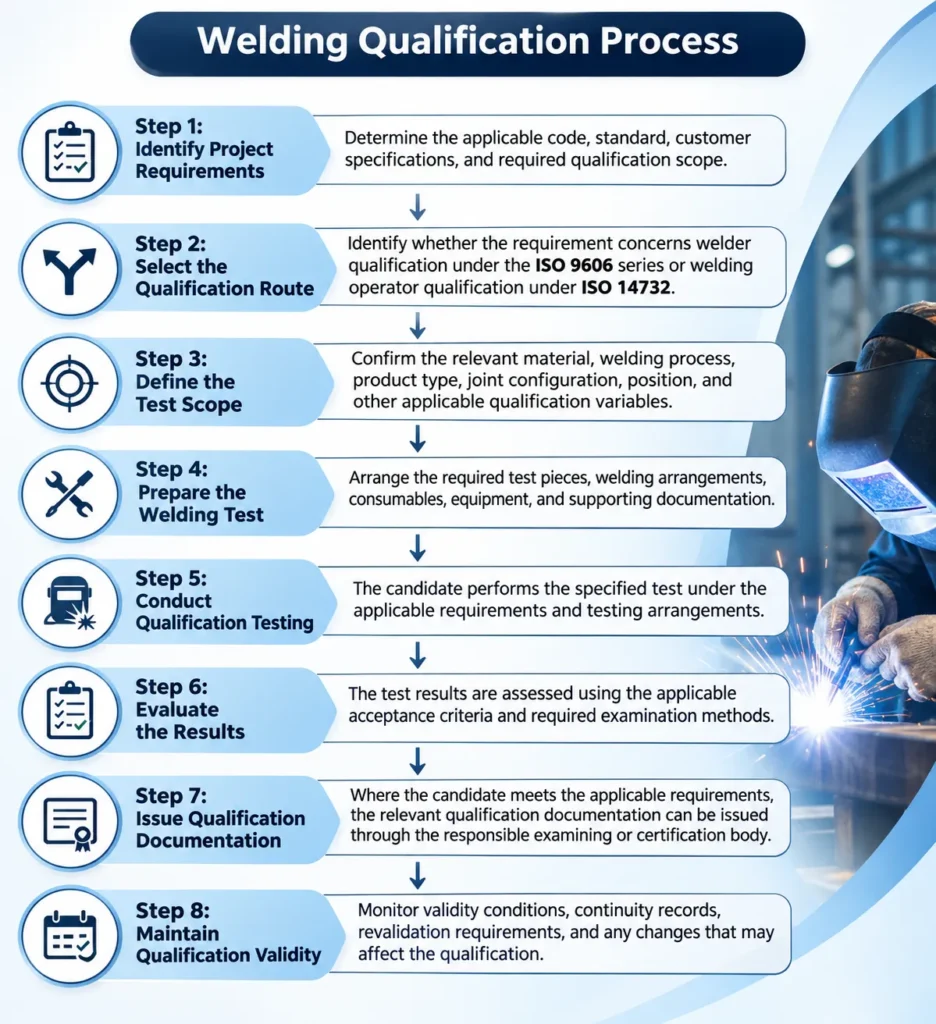
It is imperative to acknowledge that the precise sequence, examination methodologies, acceptance criteria, and validity prerequisites are contingent upon the governing standard and qualification framework in force.
Five Checks Before Booking a Welder Qualification Test
- Mistakes can be effectively averted by meticulously establishing appropriate testing protocols prior to execution.
- Verify the relevant standard as stipulated by the client, contractual agreements, or regulatory frameworks; refrain from inferring or presuming qualification criteria.
- Confirm that the welding methodology employed during production aligns with the specific qualifications mandated for each distinct process.
- Verify material and joint specifications, encompassing material classification, product morphology, and configuration, with particular emphasis on pipe welding and pressure vessel applications.
- Review the required qualification range including welding position, thickness, and diameter to ensure it aligns with tasks performed.
In advance, establish comprehensive documentation protocols and testing arrangements, verifying candidate particulars and requisite records to mitigate potential delays and ambiguities.
Why Third-Party Welder Qualification Testing Matters
For industrial projects, manufacturers are obligated to substantiate that their welding personnel satisfy requisite qualification standards. Third-party welder qualification testing furnishes impartial evaluations, yielding distinct advantages such as verifiable technical proficiency, fortified project preparedness, rigorous quality assurance, heightened supplier confidence, and a more lucid comprehension of international qualification mandates. Nevertheless, the possession of a qualification certificate does not guarantee universal acceptance; its validity is contingent upon adherence to specific standards, particular certification frameworks, project-specific exigencies, and mutual recognition agreements. Consequently, meticulous compliance with pertinent criteria remains indispensable for the successful execution of projects and the maintenance of stakeholder trust.
Common Mistakes That Can Delay Qualification
| Common Mistake | Potential Consequence | Recommended Action |
|---|---|---|
| Selecting the wrong standard | Qualification may not meet project requirements | Confirm the governing code and contract |
| Ignoring the welding process | The qualification may not cover the production process | Verify the applicable process and qualification range |
| Overlooking material requirements | Qualification may be unsuitable for the intended material | Confirm material and applicable qualification variables |
| Assuming every certificate has the same scope | The qualification may not cover the required work | Review the certificate’s scope and limitations |
| Neglecting validity and continuity requirements | Qualification may no longer meet the applicable requirements | Maintain records and check the governing validity rules |
| Booking a test without confirming client requirements | Additional testing or administrative work may be necessary | Verify requirements before arranging the test |
Avoiding these mistakes helps manufacturers plan qualification activities more effectively.
How First Welding Certification Pvt Ltd Can Help
First Welding Certification Pvt Ltd provides comprehensive welding certification and inspection support to commercial enterprises. The foundational phase for any organization involves meticulously delineating its specific certification requirements. Available qualification trajectories encompass welder verification in accordance with ISO 9606, welding operator competency assessment per ISO 14732, the orchestration of third-party testing protocols, and strategic project planning. Essential guidance regarding documentation pertinent to application submissions is furnished throughout this process. It is imperative that qualification prerequisites be established prior to initiating testing procedures for structural steel, pressure vessels, piping systems, or aluminum fabrications.
Conclusion
Welder qualification necessitates verifying that personnel satisfy the precise demands of their assigned tasks, a requirement that extends far beyond the mere possession of a certificate. Manufacturers are advised to validate standards, procedures, materials, and specifications to accurately ascertain testing requirements. Within the Indian context, it is essential to scrutinize project specifications and customer mandates. For expert guidance regarding welding personnel qualifications, one may contact First Welding Certification Pvt Ltd for dedicated assistance.