
News Letter
EN 15085-3
Checklist
EN 15085-3 Design Requirements for Railway Manufacturers in Vietnam
November 2026 Edition | Railway Welding & Design Compliance Update
Stay informed with the latest developments in railway welding standards and design requirements. This month’s update focuses on EN 15085-3, the standard addressing design and classification requirements for welded joints in railway vehicles and components, with key considerations for stress assessment, weld performance classes, joint design and inspection requirements for railway manufacturers in Vietnam.
In railway manufacturing, welding quality cannot be controlled only during production. The design stage plays a critical role in determining how welded joints carry loads, how stress is distributed, which welds require greater attention and whether joints can be manufactured and inspected effectively.
For railway manufacturers in Vietnam working with railway vehicles, components, welded assemblies or export-oriented projects, understanding EN 15085-3 design requirements is important when developing new designs and reviewing existing welded structures.
EN 15085-3 specifies design and classification rules for welding railway vehicles and components. It addresses welded joint design and classification, while structural dimensioning is covered by other relevant standards and design requirements.
What Is EN 15085-3?
EN 15085-3 is the design requirements part of the EN 15085 series, which covers welding of railway vehicles and components.
It focuses on how welded joints should be considered during design, including the assessment of stresses, safety categories, weld performance classes, weld inspection classes and joint design details.
Designers must consider the intended function of the component, the structural loading conditions, safety relevance and applicable technical requirements before defining welded joints.
Stress Assessment and Weld Classification
One important consideration during railway welding design is the assessment of stress acting on welded joints.
For new designs, a stress assessment is required to establish the basis for determining the weld performance class. The assessment results are considered together with the applicable safety category to determine the appropriate classification.
Design documentation should identify the required weld performance class for each joint, allowing production and inspection activities to follow the intended requirements.
The assessment is particularly important for welded structures subjected to repeated loading, vibration, dynamic forces and service conditions encountered during railway operation.
Safety Categories and Stress Categories
The classification of railway welded joints is influenced by the safety relevance of the component and the stress conditions acting on the joint.
Designers should evaluate:
The consequences of a potential weld failure
The importance of the component to railway operation and safety
Stress levels and loading conditions
Fatigue-related loading and service conditions
The function of the welded joint within the assembly
These factors contribute to determining the required weld performance class and inspection approach.
Weld Performance Classes (CP)
Weld performance classes establish the required level of performance for welded joints under EN 15085.
The design classification is linked to the stress assessment and safety category of the welded component. The assigned class influences requirements for weld quality and inspection.
The weld performance class should be clearly stated on manufacturing drawings or associated technical documentation. This allows welding personnel, production planners and inspection teams to identify the applicable requirements for each weld.
Weld Joint Design Considerations
Weld joint design has a direct influence on structural performance, manufacturability and inspection accessibility.
During the design stage, railway manufacturers should consider:
Avoiding weld seams in highly stressed areas wherever practical
Ensuring smooth transitions between different thicknesses
Reducing abrupt changes in cross-section and sharp edges
Selecting suitable weld joint configurations
Considering the accessibility of welds for production and inspection
Reviewing joint positioning and proximity to other welds
Well-considered joint design can reduce stress concentration and make fabrication more practical.
Material and Welding Consumable Selection
The selection of parent materials and welding consumables must be consistent with the design requirements and intended service conditions.
Material properties, weldability, compatibility of materials and the required mechanical performance should be considered before finalising welded joint details.
The welding coordinator should be involved when selecting welding consumables for specified materials. Welding procedure qualification records and applicable technical documentation should support the selected welding process and joint requirements.
Inspection Requirements and Design Documentation
Inspection requirements should be considered during the design phase rather than after fabrication begins.
Design documentation should clearly identify relevant weld details, weld performance classes and inspection requirements. Joint geometry and access should allow the required inspection methods to be carried out.
Manufacturing drawings and technical documentation should provide sufficient information for production and inspection teams to understand the specified requirements without ambiguity.
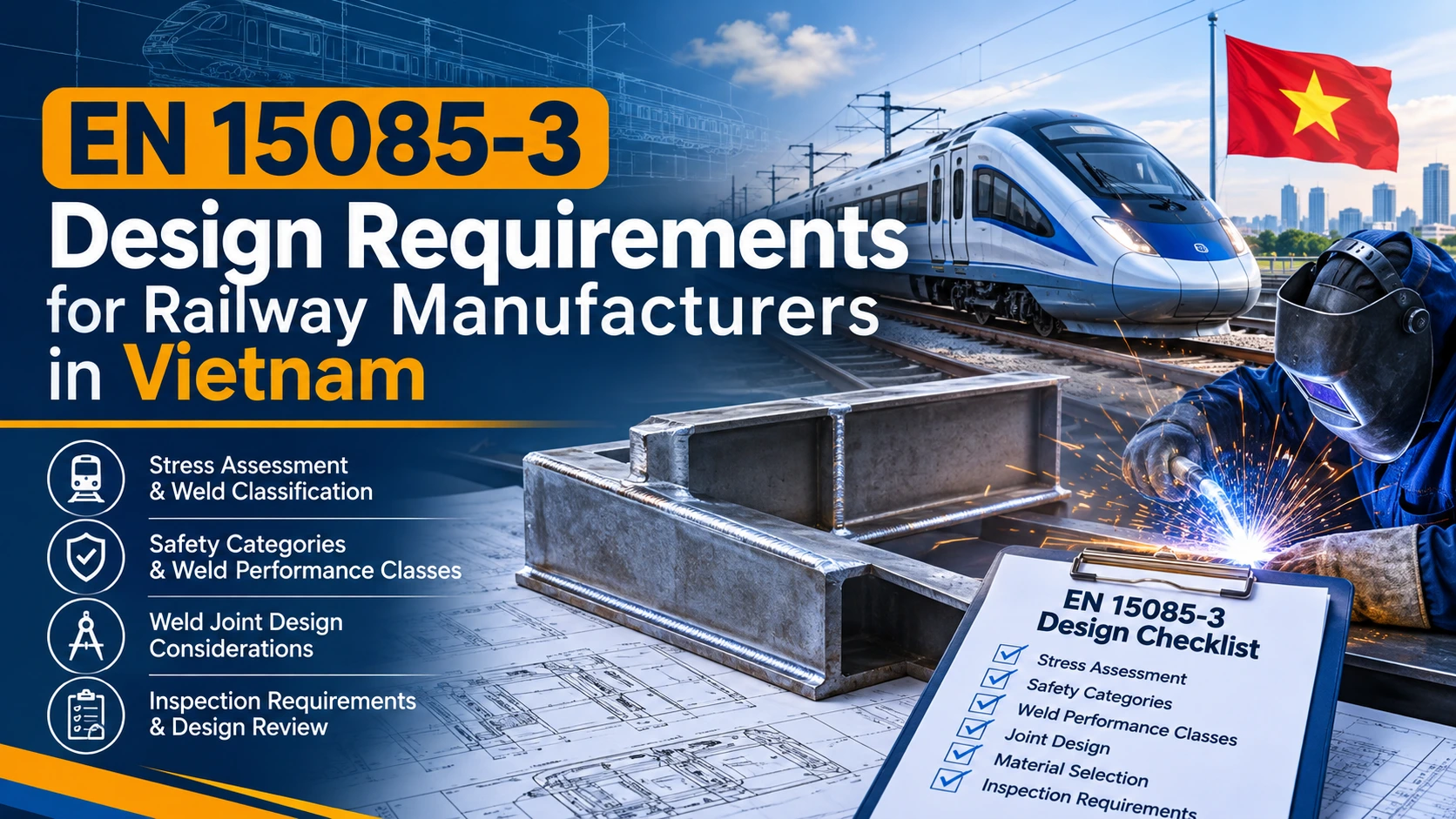
EN 15085-3 Design Review Checklist
Before releasing railway components for production, manufacturers should review the following:
Stress assessment completed for new designs
Safety and stress categories evaluated
Weld performance classes assigned
Weld details identified in drawings
Material and consumable selection reviewed
Joint accessibility considered for welding and inspection
Design requirements reviewed against applicable product standards
Technical documentation approved and controlled
Conclusion
EN 15085-3 design requirements establish an important foundation for railway welding quality by connecting design considerations with welding performance and inspection requirements.
For railway manufacturers in Vietnam, reviewing welded joint details, stress conditions, material selection, classification and inspection accessibility at the design stage can help avoid fabrication difficulties and improve the consistency of manufacturing documentation.
A structured design review before production is an important step towards meeting applicable railway welding quality requirements.
Planning railway welding certification or reviewing your welded component design?
Explore EN 15085 railway welding requirements and understand how design, welding coordination, qualification and inspection connect throughout the manufacturing process.