
News Letter
EN 15085
Welding Process Numbers
EN Welding Process Numbers: Understanding ISO 4063 Codes in EN 15085 Railway Welding
November 2026 Edition | Railway Welding & Welding Process Numbers Update
Stay informed with the latest developments in railway welding standards and manufacturing requirements. This month’s update focuses on EN Welding Process Numbers under ISO 4063, exploring the numerical designations of common welding methods and their significance in railway manufacturing. Learn how welding process identification relates to WPS, WPQR, welder qualification, production documentation, and welding quality control for manufacturers working under EN 15085 requirements.
Railway manufacturing involves complex welding operations where every process must be carefully selected, qualified, documented, and controlled. From structural railway components and vehicle frames to safety-relevant welded assemblies, manufacturers must ensure that welding activities follow the applicable technical and quality requirements.
One important aspect of welding control is the identification of welding processes through standardized numerical designations. EN welding process numbers defined by ISO 4063 establish a common identification system for welding methods used across manufacturing, engineering documentation, and production activities.
For manufacturers working toward EN 15085 Certification, understanding these process numbers is important when preparing Welding Procedure Specifications (WPS), Welding Procedure Qualification Records (WPQR), welder qualification documents, and production records.
Knowing the correct welding process designation helps maintain consistency between the approved welding procedures and the actual welding operations performed on the shop floor.
What Are EN Welding Process Numbers?
Welding process numbers are standardized numerical codes used to identify specific welding methods. ISO 4063 establishes a system for assigning numbers to different welding processes, allowing manufacturers, welding coordinators, engineers, and inspectors to identify welding techniques without repeatedly writing their complete names.
These designations are widely used in welding-related technical documentation, including welding procedure specifications, qualification records, inspection documents, and manufacturing instructions.
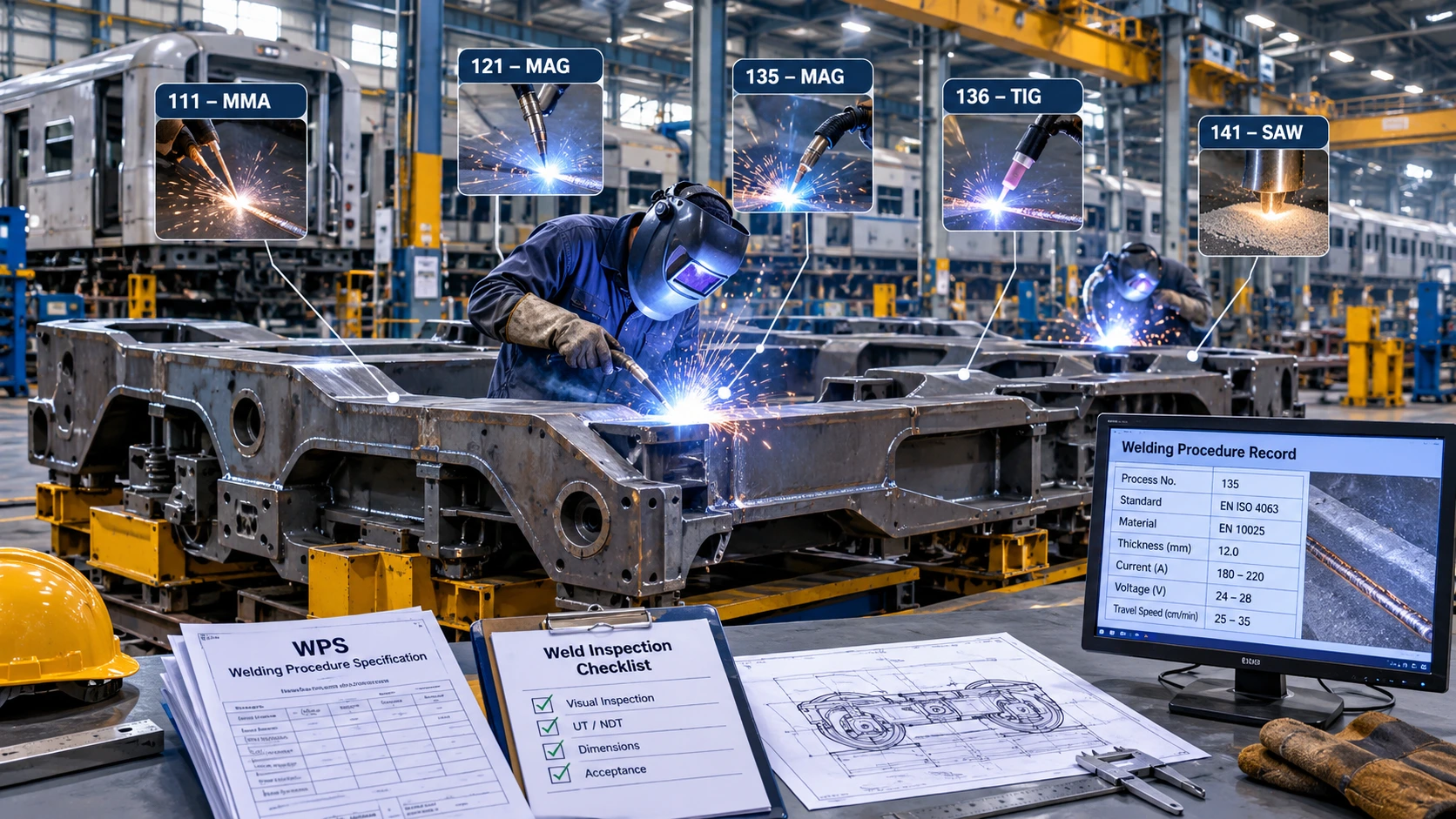
For example, Process 111 refers to manual metal arc welding, while Process 135 identifies MAG welding using a solid wire electrode. Process 141 is associated with TIG welding.
Using standardized process numbers helps reduce confusion between different welding techniques, particularly when multiple welding processes are used for the same product or manufacturing project.
Common Welding Process Numbers Used in Manufacturing
Several welding processes are commonly used in industrial fabrication and railway manufacturing, depending on the material, component design, thickness, joint configuration, production volume, and required weld quality.
Process 111, known as Manual Metal Arc Welding (MMA), uses a covered electrode to create the weld. It is frequently used for fabrication, maintenance, repair, and welding operations where flexibility and accessibility are important.
Process 121 is Submerged Arc Welding (SAW) using a solid wire electrode. It is suitable for long, continuous welds and high-productivity fabrication, particularly for larger steel components.
Process 131 refers to MIG welding with a solid wire electrode and inert shielding gas. It is commonly used for aluminium and other non-ferrous materials.
Process 135 represents MAG welding with a solid wire electrode and active shielding gas. It is widely used in steel fabrication, structural manufacturing, and mechanised welding applications.
Process 136 identifies MAG welding using a flux-cored wire electrode. It is frequently used for structural fabrication and applications requiring suitable productivity and welding characteristics.
Process 138 refers to MAG welding using a metal-cored wire electrode, which is used in various mechanised and production welding applications.
Process 141 represents TIG welding, where the weld is produced using a tungsten electrode and shielding gas, with filler material used when required. This method is commonly applied to precision welding, pipe fabrication, and applications requiring controlled welding conditions.
Process 15 identifies plasma arc welding, which is used in specialised industrial applications requiring controlled arc characteristics.
The selection of any welding process must be based on the applicable technical requirements, material properties, joint design, production conditions, and a qualified welding procedure.
Why Welding Process Numbers Matter in EN 15085 Certification
EN 15085 establishes requirements for welding railway vehicles and components, including welding quality management, welding coordination, personnel competence, procedure qualification, and production control.
Within these activities, process identification plays an important role in ensuring that welding operations are properly defined and documented.
Welding Procedure Specification (WPS)
A Welding Procedure Specification establishes the conditions and parameters required to perform a welding operation. It includes details such as the welding process, base material, joint preparation, welding consumables, positions, parameters, and other applicable requirements.
The correct process number identifies the welding method covered by the procedure. This enables production personnel to follow the specified process and helps welding coordinators verify that the approved procedure matches the planned manufacturing activity.
Welding Procedure Qualification Record (WPQR)
A Welding Procedure Qualification Record documents the results of welding procedure qualification and the conditions under which the welding procedure was tested.
The process number recorded during qualification is important because the qualification applies within the relevant rules and qualification ranges. Manufacturers must ensure that production welding follows the qualified process and remains within the applicable qualification scope.
Welder and Welding Operator Qualifications
Welders and welding operators must be qualified for the welding processes and conditions applicable to their assigned work.
Process numbers help identify the welding methods covered by a qualification and assist manufacturers in checking whether personnel qualifications are appropriate for the welding activities performed during railway component production.
Production and Inspection Records
Production records must reflect the welding operations actually performed. Process identification helps connect manufacturing instructions, WPS documents, inspection reports, weld traceability, and production monitoring records.
Maintaining consistent welding process information makes it easier to verify that the welding activities were performed according to the applicable requirements.
How Welding Process Numbers Relate to EN 15085 Certification Levels
EN 15085 certification requirements depend on the safety relevance of welded railway products, the manufacturer’s welding activities, and the applicable requirements for the product and manufacturing scope.
Certification levels determine the extent of welding quality control, welding coordination, personnel qualification, procedure qualification, and documentation applicable to the manufacturer.
Welding process numbers do not independently determine the certification level. Instead, they identify the welding methods used within the manufacturer’s production activities.
Manufacturers must establish appropriate welding controls for their certification scope and ensure that welding procedures, personnel qualifications, production processes, and technical records are consistent with the applicable EN 15085 requirements.
Correct identification of welding processes therefore contributes to the overall welding quality management system, but it must be considered alongside product classification, welding coordination responsibilities, and other applicable requirements.
Where Are Welding Process Numbers Used in Railway Welding Documentation?
Welding process numbers are used throughout the welding documentation system to maintain consistency between technical planning, qualification, production, and inspection.
During the preparation of a WPS, manufacturers identify the welding process and the parameters necessary for the intended welding operation. The corresponding WPQR establishes the qualification evidence for the applicable process and conditions.
Welder qualification certificates identify the welding processes and qualification scope covered by the welder’s competence. Production instructions and manufacturing records document the process used to manufacture the component.
Inspection reports and quality records provide evidence that the required inspections and tests have been performed. Certification scope documentation may also identify relevant welding activities and processes covered by the manufacturer’s quality management system.
Maintaining consistency across these records helps welding coordinators verify the traceability of welding operations and identify discrepancies during internal audits or certification assessments.
What Should Manufacturers Check Before Selecting a Welding Process?
Selecting a welding process requires careful consideration of the technical and manufacturing requirements of the component.
Manufacturers should evaluate the compatibility of the welding process with the base material, material thickness, joint design, welding position, accessibility, and required weld quality.
The availability of an applicable qualified welding procedure is equally important. Before production begins, manufacturers should confirm that the WPS and corresponding qualification records cover the intended welding operation.
Personnel competence must also be verified to ensure that welders and welding operators are qualified for the relevant process and working conditions.
Equipment availability, consumable selection, workshop conditions, production sequence, inspection requirements, and documentation consistency should also be considered when finalising the welding process.
These checks help ensure that the selected process is technically suitable and that the manufacturing operation remains aligned with the approved welding requirements.
Maintaining Welding Process Consistency Under EN 15085
Welding process numbers are more than numerical references in technical documents. They establish a common language for identifying welding methods across engineering, production, qualification, inspection, and quality control activities.
For railway manufacturers, maintaining consistency between the process specified in the WPS, the process qualified in the WPQR, the welder’s qualification scope, and the actual production process is an important part of welding control.
A structured approach to process identification helps manufacturers maintain reliable documentation, improve traceability, and demonstrate control over their welding operations during EN 15085 certification assessments.
Understanding ISO 4063 and correctly applying welding process numbers is therefore an important step toward establishing controlled railway welding production and maintaining certification readiness.
Conclusion
Correct welding process identification is an important part of maintaining consistency in railway manufacturing. Manufacturers must ensure that welding procedures, personnel qualifications, production records, and inspection activities reflect the processes used in actual production.
Understand the applicable certification requirements, welding process controls, qualification records, and welding coordination responsibilities to strengthen your manufacturing quality system and certification readiness.