
EUROPEAN COMISSION
DPP
PREPRATION GUIDE
How Indian Steel Manufacturers Can Prepare for the EU Digital Product Passport in 2026
By First Welding Certification Technical Editorial Team
9 Min Read
20 Aug 2026
Table Of Contents
- What Is a Digital Product Passport for Steel?
- Why Should Indian Steel Manufacturers Care About the EU DPP?
- EU Digital Product Passport Timeline for Steel
- What Information Could a Steel DPP Contain?
- The Connection Between DPP and Steel Traceability
- A Practical DPP Readiness Roadmap for Indian Steel Manufacturers
- 10-Point EU DPP Readiness Checklist
- What Indian Steel Manufacturers Should Do in 2026
- Digital Product Passport vs Traditional Steel Documentation
- Final Takeaway
- Frequently Asked Questions
Key Takeaways
Organize Steel Product Data
Strengthen Material Traceability
Maintain Quality Documentation
Prepare for EU DPP Compliance
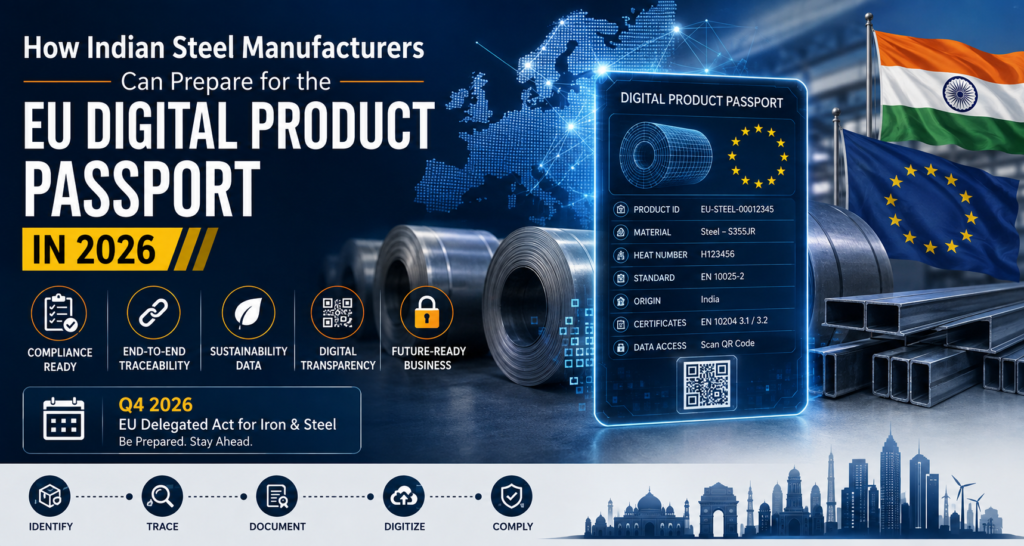
The European Union is working to create a more open and connected product economy using digital tools, and the steel industry is playing a key role in this change.
For Indian steel companies that sell products in Europe, the EU Digital Product Passport (DPP) is becoming a major issue when it comes to following rules and managing data.
Under the EU Ecodesign for Sustainable Products Regulation (ESPR), iron and steel have been chosen as key product groups that will need Digital Product Passports in the future.
The European Commission has set Q4 2026 as the likely time when specific rules for the steel sector will be fully ready.
At the same time, the EU Digital Product Passport Registry started working on 20 July 2026, offering a system for registering DPPs along with their unique codes and extra information.
For Indian manufacturers, now is the time to start getting ready before the rules become required.
This guide explains what the Digital Product Passport means for steel makers and the steps Indian exporters can take in 2026.
What Is a Digital Product Passport?
A Digital Product Passport is a digital record that holds information about a product, including details about its materials, features, sustainability aspects, compliance data, and lifecycle.
Rather than using separate paper documents or PDFs, the DPP framework makes important product information easier to find and share across the entire supply chain.
For iron and steel, the European Commission says the future DPP system aims to increase transparency and tracking throughout the supply chain.
Depending on the final rules, the information might include product details, technical and material data, information about how the product can be reused or recycled, sustainability data, and documents that prove compliance and tracking.
So, a DPP is more than just a QR code.
It is part of a larger system for managing product data and ensuring traceability.
Why Should Indian Steel Manufacturers Care About the EU DPP?
India is a major global producer and exporter of steel, and many Indian companies make and sell steel products, fabricated parts, and engineering goods to customers in Europe.
As the European Union places more emphasis on transparency, sustainability, and digital tracking, manufacturers may need to give more organized and detailed information about their products.
The DPP could affect makers in the following areas:
– Structural steel
– Steel plates and sections
– Fabricated steel parts
– Industrial equipment
– Construction products
– Automotive supply chains
– Engineering goods
– Machine parts
– Other iron and steel items that may be covered by future EU rules
The exact rules will depend on the specific product, as outlined in the final delegated act.
The key takeaway is that Indian companies selling covered products into the EU market might be subject to DPP requirements, since the EU’s DPP applies to all relevant businesses that place covered products on the EU market, including those importing goods.
EU Digital Product Passport Timeline for Steel
The DPP framework is now moving from creating policies to actually putting them into action.
Important 2026 dates:
July 2026 — DPP Registry framework is set up
The European Commission created the operational framework for the DPP Registry.
20 July 2026 — DPP Registry starts working
The European Commission launched the DPP Registry along with a testing environment.
The Registry helps with registering product IDs and related information.
Q4 2026 — Iron and steel
According to the Commission’s current plan, iron and steel will follow the ESPR delegated act in Q4 2026.
This act sets specific rules for these products.
The exact dates and rules might change as the legal and technical work continues.
So, manufacturers should see 2026 as a time to get ready, not as the final deadline to wait for.
What Information Could a Steel DPP Contain?
The last required information fields for iron and steel will depend on the specific rules for each product.
However, the European Commission has listed several types of information that might be part of the overall framework.
These are:
– How to identify the product
– How to classify the product
– Technical details about the product
– Information about the materials used
– Details about how much recycled content is in the product
– Information related to sustainability
– Information about circularity, like how the product can be reused or recycled
– Documents showing that the product meets all the necessary standards
– Information that can track the product’s history or origin
For a steel maker, this means that current records about quality and production might become even more important as digital data becomes more organized and useful.
The Connection Between DPP and Steel Traceability
One of the most important things Indian steel makers need to do is make sure they can track the materials used in their products. A maker should be able to connect a finished product to the materials and records used to make it.
For example:
Finished Product
↓
Product Identification
↓
Heat Number
↓
EN 10204 Material Certificate
↓
Chemical and Mechanical Test Results
↓
Production Records
↓
Inspection and NDT Records
↓
Sustainability and Environmental Data
This helps build a solid base for reliable digital product information. Without correct tracking, making a trustworthy Digital Product Passport is much harder.
Step 1: Create a Strong Product Identification System
The first step is to make sure every product can be uniquely identified.
Manufacturers should have clear identifiers for:
– Product type
– Batch
– Heat
– Material grade
– Production order
– Component
– Finished product
They should avoid using different identification systems in different parts of the business like purchasing, production, quality control, and shipping.
The goal is to have a single, consistent way to identify products across the entire company.
Step 2: Improve Heat Number Tracking
Tracking heat numbers is especially important for steel products. A heat number can link physical material to its production and test records.
Manufacturers should make sure:
– The heat number is recorded when the material is received.
– The heat number is connected to the material certificate.
– Identification is kept during storage.
– Heat identification is passed on after cutting.
– Fabricated parts can still be traced back to their source material.
– Final documentation keeps the connection to the material.
This helps build a strong base for future digital tracking.
Step 3: Digitize EN 10204 Certificates
Steel makers often keep material certificates such as EN 10204 Type 3.1 or 3.2, depending on the rules they follow. Instead of just keeping these as separate PDF files, they should create structured records that link:
Material → Heat Number → Certificate → Test Results → Product
This makes finding documents easier and gives better quality data for future digital systems. For companies already using EN 10204 certificates, this is a simple area to improve.
Step 4: Link Production and Quality Records
A company ready for a Digital Product Passport should not have production records in one system and quality records in another with no link between them.
If possible, manufacturers should connect:
– Material certificates
– Heat numbers
– Purchase orders
– Production orders
– WPS
– WPQR
– Welder qualifications
– Welding records
– NDT reports
– Inspection reports
– Final inspection records
– Product identification
This creates a connected chain of digital evidence.
Step 5: Start Collecting Sustainability Data
Digital Product Passports are closely related to sustainability and circularity data. For steel makers, this means companies should think about what environmental and material data they are already collecting.
Some data categories might include:
– Recycled content
– Material composition
– Production information
– Energy-related details
– Environmental performance data
– Carbon-related data
– Recycling and circularity information
The exact data requirements will depend on the EU laws that apply.
Manufacturers should not assume that all the data being talked about is already required by law. Instead, they should build systems that can collect accurate data as the requirements become clearer.
Step 6: Improve Data Quality
Digital compliance depends on the accuracy of the data behind it. Even with good software, wrong product data can cause legal problems.
Common issues with data quality include:
– Wrong heat numbers
– Duplicate product IDs
– Missing certificates
– Inconsistent product names
– Incorrect material grades
– Missing inspection records
– Different data formats between departments
– Errors from manual spreadsheets
Before data enters a digital product system, manufacturers should check its accuracy.
Step 7: Get Ready for QR Codes and Data Carriers
The European Commission says DPP information for iron and steel is likely to be connected to products through a data carrier like a QR code, depending on the rules. This means manufacturers should think about how product identification will work in the real world.
For example:
Product → QR Code/Data Carrier → Unique Product Identifier → Digital Product Information
The data carrier is not the DPP itself. It is the way users or systems find the right digital product information.
Step 8: Get Your IT Systems Ready
Indian manufacturers don’t need to create a brand new software platform right away. Instead of that, they should check if their current systems can handle:
– Unique product codes
– Organized product information
– Links between documents
– Connecting to APIs
– User access rights
– Updating data
– Records of who made changes
– Digital security certificates
– Information about the product’s life cycle
The EU DPP system uses a decentralized method, where product data stays with the relevant businesses or their service providers, and the EU Registry serves as a shared way to find this data. This means that making systems work together and having a good data structure are very important.
Step 9: Check Your Current EU Compliance Systems
Preparing for DPP should be done together with other EU compliance tasks. Indian steel makers should look at their current systems for:
EN 1090
For steel companies that sell in Europe, the Factory Production Control and traceability processes related to EN 1090 can offer a strong starting point.
EN 10204
Material inspection certificates must be properly connected to the actual product and material they cover.
Welding Records
If needed, Welding Procedure Specifications (WPS), Welding Procedure Qualification Records (WPQR), and welder qualifications should be connected to the production records.
Non-Destructive Testing (NDT)
Important NDT reports should be traceable back to the part they were tested on.
EU CBAM
Information about carbon emissions should be kept separate but in line with the overall sustainability and product data plan.
We have already covered some of these EU compliance areas, such as EN 1090, EN 10204, and EU CBAM.
A Practical DPP Readiness Roadmap for Indian Steel Manufacturers
Manufacturers can prepare for DPP in four steps.
Step 1: Check Existing Data
Find out:
– What product information do we already have?
– Where is this information kept?
– Who is responsible for the data?
– Are there any paper documents left?
– Are there records that can’t be linked right now?
Step 2: Make Traceability Standard
Set up clear rules for:
– How to identify products
– How to track heat numbers
– How to handle material certificates
– How to record production
– How to keep inspection records
– How long to keep documents
Step 3: Go Digital and Connect Systems
Move towards using digital records in a structured way and link important systems together.
The aim is to link:
Product details with materials, production, inspection, and sustainability information
Step 4: Check if Ready for DPP
Once the specific rules for the industry are clearer, compare your current data system with the final EU requirements.
The EU has already created a DPP testing area along with the Registry, so companies can get a better understanding of how the new system works.
10-Point EU DPP Readiness Checklist
Indian steel manufacturers can follow this checklist:
- First, find out which products might be impacted by the EU’s future DPP rules.
- Next, create a way to clearly identify each product.
- Make sure each batch of steel has a unique heat number that can be tracked back.
- Convert the EN 10204 material certificates into digital format.
- Connect these certificates with the records of how the steel was made.
- Link the inspection and non-destructive testing documents to the right products.
- Check how sustainability and environmental data is being collected.
- Set up ways to ensure the data is accurate and reliable.
- Look into using QR codes or other digital tools and check the digital systems in place.
- Keep an eye on the final EU iron and steel delegated act.
What Indian Steel Manufacturers Should Do in 2026
The biggest error would be waiting until the final EU rules are released before getting ready.
Manufacturers should start with the information they already have.
A good way to begin is:
Material Traceability → Certificate Management → Product Identification → Production Records → Inspection Data → Sustainability Data → Digital Product Infrastructure
This method also brings advantages beyond just meeting DPP requirements.
Better traceability can help with:
– Quality control
– Preparing for audits
– Building customer trust
– Finding documents quickly
– Understanding production processes
– Following export rules
– Making the supply chain more transparent
Digital Product Passport vs Traditional Steel Documentation
| Traditional Documentation | DPP-Ready Approach |
|---|---|
| Separate PDF certificates | Connected digital product records |
| Manual document searches | Searchable product information |
| Paper-based traceability | Digital traceability |
| Heat number recorded separately | Heat number linked to product |
| Quality records stored separately | Connected quality records |
| Limited data accessibility | Controlled digital access |
| Reactive compliance preparation | Continuous compliance readiness |
The DPP doesn’t automatically cancel current certificates or technical papers.
It’s more about making product information easier to access and better connected.
Final Takeaway
The EU Digital Product Passport is becoming an important factor for Indian steel makers who want to sell their products in Europe.
The European Commission has already set up the DPP Registry, and iron and steel are among the main product groups under the ESPR framework.
The expected timeline shows that a specific law for the steel industry is likely to be in place by the fourth quarter of 2026.
The exact rules will be decided by the EU in the end, but steel manufacturers don’t have to wait to start making improvements.
The best way to prepare is to set up a solid system that includes:
– Product identification
– Tracking heat numbers
– EN 10204 documents
– Quality records
– Sustainability data
– Digital product infrastructure
Steel producers in India who start organizing this information now will be better ready when the final DPP rules are announced.
We help manufacturers with the necessary steps for certification, inspection, and compliance for international markets, including European standards for steel, welding, and related industrial products.
Frequently Asked Questions
Is the Digital Product Passport mandatory for Indian steel manufacturers in 2026?
Not yet as a universal requirement for all steel products. The European Commission is developing product-specific DPP requirements for iron and steel, with the current indicative timeline pointing to Q4 2026 for adoption of the relevant delegated act.
Does the EU DPP apply to imported steel?
DPP obligations under applicable EU legislation can apply to economic operators placing covered products on the EU market, including imported products. The exact obligations for iron and steel will depend on the final sector-specific rules.
What should Indian steel manufacturers do before the final DPP rules?
Manufacturers should focus on product identification, material traceability, heat numbers, EN 10204 certificates, production records, inspection documentation and sustainability data.
Will a QR code be the Digital Product Passport?
No. A QR code or another data carrier can provide access to the relevant digital information, but it is not the complete DPP itself. The European Commission identifies data carriers as part of the DPP architecture for iron and steel.
Is EN 10204 being replaced by the Digital Product Passport?
No. DPP requirements and EN 10204 serve different purposes. EN 10204 concerns inspection documents for metallic products, while the DPP framework concerns broader digital product information and traceability.
When should Indian manufacturers start preparing?
Now. The DPP Registry is already operational, and the European Commission’s current indicative timeline places the iron-and-steel delegated act in Q4 2026. Early preparation allows manufacturers to identify data gaps and improve traceability before the final requirements take effect.