
News Letter
EN 10204 3.2
Witness
EN 10204 Type 3.2 Chemical Analysis Witness for Steel Material Verification
November 2026 Edition | Welding Standards & Compliance Update
Stay informed with the latest developments in international welding standards, material inspection and industrial compliance requirements. This November 2026 edition highlights important updates, technical requirements and certification insights across welding quality, material verification, inspection and conformity assessment. Explore key industry developments, standard revisions and practical compliance considerations relevant to manufacturers, welding professionals and quality teams.
Procuring steel plates or other metallic commodities necessitates the rigorous verification of chemical composition against the designated grade, a requirement substantiated by material certificates that must be underpinned by unambiguous identification protocols and comprehensive testing logs. Central to this assurance is the EN 10204 3.2 chemical analysis witness certificate, which mandates the validation of inspection documentation by both an independent manufacturer’s representative and the purchaser’s delegate. By observing chemical testing procedures first-hand, this witnessing mechanism fortifies confidence in sample provenance, the integrity of recorded data, and the accuracy of reported findings, thereby establishing a robust and dependable verification framework.
What Is Chemical Analysis Witnessing Under EN 10204 3.2?
Chemical analysis witnessing entails the systematic observation and validation of designated chemical testing procedures in strict adherence to the relevant inspection plan.
The primary aim is to substantiate that the test specimen has been accurately identified, that the prescribed analytical protocol has been rigorously adhered to, and that the documented chemical composition aligns precisely with the material currently under examination.
Contingent upon the specific product specifications and the terms outlined in the purchase order, the requisite chemical analysis may encompass:
- An examination of the manufacturer’s initial chemical analysis documentation.
- Verifying material grade and heat number.
- Checking sample identification before testing.
- Supervise the process of sample preparation and, as necessary, oversee subsequent laboratory testing.
- An examination of the chemical composition data has been conducted.
- Upon juxtaposing the observed outcomes against the pertinent material specification thresholds.
It is a misconception that EN 10204 Type 3.2 mandates a singular, universal protocol for chemical analysis or necessitates physical oversight of each test.
Rather, the specific testing arrangements are dictated by the mutually agreed-upon inspection scope and the pertinent product requirements.
How Does the Chemical Analysis Witness Process Work?
By establishing a systematic inspection framework, we guarantee alignment among material identification, laboratory findings, and associated documentation.
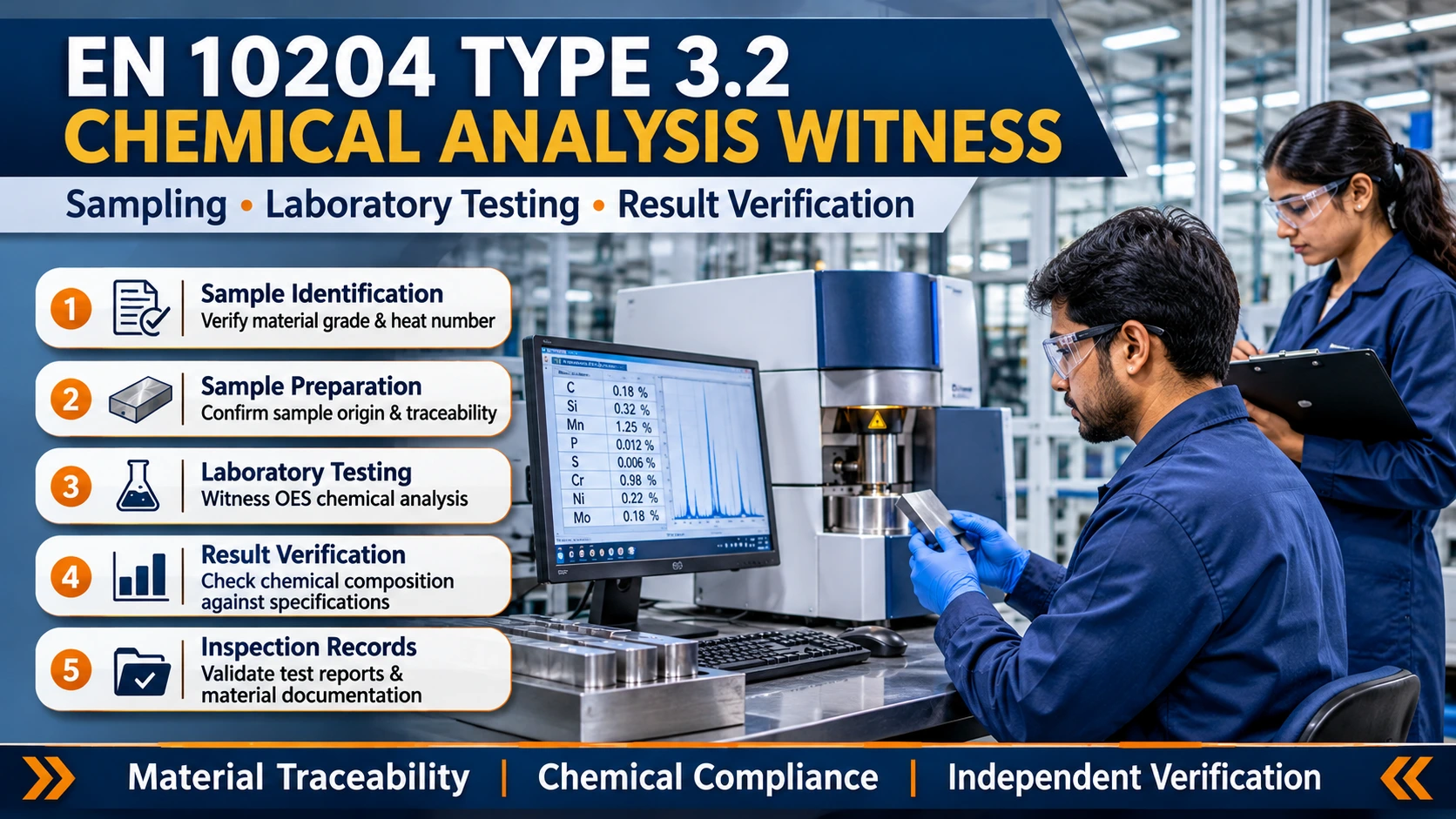
The initial phase necessitates a comprehensive review of documentary evidence, including purchase orders, Material Test Certificates, material specifications, heat or cast identifiers, and the inspection plan, to definitively ascertain the requisite examination protocols.
The second phase mandates the verification of sample identification to ensure traceability; this involves scrutinizing heat numbers, sample references, and material markings, as laboratory findings possess intrinsic value only when definitively correlated with their specific source materials.
During Step 3, the inspector observes the sample preparation and testing procedures, verifying that methodologies such as optical emission spectroscopy (OES) are executed in strict accordance with inspection mandates.
Step 4 involves scrutinizing chemical analysis findings in strict accordance with pertinent material specifications, evaluating constituents including carbon, manganese, silicon, phosphorus, sulfur, chromium, nickel, and molybdenum, where permissible thresholds are defined by specific material grades and applicable standards.
Consequently, the fifth phase is dedicated to the systematic documentation and archiving of inspection observations and test records, thereby guaranteeing that any irregularities concerning material identification, testing protocols, or outcome data are meticulously noted and rectified in strict adherence to established inspection mandates.
Ladle Analysis vs Product Analysis: What Is the Difference?
Chemical analysis may be conducted across various phases of metallic production. Grasping this differentiation proves essential when evaluating an EN 10204 3.2 inspection certificate.
| Parameter | Ladle Analysis | Product Analysis |
|---|---|---|
| Testing Stage | During steelmaking | On the finished or supplied product |
| Sample Source | Molten metal from the ladle | Sample taken from the product |
| Main Purpose | Determines the chemical composition of the heat | Checks the chemical composition of the product |
| Application | Steelmaking quality control | Product conformity verification |
| Results | Usually associated with the heat or cast | Associated with the tested product or sample |
What Should Inspectors Verify During Chemical Analysis Witnessing?
The following table highlights important inspection checkpoints.
| Inspection Checkpoint | What to Verify |
|---|---|
| Material Identification | Grade, heat number and product markings |
| Sample Identification | Connection between sample and supplied material |
| Test Method | Method specified in the applicable testing requirements |
| Laboratory Equipment | Suitability and relevant calibration status |
| Chemical Composition | Recorded values for specified elements |
| Specification Limits | Compliance with the applicable material standard |
| Test Documentation | Laboratory report and related inspection records |
| Traceability | Link between material, sample and test results |
Such verifications ensure the preservation of a robust linkage between the tangible sample and its corresponding chemical analytical records.
Common Mistakes During Chemical Analysis Witnessing
Manufacturers and material suppliers should pay attention to the following issues:
- Misidentification of the sample has occurred, as the assigned sample numbers fail to correspond with the material’s heat number.
- The documentation of test results remains incomplete, as laboratory reports frequently lack essential details or present information with insufficient clarity.
- The testing scope remains unverified because the conducted tests do not align with the stipulations of the purchase order or the approved inspection plan.
- The acceptance criteria remain ambiguous because the findings fail to be benchmarked against the appropriate material specifications.
- The absence of traceability records signifies a fragmented link between the sample, the material, and the certificate.
- The mandatory validation of pertinent documentation by designated inspection representatives remains unexecuted.
Proactively mitigating these challenges prior to material issuance can substantially diminish inspection variances and alleviate documentation bottlenecks.
Final Thoughts
When specified within an EN 10204 Type 3.2 inspection scope, chemical analysis witnessing constitutes a critical component of the inspection protocol.
Comprehensive inspection documentation must serve as the critical link connecting every phase of the workflow, ranging from sample identification and laboratory analysis through to result verification and material traceability.
For manufacturers and material suppliers engaged in the production of steel products, pressure equipment, and other vital metallic components, implementing a formalized Type 3.2 inspection protocol provides definitive documentation verifying adherence to the stipulated order specifications.
Explore EN 10204 Type 3.2 Certification
Gain a comprehensive grasp of the inspection mandates, the protocols governing material verification, and the requisite certification documentation pertinent to your product line.