
News Letter
EN 10204 3.2
Revision
EN 10204 Revision Watch 2026: What the Proposed Standards Update Could Mean for Material Inspection Documents
October 2026 Edition | Steel Trade & Compliance Update
Stay informed with the latest developments in international welding standards and certification requirements. This month’s update focuses on the current status of EN ISO 15614-1, one of the most important standards governing welding procedure qualification for metallic materials.
Why is EN 10204 being revised?
If you’ve ever spent time chasing a missing mill certificate at 5 pm on a Friday, you already understand why this standard is important. EN 10204 sets out the different types of inspection documents that come with metal products like plates, sheets, bars, forgings, and castings. It acts as a shared language between steel mills, distributors, and the people who use the products in the end.
The current version of the standard was published in 2004.
According to the BSI project description, a subcommittee decided in a meeting on April 7, 2020, to update it after a thorough review. The concern is that in long supply chains, the documents might not clearly describe the product at every stage, and the definitions and certificate issuing rules need to be clearer.
In simple terms: the world has become more complex with more traders, re-processors, and cross-border storage, and the language in the paperwork needs to keep up with these changes.
Where the revision stands today
| ITEM | WHAT PUBLIC SOURCES SHOW | STATUS |
|---|---|---|
| Current edition | EN 10204:2004, replaced the 1991 edition | In force |
| Revision project | Pr EN 10204 rev, handled under CEN/TC 459/SC 12 (WG 4) | In development |
| Trigger | Systematic review decision, April 2020 | Confirmed |
| German (DIN) mirror project | Earlier entry began Oct 2021; a newer listing shows a start date of 9 June 2026 | Active |
| Scope note | Metallic products; the draft notes it may also apply to non-metallic products | Draft wording |
| Linked legislation | Pressure Equipment Directive 2014/68/EU and Construction Products Regulation 305/2011 | Referenced |
| Publication date | Not announced in sources reviewed | Unknown |
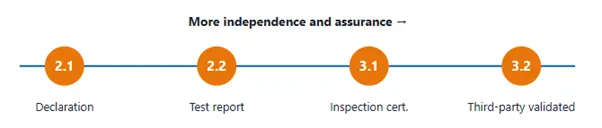
Quick refresher: the four document types you use daily
Before we talk about change, here’s the baseline. These are the core types in the 2004 edition.
| TYPE | NAME | WHO VALIDATES IT? | TYPICAL USE |
|---|---|---|---|
| 2.1 | Declaration of compliance with the order | Manufacturer | General, low-risk supply |
| 2.2 | Test report | Manufacturer | Non-specific testing results |
| 3.1 | Inspection certificate (the classic MTC) | Manufacturer’s authorised rep, independent of production | Structural, pressure, general engineering |
| 3.2 | Inspection certificate, third-party validated | Manufacturer’s rep and purchaser’s rep or authority named in regulations | Critical, regulated, safety-relevant parts |
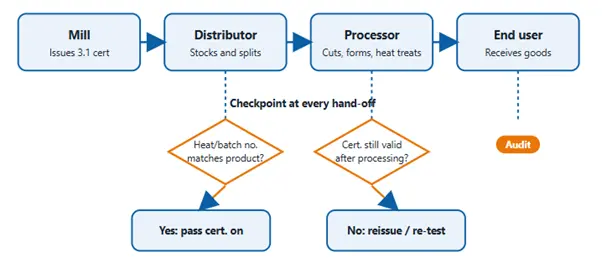
Flow chart: where documents break down in a long supply chain
This is the exact issue the revision is addressing. Every time there’s a hand-off, like when a certificate is passed from one person to another, it’s a chance for the certificate to get separated from the actual product. For example, this can happen during cutting, splitting, or restocking.
What could change? Watch items (not confirmed)
Final wording isn’t public, so here’s an honest take: these are the areas the stated motivation points toward. Treat them as things to monitor.
| WATCH AREA | WHY IT'S ON THE RADAR | WHO FEELS IT MOST |
|---|---|---|
| Sharper definitions | Committee wants more explicit terms | QA teams, auditors |
| Clearer rules on who issues certificates | Ambiguity in multi-party chains | Distributors, traders |
| Documents that follow the product | Certificates must describe goods along the chain | Processors, service centres |
| Wider applicability | Draft scope says it may also apply to non-metallic products | Mixed-material suppliers |
| Alignment with EN 10168 and regulations | Standard works alongside it and links to PED and CPR | Pressure and construction sectors |
A trend worth pairing with this
Digital MTCs, PDFs, XML certificates, and QR code-linked records are becoming more common in the industry. It’s not clear if the update covers these options, but having clean digital records can make any changes or transitions smoother.
Your 7-step readiness checklist
1.Trace your chain. Make a list of all the people or companies that handle or reissue certificates.
2.Check your 3.1 certificates. Are the heat or batch numbers still matching after cutting or splitting the material?
3.Look at your purchase orders. Write “EN 10204 3.1” or “3.2” exactly and include the edition number.
4.Review your 3.2 arrangements. Make sure you know which third-party inspectors are approved.
5.Convert your documents to digital format. Digital, searchable, and linked certificates are better than paper folders.
6.Train your team. Ensure that buyers and receiving inspectors can easily tell the difference between 2.2 and 3.1 certificates.
7.Keep up with the standard. Follow your country’s standards body (like BSI, DIN, NEN, etc.) for any notices or updates.
FAQ
Is EN 10204:2004 still valid?
Yes. The revision is in development, and the 2004 edition remains the one in force.
Do I need to reissue my current certificates?
Not at this stage. Existing certificates issued under the current edition stay valid for their orders. Wait for the published text and transition guidance.
What’s the difference between 3.1 and 3.2?
A 3.1 is validated by the manufacturer’s authorised representative, independent of production. A 3.2 adds validation by the purchaser’s representative or an authority named in regulations.
When will the new edition be published?
No date appeared in the sources checked. Follow your national standards body for updates.