
EN 1090
Steel Staircases
Handrails and Platforms
EN 1090 for Steel Staircases, Handrails and Platforms: When Is CE Marking Required Globally In 2026?
By First Welding Certification Technical Editorial Team
6 Min Read Time
06 Nov 2026
Table of Contents
- Introduction
- What is EN 1090 and why is it important?
- Does EN 1090 apply to steel staircases, handrails and platforms?
- When do I need to CE mark my steel fabricated products?
- Key manufacturing requirements
- Challenges faced by steel fabrication companies
- How can you prepare for EN 1090?
- Benefits of EN 1090
- Frequently Asked Questions
- Related searches
- Conclusion
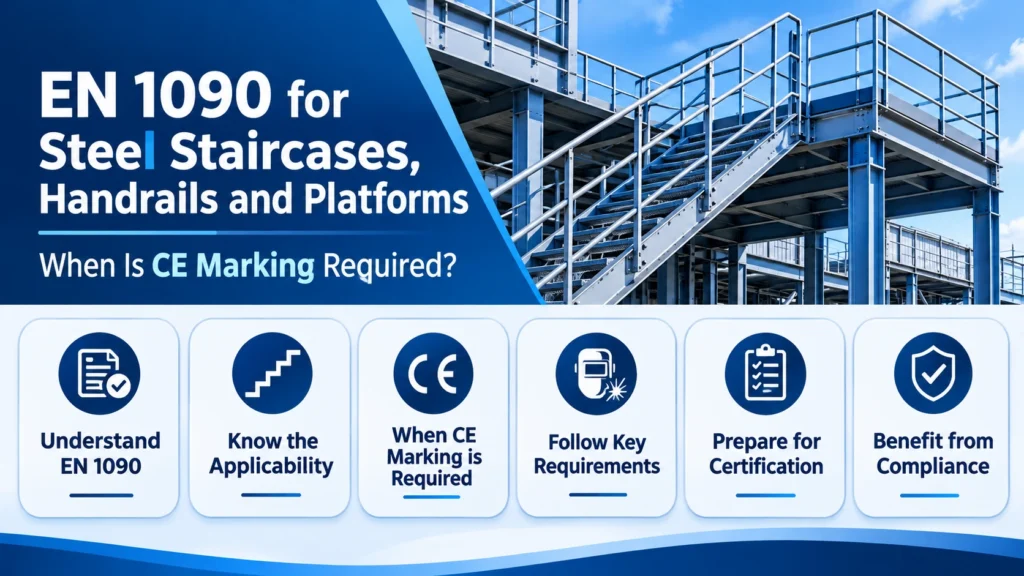
Steel staircases, handrails and access platforms are widely used throughout industry, warehouses, factories, commercial buildings and infrastructure. They are typically constructed using steel structural sections, plates, tubing, welding and fabricated components.
When supplying to construction projects in Europe, it is important to understand if you need to comply with EN 1090. Depending on what your product will be used for and how it will be used structurally you may need to comply with production control and conformity assessment requirements. But do we always need to have EN 1090 certification and CE marking applied to steel staircases, handrails and platforms? Not always. It will depend on how your product will be used, its structural use and its relevance to the technical specification.
This blog will give you a breakdown of when EN 1090 may apply to your product, what you may need to consider and how you could prepare.
What is EN 1090 and why is it important?
EN 1090 is a European standard containing several key standards to do with the execution of steel and aluminium structures.
There are three main standards:
- EN 1090-1 – Conformity Assessment of Structural Components
- EN 1090-2 – Technical execution of steel structures
- EN 1090-3 – Technical execution of aluminium structures
EN 1090-1 will be relevant if you manufacture structural steel components that will be permanently incorporated into a construction.
For example if you are manufacturing a structural steel platform or assembly for a staircase in an industrial site in Europe you may need to consider EN 1090-1.
This will help identify what controls are needed throughout the manufacturing process such as Factory Production Control (FPC) to ensure your product will consistently perform to declared performance.
Does EN 1090 apply to steel staircases, handrails and platforms?
Depending on the use and structural use of the product, there may be several different structural uses. Some products will contribute to the mechanical resistance and stability of the construction whilst others will be used for access, safety or decorative purposes.
- Steel Staircases – If you are supplying a fabricated steel staircase with structural stringers, beams and load bearing joints then EN 1090-1 may apply to your product as a structural construction product.
- Steel Handrails – If you are supplying a decorative handrail with little structural use then this may not apply to you.
- Industrial Platforms – If you are manufacturing an elevated platform for maintenance purposes with structural columns and beams this may apply to you depending on its use.
- Steel Walkways – If you are supplying fabricated steel walkways as a permanent access solution then this should be assessed.
You should not assume all metal products in a building require EN 1090 certification.
When do I need to CE mark my steel fabricated products?
If your product falls within the scope of an applicable technical specification and you have completed the required conformity assessment then you will need to CE mark your product.
Consider:
- What is your product going to be used for?
- Is it going to be permanently incorporated into a building?
- Does it contribute to the mechanical resistance/stability of the construction?
- Is it within the scope of the applicable technical specification?
- Have you completed the required production control and assessment?
For example if you are manufacturing structural steel support frames for an industrial staircase you may need to consider if your product falls within the scope of EN 1090-1. A simple decorative handrail may not fall within this scope.
Correctly identifying your product is an essential first step.
Key manufacturing requirements
If you are manufacturing products that fall within the scope of EN 1090-1 then you will need to set up suitable production controls and document your manufacturing.
Factory Production Control
Factory Production Control is an established written system ensuring that your production meets all the requirements. As a steel staircase manufacturer you will need to have Factory Production Control in place for:
- Purchasing and inspecting your materials.
- Cutting and preparing your steel components.
- Fabrication.
- Welding.
- Checking dimensions.
- Verification of your final product.
- Storage and dispatch.
If you are manufacturing industrial platforms you will need to have written procedures in place for inspecting your incoming steel materials and checking the dimensions of your fabricated components.
Material Traceability
It is important to have traceability of your materials.
You should have:
- Test Certificates.
- Steel Grades and Specifications.
- Heat and Batch Numbers.
- Incoming inspection.
- Identification.
If you have a specific grade of structural steel for your staircase design you should be able to prove you have received the correct material for your design.
Welding Controls
Welding is a key part of manufacturing steel staircases and platforms.
Typical welding joints would be:
- Stringer joints.
- Support Brackets.
- Column to Base Plate joints.
- Beam joints.
- Handrail Post joints.
You should have appropriate welding procedures in place.
Documents you may have:
- Welding Procedure Specification.
- Welding Procedure Qualification.
- Welder Qualification.
- Welding Coordination.
- Welding Consumables Control.
- Welding Inspection.
This will help keep your manufacturing consistent.
Inspection
Having inspection procedures in place will allow you to check your fabricated components meet the requirements. Depending on your product and execution you may need to carry out visual checks, dimensional checks, joint checks and non-destructive testing if required. You should have suitable inspection records in place.
Execution Classes
There are four classes of execution identified within EN 1090-2:
- EXC1
- EXC2
- EXC3
- EXC4
The correct class will depend on the complexity of the structure, service and failure consequences.
A simple steel structure may have a low execution class whereas a more critical structure may have a higher class. The execution class should be identified by the responsible designer or project. Understanding the execution class will help you set up your welding, inspection and production controls.
Documents Required
Before completing the conformity assessment you should organise your technical and quality documents.
Common documents would be:
| Document | Purpose |
|---|---|
| Factory Production Control manual | Defines manufacturing controls |
| Material test certificates | Demonstrates material specifications |
| Material traceability records | Links materials to manufactured products |
| WPS | Provides welding instructions |
| WPQR | Records welding procedure qualification |
| Welder qualification records | Demonstrates welder competence |
| Welding coordination records | Defines welding responsibilities |
| Inspection reports | Records manufacturing verification |
| Calibration records | Supports measurement reliability |
| Nonconformity records | Documents corrective actions |
| Product identification records | Supports product traceability |
Challenges faced by steel fabrication companies
There can be several challenges when preparing for EN 1090.
- Materials – You may not have a good system in place to link your materials to your fabricated components even though you have the certificates.
- Welding – You may have no suitable welding procedures.
- Inspection – You may not have sufficient inspection records.
- Production Control – You may have quality processes but no evidence of any being used.
- Assumed Execution Class – You may have assumed an execution class without considering any project requirements.
- Sub-contracting – If you have sub-contractors doing welding, cutting and/or fabrication then they may not be well controlled.
By addressing these issues early you will have a more organised process.
How can you prepare for EN 1090?
Steel staircase, handrail and platform manufacturers can follow the steps below.
Step 1 – Identify your products.
List out your structural steel products, e.g. staircases, platforms, walkways and support frames.
Step 2 – Identify if applicable.
Consider how your product will be used, what it will be used for structurally and what technical specification it falls under to determine if EN 1090-1 applies.
Step 3 – Consider your manufacturing.
Look at how you purchase your materials, cut, weld, fabricate and inspect.
Step 4 – Factory Production Control.
Set up written procedures to reflect your actual factory processes.
Step 5 – Welding.
Check you have suitable welding procedures in place such as WPS, WPQR, welder qualifications and welding coordination.
Step 6 – Technical Documents.
Ensure you have material certificates, inspection reports, calibration and production records.
Step 7 – Conformity Assessment.
If applicable contact an appropriate notified body to complete your assessment.
Benefits of EN 1090
If your products fall within the scope of EN 1090 then you will have several benefits.
- Helps you comply with applicable European construction product requirements.
- Improves consistency in your manufacturing.
- Improves material traceability.
- Improves welding and fabrication controls.
- Gives you confidence with your customers and contractors.
- Helps you gain access to relevant European construction projects.
- Improves your production documentation and inspection.
Understanding the EN 1090 requirements can be an important part of getting your steel fabrication company ready for the European market.
Frequently Asked Questions
Do all steel staircase manufacturers need to be certified to EN 1090?
No. It will depend on how your product will be used, what it will be used for structurally and the relevant requirements.
Do I need to be certified to EN 1090 for steel handrails?
Not always. If you are supplying decorative handrails that are not used structurally then they may not fall within the scope of EN 1090-1.
Do I need EN 1090 for industrial access platforms?
It may apply if they are being used as a structural component that will be permanently incorporated.
Do I need to be ISO 3834?
This will depend on the welding quality requirements of the relevant EN 1090 requirements. ISO 3834 provides a framework for welding quality.
What is Factory Production Control?
Factory Production Control is a documented system to control your manufacturing activities and ensure consistent product performance.
Related Searches
- What Is EN 15085-2 CL2 Certification for Railway Components in India? Requirements, Scope & Process
- Who Needs EN 15085 Certification? 7 Railway Business Types That Should Check Their Scope
- EN 15085 Certification: How Railway Suppliers Can Qualify for OEM Contracts in 2026
- EN 15085-4 Documentations Qualifications 15085-4 Welding Preparation Documents: How Do Welder Qualifications Support Quality Railway Production Worldwide?
Conclusion
Manufacturers of steel staircases, handrails and platforms supplied to construction projects in Europe must fully understand the application of EN 1090.
By putting a robust Factory Production Control system in place, ensuring material traceability, welding control and logging inspection data, manufacturers can ensure they have an efficient production process and are ready to meet any applicable conformity assessment requirements. Manufacturers of steel staircases, handrails and platforms supplied to construction projects in Europe must fully understand the application of EN 1090. By putting a robust Factory Production Control system in place, ensuring material traceability, welding control and logging inspection data, manufacturers can ensure they have an efficient production process and are ready to meet any applicable conformity assessment requirements.
Planning to supply structural steel products to the Global market?
First Welding Certification Pvt Ltd (PRVÁ ZVÁRAČSKÁ, a.s.) can help you explore the relevant welding quality and certification requirements for your application.