
EN 15085 Audit Checklist
CP/CT Classes
Technical Requirements
EN 15085 Certification Audit Checklist 2026: Documents, CP/CT Classes & Technical Requirements for Railway Manufacturers
By First Welding Certification Technical Editorial Team
8 Min Read
21 Sep 2026
Table Of Contents
- What Does an EN 15085 Certification Audit Check?
- EN 15085 Certification Documents Checklist
- EN 15085 Certification Levels: CL1, CL2 and CL3
- CP Weld Performance Classes
- CT Inspection Classes
- CP vs CT: What Is the Difference?
- WPS, WPQR and Welder Qualification
- Material Traceability and Production Records
- EN 15085 Pre-Audit Checklist
- Common EN 15085 Audit Findings
- EN 15085 Audit Preparation Process
- Frequently Asked Questions
- Conclusion
- Related Resources
- EN 15085 Certification for Railway Manufacturers
How Does the EN 15085 Certification Audit Process Work?
01
Verify required records
02
Check welding controls
03
Confirm inspection classes
04
Check technical compliance
05
Complete certification process
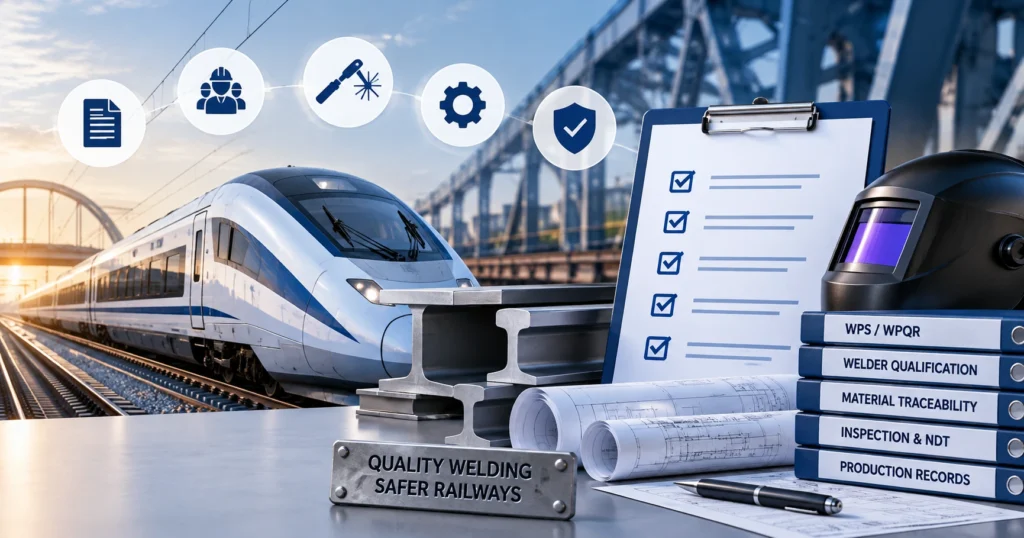
EN 15085 Certification Audit Checklist 2026: Documents, CP/CT Classes & Technical Requirements for Railway Manufacturers
A railway welding manufacturer can have welders, approved WPS and WPQR records and years of production experience—but still face audit findings when its documents do not match actual production. That is why manufacturers should prepare an EN 15085 certification audit checklist before the certification assessment.
The audit can examine more than welding documents. It can cover the certification scope, classification level, welding coordination, welding procedures, personnel qualifications, material traceability, inspection, NDT and production records. This checklist explains the EN 15085 certification documents, CP and CT classes, technical requirements and audit preparation points that railway manufacturers should review in 2026.
What Does an EN 15085 Certification Audit Check?
An EN 15085 certification requirements checks whether a railway manufacturers welding system meets the requirements and whether the documented system matches actual production.
The assessment can cover:
– Certification scope
– Manufacturer classification
– Welding coordination
– Welding personnel
– WPS and WPQR
– Welding processes
– Material identification
– Welding consumables
– Welding equipment
– Production controls
– Inspection and testing
– NDT activities
– Repair records
– Non-conformity records
– Quality documentation
The current European Part 2 reference is EN 15085-2:2020+A2:2025. Manufacturers should review their controlled documents against the current requirements and certification scheme.
EN 15085 Certification Documents Checklist
Documentation plays a role in an EN 15085 certification audit. However manufacturers should not simply collect documents for the auditor. They should make sure each record connects with the manufacturing process.
Key EN 15085 certification documents include:
| Area | Documents to Check |
|---|---|
| Certification scope | Products, locations and welding processes |
| Classification | Applicable CL level and technical classification |
| Welding coordination | Competence, responsibilities and records |
| Personnel | Welder and welding operator qualifications |
| Welding procedures | WPS and WPQR |
| Materials | Material certificates and identification |
| Consumables | Identification, storage and control |
| Equipment | Welding equipment and maintenance records |
| Inspection | Inspection plans and reports |
| NDT | Procedures, personnel records and reports |
| Production | Welding and production records |
| Quality | Repairs, non-conformities and corrective actions |
A strong traceability system should connect:
Material → Drawing → WPS → Welder → Weld → Inspection/NDT → Final Record
This connection allows the manufacturer to demonstrate that the documented welding system reflects actual production.
EN 15085 Certification Levels: CL1, CL2 and CL3
Manufacturers should establish the EN 15085 certification level before starting the certification process.
The used manufacturer classification levels include:
– CL1 – Higher safety relevance
– CL2 – Medium safety relevance
– CL3 – Lower safety relevance
The applicable classification depends on the railway component, its safety relevance and the requirements applicable to the product.Manufacturers should therefore avoid choosing a classification simply because it appears easier to achieve. The classification should match the products welding activities and certification scope.
CP Weld Performance Classes Explained
CP means Weld Performance Class.
EN 15085-3 defines weld performance classes that manufacturers use when assessing railway welded components.
These include:
– CP A
– CP B1
– CP B2
– CP C1
– CP C2
– CP C3
– CP D
The applicable CP class depends on factors such, as the stress category and safety category. Therefore manufacturers should not assign a CP class by looking at the welding process. The applicable technical documentation and design requirements determine the classification.
Cp logic
Safety Category + Stress Category
↓
Weld Performance Class
↓
Inspection Requirements
↓
Inspection Records
A manufacturer should ensure that the applicable CP classification appears consistently across relevant technical and production documentation.
CT Inspection Classes Explained
CT means Inspection Class. CT classification sets the required inspection and testing level for railway welds.
The main inspection classes include:
CT1 CT2 CT3 CT4
The required inspection rules depend on the weld classification and technical rules. A manufacturer should ensure that its inspection plan, NDT activities and inspection records match the requirements.
For example the manufacturer should be able to demonstrate:
- Which inspection class applies
- Which inspection method it uses
- Who performs the inspection
- What percentage or extent of testing applies
- Which acceptance criteria apply
- How the results remain traceable
This makes a link between weld classification and inspection proof.
CP vs CT: What Is the Difference?
| CP | CT |
|---|---|
| Weld Performance Class | Inspection Class |
| Relates to weld performance | Relates to inspection/testing |
| Includes CP A, B1, B2, C1, C2, C3 and D | Includes CT1, CT2, CT3 and CT4 |
| Connects with design and safety requirements | Connects with inspection requirements |
The relationship can be represented as:
Safety & Stress Category
↓
CP Weld Performance Class
↓
CT Inspection Class
↓
NDT / Inspection
↓
Inspection Record
Manufacturers should not use a one‑size‑fits‑all CP‑to‑CT shortcut. They should find the rules from the relevant standard and technical documents.
WPS, WPQR and Welder Qualification
A certification audit can compare the manufacturers WPS, WPQR and welder qualifications with welding activities.
WPS checklist
Check whether the WPS includes information such as:
– Welding process
– Material
– Joint type
– Welding position
– Thickness range
– Welding parameters
– Consumables
– Applicable revision
WPQR checklist
Verify that the applicable WPQR supports the welding procedure and covers the relevant qualification range.
Welder qualification checklist
Check:
– Welder identity
– Welding process
– Material range
– Welding position
– Thickness or diameter range
– Qualification validity
– Actual production application
The key question is:
Does the qualified welding procedure and personnel qualification cover the work actually performed?
Material Traceability and Production Records
Material traceability provides an important link, between incoming material and the completed railway component.
A practical traceability chain can follow:
Material Certificate
↓
Material Identification
↓
Production Component
↓
WPS / WPQR
↓
Welder Identification
↓
Welding Record
↓
Inspection / NDT
↓
Final Record
Manufacturers should also control welding consumables, equipment records drawing revisions and repair documentation. During an audit the manufacturer should be able to retrieve records without confusion or unexplained gaps.
EN 15085 Pre‑Audit Checklist
Before the certification audit review these areas:
Scope
☐ Products identified
☐ Manufacturing locations identified
☐ Welding processes identified
☐ Certification scope matches production
Classification
☐ CL classification established
☐ CP requirements identified
☐ CT inspection requirements identified
Welding Personnel
☐ Welding coordinator records available
☐ Welder qualifications current
☐ Welding operator qualifications available
☐ NDT personnel qualifications available
Welding Procedures
☐ Current WPS available
☐ Applicable WPQR available
☐ WPS and WPQR consistency checked
☐ Current document revisions controlled
Materials
☐ Material certificates available
☐ Material traceability maintained
☐ Welding consumables controlled
Inspection
☐ Inspection plan available
☐ NDT procedures available
☐ NDT reports traceable
☐ Inspection records complete
Production
☐ Welding records available
☐ Repair records maintained
☐ Non‑conformities documented
☐ Final inspection records available
Common EN 15085 Audit Findings
Manufacturers should pay particular attention to these areas:
- Scope mismatch : The certification scope does not match the work the manufacturer does.
- WPS and WPQR inconsistency : The production WPS does not match the needed qualification record.
- Qualification gaps: A welder does work outside his qualification limits.
- Poor traceability: The manufacturer cannot link material ID with the weld.
- Missing inspection records: The required inspection or NDT records are missing.
- Outdated documents: Production staff use drawings, WPS or instructions.
- Incomplete repair records: The manufacturer repairs. Does not keep full records.
- Production-document mismatch: Actual workshop practices do not match documented procedures.
EN 15085 Audit Preparation Process
For preparing an audit of EN 15085 certification, the first step is to determine the scope of certification, confirm the CL classification, and identify CP and CT classes. You will then need to evaluate welding coordination, WPS and WPQR. Next, check qualifications of personnel and traceability of materials. Finally, evaluate the records for inspection/NDT, production control, and repairs prior to conducting the last round of review before auditing. The above checklist will assist railway manufacturers to find weaknesses in documentation, welding, inspection, and production processes.
Frequently Asked Questions
What documents are required for an EN 15085 certification audit?
Manufacturers should prepare documents that cover certification scope, classification, welding coordination, personnel qualifications, WPS, WPQR, materials, production, inspection, NDT, repairs and quality records.
What is the difference between CP and CT in EN 15085?
CP means Weld Performance Class. CT means Inspection Class. CP relates to weld performance requirements. CT relates to inspection and testing requirements.
What are CL1, CL2 and CL3 in EN 15085?
CL1, CL2 and CL3 represent manufacturer classification levels based on the safety relevance of railway welded components.
Conclusion
For preparing an audit of EN 15085 certification, the first step is to determine the scope of certification, confirm the CL classification, and identify CP and CT classes. You will then need to evaluate welding coordination, WPS, and WPQR. Next, check qualifications of personnel and traceability of materials. Finally, evaluate the records for inspection/NDT, production control, and repairs prior to conducting the last round of review before auditing. The above checklist will assist railway manufacturers to find weaknesses in documentation, welding, inspection, and production processes.
EN 15085 Certification for Railway Manufacturers
Railway manufacturers need a defined certification scope, controlled welding procedures, qualified personnel and traceable production and inspection records. First Welding Certification Pvt Ltd (PRVÁ ZVÁRAČSKÁ, a.s.) provides certification for railway welding manufacturers within its certification scope.