
News Letter
European Comission
2026
EU Market Access in 2026: How EN ISO 3834 Helps Indian Welding Manufacturers Prove Compliance
October 2026 Edition | Steel Trade & Compliance Update
Stay informed with the latest developments in international welding standards and certification requirements. This month’s update focuses on the current status of EN ISO 15614-1, one of the most important standards governing welding procedure qualification for metallic materials.
The short answer
EN ISO 3834 is not a law from the EU. It is your evidence. It proves to EU buyers, notified bodies, and auditors that your welding was planned, done by qualified workers, controlled, and recorded. As the EU makes construction products, pressure equipment, and steel trade rules stricter in 2026, having this evidence ready before any inquiry comes is a real benefit.
If you send welded products from India to Europe, you might have noticed that the questions are getting more detailed. People ask things like, who approved the welding process? Is this welder qualified for this specific job? Can you track this weld back to the materials used and the inspections done? Buyers are asking these questions because EU rules are becoming stricter and require better documented and controlled manufacturing. EN ISO 3834 offers a recognized method to answer these questions.
What changed in 2026
This year, three EU developments are important. None of them changed the ISO 3834 standard itself, but together they improve the requirements for keeping records and tracking information.
| Date | EU development | What it means for you |
|---|---|---|
| 8 Jan 2026 | Construction Products Regulation (EU) 2024/3110 became generally applicable | Structural steel supplied under EN 1090 sits in this framework. Harmonised standards already in force under the old CPR remain valid during the transition, so keep welding and production-control records audit-ready. |
| 30 May 2026 | Updated PED 2014/68/EU text adds emergency-procedure articles (43a to 43e) | Welding rules for pressure equipment are not rewritten, but the focus on documented compliance continues. See our PED amendments update. |
| 1 Jul 2026 | Regulation (EU) 2026/1384 replaced the steel safeguard: about 18.3 million tonnes of duty-free quota, 50% out-of-quota duty, and "melt and pour" origin evidence. | This governs steel imports, not your welding certificate. It does signal closer EU scrutiny of origin and traceability, so expect buyers to ask for material records next to welding records. Read our steel quota explainer. |
Good to know: there is no “ISO 3834:2026”. Parts 1 to 5 are still the 2021 versions, and ISO 3834-6:2024 is just guidance. For more details, check our ISO 3834 latest edition guide.
Why ISO 3834 is evidence, not law
There is no EU rule that says you must have ISO 3834.What the EU does require is that welding is done using approved methods, by trained workers, and with records you can show. ISO 3834 turns that into a clear system that can be checked, and having an accredited certificate means a buyer doesn’t have to rely on your word alone. For structural steel, the connection is direct.
EN 1090-2 links welding quality to the execution class of the project, and those quality standards are based on parts of ISO 3834.That’s why most fabricators who want CE marking end up getting ISO 3834 certification.
Where ISO 3834 helps: EN 1090, PED and buyer approval
| EU route | What the EU side looks for | How ISO 3834 helps |
|---|---|---|
| EN 1090 and CE marking | Welding quality matched to execution class, qualified procedures and welders, factory production control. | Parts 4, 3 and 2 map to execution classes, giving the welding side of your production control a ready structure. |
| PED 2014/68/EU | Approved welding procedures, qualified welders, controlled manufacturing. | Shows a documented welding system alongside the approvals your notified body reviews. It does not replace those approvals. |
| EU buyer approval | Evidence of capability before the first order. | A third-party certificate is faster to accept than self-declared claims. See the supplier prequalification checklist. |
EN 1090 execution class and the ISO 3834 part usually expected
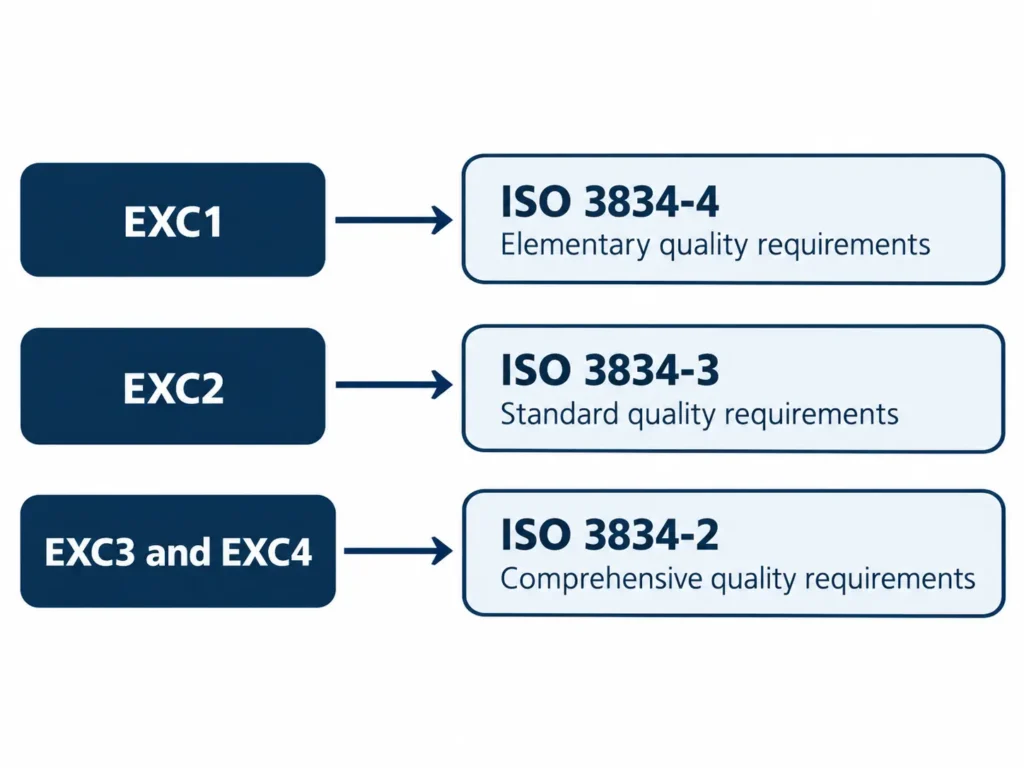
Your contract or customer might request a higher part than the minimum. Check the three quality levels.
Your roadmap from enquiry to certificate
Here is the usual path that most Indian manufacturers take, starting from the first EU inquiry up to when they provide proof that a buyer can trust.

Steps 3 and 4 take the most time. Start the welding system early.
Readiness checklist
Auditors and EU buyers always check the same eight areas. If you can provide records for each of them, you’re already most of the way through.
| Area | What to have ready |
|---|---|
| Contract review | Customer specification, standards, execution class and agreed quality level, all recorded before production. |
| Welding coordination | A named coordinator with competence that fits your work. See coordinator requirements. |
| Procedures | WPS backed by WPQR for your processes and materials. WPS and WPQR certification. |
| People | Valid welder and operator qualifications, with continuity records. |
| Equipment | Welding, inspection and measuring equipment calibrated and maintained. |
| Materials | Material certificates, consumables storage and a clear trace from material to weld. |
| Inspection and NDT | Records before, during and after welding, with qualified NDT personnel. |
| Non-conformities | Logged, corrected and closed, with the reason recorded. |
Four mistakes that slow certification
- Waiting for a “2026 edition.”
It doesn’t exist. Use the 2021 versions right now.
- Picking the cheapest part.
Part 4 might seem simpler, but if your contract requires Part 3 or 2, you’ll have to certify twice.
- Seeing it as just paper.
Auditors track real work from placing an order to inspecting the final product.
- Breaking the chain.
Just having welder certificates isn’t enough. You need to connect each weld to the welder, the WPS, and the material used.
FAQ
Is EN ISO 3834 mandatory for exporting welded products to the EU?
It’s not required on its own. No EU regulation lists ISO 3834 as a general requirement. However, some standards like EN 1090 require controlled welding for CE marking. EN 1090-2 connects welding needs to specific parts of ISO 3834 based on the execution class. Also, many EU buyers ask for ISO 3834 during supplier approval.
Which part of ISO 3834 do I need: Part 2, 3 or 4?
It depends on your product, contract, and risk level. For EN 1090, EXC1 corresponds to Part 4, EXC2 to Part 3, and EXC3 and EXC4 to Part 2.Your customer might need more than the minimum requirements, so make sure to check before you begin.
Has ISO 3834 changed in 2026?
Parts 1 through 5 are still the 2021 versions. ISO 3834-6:2024 provides guidance on how to implement the standard but does not introduce any new requirements.
Does ISO 3834 replace WPS, WPQR or welder qualifications?
No. It wants you to have them and to manage and track them. Think of ISO 3834 as the system that handles those approvals.
Planning EU supply? Get your welding proof in order.
First Welding Certification Pvt Ltd (PRVÁ ZVÁRAČSKÁ, a.s.) helps manufacturers choose the right ISO 3834 level and prepare for audit.