
News Letter
EN ISO 3834
Checklist
EN ISO 3834 Non-Conformities: 7 Welding Quality Problems Manufacturers Should Fix Before an Audit
October 2026 Edition | Steel Trade & Compliance Update
Stay informed with the latest developments in international welding standards and certification requirements. This month’s update focuses on the current status of EN ISO 15614-1, one of the most important standards governing welding procedure qualification for metallic materials.
Even the most minor deficiencies in welding protocols, material provenance, or inspection documentation can precipitate significant complications during a certification audit. Consequently, manufacturers must scrutinize seven critical domains prior to the auditor’s arrival to ensure comprehensive readiness.
For manufacturers engaged in welding operations, quality extends far beyond the mere fabrication of sound welds; it fundamentally entails substantiating the rigorous adherence to proper protocols, the deployment of certified personnel, the utilization of compliant materials, and the implementation of comprehensive inspection controls across the entire production lifecycle. The EN ISO 3834 certification framework delineates the quality imperatives governing the fusion welding of metallic materials.
Consequently, manufacturers are mandated to institute controls that are commensurate with their chosen specifications and specific manufacturing operations. Prior to your upcoming audit, scrutinize these seven potential areas of concern.
1. WPS Documents Do Not Match Actual Production
Although a Welding Procedure Specification (WPS) may exist, is it being strictly adhered to by the workforce?
Differences in welding parameters, materials, positions or other relevant variables can indicate that production needs further review.
What to check: Compare the applicable WPS with actual shop-floor practices and confirm that the supporting procedure qualification evidence is suitable where required.
2. Welder Qualifications Are Incomplete or Out of Scope
Possession of a welder’s certification does not invariably authorize the performance of all welding operations.
The requisite qualifications must align precisely with the specific tasks at hand, encompassing pertinent procedures, materials, roles, and other pertinent variables.
Ensure that personnel qualifications align precisely with their designated responsibilities, while simultaneously verifying the validity or continuity mandates applicable to each role.
3. Material Traceability Has Gaps
The absence of heat treatment records, ambiguous material identification, or incomplete material documentation can significantly impede the determination of the specific material employed in a given component.
Ensure comprehensive verification of material identification, pertinent inspection certificates, and traceability documentation across all stages of production, adhering strictly to the applicable regulatory mandates.
4. Welding Consumables Are Not Properly Controlled
Substandard consumables or inadequate storage and handling protocols can compromise the integrity of the welding process.
What to check: Review consumable specifications, identification, storage conditions, issue procedures and handling instructions. Pay particular attention to moisture-sensitive consumables and manufacturer recommendations.
5. Inspection Records Are Missing or Incomplete
Although a weld may be visually acceptable, it cannot be guaranteed if all necessary inspections and testing have been performed. To ensure compliance with these standards, it is necessary to document the results, apply them, and verify the welding process before, during, and after welding, where necessary.
6. Welding Equipment Checks Are Overlooked
Equipment malfunctions may compromise both process uniformity and the dependability of inspection outcomes.
Examine equipment maintenance logs, verification reports, and calibration records where applicable, ensuring that all apparatus remains fit for its designated purpose and that any identified deficiencies have been effectively remediated.
7. Nonconformities Are Not Followed Through
Identifying a problem constitutes merely the initial phase; should the issue persist or recur, it indicates that the corrective measures implemented have failed to address its root cause.
What to check: Review nonconformity records, immediate corrections, root-cause analysis where appropriate, corrective actions and follow-up evidence.
Quick Review Table: Seven Areas to Check
| Quality area | Potential warning sign | Recommended action |
|---|---|---|
| Welding procedures | WPS does not reflect actual work | Compare production practices with applicable procedures |
| Personnel | Qualification does not cover assigned work | Verify qualification scope and applicable validity requirements |
| Materials | Missing identification or certificates | Review material records and traceability |
| Consumables | Unclear storage or issue controls | Check handling instructions and identification |
| Inspection | Missing test or inspection records | Verify required inspections and documented results |
| Equipment | Overdue or unavailable checks | Review maintenance and applicable verification records |
| Corrective action | Repeated unresolved problems | Investigate causes and verify corrective-action effectiveness |
Flowchart: What Should You Do When You Find a Welding Quality Gap?
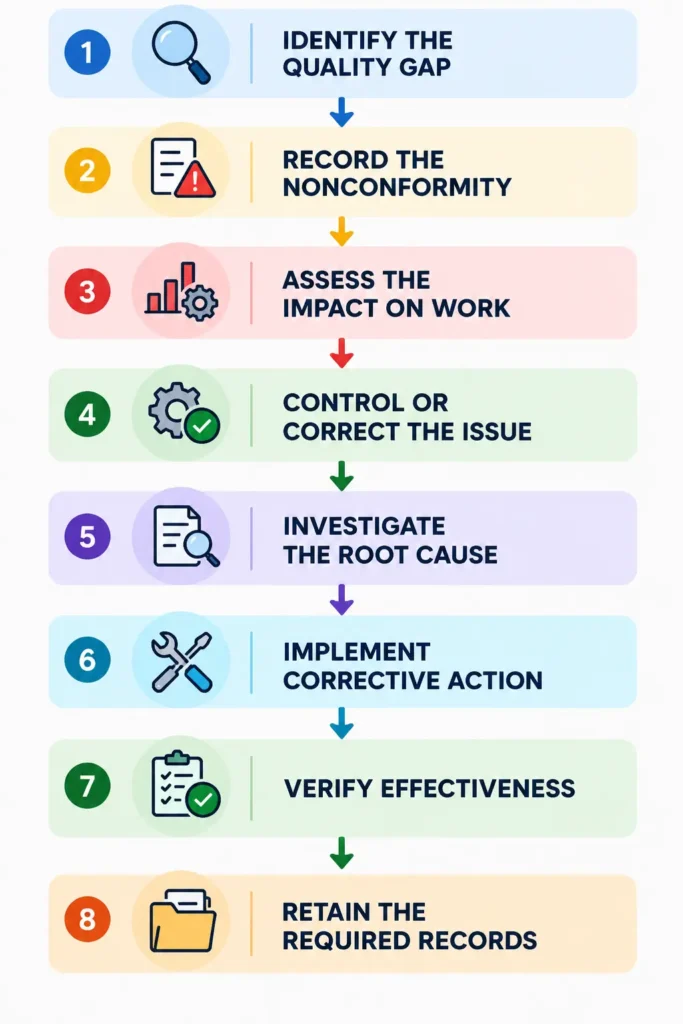
Follow your documented procedures and applicable contractual, technical and regulatory requirements when handling nonconformities.
A Simple Pre-Audit Action Plan
One need not await the formal audit to discern underlying deficiencies.
Begin by examining a selection of recent welding operations, meticulously tracing each engagement from the initial identification of materials and the corresponding Welding Procedure Specification (WPS) through to personnel qualification, inspection protocols, and the compilation of final documentation.
Upon identifying any deficiency, one must immediately assign accountability, formulate a fitting corrective measure, and preserve documentation substantiating the resolution.
The objective transcends the mere compilation of documentation for audit purposes; rather, it aims to substantiate that welding quality is rigorously governed in operational practice.
Preparing for EN ISO 3834 Certification?
Manufacturers can use a structured review process to identify flaws, improve documentation control, and prepare for certification assessment. First Welding Certification Pvt Ltd supports manufacturers in understanding and meeting the welding quality requirements relevant to their certification objectives. Discover more information about our EN ISO 3834 certification services or talk with one of our experts.