
News Letter
EN 15085-3
Checklist
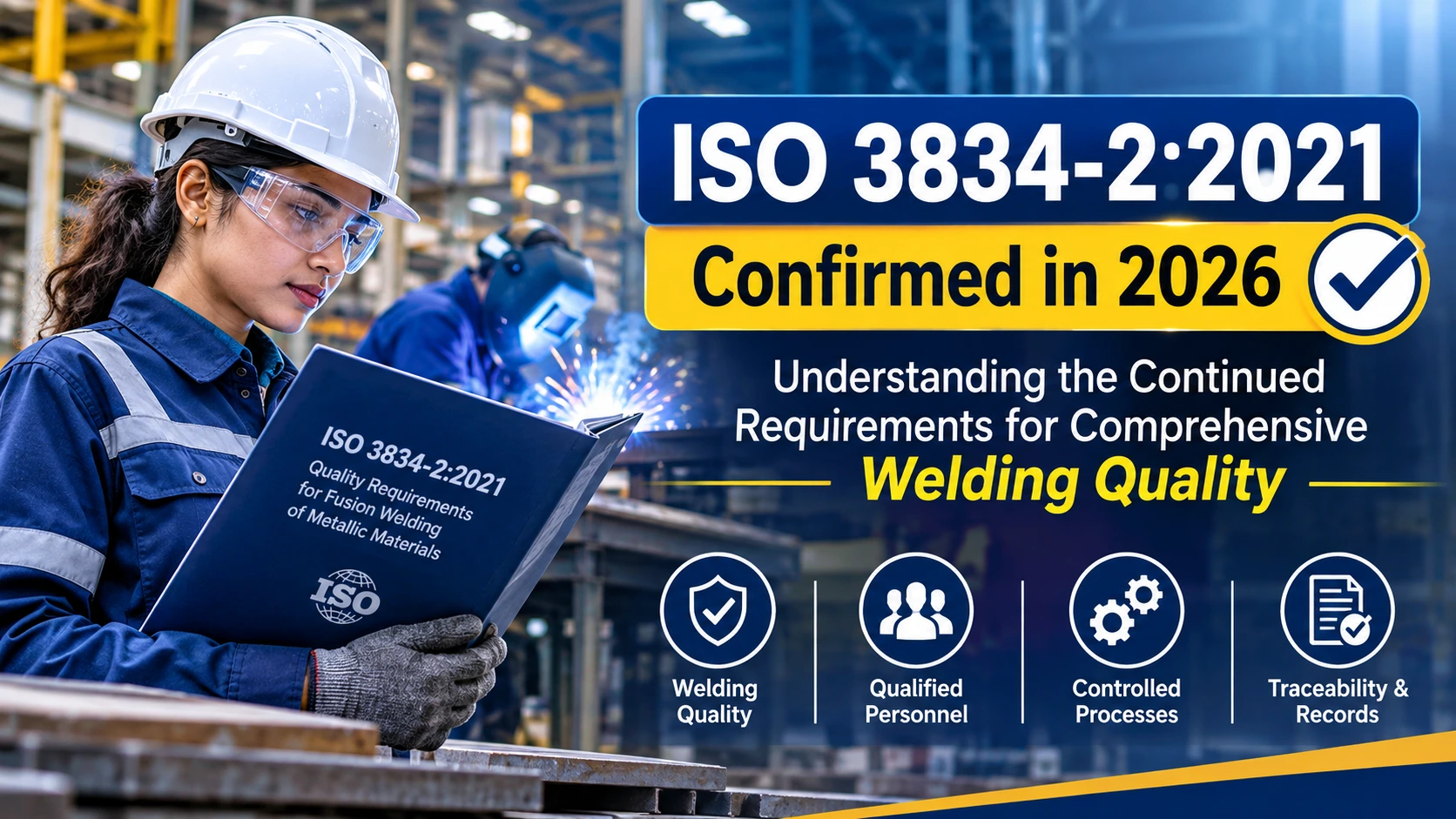
ISO 3834-2:2021 Confirmed in 2026: What Welding Manufacturers Should Know
November 2026 Edition |Welding Standards & Compliance Update
Stay informed with the latest developments in international welding standards and quality requirements. This month’s update focuses on ISO 3834-2:2021, the standard establishing comprehensive quality requirements for fusion welding of metallic materials, following its confirmation in 2026. Explore key considerations covering welding coordination, personnel qualification, welding procedure control, equipment verification, inspection, material traceability and quality documentation for welding manufacturers.
Maintaining consistent welding quality is essential for manufacturers involved in the fabrication and production of metallic structures and components. International welding standards establish requirements for controlling welding activities, managing personnel competence, maintaining equipment and ensuring product quality.
In an important standards update for 2026, the International Organization for Standardization (ISO) has reviewed and confirmed ISO 3834-2:2021 – Quality Requirements for Fusion Welding of Metallic Materials – Part 2: Comprehensive Quality Requirements.
Following its systematic review, the existing 2021 edition remains current. This confirmation highlights the continued relevance of comprehensive welding quality requirements for manufacturers operating in different industrial sectors.
Understanding ISO 3834-2:2021
ISO 3834-2:2021 establishes comprehensive quality requirements for fusion welding of metallic materials in both workshops and field installation locations.
It addresses the essential controls required to maintain welding quality throughout manufacturing activities. The standard focuses on systematic control of welding operations rather than relying only on final product inspection.
Its requirements cover several important areas, including:
Review of requirements and technical review
Welding personnel competence
Inspection and testing personnel
Welding equipment and related activities
Welding consumables and material storage
Post-weld heat treatment
Inspection and testing
Non-conformance and corrective actions
Calibration and validation of equipment
Identification, traceability and quality records
These areas contribute to a structured approach to welding quality management.
What Does the 2026 Confirmation Mean?
The 2026 review confirms that ISO 3834-2:2021 remains the current published edition.
For manufacturers, this means the existing edition continues to serve as the reference for comprehensive welding quality requirements.
The confirmation does not introduce a new set of technical requirements or replace the 2021 edition. However, manufacturers should continue reviewing their welding quality management arrangements against the applicable requiremen
Key Areas Manufacturers Should Review
Following this standards update, manufacturers can review the effectiveness of their existing welding quality controls.
Welding Coordination
Check whether welding coordination responsibilities are clearly assigned and managed in accordance with applicable requirements.
Welding Procedure Qualification
Review Welding Procedure Specifications (WPS) and Welding Procedure Qualification Records (WPQR) to ensure that applicable welding procedures are properly qualified and controlled.
Personnel Qualification
Verify the qualifications and competence records of welders, welding operators and inspection personnel according to the applicable standards and project requirements.
Equipment and Calibration
Check welding equipment condition, maintenance arrangements and calibration or validation records for relevant measuring, inspection and testing equipment.
Material Traceability
Ensure parent materials and welding consumables are properly identified, stored and traceable through the manufacturing process.
Inspection and Documentation
Review inspection plans, test records, non-conformance reports and quality documentation to maintain effective control over welding activities.
Relationship Between ISO 3834 and Other Welding Standards
ISO 3834-2 works alongside several other international welding standards that address specific aspects of manufacturing quality.
| Related Standard | Main Area |
|---|---|
| ISO 3834-1 | Criteria for selecting the appropriate quality requirement level |
| ISO 3834-5:2021 | Documents required to claim conformity |
| ISO 3834-6:2024 | Guidelines for implementing the ISO 3834 series |
| ISO 14731:2019 | Welding coordination tasks and responsibilities |
| ISO 15614-1 | Welding procedure qualification testing |
| ISO 9606-1 | Welder qualification testing for steels |
Understanding the relationship between these standards helps manufacturers establish an integrated approach to welding quality management.
Why This Update Matters to Manufacturers
The confirmation of ISO 3834-2:2021 reinforces the continued importance of comprehensive welding quality controls across manufacturing operations.
Manufacturers involved in structural steel fabrication, railway manufacturing, pressure equipment production and other welded products should maintain effective systems for:
Controlling welding procedures and production activities
Maintaining qualified welding personnel
Monitoring inspection and testing activities
Ensuring material identification and traceability
Maintaining accurate welding quality records
Addressing non-conformities through corrective actions
A structured approach to these areas helps maintain consistent manufacturing quality and demonstrate conformity with applicable technical requirements.
Conclusion
The 2026 confirmation of ISO 3834-2:2021 is an important standards update for the welding industry. Although no new edition has been introduced, the confirmation establishes that the existing comprehensive quality requirements remain current.
Manufacturers should continue monitoring applicable welding standards and reviewing their quality management arrangements to maintain effective control over welding operations.
Stay informed about international welding standards, technical developments and certification requirements.
Visit our website to explore more technical articles and welding standards updates.