
EN 10204
EUROPEAN COMISSION
DPP
Steel Traceability for EU Exports: EN 10204, Heat Numbers & Digital Product Passport
By First Welding Certification Technical Editorial Team
10 Min Read
20 Aug 2026
Table Of Contents
- Introduction
- What Is Steel Traceability?
- Why Is Steel Traceability Important for EU Exports?
- EN 10204 and Steel Material Documentation
- EN 10204 3.1 vs 3.2
- What Is a Heat Number?
- How Heat Number Traceability Works
- Steel Traceability and Digital Product Passports
- What Could a Steel Digital Product Passport Contain?
- EN 10204 + Heat Numbers + DPP: How They Connect
- Example: Steel Export from India to the EU
- Common Steel Traceability Problems
- How Manufacturers Can Prepare for EU Steel Traceability Requirements
- Steel Traceability Checklist for EU Exporters
- Frequently Asked Questions
- Conclusion
Key Takeaways
Certification Scope
Welding Processes
Production Locations
Assessment Cost
Introduction
Steel traceability is becoming a key requirement for steel makers who want to export to the European Union.Buyers, auditors, and regulators are now asking for clear proof about where the steel came from, what kind of material was used, what tests were done, and how the material can be tracked through the manufacturing process.
For steel producers in India and around the world, three things are especially important: EN 10204 inspection documents, heat number traceability, and being ready for Digital Product Passports (DPP).
EN 10204 is a set of rules for creating inspection documents for metal products.
Heat numbers link steel products to their material test records.At the same time, the EU is working on Digital Product Passport rules that will make the iron and steel supply chain more transparent and traceable digitally.
This guide explains how these systems work together and what steel exporters should be ready for by 2026.
What Is Steel Traceability?
Steel traceability means being able to follow a material from when it was first made, through storage, processing, shaping, checking, and finally delivered.
A good traceability system links these steps together:
Purchase Order → Steel Type → Heat Number → Material Certificate → Test Results → Product Label → Manufacturing Record → Final Product
For example, a steel plate used in an EU project might have a heat number that connects to its material certificate.
This certificate includes details like chemical makeup, test results, the standard it was made to, and other inspection information.
This creates a clear, checkable record of the material used in the final product.
Why Is Steel Traceability Important for EU Exports?
European customers are starting to expect manufacturers to show clear proof that the materials used are of good quality and meet the necessary standards.
Tracking the history of materials is very important for products used in areas like:
– Structural steel
– Pressure equipment
– Industrial machinery
– Railway parts
– Heavy engineering
– Steel structures
– Energy infrastructure
In some cases, tracking is also a key part of the process for checking if products meet the required standards and rules.
For example, the Pressure Equipment Directive says that there should be proper ways to track materials that help with pressure resistance from when they are received, through the production process, up to the final testing.
So, tracking isn’t just about filling out forms.
It’s an important part of a manufacturer’s quality and compliance system.
EN 10204 and Steel Material Documentation
EN 10204 outlines various kinds of inspection documents that are used for metal products.
Typical types of inspection documents are:
| Type | General Purpose |
|---|---|
| 2.1 | Declaration of compliance with the order |
| 2.2 | Declaration of compliance with test results from non-specific inspection |
| 3.1 | Inspection document containing specific inspection results validated by the manufacturer's authorized inspection representative |
| 3.2 | Inspection document with specific results validated by the manufacturer's authorized representative and an additional authorized inspection representative |
The specific certificate needed is based on the purchase order, product standards, application, and any agreements in place.
EN 10204 3.1 vs 3.2
The difference between 3.1 and 3.2 certificates is very important for exporters.
A Type 3.1 certificate shows specific test results for the product that was sent, and these results are checked by someone officially approved by the manufacturer.
A Type 3.2 certificate goes one step further by having another officially approved person check the product, based on the agreement or rules that apply.
The certificate should match the real material that was sent, including all necessary details about how it was identified and tested.
PZVAR’s EN 10204 guide has more information on Type 3.1 and Type 3.2 certificates.
What Is a Heat Number?
A heat number is a special code given to a group of metal made at the same time during steel production.
It helps connect the actual steel to the records about how it was made and tested.
For example:
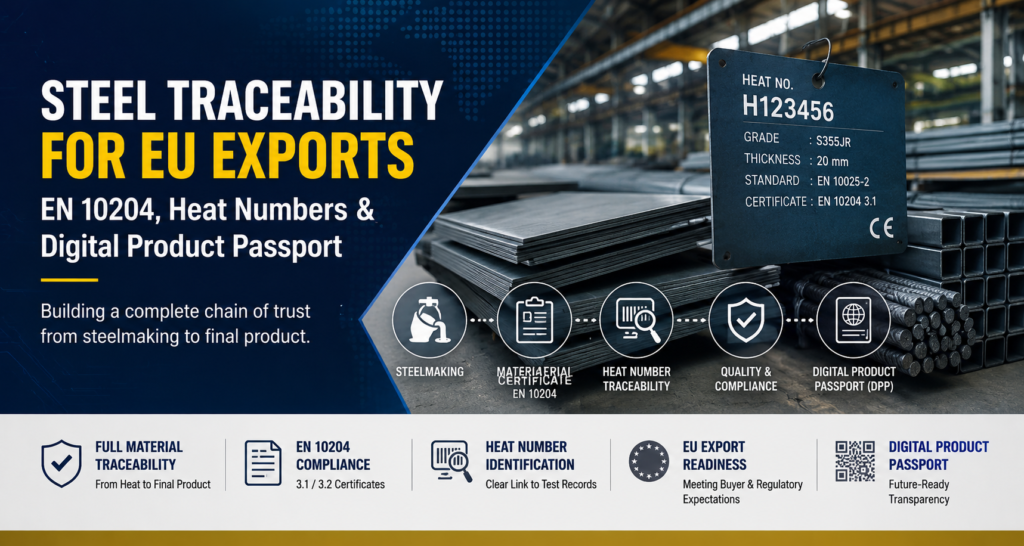
Steel Plate: S355
Thickness: 20 mm
Heat Number: H123456
Material Certificate: EN 10204 3.1
Chemical Analysis: Done
Mechanical Tests: Done
If the heat number on the steel matches the certificate, the manufacturer can show exactly how the material was made and what it is like in terms of quality.
How Heat Number Traceability Works
A good traceability system should keep track of materials all through the making process.
When steel comes to the factory, write down:
– Supplier
– Material type
– Size
– Amount
– Heat number
– Material certificate
– Purchase order
– Specification
Make sure the materials stay labeled during storage. If you mix materials with different heat numbers without proper labels, it can cause problems in tracking them back.
When cutting a plate, pipe, or beam into smaller pieces, the original label should go with the new parts or be tracked properly so they can still be followed. The material labels should stay attached to the records of the work done on them.
If needed, this includes:
– Welding procedure specification
– Welding procedure qualification record
– Welder qualifications
– Welding logs
– Non-destructive testing reports
– Inspection records
– Final check reports
The finished product should be able to be connected back to all the material details and the records of how it was made. This creates a clear record that can be checked during customer visits, audits, or inspections.
Steel Traceability and Digital Product Passports
The next big change is the Digital Product Passport.
Under the EU’s Ecodesign for Sustainable Products Regulation (ESPR), these passports are meant to make important product information easier to find throughout the product’s life.
For iron and steel, the European Commission has named this sector as a key area of focus.
Detailed rules are expected to come from a future product-specific rule.
The European Commission is planning to finish this rule by the end of 2026.
This means steel producers should begin getting their data and tracking systems ready now, instead of waiting for all the final details.
What Could a Steel Digital Product Passport Contain?
The specific data that must be provided for iron and steel products will depend on the relevant EU laws and any future rules that are created.
Manufacturers should think about creating organized digital records for details like:
– Product identification
– Steel grade
– Material specifications
– Heat number
– Material certificate
– Chemical composition
– Mechanical properties
– Manufacturing information
– Recycled content, if it applies
– Environmental information
– Sustainability-related data
– Compliance documents
– Product lifecycle information
The European Commission says that digital product passports (DPPs) are meant to increase transparency and make it easier to track products.
They also help provide information about the product’s features, materials, how circular it is, and other sustainability-related details.
EN 10204 + Heat Numbers + DPP: How They Connect
These three parts shouldn’t be seen as separate things.
They can work together in a connected way to track the product:
Heat Number
↓
EN 10204 Material Certificate
↓
Chemical and Mechanical Test Results
↓
Manufacturing and Fabrication Records
↓
Inspection and NDT Documents
↓
Final Product Identification
↓
Digital Product Passport
So, the future of steel compliance is heading toward connected, organized, and easily accessible product information. Older certificates are still important, but more and more, manufacturers need the basic information to be correct, consistent, and easy to manage digitally.
Example: Steel Export from India to the EU
An Indian company makes structural steel parts for a customer in the EU.
– They get steel plates with different heat numbers.
– A good way to track where each piece of steel comes from is as follows:
– First, they check the steel and make sure they have the right heat number.
– Next, they match that heat number with the correct EN 10204 material certificate.
– Then, they put the material details into their company’s tracking system.
– During cutting and making the parts, they mark each piece so they can track it.
– They also connect the steel to records about welding and inspections.
– They do all the necessary quality checks and non-destructive testing.
– Once the product is finished, they link it to all the supporting documents.
– They also keep all the digital information in a structured way for future needs.
This creates a clear and traceable path from the steel they receive to the final product they export.
Common Steel Traceability Problems
Manufacturers often face problems with tracking materials because of small mistakes in their processes.
Common issues include:
– Heat numbers are lost after cutting.
– Material certificates don’t match the actual materials.
– Different heats are mixed up when stored.
– Certificates have wrong material details.
– Traceability is kept on paper but not in digital systems.
– Inspection records are kept separate from material records.
– Material labels aren’t passed on to finished parts.
– Supplier documents are missing important details.
– Production and quality check records use different numbers for the same materials.
These problems can cause delays during inspections and customer checks.
How Manufacturers Can Prepare for EU Steel Traceability Requirements
A good way to prepare should have five steps.
First, make sure everyone uses the same method to identify materials.
Next, create a clear process for keeping track of and passing on heat numbers during production.
Then, turn material certificates into digital files.
Keep them easy to find and connect them to the right materials.
Also, link quality records to important documents like:
– Welding Procedure Specifications (WPS) and Welding Procedure Qualification Records (WPQR)
– Welder qualifications
– Non-Destructive Testing (NDT) reports
– Inspection reports
– Production records
Don’t just keep compliance info as separate PDFs.
Make sure records are organized so they can be easily found and connected to each product.
Finally, get ready for the DPP requirements.
The European Commission is working on this, and the steel industry will soon need specific product rules.Setting up traceability and product data systems now can help avoid problems later.
Steel Traceability Checklist for EU Exporters
Before sending steel products to a customer in the EU, manufacturers should make sure:
– The correct material grade is known.
The heat number is written down.
– The heat number matches the material certificate.
– The needed EN 10204 inspection document is available.
– The material can still be traced after it is cut.
– The manufacturing records are connected to the material.
– The required welding documents are available.
– The necessary NDT and inspection records are kept.
– The final product is properly marked.
– Documents can be found quickly.
– Product information is organized in a clear digital format.
Frequently Asked Questions
Is EN 10204 mandatory for every steel export to the EU?
Not necessarily. The required inspection document depends on the applicable product standard, purchase order, contract, regulatory requirements and customer specifications.
What is the difference between EN 10204 3.1 and 3.2?
Type 3.1 involves specific inspection results validated by the manufacturer’s authorized inspection representative. Type 3.2 adds verification by an additional authorized inspection representative according to the applicable requirements.
Why is the heat number important?
The heat number provides a traceability link between the physical steel and the material’s production and test records.
Is a Digital Product Passport currently mandatory for all steel exports?
No. The EU is developing product-specific DPP requirements for iron and steel. The European Commission currently indicates an expected sector-specific delegated act in Q4 2026. Manufacturers should therefore prepare for the upcoming framework rather than assume that a universal steel DPP obligation is already in force.
How can manufacturers prepare for Digital Product Passports?
Start by standardising product identification, digitising material certificates, maintaining heat number traceability and connecting quality, inspection and manufacturing records into structured product data.
Conclusion
Steel traceability for exports to the EU is changing from just needing paper documents into a bigger plan that uses digital information.
EN 10204 gives important proof that steel has been checked properly, and heat numbers connect the real steel to its test results.
Digital Product Passports are coming soon, and they will help make product, material, sustainability, and life cycle details easier to find.
For steel makers sending products to Europe, the best move is to build a solid traceability system now.
This means knowing exactly what materials are used, keeping good EN 10204 records, making sure heat numbers are tracked properly, and slowly moving product information into digital formats.
As the EU develops rules for iron and steel Digital Product Passports, companies with strong digital traceability systems will be better ready for new compliance rules and customer data requests.
Need help with EN 10204, material tracking, welding certifications, or EU compliance?
PZVAR can help manufacturers understand the right certification and inspection needs for international markets.