
News Letter
EN ISO 3834
Checklist
EN ISO 3834: How Poor Welding Consumable Storage Can Compromise Weld Quality in 2026
October 2026 Edition | Steel Trade & Compliance Update
Stay informed with the latest developments in international welding standards and certification requirements. This month’s update focuses on the current status of EN ISO 15614-1, one of the most important standards governing welding procedure qualification for metallic materials.
Welding issues can start even before the weld is made, if the materials used aren’t handled right. For companies, keeping the welds good every time means storing and using these materials properly to stop problems like dirt, wetness, and mix-ups. Following EN ISO 3834 standards is really important because it helps control these things. As companies work towards better quality in 2026, checking how they store and use these materials is key. The talk will look at five common errors, what problems they cause, and ways to stop them.
Why Welding Consumable Storage Matters
Welding materials like electrodes, filler wires, and fluxes are important for making strong welds, but each has different storage and handling requirements. Some materials are affected by moisture, while others need to be kept away from dirt, rust, or physical damage. If these materials aren’t managed properly, it can cause problems like faulty welds, cracks caused by hydrogen, unreliable results, difficulty tracking where materials came from, wasted resources, delays in production, and trouble showing that quality checks were done correctly. Good storage is really important because bad conditions can create risks even in a carefully controlled welding process.
5 Welding Consumable Storage Mistakes Manufacturers Should Avoid
1 Ignoring the Recommended Storage Conditions
Not all welding consumables can be stored in the same way.
Factors like temperature, humidity, packaging, and exposure to the environment can affect how well the consumables are kept. For items that are sensitive to moisture, improper storage can cause them to absorb too much moisture, which can harm their performance during welding.
What manufacturers should do:
- Follow the storage guidelines provided by the consumable’s manufacturer.
- Keep consumables in designated storage areas that are suitable for them.
- Protect the products from moisture, dirt, and physical damage.
- Check the environmental conditions regularly, especially if required by the relevant procedures.
- Inspect the packaging and the condition of the consumables before using them.
Having a good storage system helps in keeping track of things and finding any issues before the consumables are used in production.
2 Allowing Moisture Exposure in Sensitive Consumables
Moisture control is very important for some low-hydrogen electrodes and other materials that have specific moisture limits. If these materials take in too much moisture, hydrogen can get into the weld metal during the welding process. In certain conditions, this hydrogen can lead to a problem called delayed hydrogen cracking.
The level of risk depends on several things like the type of material used, the base metal, how tight the joint is, the welding method, and other related factors.
What manufacturers should do:
- Identify consumables that require moisture protection.
- Follow specified drying, rebaking, and holding instructions where applicable.
- Use suitable storage or holding equipment when required.
- Establish clear procedures for issuing and returning consumables.
- Avoid applying generic drying temperatures or times to consumables without checking the manufacturer’s instructions.
Important: Not every electrode or filler material requires rebaking. Unnecessary or incorrect heating can damage some consumables or compromise their performance.
3 Losing Consumable Identification and Traceability
Imagine a team making a key welded part but not knowing which filler material or batch of consumables was used.
Even if the weld looks good, not knowing the exact filler or batch can make it hard to show that the work meets the needed standards and customer expectations. Not properly identifying the consumables can also lead to using the wrong filler for a specific welding job.
What manufacturers should do:
- Keep the original labels and identification clear and easy to read.
- Separate different types and designs of consumables as needed.
- Make sure batch numbers are clearly marked when required.
- Set up a system to properly issue and track consumables.
- Ensure workers can easily find and use the correct filler for each welding task.
| Common Problem | Potential Consequence | Recommended Control |
|---|---|---|
| Missing Product Labels | Uncertainty About Consumable Identity | Maintain Identification Throughout Storage and Issue |
| Mixed Consumable Types | Incorrect Material Selection | Use Designated Storage Locations |
| Missing Batch Records | Reduced Traceability | Maintain Records Where Required |
| Uncontrolled Returns | Uncertainty About Consumable Condition | Establish Return and Reissue Procedures |
Traceability requirements need to be determined according to the relevant standard, written procedures, technical specifications, and what the customer has specified.
4 Using Consumables Without Checking Their Condition
Consumables may no longer be usable if their packaging is damaged, they have corroded, they are contaminated, or they have been stored incorrectly. Just because a product appears fine does not mean it is suitable for all uses.
Also, minor damage to the packaging does not always mean the item should be thrown away; whether it is acceptable depends on the product and its guidelines.
What manufacturers should do:
- Inspection of consumables should happen when they are received and before they are used when necessary.
- Examine the packaging for any damage and check the product’s identification.
- Look for signs of corrosion, contamination, or any form of damage.
- Keep questionable items separate until it is clear if they are still usable.
- Follow the documented process for accepting, rejecting, and handling items that are unsure.
This method helps stop unsuitable consumables from being used in production, while also avoiding unnecessary waste by not automatically throwing away every item that looks questionable.
5 Neglecting Storage Procedures and Records
Even a storage area that’s kept in good shape can become hard to handle if workers don’t know the right steps to follow.
For instance, one person might put unused supplies back in storage without checking if they’re still good, while another might do things differently. These differences can mess up how well the process is controlled. Also, if there are missing records, it can be tough to make sure that all the required checks and steps were done properly.
What manufacturers should do:
- Write down all the rules for storing and handling items.
- Make sure someone is in charge of keeping track of the supplies.
- Teach workers about the specific rules for the products they handle.
- Keep proper records about the environment, drying time, holding conditions, and where items came from.
- Check if there are any mistakes and fix them properly.
The records should match the level of need and risk. The goal is not to create too much paper just for the sake of it, but to show that the right steps are being followed in a consistent way.
Welding Consumable Storage: Quick Reference Table
The following table provides a general overview of common consumables and their storage considerations.
| Consumable Type | Main Consideration | Recommended Approach |
|---|---|---|
| Low-hydrogen Covered Electrodes | Moisture pickup can increase hydrogen-related cracking risk under susceptible conditions | Follow specified storage, holding, and rebaking instructions |
| Solid Welding Wires | Moisture, corrosion, dust, and contamination | Keep clean and dry, and protect against corrosion |
| Flux-cored Wires | Product-specific moisture sensitivity and contamination | Follow manufacturer storage and handling guidance |
| Submerged Arc Welding Fluxes | Moisture control and flux condition | Follow specified drying, recovery, and reuse instructions where applicable |
| Filler Rods and Other Filler Materials | Cleanliness, identification, and environmental exposure | Store appropriately and preserve product identification |
Keep in mind that these are general points, not specific rules for all storage. Make sure to follow the instructions from the consumable manufacturer and any welding guidelines that apply.
How EN ISO 3834 Relates to Welding Consumable Control
The EN ISO 3834 series sets quality standards for fusion welding of metallic materials, emphasizing necessary controls to ensure consistent welding quality. The requirements depend on the chosen standard parts, the manufacturer’s activities, and relevant technical and contractual needs. Proper storage of consumables is part of a broader welding quality system, which also includes specifications, welder competence, welding coordination, equipment maintenance, inspection, material traceability, and handling of nonconformities. Manufacturers must ensure that consumables are suitable and implement consistent controls, with certification requiring compliance with all applicable standards, not just storage practices.
A Practical Welding Consumable Control Process
Manufacturers can use the following workflow to establish a consistent approach to consumable management.
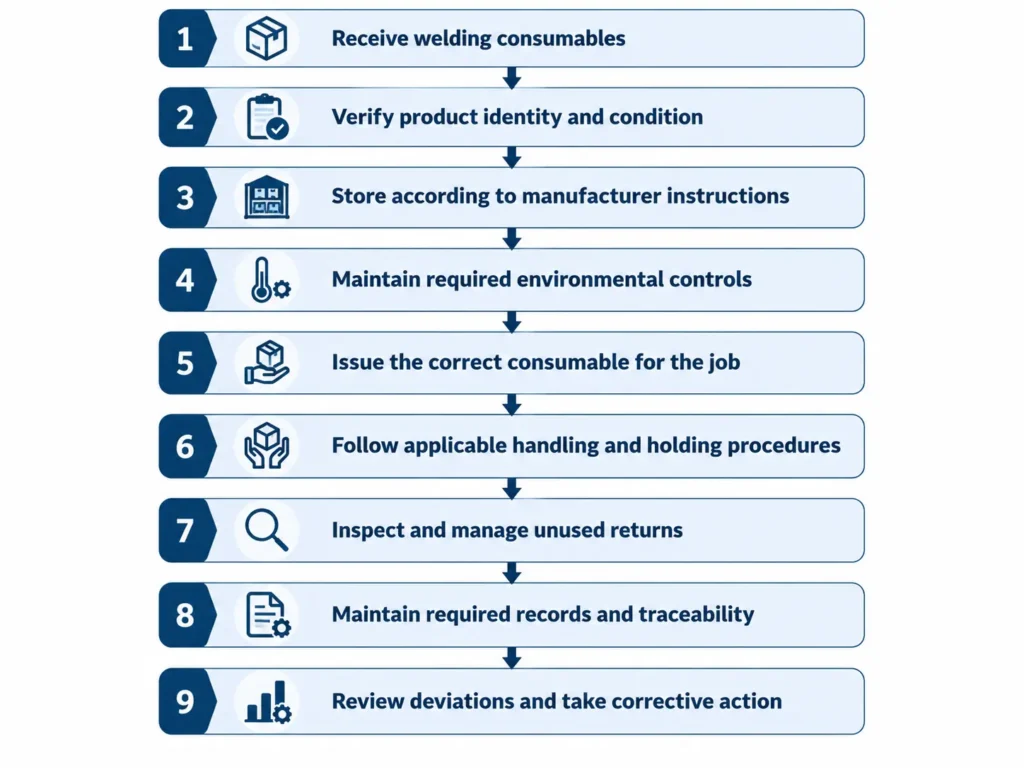
The process should be adjusted based on the materials being used, the risks involved in production, and the standards that apply to the manufacturer.
Welding Consumable Storage Audit Checklist
Before your next internal quality review or certification assessment, consider these questions.
| No. | Verification Question | Status |
|---|---|---|
| 1 | Are consumables stored according to manufacturer instructions? | ☐ |
| 2 | Are moisture-sensitive consumables identified? | ☐ |
| 3 | Are required drying and holding procedures documented? | ☐ |
| 4 | Are consumables protected from contamination and damage? | ☐ |
| 5 | Is product identification maintained throughout storage and issue? | ☐ |
| 6 | Are consumable issuing and return procedures established? | ☐ |
| 7 | Are questionable or unsuitable consumables isolated? | ☐ |
| 8 | Are personnel trained in applicable handling requirements? | ☐ |
| 9 | Are required records maintained and retrievable? | ☐ |
| 10 | Are deviations investigated and addressed appropriately? | ☐ |
This checklist serves as a practical starting point. It is not a substitute for the full EN ISO 3834 requirements, any other applicable standards, or specific customer obligations.
Frequently Asked Questions
Why is welding consumable storage important under EN ISO 3834?
Good storage and handling help makers keep consumables in good condition and ensure steady welding quality. The right controls should match the standard rules, product directions, and the way things are made.
Can moisture in welding consumables cause weld defects?
Moisture absorption in materials that are prone to it can raise the chance of hydrogen-induced cracking when specific conditions are met. Other elements, like the type of material, how tightly the parts are joined, and the welding techniques used, also play a role in determining the risk.
Do all welding electrodes need to be rebaked?
Rebaking needs vary depending on the type of electrode, the product’s instructions, how it was stored, and the correct procedures. Manufacturers shouldn’t use the same drying method for all consumables.
What records should manufacturers maintain?
Depending on the specific requirements, records might include information about how consumables are identified, stored, dried, or kept, as well as how they are issued and returned, and how they can be traced back. Not all records are required for every type of consumable or every use case.
Does EN ISO 3834 certification guarantee defect-free welding?
A certification shows that the welding work meets the required quality standards for the specific area it covers. Keeping a consistent level of quality also relies on proper methods, skilled workers, right procedures, and good control during production and checking.
Final Takeaway: Better Storage Supports Better Welding Quality
Storing welding consumables might seem like a simple part of production, but if not managed properly, it can lead to unnecessary risks.
By following the manufacturer’s guidelines, managing products that are sensitive to moisture, keeping proper identification, training workers, and keeping accurate records, manufacturers can improve their welding quality processes.
For businesses aiming for EN ISO 3834 certification, checking how consumables are managed is a useful way to find areas for improvement and better control production.