
ISO 9606-1
Welder Qualification
2026 Requirements
Who Can Witness an ISO 9606-1 Welder Qualification Test? Examiner, Examining Body & 2026 Requirements for Indian and Global Manufacturers
By First Welding Certification Technical Editorial Team
8 Min Read
22 Sep 2026
Table Of Contents
- Introduction : A Welder Can Pass a Test.. Who Verifies It?
- What Is an ISO 9606‑1 Welder Qualification Test?
- Who Can Witness the Qualification Test?
- What Does the Examiner or Examining Body Check?
- How Does the ISO 9606‑1 Witnessing Process Work?
- What Technical Conditions Matter During the Test?
- Why Is Test Witnessing Important for Manufacturers?
- Where Is ISO 9606-1 Used?
- What Is the ISO 9606-1 Status in 2026?
- How Should Manufacturers Prepare for the Test?
- Frequently Asked Questions
- Conclusion
- Related Resources
- Need ISO 9606-1 Welder Qualification, for Your Manufacturing Team?
Manufacturer, Welder & Examiner: Who Does What?
MANUFACTURERS
- Production
- Documentation
- Test
- Records
WELDER
- Perform
- Follows
- Do weld
- Skill
EXAMINER
- Verify
- Check
- Review
- Record
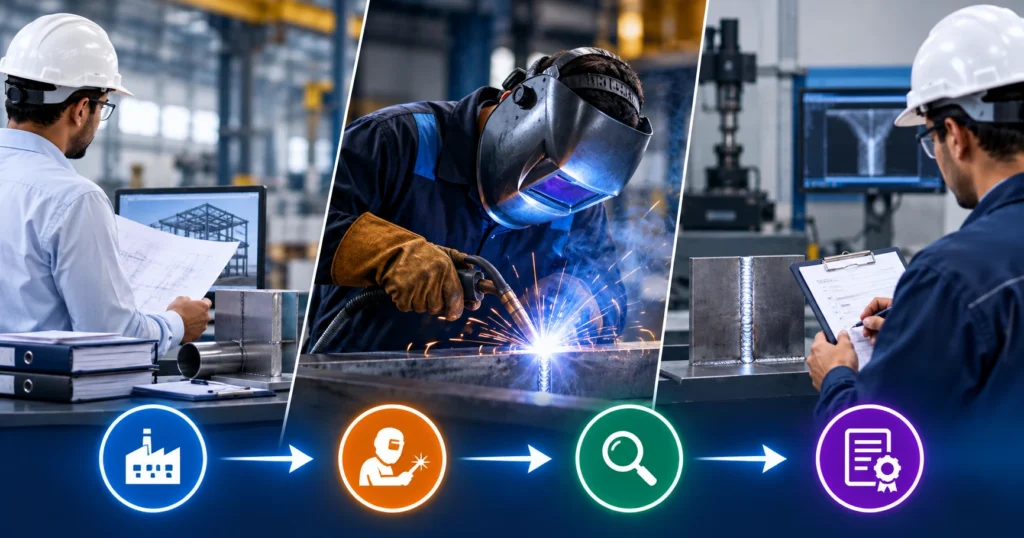
A manufacturer may have a welder who can make a weld every day.. When that welder must take the ISO 9606‑1 qualification experience alone does not suffice.
The important question is:
Who watches the qualification test, who checks the test results and how does the qualification become acceptable for production?
This matters to manufacturers, fabricators, structural steel producers, pressure equipment makers, railway component makers and companies that supply welded products worldwide.
Under ISO 9606‑1 the welding of test pieces is watched by the examiner or the examining body and the testing is checked by them. The standard also allows the examiner or examining body to stop a test if the welding conditions are wrong or if it looks like the welder cannot meet the requirements.
This article explains the role of the examiner and the examining body what is watched what manufacturers should prepare and where this qualification fits into a controlled welding system.
ISO 9606‑1:2012 sets the rules for testing welders who do fusion welding on steels. It gives a framework so that a welder’s skill can be checked under defined conditions. ISO still lists the 2012 edition as the published edition.
The qualification is not simply an approval saying that someone is a “certified welder.”
It is linked to defined conditions such as:
– Welding process
– Product type
– Joint type
– Material
– Test piece thickness
– Pipe diameter where needed
– Welding position
– Filler material
– Backing conditions
– examination and testing
Common welding processes may include MMA/SMAW, TIG and MIG/MAG depending on the scope that must be qualified.
Therefore a manufacturer should always compare the production welding conditions with the scope that was qualified.
The key terms used in ISO 9606-1 are examiner and examining body.
The standard says that the welding of the test pieces must be witnessed by the examiner or the examining body. The required testing is also. Verified by them.
Examiner
An examiner is the person who carries out the examination role as required by the qualification arrangements.
Examining Body
An examining body is the organization that handles the examination and verification tasks within the certification arrangement.
The important point, for manufacturers is that the qualification test needs an independent verification structure. It should not rely on an internal declaration that the welder performed well.
Witnessing is more than watching someone weld.
The qualification test must be carried out under the defined conditions with the test piece and relevant information properly identified.
The examiner or examining body may check aspects such as:
–Welder identification : The person performing the test must be clearly identified.
– Test‑piece identification : The test piece is identified so that it can be linked to the welder and the examination record.
– Welding conditions: The welding conditions used during the qualification test must match the requirements.
– Welding position : The position used during the test is recorded and marked as required. ISO 9606‑1 specifically requires welding positions for test pieces to be marked.
– Test results : The required examinations and tests are verified according to the qualification requirements.
This creates a link between:
Welder → Test Piece → Welding Conditions → Examination → Qualification
A practical chronological workflow can be understood as follows:
Step 1. Define the qualification scope
Identify the welding process, material, joint type, product form, position and other applicable variables.
Step 2. Prepare the test conditions
The qualification test is arranged under the required welding conditions. ISO 9606‑1 states that the qualification test must follow a pWPS or WPS prepared in line, with the welding procedure requirements.
Step 3. Identify the welder and test piece
The test piece carries all the required identification marks, such as the examiner name and the welder name.
Step 4. Witness the welding
The examiner or the examining body watches the welding of the test piece to ensure it is done correctly.
Step 5. Examine and test
The necessary examination and testing are carried out in line with the qualification rules that apply. Depending on the arrangement this may include a check and either destructive or non‑destructive tests.
Step 6. Verify the results
The examiner or the examining body confirms that the testing was done correctly.
Step 7. Establish the qualification
The scope of the qualification is set by looking at the test conditions and the rules that apply.
Step 8. Use the qualification in production
The manufacturer can then match the production welding needs with the range that the welder is qualified for.
A common error for manufacturers is to see welder qualification as one generic approval.
The qualification ties to technical variables.
These may include:
| Variable | Why it matters |
|---|---|
| Welding process | Determines the process in which the welder demonstrated competence |
| Material | Establishes the applicable material qualification |
| Joint type | Distinguishes relevant weld configurations |
| Thickness | Affects the qualified thickness range |
| Pipe diameter | Important for applicable pipe qualifications |
| Welding position | Determines the applicable positional qualification |
| Filler material | Relevant to the qualification conditions |
| Backing | Can affect qualification range |
| Test piece | Provides the physical basis for qualification |
That is why the qualification scope matters more than asking if someone “has a welder certificate. First Welding Certification Pvt Ltd (PRVÁ ZVÁRAČSKÁ, a.s.) welder qualification page explains qualification by listing welding processes, materials, positions, joint types and other variables that apply.
For a manufacturer a witnessed qualification gives clear proof that the test happened under the right conditions. This becomes particularly important when supplying welded products for:
- Structural steel fabrication
- Industrial equipment
- Pressure equipment
- Railway vehicles and components
- Heavy engineering
- Construction projects
- Export manufacturing
- International welding projects
For example EN 1090 requires welders as part of the welding controls used in structural steel and aluminium production. Likewise EN ISO 3834 sets welding quality rules and calls for welders as part of the overall quality system.
ISO 9606-1 covers the testing that shows welders can do fusion welding on steel.
Its relevance can extend across manufacturers and fabrication organizations working with:
- Structural steel components
- Industrial machinery
- Pressure-related fabrication
- Steel construction
- Railway components
- Engineering assemblies
- Fabricated steel products
- Export-oriented manufacturing
The precise requirements for qualification depend on the project the welding standard, the product needs and the certification plan.
If a company aims for steel conformity having qualified welders fits with EN 1090. For welding quality systems qualified welders are part of the EN ISO 3834 rules. Thus ISO 9606-1 qualification can become a part of the people skills needed for larger manufacturing and welding quality rules.
This is a point for manufacturers looking for the newest ISO 9606 standard. In 2026 ISO 9606-1:2012 is still the published version that ISO lists. It was last. Approved in 2023. ISO also says a newer draft, ISO/DIS 9606.2 will come out soon.
Therefore:
Current published edition: ISO 9606-1:2012
2026 status: Current
Revision status: Replacement under development
Manufacturers should make a difference, between the current published standard and the draft that is being developed when they plan qualification work.In railway manufacturing EN 15085 also names welders and operators as part of its quality rules. Thus ISO 9606-1 qualification can become a part of the people skills needed for larger manufacturing and welding quality rules.
Before scheduling an ISO 9606-1 qualification test manufacturers should establish:
- The required welding process
- Material and applicable material group
- Joint type
- Plate or pipe configuration
- Required thickness or diameter
- Welding position
- Relevant filler material
- WPS or pWPS
- Test-piece identification
- Required examination and testing
- Examiner or examining body arrangements
- Qualification documentation
A useful internal sequence is:
Production Requirement → Qualification Scope → Test Preparation → Witnessed Test → Examination → Verification → Qualification Record → Production Assignment
This stops the usual error of testing a welder first and then checking the production needs.
What is a welder qualification test record WQTR?
A WQTR is a document that keeps track of all the details and results from a welder’s qualification test. It includes things like the date, type of weld materials used and test outcomes. The way it looks and what information it contains can differ based on the certification program or standard being followed.
How can I check welder certification online?
To check a welder’s certification online you need to go to the website of the organization that issued the certification. If they offer an online verification tool you can usually search using the certificate number or other ID details they provide. Not all agencies have this feature so it depends on where the certification was granted.
What is a third-party welder certification bogy?
A third-party welder certification bodies that checks and certifies welders based on industry standards. These organizations are not connected to the welders or employers which helps ensure the process is fair and meets required safety and quality rules.
What is a welder qualification 6-month continuity log?
A 6-month continuity log is a record that shows a welder has kept up with welding work over a six-month period. This log proves the welder is still active and qualified according to the requirements of the certification body. The exact rules for what counts as activity. How long the log must be kept depend on the specific certification standard.
An ISO 9606-1 welder qualification test is more than a practical welding demonstration.
For the ISO 9606-1 qualification to be properly established we must conduct the test under the conditions have it witnessed by the examiner or examining body and then verify the required testing.
For manufacturers the important sequence is:
Define the ISO 9606-1 qualification scope → prepare the ISO 9606-1 test → identify the welder and test piece → conduct the ISO 9606-1 witnessed welding test → complete ISO 9606-1 examination and testing → verify ISO 9606-1 results → establish ISO 9606-1 qualification → compare ISO 9606-1 qualification with production requirements.
This ISO 9606-1 approach gives manufacturers a basis for assigning qualified welding personnel to production work across structural steel, industrial fabrication, railway components and other applications where documented welding competence is required.
As of 2026 ISO 9606-1:2012 remains the published edition while ISO indicates that a replacement is under development. We should verify the ISO 9606-1 edition and project requirements before arranging qualification testing.
- ISO 9606-1 Welder Qualification Test: What Happens During the Certification Process?
- How to Read an ISO 9606-1 Welder Qualification Certificate
- Welder Certification Audit Checklist: What Inspectors Check Under ISO 9606-1
- ISO 9606-1 vs ISO 14732: Welder vs Welding Operator Qualification
- EN 1090 Certification for Structural Steel and Aluminium
- EN 15085 Certification for Railway Vehicles & Components
- EN ISO 3834 Certification for Fusion Welding Quality Requirements
- WPS & WPQR Certification
- EN ISO 9606 Welder & Welding Operator Qualification
The right ISO 9606-1 qualification starts with identifying the welding process, material, joint type, welding position, test conditions and required ISO 9606-1 qualification scope before the test is conducted. EN ISO 9606 Welder & Welding Operator Qualification global manufacturers establish the applicable ISO 9606-1 qualification requirements first and then arrange the appropriate ISO 9606-1 qualification testing and verification.