
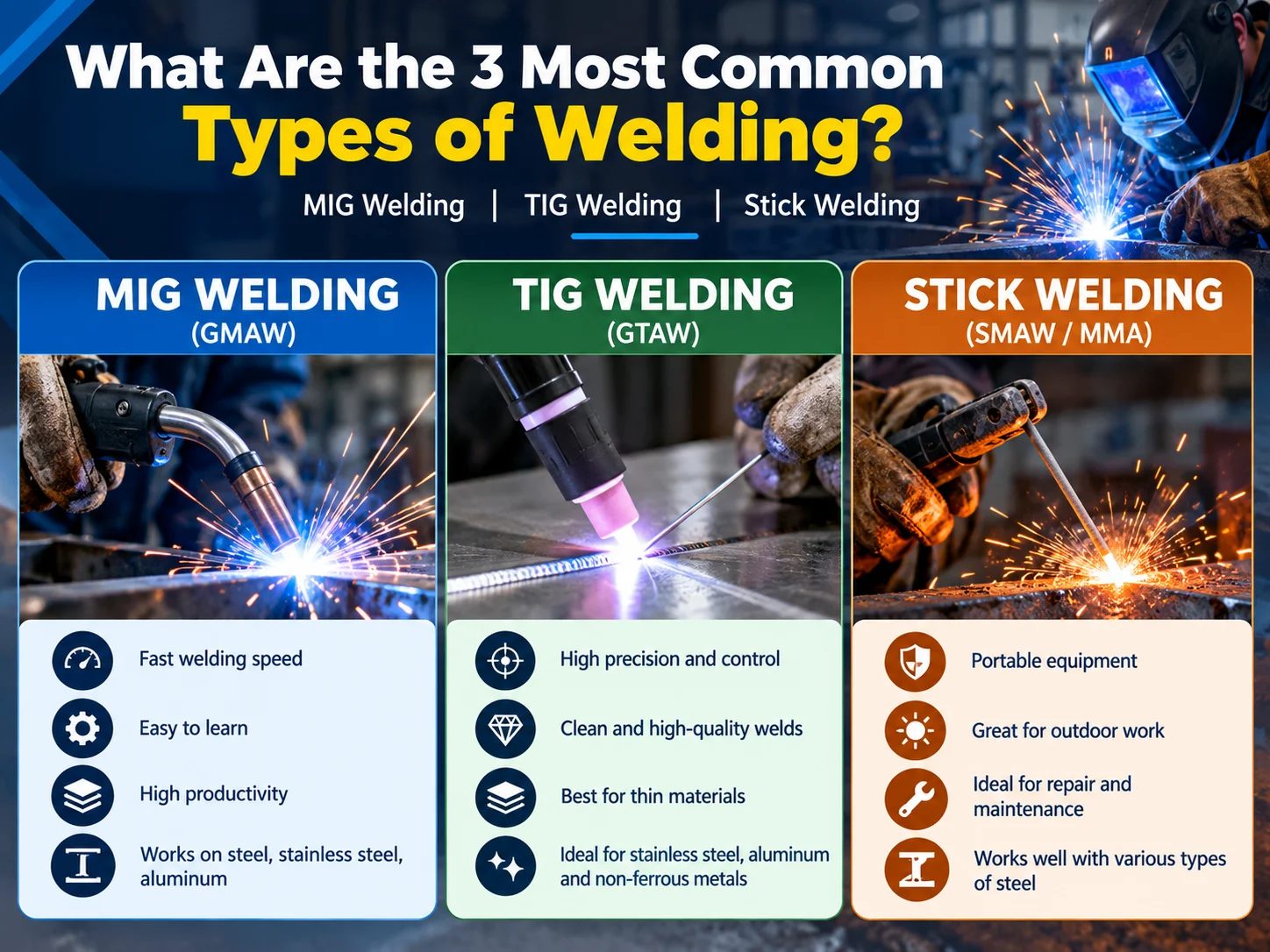
MIG WELDING
TIG WELDING
STICK WELDING
05 Oct 2026
What Are the 3 Most Common Types of Welding?
By Editorial Team
Table Of Contents
- The 3 most common types of welding are:
- MIG vs TIG vs Stick Welding at a Glance
- 1. MIG Welding
- How MIG Welding Works
- Advantages of MIG Welding
- Common MIG Welding Applications
- 2. TIG Welding
- How TIG Welding Works
- Advantages of TIG Welding
- Common TIG Welding Applications
- 3. Stick Welding
- How Stick Welding Works
- Advantages of Stick Welding
- Common Stick Welding Applications
- MIG vs TIG vs Stick: Which Welding Process Is Best?
- Simple Welding Process Selection
- MIG vs TIG vs Stick: Quick Decision Table
- Are MIG, TIG and Stick the Only Types of Welding?
- MIG, TIG and Stick Welding Process Comparison
- Choosing the Right Welding Process
- FAQ
- Conclusion
See Also.....
- EN 15085 Purchase and Supply: Requirements for Welded Railway Components
- EN 1090 Equipment Calibration Requirements: Which Measuring, Welding & Inspection Equipment Needs Calibration in India?
- What Is EN 15085-2 CL2 Certification for Railway Components in India? Requirements, Scope & Process
- What Are the ISO 3834 Welding Coordinator Requirements, Qualifications & Responsibilities in India?
- Welding Documentation Checklist: 25 Records Every Fabricator Should Maintain
Certification Alerts
- Global Steel Overcapacity 2026: What Indian Steel Exporters Need to Know
- India-EU Steel Export Quota 2026: What Indian Manufacturers Need to Know About EU Market Access
- How Global Supply Chains Are Changing Welding Compliance
- ISO 9001:2026 Revision Is Almost Here: What Manufacturers Should Prepare For
Welding is a process that permanently connects metal pieces using heat and pressure. Some common welding techniques are MIG, TIG, and Stick welding. Each method works best for different types of metal, thicknesses, uses, and how much is needed to be made.
The 3 most common types of welding are:
- MIG Welding — GMAW
- TIG Welding — GTAW
- Stick Welding — SMAW/MMA
MIG vs TIG vs Stick Welding at a Glance
| Feature | MIG Welding | TIG Welding | Stick Welding |
|---|---|---|---|
| Automation potential | High | High | Low–Medium |
| Best suited for | Production & fabrication | Precision welding | Site & repair work |
| Ease of learning | Easier | More difficult | Moderate |
| Electrode | Consumable wire | Non-consumable tungsten | Consumable coated electrode |
| Portability | Moderate | Moderate | High |
| Precision | High | Very high | Moderate |
| Shielding | Shielding gas | Shielding gas | Electrode flux |
| Technical name | GMAW | GTAW | SMAW/MMA |
| Typical materials | Steel, stainless steel, aluminium | Steel, stainless steel, aluminium, copper and more | Steel and various alloys |
| Welding speed | High | Low–Medium | Medium |
1. MIG Welding
MIG welding, also called Gas Metal Arc Welding or GMAW, uses a wire that is fed continuously and a shielding gas to cover the welding area. This helps protect the welding process and makes it quick and efficient for building things.
How MIG Welding Works
The power source gives energy to the wire feeder, which sends the wire to the welding gun. This creates an arc that melts the metal, forming a pool of liquid weld. Once it cools and hardens, it becomes a strong joint. The wire also serves as the material used to fill the joint, and it is protected by a shielding gas.
Advantages of MIG Welding
– Fast welding speed
– Constant wire feeding
– Simple to learn
– Great for making lots of welds quickly
– Can be used manually or with machines
– Works on steel, stainless steel, and aluminum
Common MIG Welding Applications
MIG welding is used in making cars, building structures, creating metal parts, making machines, producing industrial items, and fixing or repairing things.
It’s great for getting a lot done quickly and efficiently.
2. TIG Welding
TIG welding uses a non-consumable tungsten electrode. A filler rod may be added when necessary. Shielding gas, typically argon, is used to protect the weld area.
How TIG Welding Works
- Power comes from an external source.
- A tungsten electrode is used.
- The arc is carefully controlled.
- A weld pool forms as the metal melts.
- Filler metal can be added if needed.
- The finished weld is strong and smooth.
- The tungsten electrode stays separate from the weld area.
- This allows the welder more control over the process.
Advantages of TIG Welding
- Good control over the welding process
- Accurate and consistent results
- Welds that look neat and nice
- Works well with thin materials
- Can be used on different types of non-ferrous metals
- Important for making sure the weld is both good quality and looks nice
Common TIG Welding Applications
TIG welding is used for:
- Welding stainless steel
- Joining aluminum
- Welding pipes and tubes
- Making aerospace parts
- Building automotive parts
- Creating precise metalwork
- Producing high-quality industrial products
- It’s best when precision, control, and a good look are more important than speed
3. Stick Welding
Stick welding, also called Shielded Metal Arc Welding, uses a special electrode that gets used up during the process. An electric arc is created between the electrode and the metal being welded. This arc heats up the electrode and the base metal until they melt. At the same time, the electrode produces gases and a layer of slag that help protect the weld from impurities.
How Stick Welding Works
The power source creates an arc between the electrode and the workpiece, melting the electrode and forming a weld pool. A layer of slag forms around the weld, protecting it from the air, and once the weld is done, it is ready without needing extra gas to shield it.
Advantages of Stick Welding
- Portable equipment
- Great for working outside
- Doesn’t need extra shielding gas
- Good for fixing and keeping things in shape
- Can weld in different positions
- Works well with various types of steel
Common Stick Welding Applications
Structural steelwork, construction, pipeline and repair work, heavy equipment maintenance, outdoor fabrication, general maintenance, and perfect for being portable, flexible, and suitable for use outdoors.
MIG vs TIG vs Stick: Which Welding Process Is Best?
There isn’t one single best welding method that works for everything. The right choice depends on the type of material and how thick it is. It also takes into account the way the parts are joined together and the position you’re welding in. The quality of the weld, how fast you can make it, and how safe it is for the environment are all important factors. You should follow the proper welding steps that are right for the job.
Simple Welding Process Selection
- Fast production welding: MIG / GMAW
- Accurate and clean welds: TIG / GTAW
- Welding for outdoor or repair jobs: Stick / SMAW / MMA
- Choose the right welding method depending on the WPS, approved process, material type, and welder’s qualifications.
MIG vs TIG vs Stick: Quick Decision Table
| Requirement | Recommended Process |
|---|---|
| Thin and precision welding | TIG |
| Clean high-quality appearance | TIG |
| Controlled precision work | TIG |
| Outdoor welding | Stick |
| Portable repair work | Stick |
| Construction and structural repair | Stick |
| Fast production | MIG |
| General fabrication | MIG |
| Automated production | MIG |
Are MIG, TIG and Stick the Only Types of Welding?
There are many types of welding processes, like Flux-Cored Arc, Submerged Arc, Gas, Resistance, Laser Beam, Electron Beam, Friction, and Plasma Arc Welding. Among these, MIG, TIG, and Stick are common arc-welding techniques. Each of these methods uses different electrodes and shielding gases, which help classify them in welding process categories.
MIG, TIG and Stick Welding Process Comparison
A useful way to compare the processes is by their typical deposition-rate ranges.
| Process | Typical Deposition Rate |
|---|---|
| MIG/GMAW | 1–8 kg/hr |
| TIG/GTAW | 1–4 kg/hr |
| Stick/MMA | 1–4 kg/hr |
The usual ranges can change based on the tools and settings used; MIG welding is better for making things faster, TIG welding is better for precise control, and Stick welding is better for working in different conditions.
Choosing the Right Welding Process
- Base material type
- Material thickness
- Joint shape
- Welding position
- Needed weld quality
- Production rate
- Inside or outside environment
- Equipment available
- Welder’s training level
- Approved welding methods and standards
- Important to focus on qualification and quality rather than making things easy or fast.
FAQ: Common Welding Processes
What are the 3 most common types of welding?
The three commonly recognized arc-welding processes are MIG welding (GMAW), TIG welding (GTAW), and Stick welding (SMAW/MMA).
Which type of welding is easiest to learn?
MIG welding is generally considered easier for beginners because it uses a continuously fed wire electrode and can provide relatively straightforward operation.
Which welding process gives the cleanest weld?
TIG welding is widely preferred when high precision, control and a clean weld appearance are required.
Which welding process is best for outdoor work?
Stick welding is particularly useful for outdoor work because it does not require a separate shielding-gas supply and is relatively portable.
Is MIG stronger than TIG welding?
Neither process is automatically “stronger.” Weld strength depends on material, joint design, welding procedure, parameters, welder skill and inspection requirements. TIG can provide highly controlled welds, while properly performed MIG welds can also achieve excellent mechanical performance.
What is the difference between MIG, TIG and Stick welding?
MIG uses a continuously fed consumable wire, TIG uses a non-consumable tungsten electrode with optional filler metal, and Stick welding uses a consumable flux-coated electrode.
Conclusion
MIG, TIG, and Stick welding are different types of arc welding, each used for specific tasks. MIG welding is great for making things quickly and is often used in general metal work. TIG welding is better when you need high quality and precision, especially for thinner materials. Stick welding is best for fixing things on the go, especially outdoors or in places where it’s hard to set up equipment. Choosing the right welding method depends on the material being used, the way the parts are joined, how thick they are, what’s needed in terms of production, and the standards that must be followed. Knowing the differences between these methods helps improve the quality of the weld, how much can be produced, and ensures everything meets the required standards. Other related topics include Welder Qualification and WPS & WPQR.