
DOCUMENTATION
STRUCTURAL STEEL
CHECKLIST
Welding Documentation Checklist: 25 Records Every Fabricator Should Maintain
By Technical Editorial Team
5 Min Read
05 Oct 2026
Table Of Contents
- Welding Documentation Checklist
- Welding Documentation Flow
- 25 Essential Welding Records
- A. Project & Technical Documentation
- B. Welding Procedure Records
- C. Welder & Personnel Records
- D. Material & Consumable Records
- E. Welding Inspection & Testing Records
- What Should a Welding Documentation System Prove?
- Welding Documentation Checklist for an Audit
- Common Welding Documentation Mistakes
- How to Organize Welding Records
- Why Welding Documentation Matters
- Frequently Asked Questions
- Final Welding Documentation Checklist
Key Takeaways
25 RECORDS CHECKLIST
MATERIAL CONSUMABLES
WELDING REQUIREMENTS
CERTIFICATION READINESS
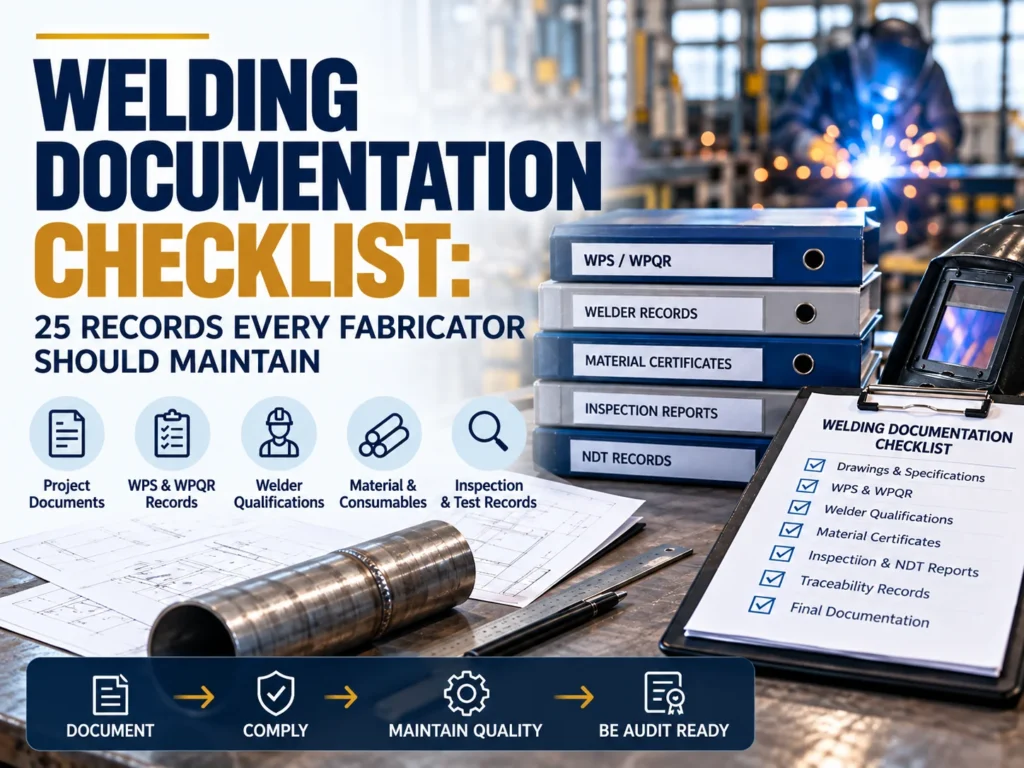
Welding Documentation Checklist
For a welding company or fabricator, quality isn’t just about the weld itself. It also needs to be backed up by proper records, inspection reports, and the ability to track everything back to its source.
Having a good system for keeping welding records helps companies show that they used approved methods, trained workers, approved materials, and necessary checks during production.
ISO 3834 covers the quality standards for welding metal, including things like the welders, how inspections are done, the welding process, the materials used, and any heat treatment after welding.
Use this 25-point checklist for welding documentation to make sure your records are ready for customer visits, audits, or certification checks.
Welding Documentation Flow
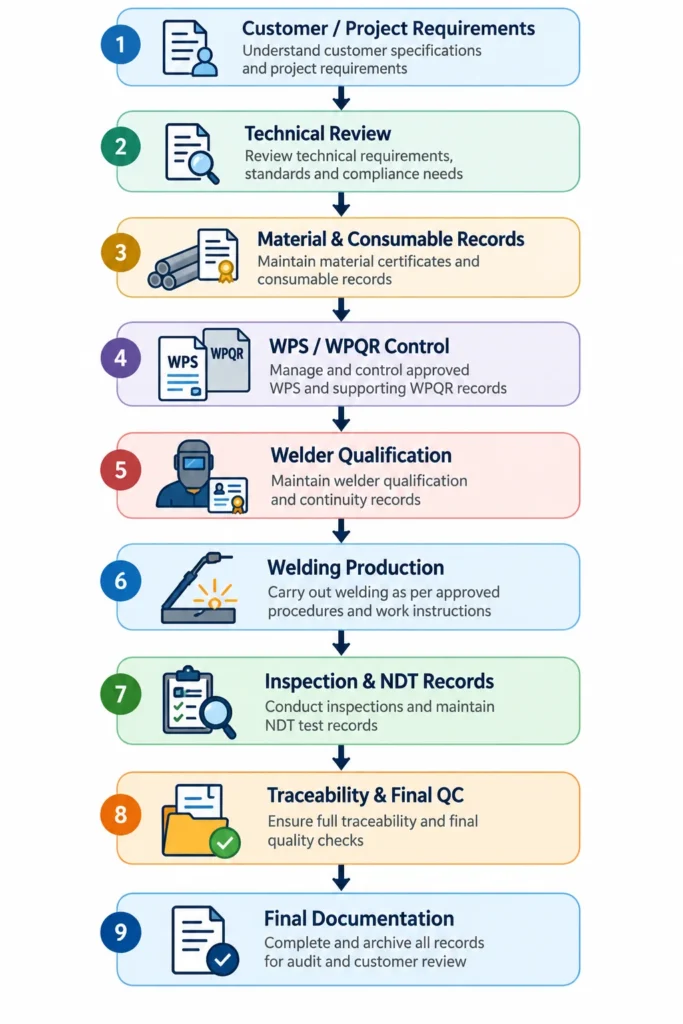
The goal is to keep a clear link between the material used, the welding method, the welder who did the work, the actual weld made, and the results from the inspection.
25 Essential Welding Records
A. Project & Technical Documentation
| No. | Record | Purpose |
|---|---|---|
| 1 | Contract / Purchase Order | Defines customer and project requirements |
| 2 | Technical Specification | Identifies applicable technical requirements |
| 3 | Drawing & Revision Records | Controls design and revision status |
| 4 | Welding Coordination / Quality Plan | Defines welding controls and responsibilities |
| 5 | Inspection & Test Plan (ITP) | Defines inspection stages and acceptance requirements |
A controlled technical review is important because welding requirements need to be set before production starts. ISO 3834 includes a review of requirements and a technical review as part of its welding-quality system.
B. Welding Procedure Records
| No. | Record | Purpose |
|---|---|---|
| 6 | Welding Procedure Specification (WPS) | Defines production welding parameters |
| 7 | Welding Procedure Qualification Record (WPQR) | Demonstrates qualification of the welding procedure |
| 8 | WPS Revision History | Controls changes to approved procedures |
| 9 | Welding Parameter Records | Records actual or required welding parameters |
| 10 | Welding Work Instructions | Provides production-level instructions |
WPS and WPQR records need to be managed to ensure that production welding happens within the approved qualified limits.
ISO 15614-1 sets out the rules for welding procedure qualification tests and explains the ranges of qualification depending on key factors.
A new 2026 ISO Technical Specification, ISO/TS 8182:2026, focuses on how to report welding parameters related to arc energy and how to move this information from WPQRs to WPSs.
C. Welder & Personnel Records
| No. | Record | Purpose |
|---|---|---|
| 11 | Welder Qualification Certificate | Demonstrates welder qualification |
| 12 | Welder Continuity Records | Demonstrates continued qualification where applicable |
| 13 | Welding Coordinator Records | Demonstrates responsible welding coordination |
| 14 | NDT Personnel Qualifications | Demonstrates competency of inspection personnel |
Keeping up-to-date qualification and continuity records helps stop a welding job that is otherwise compliant from becoming a problem with documentation.
D. Material & Consumable Records
| No. | Record | Purpose |
|---|---|---|
| 15 | Material Certificates | Demonstrates material specification and test results |
| 16 | Heat / Batch Traceability Records | Links material to production |
| 17 | Welding Consumable Certificates | Identifies consumable specification |
| 18 | Consumable Storage Records | Demonstrates controlled storage and handling |
| 19 | Consumable Issue / Batch Records | Tracks consumables used in production |
Tracing materials and consumables is very important when the customer or a relevant standard asks for details like a specific heat, batch, or lot number. ISO 3834 has rules about how to store and handle welding consumables and parent materials.
E. Welding Inspection & Testing Records
| No. | Record | Purpose |
|---|---|---|
| 20 | Visual Inspection Records | Records visual examination of welds |
| 21 | NDT Reports | Documents required non-destructive testing |
| 22 | Dimensional Inspection Reports | Confirms required dimensions and tolerances |
| 23 | Welding Repair Records | Documents repair and rework activities |
| 24 | Non-Conformity Reports (NCRs) | Records deviations and corrective actions |
| 25 | Final Inspection / Release Record | Confirms completion and acceptance |
The specific inspections needed are based on the product standard that applies, the design specifications, the customer’s requirements, and the inspection plan in place.
What Should a Welding Documentation System Prove?
A good documentation system should let an auditor or customer answer these five simple questions:
1.What material was used?
Material certificate → Heat/Batch number → Component
2.Who did the welding?
Welder → Qualification → Production weld
3.Which procedure was followed?
WPS → WPQR → Welding operation
4.What was checked?
Weld → Visual/NDT/Dimensional inspection
5.Was the result okay?
Inspection result → Acceptance criteria → Final release
This makes the basic welding traceability chain:
Material → Welder → WPS/WPQR → Weld → Inspection → Final Release
Welding Documentation Checklist for an Audit
Before a welding certification or customer audit, make sure that:
– Current drawings are available
– Technical requirements have been checked
– Approved WPSs are on hand
– Supporting WPQRs can be traced back
– Welder qualifications are up to date
– Welder continuity is managed when needed
– Material certificates are available
– Heat numbers can be traced
– Consumable certificates are available
– Consumable storage is properly managed
– The ITP is approved
– Inspection records are full and complete
– NDT reports are available
– Repair records are kept
– NCRs and corrective actions are noted down
– Final inspection records are complete
– All records are clearly labeled and properly controlled
Common Welding Documentation Mistakes
Missing link between WPS and WPQR
A WPS needs to be connected to the qualification that supports the range of production it covers.
Old or incomplete welder records
Before giving someone welding work, their qualification and ongoing records should be checked.
Weak material tracking
The certificate for the material should match the actual material used in production.
No NDT reports
NDT tests should have written results and show which weld or part was checked.
Uncontrolled changes to documents
Using an old WPS or drawing can cause big issues with production and following rules.
Incomplete repair records
Repairs need to be properly recorded and not just treated as changes made during production.
How to Organize Welding Records
A simple digital folder structure can make audits significantly easier:
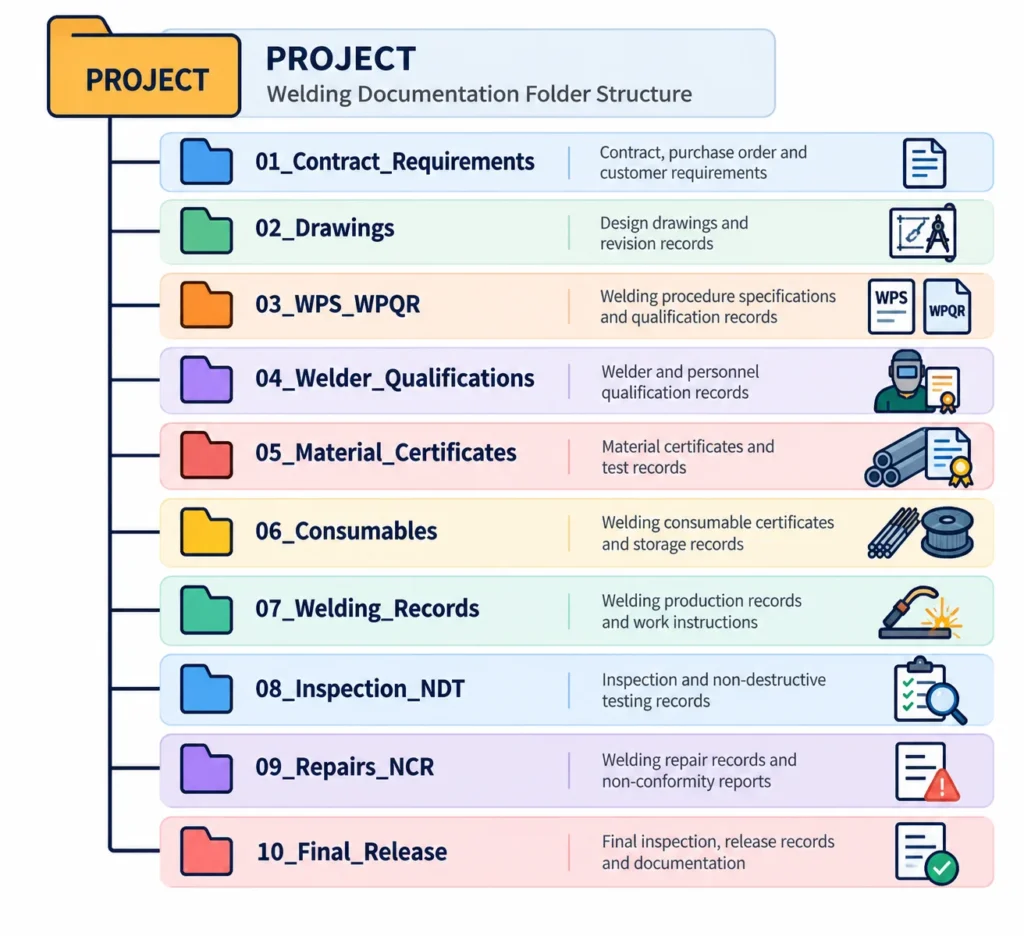
Larger manufacturers can handle these records using a digital welding traceability system that connects each weld to its materials, welder, WPS, inspection, and final approval.
Why Welding Documentation Matters
Proper welding documentation helps manufacturers show:
Compliance → Traceability → Quality Control → Customer Confidence
ISO 3834 gives a structure for welding quality standards, and ISO 3834-6:2024 offers advice on how to follow the ISO 3834 series.
However, the specific documentation needed should be based on the relevant ISO or EN standard, product details, contract terms, and any legal rules that apply.
Frequently Asked Questions
What documents are required for welding?
Typical records include WPS, WPQR, welder qualifications, material certificates, consumable records, inspection reports, NDT reports, traceability records, repair records and final release documentation. The exact requirements depend on the applicable project and standards.
Why is welding documentation important?
It provides evidence that qualified procedures, personnel, materials and inspection processes were used and helps establish production traceability.
What is welding traceability?
Welding traceability is the ability to connect a completed weld with relevant information such as the material, heat number, WPS, welder, consumable and inspection results.
What is the difference between WPS and WPQR?
A WPS defines how production welding is to be performed. A WPQR records the results and qualification of the welding procedure test.
How long should welding records be retained?
There is no single retention period for every welding project. Retention should follow the applicable contract, product standard, regulatory requirement and quality-management procedure.
Final Welding Documentation Checklist
Before finishing a welding project, check this chain:
Project Requirements
↓
WPS + WPQR
↓
Qualified Welder
↓
Approved Material + Consumables
↓
Production Welding
↓
Inspection + NDT
↓
Repairs / NCRs if Needed
↓
Final Inspection
↓
Complete Manufacturing Record
Having a full and traceable record helps fabricators show that welding was done using approved methods, skilled workers, proper materials, and properly documented checks.
ISO 3834 → WPS/WPQR → ISO 9606 → EN 10204 → EN 1090 → EN 15085 → ISO 9712 → Accreditation & Recognition
This builds a strong connection between welding documentation, welding qualifications, and certification without making the page look like it’s full of keywords.