
SPVD REQUIREMENTS
MALAYSIA REGION
CE MARKING
17 Sep 2026
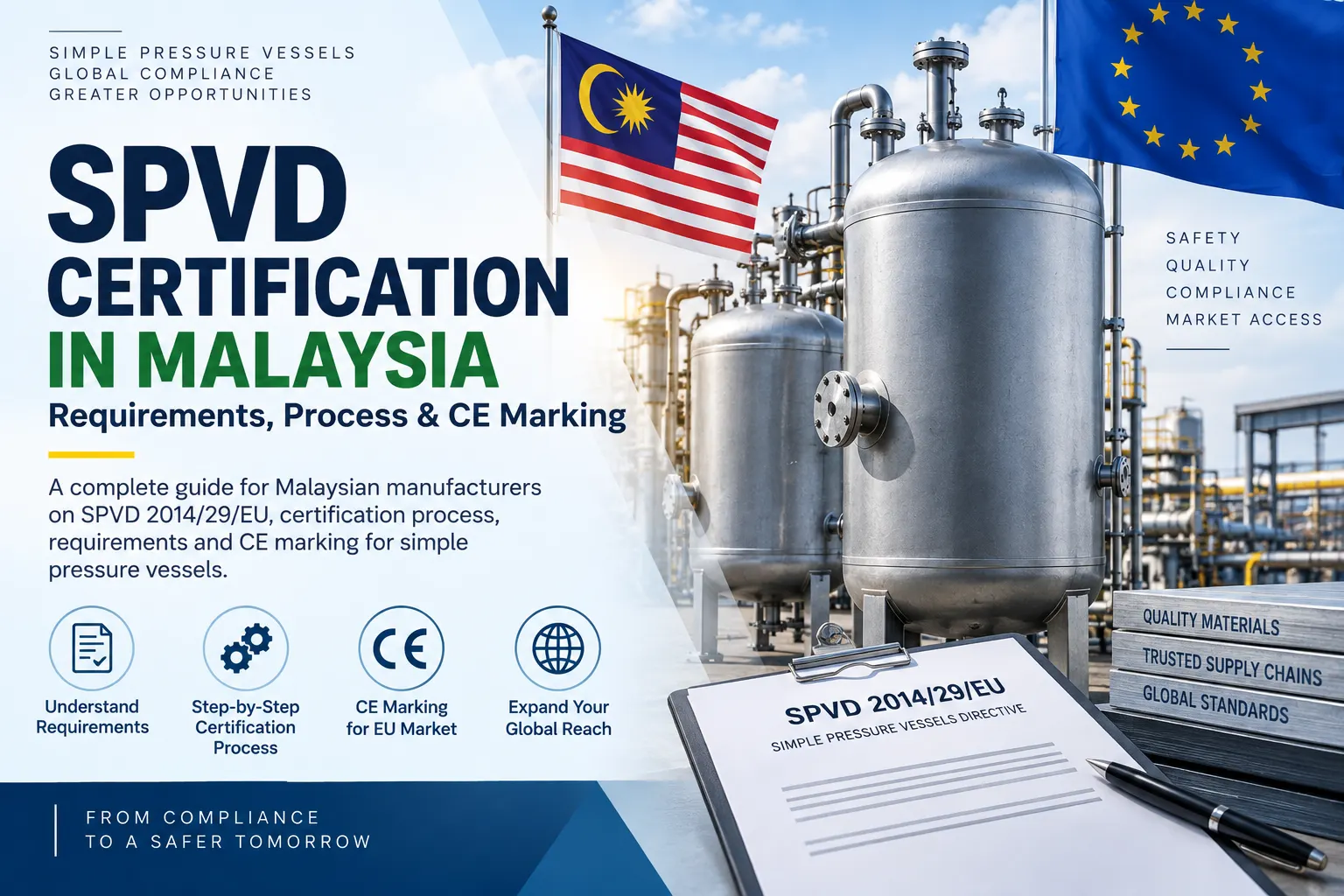
SPVD Certification in Malaysia: Requirements, Process & CE Marking
By Editorial Team
Table Of Contents
- What Is SPVD Certification?
- When Does SPVD Apply?
- SPVD vs PED: Which One Applies?
- SPVD Requirements for Malaysian Manufacturers
- Understanding PS × V
- SPVD Certification Process in Malaysia
- CE Marking for SPVD Pressure Vessels
- SPVD and DOSH Requirements in Malaysia
- Common SPVD Compliance Mistakes
- SPVD Certification Checklist
- Conclusion
Related Blogs
SEP
11
SPVD Certification 2026: Latest 2014/29/EU Update, EN 286-1, Documents & CE Marking for Indian Manufacturers
AUG
06
SPVD Certification: Complete Guide to the Simple Pressure Vessels Directive (2014/29/EU)
See Also.....
What Is SPVD Certification?
The Simple Pressure Vessels Directive (SPVD) 2014/29/EU sets out the rules that certain simple pressure vessels must follow if they are sold in the European Union.
For Malaysian companies that make pressure vessels, they need to follow SPVD if those vessels are made in Malaysia and are meant to be sold in the EU.
It’s important to note that SPVD is different from the rules that apply to pressure vessels made in Malaysia.
Malaysian pressure vessels might still have to meet the safety standards set by the Department of Occupational Safety and Health (DOSH).
When Does SPVD Apply?
A pressure vessel might be covered by SPVD 2014/29/EU if it fits the conditions set by the Directive.
Usually, the vessel needs to:
– Be made by welding and produced in a series.
– Be designed to hold air or nitrogen.
– Have a maximum working pressure higher than 5 bar.
– Not be heated or fired.
– Use certain types of steel or aluminium alloys.
– Have a maximum working pressure of up to 30 bar.
– Meet the condition that the product of pressure (PS) and volume (V) is less than or equal to 10,000 bar·L.
– Follow the temperature requirements set by the Directive.
It’s important to check the full scope of the Directive against the latest version of SPVD before choosing how to show it meets the rules.
SPVD vs PED: Which One Applies?
SPVD and the Pressure Equipment Directive (PED) 2014/68/EU are different EU regulatory frameworks.
| SPVD 2014/29/EU | PED 2014/68/EU |
|---|---|
| Simple pressure vessels | Wider range of pressure equipment |
| Primarily air/nitrogen vessels within SPVD scope | Various gases and liquids |
| Specific scope conditions | Broader technical scope |
| Uses SPVD conformity modules | Uses PED classification categories/modules |
| Applies to qualifying simple pressure vessels | Applies to qualifying pressure equipment |
A manufacturer should therefore perform a scope assessment before assuming that SPVD applies.
SPVD Requirements for Malaysian Manufacturers
The main areas that need to be followed for compliance include:
Design
Manufacturers should set up:
– Design pressure
– Maximum working pressure
– Design temperature
– Vessel volume
– PS × V
– Dimensions
– Wall thickness
– Design calculations
– Technical drawings
Materials
Materials used to hold pressure must meet the required SPVD standards. Manufacturers should keep track of:
– Material certificates
– Material specifications
– Traceability of heat and lot numbers
– Records from incoming inspections
Welding
Since SPVD applies to welded simple pressure vessels, controlling the welding process is very important. Manufacturers should have proper:
– Welding Procedure Specifications (WPS)
– Welding procedure qualifications
– Qualifications for welders and welding operators
– Records for welding materials
– Traceability of welding
– Records for inspections and tests
Testing and Inspection
Depending on the chosen method of compliance, manufacturers might need to do:
– Visual inspection
– Check dimensions
– Non-destructive testing when needed
– Pressure testing
– Production inspections
– Prototype or type testing if required.
Understanding PS × V
PS multiplied by V is a key part of checking if a vessel meets the SPVD rules.
Here’s what each part means:
PS stands for the highest pressure the vessel can handle, measured in bar.
V is the total volume of the vessel, measured in liters.
For example:
PS is 10 bar.
V is 500 liters.
So, PS multiplied by V equals 5,000 bar·liters.
This number helps decide which steps are needed for the conformity assessment under SPVD.
But it’s important to remember that just knowing PS multiplied by V isn’t enough.
The vessel also has to fit the conditions set by the Directive before SPVD applies.
SPVD Certification Process in Malaysia
A practical compliance process can be structured as follows:
| Step | Process |
|---|---|
| 1 | Product & Market Identification |
| 2 | SPVD Scope Assessment |
| 3 | PS × V Calculation |
| 4 | Applicable Standards |
| 5 | Design & Material Review |
| 6 | WPS / WPQR & Welder Qualification |
| 7 | Conformity Assessment |
| 8 | Manufacturing & Testing |
| 9 | Technical Documentation |
| 10 | EU Declaration of Conformity |
| 11 | CE Marking |
| 12 | EU Market Placement |
Step 1: Check the market
Find out if the vessel will be sold in Malaysia, sent to the EU, or both.
Step 2: Check if SPVD applies
Look at the pressure, volume, type of liquid, materials used, build details, and how the vessel will be used.
Step 3: Find the PS × V value
Calculate the PS × V number and choose the right way to check if it meets the rules.
Step 4: Collect technical papers
Prepare drawings, calculations, certificates for materials, welding details, and test records.
Step 5: Do the conformity check
Depending on the PS × V value and chosen method, you might need a third party to check it.
For vessels with PS × V over 50 bar·L, SPVD Article 13 says they must go through EU-type testing under Module B, then follow the right production approval process.
Step 6: Get the EU Declaration of Conformity
Once the conformity check is done, the manufacturer prepares the EU Declaration of Conformity.
Step 7: Add the CE mark
If needed, put the CE mark on the vessel as required by SPVD.
CE Marking for SPVD Pressure Vessels
The CE marking shows that the manufacturer has followed all the necessary steps required by the EU to make sure a product meets safety and quality standards.
It’s not just a logo that shows the product is good quality.
Before putting the CE mark on a product, the manufacturer needs to make sure several things are done:
– First, they should find out which EU laws apply to the product.
– Then, they must complete the right process to check if the product meets those laws.
– They should have all the technical documents ready.
– If needed, they must get a third-party check to confirm the product is safe.
– They need to write the EU Declaration of Conformity.
– They should have clear labels and instructions for the product.
If a special body checks the product during production, they must include that body’s number next to the CE mark as required by the rules.
SPVD and DOSH Requirements in Malaysia
For Malaysian manufacturers, it’s important to know that meeting DOSH standards doesn’t mean you automatically meet SPVD standards, and vice versa.
If the vessel is made for the Malaysian market, you must follow the DOSH rules that apply.
If the vessel is made for the EU market, you need to follow EU laws, which might include SPVD rules if they apply.
If a manufacturer makes vessels for both the Malaysian and EU markets, they might need to follow both sets of rules.
So, just because a product meets DOSH standards doesn’t mean it meets SPVD standards, and meeting SPVD standards doesn’t mean it meets Malaysian DOSH requirements.
Common SPVD Compliance Mistakes
If every pressure vessel is covered by SPVD, then SPVD has a clear set of rules.
It can be confusing to mix up SPVD with PED.
The right EU law depends on what the equipment is used for.Putting a CE mark on the product too early is a problem.
The CE mark should come after all the necessary checks and approvals are done.Not checking welding skills is a big mistake.
Welding methods and the skills of welders are important for making sure the pressure vessel is safe.Not keeping track of materials properly is also a mistake.
You should have proof of the materials used and be able to trace them throughout the whole making process.Thinking that a CE certificate means everything is done is wrong.
Getting a CE mark means doing a lot of work, like making sure the product meets the rules, keeping records, and writing a declaration from the manufacturer.
SPVD Certification Checklist
Before sending a qualifying simple pressure vessel from Malaysia to the EU, make sure to:
– Check if the SPVD scope is confirmed
– Calculate PS × V
– Complete the design calculations
– Finish the technical drawings
– Verify the materials used
– Set up material traceability
– Have WPS/WPQR available when needed
– Ensure welder qualifications are ready
– Create an inspection plan
– Complete all required tests
– Finish the conformity assessment
– Prepare the technical file
– Prepare the EU Declaration of Conformity
– Meet the CE marking requirements
– Prepare the user instructions and safety information
Conclusion
SPVD Certification in Malaysia is especially important for local manufacturers who make simple pressure vessels that are sold in Europe.
The process starts by checking if the vessel is covered by SPVD 2014/29/EU.
Then, you need to do a PS × V assessment, check the design and materials, ensure the welding is up to standard, follow manufacturing controls, perform testing, and choose the right conformity assessment method.
For Malaysian companies, it’s important to understand the difference between SPVD CE compliance and DOSH requirements.
These are for different markets and must be checked separately.
If your company makes air receivers, compressed air vessels, or other simple pressure vessels for export to Europe, figuring out if SPVD applies at the design stage can help prevent problems later.
Need help deciding if your pressure vessel is covered by SPVD 2014/29/EU?
Contact First Welding Certification Pvt Ltd (PRVÁ ZVÁRAČSKÁ, a.s.) for help with SPVD scope, conformity assessment, welding standards, and CE marking.