
Material Certificates
Steel Grades
European Requirements
EN 10025-1 Explained: Steel Grades, Material Certificates, Production and European Market Requirements
By First Welding Certification Technical Editorial Team
8 Min Read Time
28 Oct 2026
Table of Contents
- Introduction
- What Is EN 10025-1?
- What Is the Purpose of EN 10025-1?
- Which Steel Products Are Covered?
- Understanding Steel Grades and the EN 10025 Series
- How Does EN 10025-1 Affect Structural Steel Design?
- What Should Manufacturers Check During Production?
- What Do Welders and Fabricators Need to Know?
- Which Material Certificates and Inspection Documents Matter?
- How Does Material Traceability Work?
- What Is the Difference Between EN 10025-1, EN 1090 and EN ISO 3834?
- What Should Indian Manufacturers Know About European Markets?
- Common Mistakes in Structural Steel Material Control
- Frequently Asked Question
- Conclusion
Introduction
Structural steel is widely used in industrial buildings, bridges, railway infrastructure, manufacturing facilities, energy projects and other engineering applications. For these projects, selecting the appropriate steel material and maintaining reliable quality documentation are important steps in achieving the required performance and safety.
For steel manufacturers, designers, fabricators, welding engineers and quality managers, understanding European material standards can help reduce documentation errors, improve traceability and meet customer specifications.
EN 10025-1 is a European standard covering general technical delivery conditions for specified hot-rolled structural steel products. It forms part of the EN 10025 series, which addresses different categories of structural steel and their technical delivery requirements. But how does EN 10025-1 relate to steel grades, material certificates, manufacturing processes and companies exporting products to Europe?
This guide explains the standard’s purpose, its relevance to different industrial roles, and the practical checks businesses should consider when purchasing, manufacturing or fabricating structural steel products.
What Is EN 10025-1?
EN 10025-1 is titled Hot rolled products of structural steels — Part 1: General technical delivery conditions in the established edition of the standard.
It addresses general delivery conditions for specified flat and long products made from hot-rolled structural steel. These products may be used in welded, bolted and riveted structures.
Examples include steel plates, sheets, sections and bars, subject to the scope and definitions of the applicable standard.
EN 10025-1 should not be confused with a standard that independently defines every steel grade or every requirement for a finished structural component. The specific material requirements are addressed in the other relevant parts of the EN 10025 series.
For a manufacturer or buyer, understanding the standard begins with three questions:
- What type of steel product is being supplied?
- Which steel grade and product standard are specified?
- What inspection documentation and delivery conditions are required?
What Is the Purpose of EN 10025-1?
The purpose of EN 10025-1 is to establish general technical delivery conditions for the structural steel products within its scope. In practical terms, it helps provide a common framework for specifying and supplying material for engineering and construction applications.
Its relevance can be understood across several industrial activities.
For steel manufacturers: Helps understand the general supply conditions for your product.
For purchasing teams: It helps them identify the material specification and documentation requirements that should be addressed in purchase orders.
For design engineers: It supports the process of identifying an appropriate material specification alongside structural calculations, design codes and project requirements.
For production managers: It helps establish the importance of verifying material identity and applicable requirements before the steel enters fabrication.
For quality managers: It provides context for reviewing material records and checking that supplied products correspond to the specified requirements.
The standard does not replace engineering design, welding procedures, structural execution requirements or project-specific inspection plans. Each must be addressed according to the intended application.
Which Steel Products Are Covered by EN 10025-1?
EN 10025-1 covers specified flat and long products made from hot-rolled structural steels. Structural hollow sections and tubes are excluded from its stated scope.
Typical product forms within the relevant product categories include:
- Steel plates and sheets: Used in fabricated structures, industrial equipment supports and structural assemblies.
- Hot-rolled sections: Such as beams, channels and angles used in structural frameworks.
- Steel bars and other long products: Used in engineering and construction applications where the relevant product requirements apply.
The exact requirements depend on the product form, steel grade, applicable part of EN 10025 and the purchase specification.
Before purchasing material, a company should confirm that the selected standard actually applies to the product being ordered.
Understanding Steel Grades and the EN 10025 Series
Steel grades are selected according to the mechanical properties, application and design requirements of a project. The EN 10025 series addresses different categories of hot-rolled structural steels.
What do S235 and S355 mean?
S235 and S355 are examples of structural steel grade designations associated with EN 10025-2.
The numbers indicate nominal minimum yield strength values, in MPa, for specified product conditions and thickness ranges. The applicable standard must be checked for the exact value.
For example, S355 does not automatically mean that every product has a minimum yield strength of 355 MPa regardless of thickness or delivery condition.
When selecting steel, engineers should also consider toughness, weldability, product dimensions, loading conditions and other applicable requirements.
Important: EN 10025-1 provides general delivery conditions; the specific steel grade requirements must be taken from the relevant part of the series.
| Standard | Main subject |
|---|---|
| EN 10025-1 | General technical delivery conditions |
| EN 10025-2 | Non-alloy structural steels |
| EN 10025-3 | Normalized or normalized-rolled weldable fine-grain structural steels |
| EN 10025-4 | Thermomechanically rolled weldable fine-grain structural steels |
| EN 10025-5 | Structural steels with improved atmospheric corrosion resistance |
| EN 10025-6 | Flat products of high-yield-strength structural steels in the quenched and tempered condition |
How Does EN 10025-1 Affect Structural Steel Design?
Design engineers must select materials that are suitable for the intended structure, loads and environmental conditions.
A material designation alone does not establish whether the steel is appropriate for every application.
When specifying structural steel, the design team should consider:
- Required strength and serviceability performance.
- Product form and thickness.
- Toughness requirements for the intended temperature and service conditions.
- Weldability and the proposed fabrication process.
- Exposure to atmospheric corrosion or other environmental conditions.
- Applicable structural design standards and project specifications.
- Material availability and the documentation required by the purchaser.
For projects in Europe, structural design standards such as the relevant Eurocodes work alongside material and execution standards. They serve different purposes within the overall design and construction framework.
For example, a designer specifying a steel beam for an industrial building should define the appropriate material grade and product requirements, while the structural design calculations establish whether the member is suitable for its intended use.
The final specification should be coordinated with procurement, fabrication and inspection requirements.
What Should Manufacturers Check During Production?
Steel manufacturers and companies processing structural steel need effective controls to ensure that the supplied material corresponds to the requirements agreed with the customer.
The following practices can help.
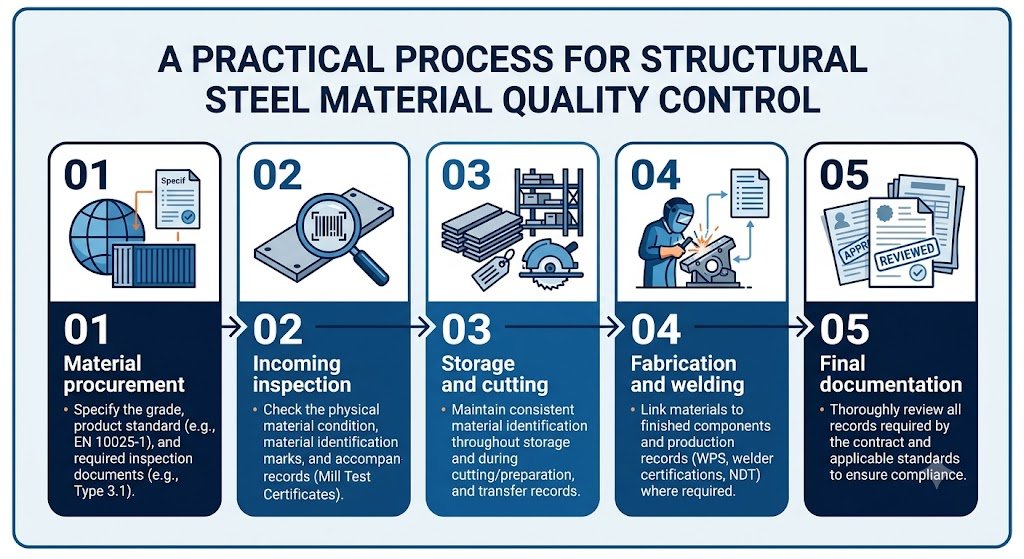
6.1 Review the purchase order
Check the specified steel grade, product form, dimensions, applicable standard, delivery condition and required inspection documentation.
6.2 Verify the supplied material
Compare the delivery documents and available material identification with the purchase order. Investigate discrepancies before releasing the material for production.
6.3 Maintain material identification
Ensure that identification remains readable and traceable during storage, cutting and transfer between production stages.
6.4 Control production records
Maintain the records required by the manufacturer’s procedures, customer specification and applicable product requirements.
6.5 Review nonconforming material
If the supplied product or documentation does not meet the agreed requirements, follow the established procedure for identifying, segregating and resolving the nonconformity.
These controls are relevant to material suppliers and fabricators, although the precise obligations depend on their roles and the standards applicable to their products.
What Do Welders and Fabricators Need to Know?
EN 10025-1 is not a welder qualification standard. However, the material selected for a welded structure can influence fabrication planning and welding quality.
Welders, welding engineers, welding coordinators and production supervisors should understand the specified material and the applicable welding requirements.
Before welding begins, the company should consider:
- Whether the delivered material matches the specified grade.
- Whether the material’s chemical and mechanical properties are supported by the required documentation.
- Whether the selected welding procedure is suitable for the base material and joint.
- Whether preheating or other controls are required by the qualified procedure and applicable requirements.
- Whether the required welder qualifications, inspection arrangements and production records are in place.
Example: Structural steel fabrication
An Indian fabrication company receives steel plates for manufacturing welded supports for a European industrial project.
Before fabrication, its quality team verifies the grade and material documentation, confirms identification and checks the project specification. The welding team then follows the applicable qualified welding procedures and inspection requirements.
This coordinated approach helps connect material quality with welding quality and finished-component conformity.
Which Material Certificates and Inspection Documents Matter?
Material documentation helps demonstrate whether the supplied steel corresponds to the requirements specified by the purchaser.
EN 10204 defines types of inspection documents for metallic products. The required type should be established through the applicable product requirements and purchase order.
Some typical examples of documents are:
Type 2.1 – Declaration of Conformity (no test data)
Type 2.2 – Test Report (with non-specific testing data)
Type 3.1 – Inspection Certificate (with specific testing data)
Type 3.2 – Inspection Certificate (with extra verification by the purchasers representative or appropriately appointed independent inspector)
The exact requirements and responsibilities are defined by the applicable edition of EN 10204.
What should a quality manager check on a material certificate?
Depending on the document and purchase requirements, checks may include:
- Manufacturer and product identification.
- Steel grade and applicable material standard.
- Dimensions and delivery condition.
- Heat or batch number, where applicable.
- Relevant chemical composition and mechanical test results.
- Required inspection-document type.
- Consistency between the certificate and the physical material identification.
A certificate should not be accepted merely because it contains a familiar grade designation.
How Does Material Traceability Work?
Material traceability connects the supplied steel with its relevant documentation and the components manufactured from it.
Traceability requirements are not identical for every project. The necessary level of identification and record retention should be determined from the applicable standards, contractual specifications and quality procedures.
What Is the Difference Between EN 10025-1, EN 1090 and EN ISO 3834?
Each of these standards focuses on a particular part of the structural steel supply chain.
Standard Focus:
EN 10025-1 General technical delivery conditions for hot rolled specified structural steels
EN 1090 Execution of structures in steel and aluminium. Includes relevant sections for technical execution and conformity assessment.
EN ISO 3834 Fusion welding quality requirements for metallic materials.
Why does the difference matter?
A steel manufacturer may supply material according to the relevant EN 10025 requirements. A company manufacturing structural components may also need to consider the applicable EN 1090 requirements. If the work involves fusion welding, EN ISO 3834 may be relevant to its welding quality arrangements.
These requirements are not interchangeable. Their applicability depends on the company’s activities, the product’s intended use and the relevant regulatory and contractual framework.
What Should Indian Manufacturers Know About European Markets?
Indian steel manufacturers, stockists and fabricators may supply products to customers in Germany, France, Italy, Spain, the Netherlands and other European markets.
When a European customer specifies EN 10025, the supplier should establish which part of the series, steel grade, product form and inspection-document requirements apply to the order.
For companies supplying structural construction products, additional requirements may apply under the relevant European construction-products framework. The European Commission explains that harmonised standards provide a common basis for assessing and declaring product performance under applicable EU legislation.
Practical checklist for Indian exporters
Before accepting an export order, the company should:
- Review the customer’s technical specification and drawings.
- Confirm the applicable material standard and steel grade.
- Establish the required inspection-document type before procurement.
- Verify that the material supplied matches the order.
- Maintain the traceability and quality records required by the project.
- Identify any additional product conformity, declaration or marking obligations.
- Coordinate with the customer or relevant conformity-assessment body where requirements are unclear.
Does EN 10025-1 automatically make a product eligible for sale throughout Europe?
No. Referencing a material standard does not automatically satisfy every requirement for market access. Applicable product legislation, harmonised technical specifications, intended use and conformity-assessment obligations must be checked for the specific product.
The European Commission’s official harmonised standards resource is a useful starting point for checking the relevant framework.
Common Mistakes in Structural Steel Material Control
Companies can reduce avoidable quality problems by watching for the following issues.
- Using the wrong material standard: A purchase order may refer to a general standard without identifying the specific material requirements needed for the application.
- Accepting incomplete documentation: Certificates may be missing, inconsistent with the order or insufficient for the specified inspection requirements.
- Losing material identification: Cutting and handling can break the connection between a physical component and its original material records.
- Confusing material and welding requirements: A conforming steel product does not automatically demonstrate that the finished welded component meets all applicable requirements.
- Assuming all European projects have identical requirements: The applicable standards and legal obligations depend on the product, intended use, project specification and relevant legislation.
- Leaving document requirements until delivery: Inspection-document requirements should be established during procurement rather than after the material has already been manufactured and delivered.
A coordinated approach between design, procurement, production, welding and quality teams helps prevent these problems.
Frequently Asked Questions
What is EN 10025-1?
EN 10025-1 is an important reference for understanding the general delivery conditions of specified hot-rolled structural steel products. For manufacturers, designers, fabricators and quality managers, its practical value lies in correctly identifying materials, specifying purchasing requirements and maintaining appropriate documentation.
For Indian companies supplying steel or fabricated components to European customers, understanding the difference between material standards, structural execution requirements and welding quality requirements can improve procurement planning and quality management.
A reliable approach connects material selection and inspection with production controls, welding processes and final documentation.
Does EN 10025-1 provide technical requirements for all structural steels?
No. Technical requirements for each type of steel are provided in the other relevant sections of EN 10025.
Is it always necessary to provide an EN 10204 type 3.1 certificate?
No. The type of inspection certificate which is required depends on the requirements of the product, purchase order and project specification.
Can Indian manufacturers use the EN 10025 requirements?
Yes. If it is specified that the product needs to be manufactured to EN 10025 standard or if the customer requires it. The manufacturer should identify what requirements the product has and whether there are any further requirements for the market they are supplying to.
Does EN 10025-1 apply to structural hollow sections?
No. The scope of this standard does not cover structural hollow sections or tubes. You should identify what product standard applies.
Conclusion
EN 10025-1 is an important reference for understanding the general delivery conditions of specified hot-rolled structural steel products. For manufacturers, designers, fabricators and quality managers, its practical value lies in correctly identifying materials, specifying purchasing requirements and maintaining appropriate documentation.
For Indian companies supplying steel or fabricated components to European customers, understanding the difference between material standards, structural execution requirements and welding quality requirements can improve procurement planning and quality management.
A reliable approach connects material selection and inspection with production controls, welding processes and final documentation.
Planning structural steel fabrication or supplying products to European customers?
First Welding Certification Pvt Ltd (PRVÁ ZVÁRAČSKÁ, a.s.) can help you explore the relevant welding quality and certification requirements for your application.